Dolby Atmos vs IMAX Enhanced: What’s the Difference at Home?
Which should your cinema be built around?
Dolby Atmos and IMAX Enhanced are not direct rivals, and that is the source of most of the confusion. Dolby Atmos is an object-based audio format. IMAX Enhanced is a certification programme from IMAX and DTS that covers picture and sound together, and its audio is a variant of DTS:X rather than anything Dolby makes. In a well-designed room you do not have to choose between them, because the same speakers, processor and calibration serve both. What matters far more than the logo is the room those formats are played in.
This guide explains what each one actually is, how they differ in sound, picture and content, what IMAX Enhanced asks of your bass management, how Dolby Cinema and IMAX compare in a commercial theatre, and how we specify a home cinema so that it handles both properly. It sits alongside our wider comparison of Dolby Atmos, THX and IMAX Enhanced, which also covers THX standards and speaker brands.
Dolby Atmos vs IMAX Enhanced at a Glance
| Dolby Atmos | IMAX Enhanced | |
|---|---|---|
| What it is | An object-based audio format from Dolby | A certification programme from IMAX and DTS for content and devices, covering picture and sound |
| Audio | Dolby Atmos: beds plus positioned objects, rendered to your speaker layout | IMAX DTS:X, a DTS-developed subset of DTS:X, with its own bass management |
| Picture | None. Dolby Vision is a separate HDR format | IMAX mode: HDR10 or HDR10+ and the expanded IMAX aspect ratio on IMAX-shot content |
| Content | The dominant immersive format across streaming, UHD Blu-ray and cinema | A smaller catalogue: selected titles on Disney+ and Sony Pictures Core and a limited number of UHD Blu-ray discs |
| Speaker layout | Scales from 5.1.2 up to 24.1.10 in the home | Any 5.1 or larger system works; 5.1.4 and 7.1.4 are the ideal layouts |
| Fallback | Plays on any Atmos-capable processor | Systems without DTS:X normally play an alternative Dolby Atmos track |
How Dolby Atmos Works
Dolby Atmos arrived in commercial cinemas in 2012 and in the home from 2014. Rather than mixing a soundtrack into fixed channels, the mixer places individual sounds as objects with a position in three-dimensional space. Your processor knows where your speakers are and renders each object to whichever speakers best recreate that position. The same mix therefore adapts to a 5.1.2 bedroom system and to a reference cinema with dozens of speakers, and in the home Dolby supports layouts up to 24.1.10: 24 speakers at ear level, 10 overhead and a subwoofer channel.
That flexibility is the reason Atmos is the foundation of almost every cinema we design. Every major processor decodes it, and it is the immersive format used by the large majority of streaming services and UHD Blu-ray releases. The trade-off is that Dolby publishes a family of recommended speaker layouts rather than one, so the installer has to reconcile them into a single coherent layout for the room. That reconciliation is a design task, not a product choice.
What IMAX Enhanced Actually Is
IMAX Enhanced is a certification programme run by IMAX and DTS. IMAX assesses the picture side and DTS assesses the audio side, and the certification applies to both content and hardware: televisions, projectors, AV receivers, processors, speakers and soundbars. It is a programme that recognises products and titles that meet its standards, which is why it behaves very differently from a format such as Atmos that you simply decode.
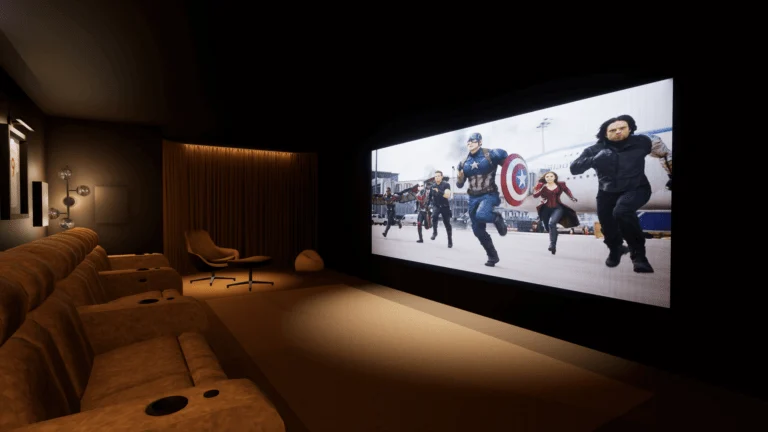
Picture. When compatible IMAX Enhanced content is detected, the display switches to an IMAX mode. IMAX-shot footage keeps its expanded aspect ratio, 1.43:1 for film or 1.90:1 for digital IMAX, instead of being cropped to the usual theatrical frame, and 4K content uses HDR10 or HDR10+. The expanded ratios matter for screen design, because the image height changes during a film. Our guide to movie aspect ratios explains how to specify a screen that copes with that.
Sound. The audio is IMAX DTS:X, a DTS-developed subset of DTS:X designed to simulate the IMAX theatrical sound in a home cinema. It is not a direct port of the cinema mix. It exists in two forms: a lossless version on disc delivered through DTS-HD Master Audio, and a streaming version, DTS:X for Streaming, which is delivered as 5.1.4. Where a system cannot decode DTS:X, IMAX Enhanced titles normally offer an alternative immersive track, usually Dolby Atmos.
The Technical Difference: IMAX Bass Management
The most important practical difference sits in the bass. IMAX DTS:X takes the bass below 70Hz out of the main channels and places it in a dedicated bass channel that replaces the usual LFE channel. The processor’s IMAX bass management then completes the process, engaging automatically when IMAX DTS:X is detected. Without it, the content still plays through ordinary bass management, but not as intended.
This places clear demands on the system, and they are exactly the ones a carefully designed cinema already meets:
- The main speakers must reproduce 70Hz properly at the output levels the room requires, because the crossover sits there.
- Speaker and subwoofer response must overlap cleanly around the crossover. One published installer guideline suggests equalising the main speakers flat to at least 50Hz and the subwoofers flat well above the crossover.
- A separate calibration profile is worth having for IMAX DTS:X, because the equalisation that suits IMAX bass management is not appropriate for other formats.
- Surround placement needs thought. In the 5.1.4 streaming mode the surround channels route to the back speakers, so their position needs planning with the rear wall and cabling during construction.
None of this requires special speakers. It requires a processor that supports the format, speakers that reach low enough, and a calibration carried out by someone who knows what the target is. Our home cinema calibration process measures each speaker and subwoofer in the finished room and builds the profiles for each format.
Dolby Cinema vs IMAX in a Commercial Theatre
People often search for the difference between the two brands in a commercial cinema, and the two comparisons are separate. In the theatre, the differences come down to intention. Dolby Cinema pairs a Dolby Vision laser projector with Dolby Atmos, using a 9.1 channel bed and up to 118 simultaneous objects, in purpose-built auditoria that can carry up to 64 speakers. IMAX uses its own sound systems, 6-channel and 12-channel, with the main channels bass-managed at 70Hz, together with a taller screen. IMAX-shot footage is captured on 65mm film in 1.43:1, and digital IMAX productions are edited in 1.90:1.
IMAX Enhanced is the home counterpart of that second approach, and Dolby Atmos with Dolby Vision is the home counterpart of the first. Neither home version reproduces the theatre, which is a purpose-built room, but each carries the same priorities: IMAX leans towards scale and impact, Dolby towards precision and object placement.
The Content Reality
Content is where the two formats differ most today. Dolby Atmos is available almost everywhere: the major streaming services, UHD Blu-ray, games consoles and music streaming. IMAX Enhanced content is more limited. As reported in 2024 and 2025, selected films are available on Disney+, including Marvel titles with IMAX Enhanced picture, and DTS:X audio for them was added in May 2024. Sony Pictures Core carries IMAX Enhanced titles on supported Sony televisions and the PlayStation 5. A limited number of UHD Blu-ray discs carry the IMAX Enhanced and DTS:X labels, and only a small number of those are true IMAX DTS:X releases.
Streaming IMAX DTS:X also has hardware caveats. The service has to deliver DTS:X to a device that can decode it, and when it first launched, support was limited to certain televisions, so a dedicated processor in a cinema room may only receive it through a compatible player or after transcoding. Availability changes, so check the current device and title lists before building a viewing plan around it. For most households, Atmos will still account for the large majority of what they watch.
Designing One Room for Both
The practical answer for a dedicated room is to build around Dolby Atmos and make sure nothing in the design prevents IMAX Enhanced. IMAX describes 5.1.4 and 7.1.4 as the ideal layouts, because the four height speakers match those in most IMAX theatres, and 7.1.4 is a sensible common base for Atmos too. From there, a larger room can add more height and wide channels for Atmos without harming IMAX playback. A few decisions made early make the difference:
- Choose a processor that decodes Atmos, DTS:X and IMAX Enhanced. The Trinnov Altitude range does, and its room correction applies across formats.
- Specify speakers that go low enough. The 70Hz crossover rewards main speakers with real low-frequency capability, which suits the Artcoustic arrays we use in many rooms.
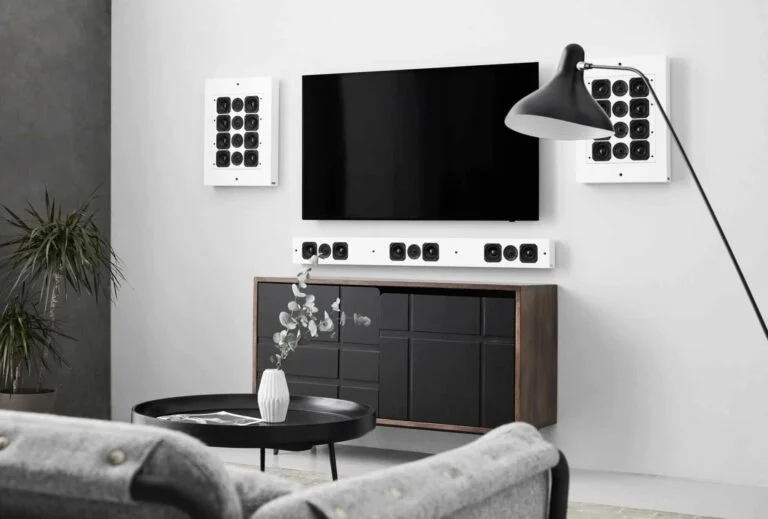
- Plan the walls before building. Hidden arrays behind stretched fabric walls allow every speaker and acoustic treatment to sit exactly where the design needs it.
- Size the screen for the expanded ratios. IMAX-shot sequences change the image height mid-film, so the screen and masking should handle 1.43:1 or 1.90:1 as well as scope.
- Calibrate for each format. A single profile rarely serves every format equally well.
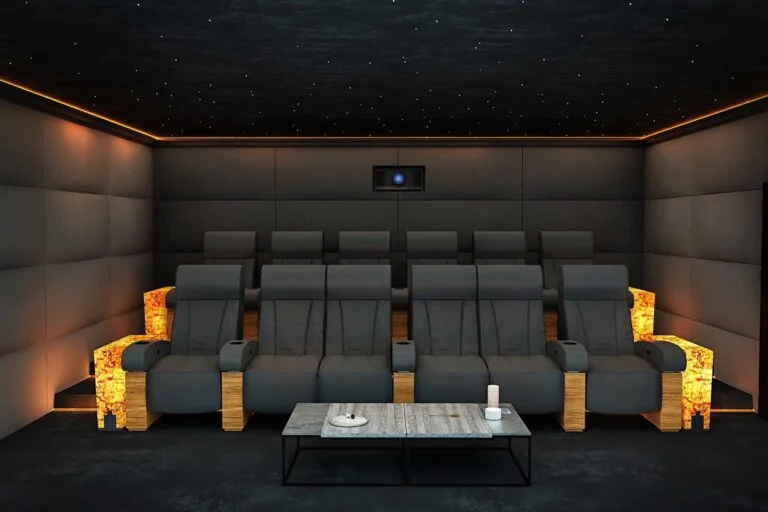
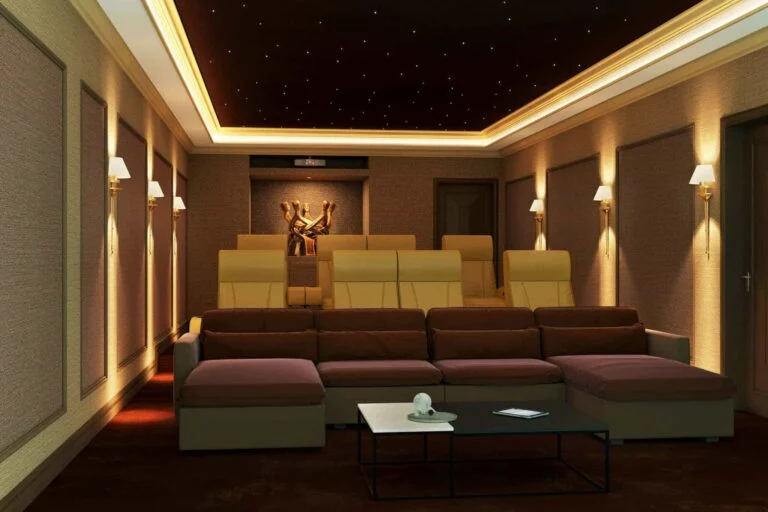
Our IMAX Enhanced cinema in Dubai shows these decisions at full scale. It was designed to the IMAX Enhanced specifications for a client who wanted the large-format experience: a room over 11m by 7m with a 4m head height, seating 18, with a 6.4m wide screen lit by a Sony VPL-VW5000 laser projector. The sound comes from 48 Artcoustic Performance A6 speakers and five Performance P6 subwoofers in a 13.2.14 pattern, hidden behind stretched fabric walls and driven by a Trinnov Altitude 32 and four Trinnov Amplitude amplifiers, which lets three of the subwoofers carry the full-range front channels while two handle conventional low bass. The 13.2.14 layout is our design response to a room of that size and a brief with no limits, not an IMAX requirement: the format itself works from a 5.1.4 system upward.
Which Should You Build Around?
If you watch a broad mix of films, series, sport and music: build around Dolby Atmos, because that is where almost all of the content is, and make sure the processor and bass management also handle IMAX DTS:X.
If you mainly want the large-format blockbuster experience: IMAX Enhanced is worth specifying deliberately, with a 7.1.4 or larger layout, speakers with proper low-frequency extension and a dedicated calibration profile, alongside Atmos for everything else.
If your room is modest in size: concentrate on the fundamentals. A well-treated, correctly calibrated 5.1.4 room will outperform a larger system in a poorly designed space, whichever logo is on the disc.
Frequently Asked Questions — Dolby Atmos vs IMAX Enhanced
Is IMAX Enhanced better than Dolby Atmos?
They are different kinds of thing. Dolby Atmos is an audio format with by far the larger library. IMAX Enhanced is a certification for picture and sound that uses its own DTS:X-based audio. For most viewing, Atmos is the more useful foundation, and IMAX Enhanced adds the large-format presentation on the titles that carry it.
Can a home cinema support both Dolby Atmos and IMAX Enhanced?
Yes. The speakers and room are shared. The processor needs to decode both Atmos and DTS:X with IMAX bass management, and the calibration should include a profile for IMAX DTS:X.
What speaker layout does IMAX Enhanced need?
Any 5.1 system or larger will play IMAX Enhanced content. The ideal layouts are 5.1.4 and 7.1.4, because the four height speakers match those in most IMAX theatres. A larger layout, such as the 13.2.14 in our Dubai room, is a design choice for a very large room.
Is IMAX Enhanced the same as DTS:X?
Not exactly. IMAX DTS:X is a DTS-developed subset of DTS:X, designed to simulate the IMAX theatrical sound at home, with its own bass management. Standard DTS:X content does not carry that treatment.
Does Dolby Atmos include Dolby Vision?
No. Dolby Atmos is an audio format and Dolby Vision is a separate HDR picture format. Dolby Cinema in a theatre combines both, whereas IMAX Enhanced at home covers picture and sound within one programme.
What is the difference between Dolby Cinema and IMAX?
Dolby Cinema pairs a Dolby Vision laser projector with Dolby Atmos in a purpose-built auditorium. IMAX uses its own sound systems and a taller screen, with IMAX-shot footage in 1.43:1 on film or 1.90:1 for digital productions.
How much IMAX Enhanced content is there?
Much less than Dolby Atmos. Selected films are available on Disney+ and Sony Pictures Core, and a limited number of UHD Blu-ray discs carry the labels. Availability changes, so check current title and device lists.
If you are planning a cinema and want the room, speaker layout and calibration specified for both formats, get in touch to discuss your project. You can also explore our home cinema installation service, the home cinema design guide and our Dubai cinema work.