
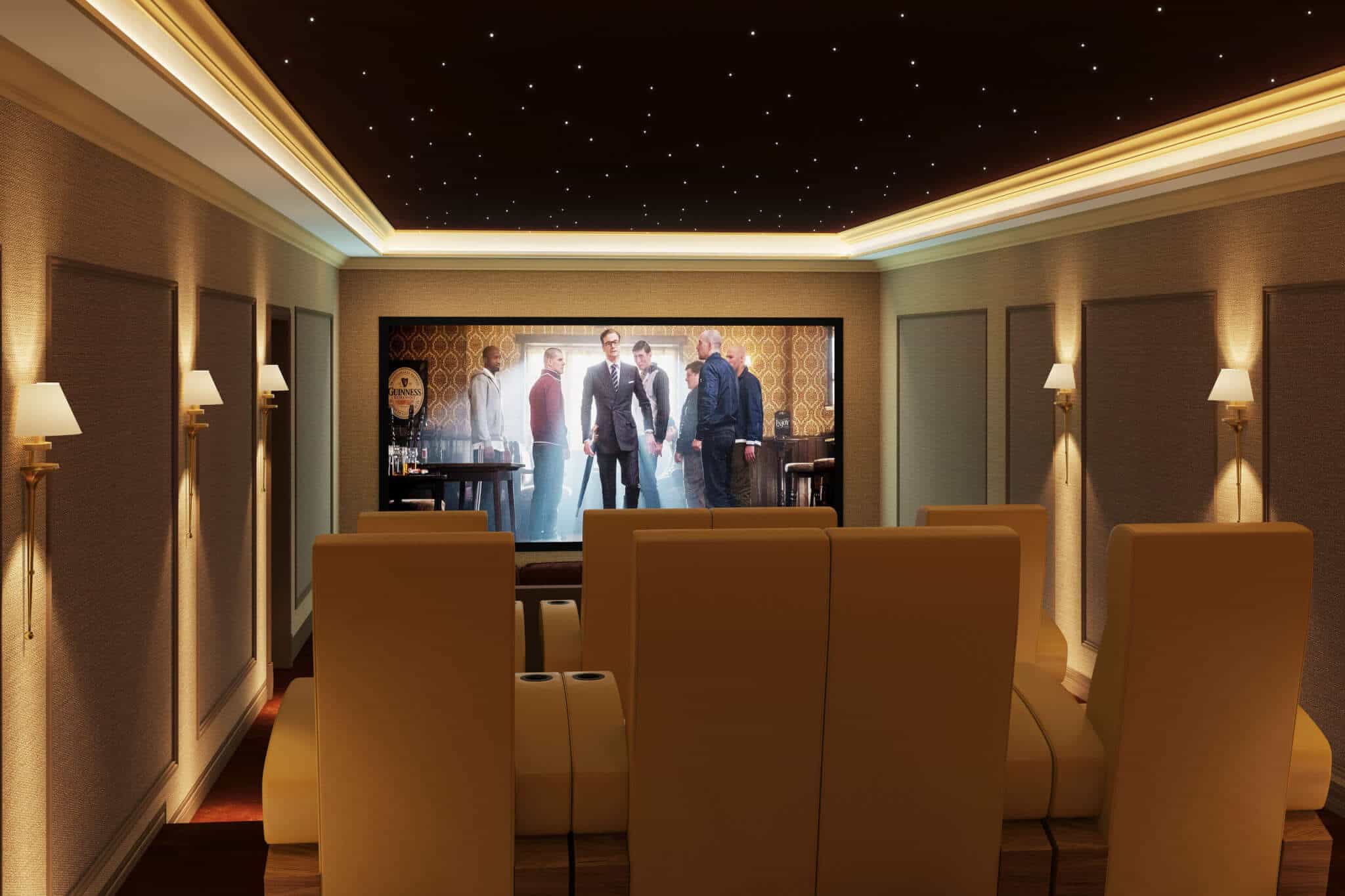
Fabric Wall Installation

Fabric Wall Installation for Home Cinemas & Media Rooms
A Finish and an Acoustic Instrument at Once, Built Into the Room
Fabric walling is the single detail that most separates a genuinely bespoke cinema room from one with equipment simply installed inside it. Rather than treating acoustic panels as something added to a finished room, our own track-and-fabric system turns the wall itself into the room’s acoustic instrument — concealing every speaker, cable and light fitting behind a seamless, drum-tight finish that reads as considered interior design rather than a technical installation. It’s a service we build into nearly every dedicated cinema we design, and one that transforms a media room just as effectively as a full-scale reference cinema.

Home Cinema

Design

Acoustic Treatments

Seating

Media Rooms
The System
Every fabric wall we build follows the same underlying construction, adapted to what each specific room needs it to conceal. 100mm stud work is built across the treated walls, acoustic fleece is fitted into the resulting voids alongside any speakers being concealed within them, our engineered track system is fixed to the studwork, and mineral wool or fibreglass acoustic core is installed over the fleece before the final fabric is stretched into place.
Depth, Built to the Job. The track system isn’t fixed to a single depth — a wall built purely for a clean decorative finish sits shallow against the studwork, while a wall concealing speakers, thicker acoustic treatment, or both is built out further to give everything behind the fabric the space it actually needs. Getting this right at the design stage means the finished wall never looks like it’s straining to hide what’s behind it.
Texture & Detail. Acoustic wadding behind individual panels creates a deliberately padded, upholstered look rather than a flat surface, and a narrow gap left between adjoining panels allows for a trim strip — often a slim chrome or brushed metal insert — for a clean, deliberate seam rather than an invisible one. Where a panel conceals a speaker that may need future access, we build it removable, so a service visit never means cutting into a finished wall.
Installation Conditions. A completely clean, dust-free site is a genuine requirement before fabric can be fitted, not just good practice — dust or debris trapped behind a taut fabric finish shows immediately once the wall is stretched, and can’t be corrected afterward without removing sections of the finished work. We schedule fabric fitting as one of the final stages of a build, after any dust-generating trades have finished and the room has been properly cleaned down, so the finish goes on once and stays right.
Fabric Options
Fabric choice is a genuine specification decision, not just a colour swatch. Behind an acoustically transparent screen, or wherever speakers sit directly behind the finish, we specify an open-weave acoustic cloth chosen specifically to let sound pass through without audible impact on tonal balance — a poorly chosen weave can measurably dull high frequencies before they even reach the room, so this decision is made alongside the speaker specification, not after it.
Elsewhere in the room, a heavier fabric — a genuine wool crepe, a crushed velvet, an Ultrasuede — can be specified purely for its look and feel, since that section of wall carries no acoustic transparency requirement at all. We work with fabric ranges from Camira, Gabriel and Kvadrat among others, giving genuine depth of choice in weight, texture and finish rather than a limited in-house swatch book, and every fabric is available across a wide colour range with RAL colour-matching available where a precise shade is part of the room’s wider design. Durability matters as much as looks: the fabrics we specify are chosen to hold their tension and colour over years of use, not just to look right on the day of installation.
Concealment
Beyond acoustic performance, fabric walling exists to remove every piece of visible technology from a finished room. Surround and height speakers disappear entirely behind the acoustically transparent sections built to house them, cable runs sit invisibly within the stud cavity behind the fleece, and vertical panels can be built out slightly further than their neighbours specifically to conceal LED lighting strips run down their edge — a detail that reads as considered architectural lighting rather than an obvious fitting once the room is finished.
Because every panel is built to the room’s drawings, speaker positions, service access and lighting details are planned before the fabric goes up rather than worked around afterwards. Panels that conceal equipment which may need attention later are made removable, so a service visit never means damaging the finish. Once the room is complete, nothing on the walls hints at the technology behind them.
Acoustic Performance
It’s worth being precise about what the fabric itself actually does: on its own, an open-weave acoustic cloth is close to acoustically invisible, neither absorbing nor reflecting meaningfully in its own right. The genuine acoustic work happens in what sits behind it — the mineral wool or fibreglass core, positioned and sized according to a full acoustic model built before construction begins. Sitting in the intended seating position and checking where a mirror held against each side wall reflects the screen reveals the first-reflection points that most need treating, and the wall directly behind the screen itself needs full, dark, absorbent coverage so sound isn’t bounced straight back through the fabric it just passed through. Fabric walling is the finish that makes this acoustic engineering invisible, not a substitute for it.
Where We Use It
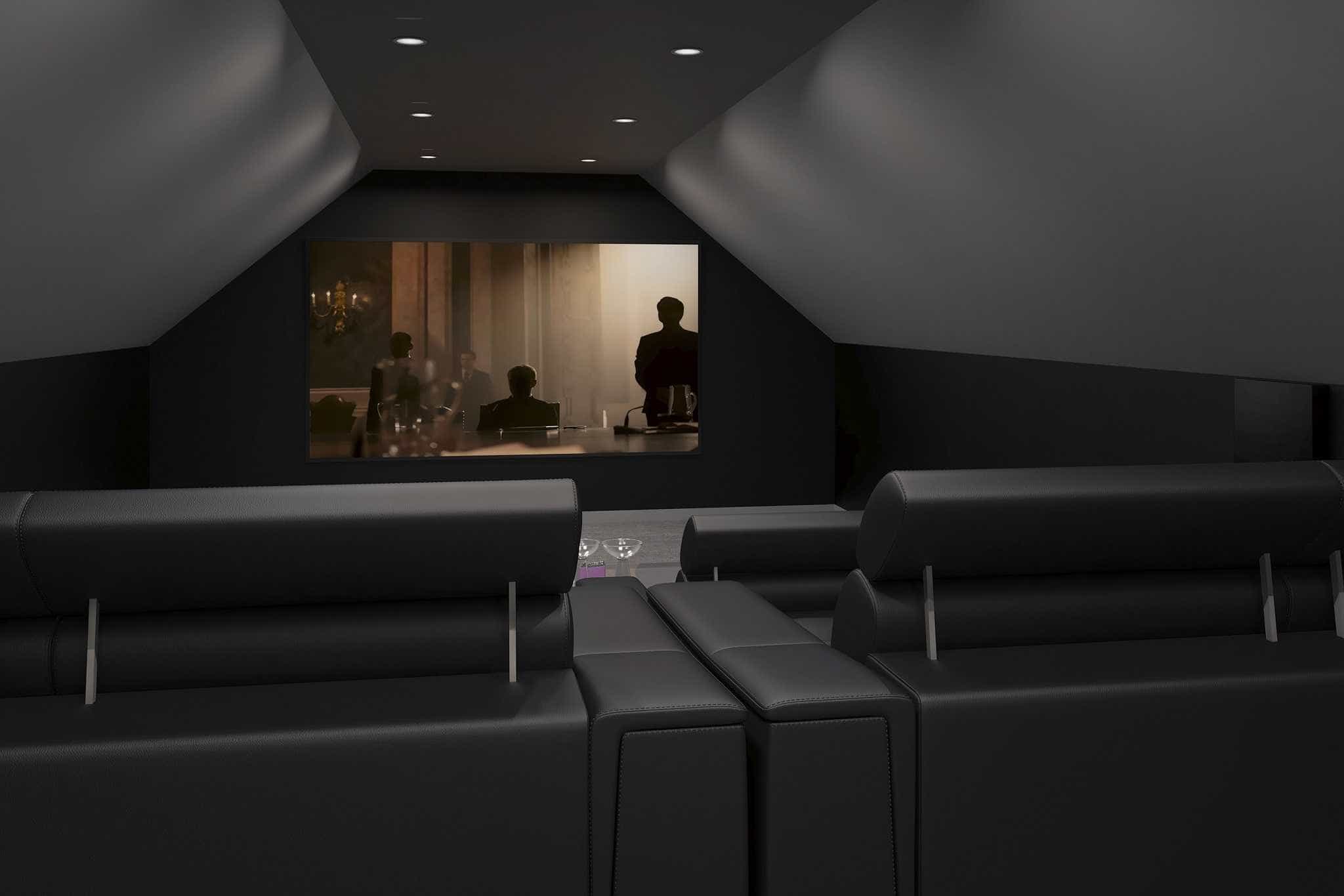
Fabric walling suits a room built from scratch just as well as an existing space being substantially altered, and it isn’t reserved for a fully dedicated cinema. A media room that needs to look considered and feel genuinely cinematic — while still concealing the technology that makes it work — benefits from exactly the same construction, simply built to a lighter specification where full acoustic isolation isn’t the brief.
It works equally well in a converted loft, a basement, or a purpose-built extension, and adapts to whatever architectural quirks the room presents — a sloped ceiling, an awkward chimney breast, a radiator that can’t be relocated. Rather than forcing a room’s existing features to disappear, the track system is simply built around them, following whatever line the design calls for. And because the finish is entirely ours to specify, a room that mixes a dedicated cinema wall with a more conventional plastered ceiling, or a fabric feature wall alongside painted surfaces elsewhere, is just as achievable as fabric walling used floor-to-ceiling throughout. Whatever the room, the result is the same: a finish that does the acoustic job properly while looking like nothing but a well-designed wall.
Fabric Walling FAQs
- Is fabric walling itself an acoustic treatment?
Not on its own. An open-weave acoustic fabric is close to acoustically transparent, neither absorbing nor reflecting meaningfully. The genuine acoustic work happens in the mineral wool or fibreglass core built behind it, positioned according to a full acoustic model of the room. - Can fabric walling conceal speakers and cabling?
Yes. Speakers sit behind acoustically transparent sections of the fabric finish, and all cabling runs invisibly within the stud cavity behind the acoustic fleece, with panels built removable wherever future access to concealed equipment may be needed. - Is fabric walling only suitable for dedicated cinema rooms?
No. The same construction suits a media room just as well, built to a lighter specification where full acoustic isolation is not required, giving a considered, cinematic finish without the depth of treatment a dedicated cinema needs. - Can the fabric be colour-matched to a specific design?
Yes. Fabrics are available across a wide colour and texture range and can be RAL colour-matched where a precise shade is required as part of the room’s wider interior design. - What is a fabric wall built from?
100mm stud work is built across the treated walls, acoustic fleece is fitted into the voids alongside any concealed speakers, our engineered track system is fixed to the studwork, and mineral wool or fibreglass acoustic core is installed over the fleece before the fabric is stretched into place. - How deep is a fabric wall?
It depends on the job. A wall built purely for a clean decorative finish sits shallow against the studwork, while a wall concealing speakers, thicker acoustic treatment or both is built out further. Getting this right at design stage means the finished wall never looks as though it is straining to hide what is behind it. - Why does the site need to be clean before the fabric is fitted?
Dust or debris trapped behind a taut fabric finish shows immediately once the wall is stretched and cannot be corrected without removing sections of the finished work, so fabric fitting is scheduled as one of the final stages of a build.
Home Cinema Installation → · Home Cinema Design Details → · Home Cinema Design → · Audio Visual Installers → · Home Cinema Seating → · Contact Us →