Luxury Home Cinema Installation
Award-winning home cinema design, acoustic engineering, 4K and laser projection, Dolby Atmos and IMAX Enhanced. London, Cheshire, Dubai and worldwide. Since 1998.
There is No Substitute for the Real Thing
A great home cinema is not about having a large television and a soundbar. It is about creating an environment — a room designed from the ground up where every element, from the shape of the walls to the position of each speaker, exists to serve a single purpose: the most immersive, technically perfect film and audio experience it is possible to create in a private home.
Custom Controls have been designing and installing home cinemas since 1998. In that time we have built rooms that range from intimate four-seat screening rooms in London apartments to an 18-seat IMAX Enhanced cinema in Dubai — one of the finest private screening rooms in the world, with a 6.4 metre projector screen, a 13.2.14 Dolby Atmos speaker configuration, and a construction budget of £750,000. Every project between those two points has been approached with the same rigour: acoustic design first, technology in service of the experience, and an uncompromising standard of finish.
We are five-time Crestron Integration Award winners and have received industry recognition for our cinema installations across the UK and internationally. Our portfolio spans dedicated basement screening rooms, garage conversions, loft cinemas, dedicated new-build cinema suites and living room cinema systems. What they share is a level of design, engineering and finish that sets them apart from anything produced by a company that treats cinema as a secondary service.
Acoustic Design and Calibration — The Foundation of Everything
Two elements separate a genuinely great home cinema from one that is merely technically impressive: the design of the room it is installed in, and the calibration of the system once installation is complete. Everything else — projector, screen, speaker brand, amplifier — performs within the limits that these two elements set. Get both right and even a modest equipment specification will sound and look extraordinary. Get either wrong and no amount of hardware quality will compensate. Our acoustic design process begins before a single piece of equipment is specified. Room dimensions, speaker layout, isolation requirements and acoustic treatment are all designed using acoustic modelling software and documented in full construction drawings — giving the acoustic contractor a precise specification rather than a rough guide. Our calibration service completes the process — using Trinnov Altitude, Dirac Live, Anthem ARC and ISF-standard video calibration tools to set every system parameter to the specific room it occupies. We calibrate every system we install. It is not optional.
Our Portfolio — A Selection of Projects
We have completed home cinema installations across London, Cheshire, the Home Counties, Dubai, Nigeria, Portugal, France and beyond. A small selection:
- IMAX Enhanced Cinema, Dubai — 11m x 7m room, 6.4m projector screen, 13.2.14 Dolby Atmos, 18-seat capacity. £750,000. One of the finest private screening rooms in the world.
- Home Cinema, Dubai — 3.5m projection screen, 17-channel Artcoustic audio system, Anthem amplification, SIM2 Lumis 3DS projector. Room designed from scratch for optimal acoustics.
- Home Theater, Dubai — 5m+ curved screen, Artcoustic cinema speaker system, Sony 4K projector, star-effect ceiling, Crestron lighting integration. Eight-seat capacity.
- Trinnov Home Cinema, Africa — £250,000 world-class installation featuring Trinnov Altitude processor, one of our most technically ambitious projects.
- Home Cinema, Hampstead — Classical design for a ten-seat room in north London. Fibre optic ceiling, fabric-covered stud walls, Crestron lighting and full Dolby Atmos.
- View the full portfolio →
The Process — How We Build a Home Cinema
Every Custom Controls home cinema begins the same way: with an honest conversation about the room, the budget and the experience the client is trying to create. Everything else follows from that.
Stage 1 — Consultation and Brief
We visit the property — or meet at our London or Cheshire office — to understand the space, the brief and the budget. The key questions at this stage: Is this a dedicated room or a dual-purpose space? Is the room already built, or are we designing from scratch? Is sound isolation to the rest of the property a requirement? What is the seating capacity? What level of finish is expected? Is integration with a broader smart home system required?
We do not use a standard product package or tiered pricing menu. Every cinema we build is bespoke, and the specification is determined by the room and the brief, not by a catalogue.
Stage 2 — Acoustic Design
This is where most home cinema installations — and most home cinema installers — go wrong. Acoustics are not an afterthought. They are the foundation of everything that follows. The shape of the room, the dimensions of the ceiling, the position of the speaker array, the angle of the rear wall, the choice and placement of absorption and diffusion panels — all of these decisions must be made before a single piece of equipment is specified, because equipment choices depend on the acoustic environment they are going into.
We design our rooms using acoustic modelling software, and we produce full construction drawings — including stud wall specifications, cavity depths for concealed speakers, acoustic underlay and carpet specifications, and damping requirements for walls, floor and ceiling. These drawings go to the acoustic contractor and joiner as a precise specification, not a rough guide.
The three acoustic principles we design around are: minimising room modes (the standing waves caused by parallel surfaces that produce bass unevenness), controlling early reflections (the first sounds to arrive at the listening position after the direct signal, which blur imaging and reduce clarity), and optimising reverberation time (the decay of sound after it stops — too long and the room sounds muddy; too short and it sounds harsh and fatiguing).

Stage 3 — 3D Renders and Client Approval
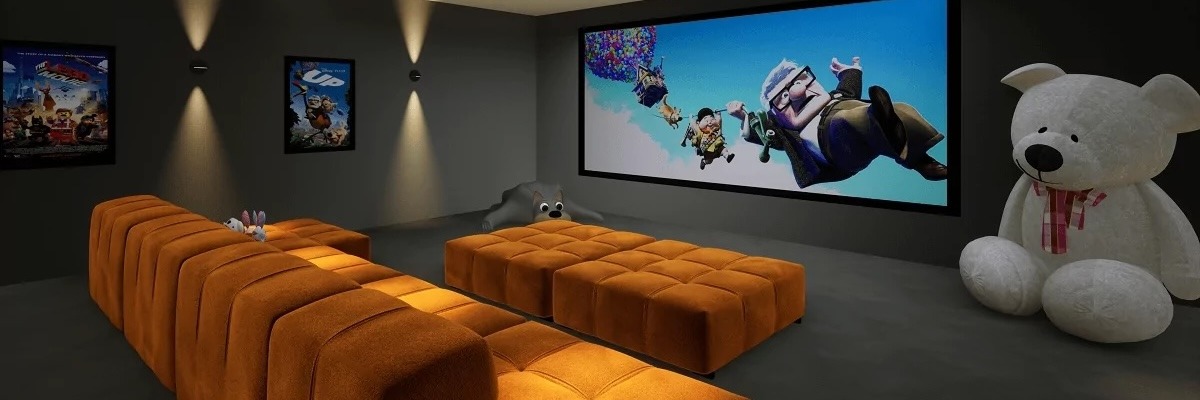
Before any construction begins, we produce photorealistic 3D renders of the completed room — showing the seating arrangement, screen position, wall treatments, ceiling design, lighting and soft furnishings. Clients see exactly what they are getting before a single wall is opened. Changes at render stage cost nothing. Changes during construction cost considerably more.
This visualisation process also allows us to work with an interior designer or architect where one is involved — the renders can be shared and iterated with the design team before the project moves into construction.
Stage 4 — Construction Management
We manage the construction phase — coordinating acoustic contractors, joiners, plasterers, electricians and soft furnishing suppliers. We can work with our own trusted trades or alongside the client’s existing main contractor. Our role in either case is to ensure the acoustic specification is followed precisely, that all speaker, screen and equipment positions are prepared correctly, and that the electrical and data infrastructure meets the requirements of the AV system.
Construction details that most contractors miss — and that have a significant impact on acoustic performance — include the precise placement of acoustic panels relative to the first reflection points, the depth and filling of cavity walls around concealed speakers, the isolation of equipment from surfaces that could transmit vibration, and the continuity of acoustic treatment between ceiling and walls at the junction.
Stage 5 — Equipment Installation
Once the room is complete, the AV equipment is installed. Projector, screen, amplification, sources, rack equipment, control system, lighting — installed and cabled to our standard, which means concealed cable runs, proper strain relief, labelled terminations and a rack build that can be opened and understood by anyone who needs to work on it in the future.
Stage 6 — Calibration
Calibration is where a home cinema becomes what it was designed to be. A speaker system that is not calibrated correctly to the specific room it is in will never perform as intended, regardless of the specification of the hardware. We use professional calibration tools — including Dirac Live, Trinnov Altitude processing and ISF video calibration — to set speaker levels, distances and equalization, optimise bass management, and calibrate display settings for accurate colour reproduction and correct gamma tracking.
This is a process that takes time — typically a full day for a complex Atmos system. We do not rush it. The calibration is the difference between a technically excellent system that sounds correct, and one that sounds extraordinary.
Stage 7 — Handover and Support
We provide a full demonstration of the completed system, a written guide to operation, and ongoing support. Our proactive remote monitoring means we are aware of any issues before the client is. We are still maintaining cinema installations we completed in the early 2000s.
The Technology — What We Specify
We do not have a preferred supplier list driven by commercial arrangements. We specify what is right for each room and each budget. These are the technologies and brands that appear most frequently in our installations.
Projection
For dedicated cinema rooms, a projector and screen is almost always the right choice over a flat panel display. A 3-metre screen at 2.5 metres viewing distance produces a field of view that fills human peripheral vision in a way that no television, regardless of size, can approach at a reasonable viewing distance. The visual experience of a properly specified projection system in a properly designed room is simply not comparable to a television.
We specify 4K laser projectors from Sony, JVC and SIM2 depending on room size, ambient light levels and budget. Laser light sources have effectively eliminated the lamp replacement and brightness degradation issues that affected earlier projector technology — a well-specified laser projector will maintain its brightness for 20,000 hours or more. For our most demanding projects, including IMAX Enhanced installations, we specify projectors meeting the IMAX Enhanced brightness and resolution certification requirements.
Screen choice — fixed frame or motorised, flat or curved, perforated or solid — depends on room geometry and whether speakers will be positioned behind the screen (perforated screens allow sound to pass through, eliminating the visual compromise of speakers mounted beside the image). Curved screens improve uniformity of image brightness and can enhance the perceived sense of immersion in wider rooms.
Audio
Cinema audio is the single most important technical element of a home cinema. Clients frequently underestimate its importance relative to the display — but the experience of a great audio system at reference level in a well-designed room is visceral, physical and completely different from anything a television or soundbar can produce.
We design and install Dolby Atmos speaker systems as standard for dedicated cinema rooms — configuring the array to maximise the three-dimensional object placement that Atmos enables. A minimum configuration for a serious installation is 7.2.4 (seven surround channels, two subwoofers, four height channels). Our most ambitious installations have used 13.2.14 configurations — the IMAX Enhanced specification.
Speaker brands we regularly specify include Artcoustic — whose Cinema systems are among the finest purpose-designed cinema speakers available — Steinway Lyngdorf for the most demanding acoustic environments, Bowers & Wilkins Custom Theater for clients seeking a recognisable audiophile pedigree, and Origin Acoustics for more discreet architectural installation requirements.
Amplification and processing are as important as the speakers. We specify Anthem AVM and MCA series for most installations — their Anthem Room Correction (ARC) system is one of the most effective automatic calibration tools available at this level. For our most technically ambitious projects, the Trinnov Altitude processor is the reference standard — using proprietary 3D microphone measurement and room correction algorithms to achieve a level of accuracy that no other system can match.
Source Material
The final quality of a home cinema is only as good as the source material feeding it. Streaming services, even at 4K, apply compression that removes picture and audio information that a properly engineered cinema system can resolve. For clients who want the absolute best, Kaleidescape is the definitive answer — a movie server that stores and plays back films at full uncompressed Blu-ray quality (and, for Kaleidescape-mastered titles, above it), with lossless Dolby Atmos audio that streaming cannot match.
We specify Kaleidescape on the majority of our high-end cinema installations. The difference in picture and audio quality compared to a 4K streaming service is immediately audible and visible to anyone who spends five minutes comparing them.
Seating
Cinema seating is the element clients spend the most time choosing and the least time specifying correctly. The critical decisions — row spacing, seat height, sightlines to the screen, recliner mechanisms — need to be made in the context of the room layout, not selected from a catalogue. A seat that reclines beautifully in a supplier’s showroom will foul the legs of the person behind it if the row spacing is wrong.
We work with specialist cinema seating suppliers and specify seating as part of the overall room design — ensuring correct sightlines, appropriate row spacing, and the level of finish (leather grade, stitching, powered recline, built-in cup holders, LED base lighting) that matches the room. Read more about our cinema seating options →
Lighting and Control
Cinema lighting design is an underappreciated element of the total experience. The right lighting before and after a film — dimmed bias lighting during playback, pre-show lighting that builds anticipation, adjustable cove and aisle lighting for safety during playback — transforms the experience from watching a film in a dark room to something that genuinely resembles a private screening facility.
We integrate all cinema lighting with Lutron lighting control — allowing scenes to be recalled automatically when a film starts, pauses or stops. A fibre optic star-effect ceiling, dimmable independently of the main lighting, is a feature of several of our installations — creating the effect of watching a film under an open sky.
Cinema control is integrated with Crestron on most of our installations — a single touchpanel or Crestron app manages sources, volume, lighting and screen position. The experience of pressing one button and having the lights fade, the screen descend, the projector warm up and the source cue correctly is one of the most satisfying moments in a well-designed smart home.
Types of Home Cinema We Install
Dedicated Cinema Rooms
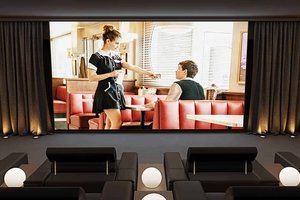
A room designed exclusively for cinema — acoustically treated, light-controlled, with fixed seating and a large projection screen. This is the highest-performance option and the one that allows the greatest acoustic and visual achievement. Read more about our design process →
Home Theatre Rooms
A dedicated room designed to the standards of a small professional theatre — tiered seating, full acoustic treatment, premium speaker systems and the highest-specification projection and display. Our largest installations fall into this category. Read more about home theatre installations →
Living Room Cinemas
A high-quality AV system integrated into a living room or family room without the full acoustic treatment of a dedicated space. Typically built around a large flat panel display or a short-throw projector, with a premium soundbar or discreet speaker system. The right choice for clients who want excellent audio and visual performance in a multi-purpose room.
Basement and Garage Conversions
Some of our finest cinemas have been built in basements and garages — spaces that offer the natural acoustic isolation and light control that above-ground rooms rarely provide. A well-designed basement cinema eliminates sound transmission to the rest of the house almost entirely. We regularly specify cinema rooms in these locations, including projects in London where basement space is at a premium and the cinema represents the most ambitious use of what would otherwise be storage.
IMAX Enhanced
IMAX Enhanced is the highest residential cinema certification available, covering both audio and video performance. An IMAX Enhanced room must meet specific requirements for screen size, projector brightness, and audio configuration — typically a 13.2.14 or larger Dolby Atmos system. We have designed and installed IMAX Enhanced certified rooms and have the technical knowledge and equipment relationships to deliver this specification. Our Dubai IMAX cinema — 6.4 metre screen, 18 seats, £750,000 — is widely considered one of the finest private screening rooms in existence.
International
We have installed home cinemas in Dubai, Nigeria, Portugal, France, the Alps and beyond. Our pre-build methodology — systems fully assembled and tested in our UK workshop before shipping — means international cinema installations proceed with the same precision as domestic ones. Read more about our international service →
Why Custom Controls for Your Home Cinema?
- 25+ years of home cinema experience — We have been designing and installing dedicated cinema rooms since the late 1990s. Our portfolio spans hundreds of installations across five continents.
- Acoustic design as standard — We do not install equipment in rooms; we design rooms around equipment. Acoustic modelling, construction drawings and precise contractor specifications are included in every dedicated cinema project.
- IMAX Enhanced capability — We have delivered IMAX Enhanced installations and have the technical relationships and hardware knowledge to specify and deliver to this standard.
- Five-time Crestron Integration Award winners — Industry recognition for the quality of our cinema and smart home installations, including Best International Project for our Dubai estate installation.
- Full project management — We manage the construction phase as well as the AV installation. One company, accountable for the complete result.
- Calibration expertise — Professional AV calibration using Dirac Live, Trinnov Altitude and ISF tools. We do not leave a system uncalibrated.
- Integration with smart home systems — Every cinema we install can be integrated with Crestron and Lutron for seamless whole-home control.
- Worldwide delivery — Active projects across London, Cheshire, Dubai, the Alps and beyond. We go where the project takes us.
How Much Does a Home Cinema Cost?
This is the question we are asked most frequently, and we will give an honest answer — with the caveat that every project is different.
A well-specified living room cinema — quality flat panel or projector, a premium Dolby Atmos soundbar or small speaker system, good source equipment — can be achieved for £10,000–£20,000.
A dedicated home cinema room with acoustic treatment, 4K projection, a proper Dolby Atmos speaker system, Kaleidescape, Crestron control and Lutron lighting typically starts from £30,000–£50,000 for a smaller room and rises to £80,000–£150,000 for a large, fully specified space with premium seating and high-end speaker brands.
Our most ambitious cinema projects — large-scale dedicated rooms with IMAX Enhanced specifications, the finest speaker systems and the highest-grade projection — have ranged from £150,000 to £750,000.
These ranges are guidelines. The actual cost of your project depends entirely on room size, acoustic requirements, equipment specification, seating, finish level and integration complexity. We provide free, detailed, no-obligation quotations. There are no hidden costs and no vague estimates.
Contact us to discuss your home cinema project.
Frequently Asked Questions
How much does a home cinema cost in the UK?
A dedicated home cinema room starts from around £30,000 for a well-specified entry-level installation, rising to £100,000–£250,000 for a high-end room with full acoustic design, 4K laser projection and Dolby Atmos. Our most ambitious projects have reached £750,000. We provide detailed, no-obligation quotations for all project sizes.
What is the difference between a home cinema and a home theatre?
The terms are largely interchangeable. A dedicated home cinema or home theatre is a room designed exclusively for film and audio — acoustically treated, light-controlled, with fixed seating and a large projection screen. A media room or living room cinema is a more versatile space with a high-quality AV system but without the full treatment of a dedicated room.
What room size do I need for a home cinema?
A meaningful dedicated cinema can be achieved in a room as small as 4m x 5m, though 5m x 7m or larger gives significantly more flexibility. Ceiling height matters — a minimum of 2.7m is preferable; 3m or above allows optimal positioning for Dolby Atmos height speakers. We regularly work in basements, attics, garages and dedicated new-build rooms.
What is Dolby Atmos and do I need it?
Dolby Atmos is an object-based surround sound format that adds height channels — typically speakers in the ceiling — to conventional surround sound. It allows sound to be precisely placed and moved in three-dimensional space. For a dedicated cinema room, Atmos is now the standard we recommend. The difference between a well-implemented Atmos system and a conventional surround system is not subtle.
What is IMAX Enhanced?
IMAX Enhanced is a certification covering both audio and video — screen size relative to room dimensions, projector brightness and a typically 13.2.14 or larger Atmos configuration. We have delivered IMAX Enhanced installations, including a 6.4m screen, 18-seat cinema in Dubai, widely regarded as one of the finest private screening rooms in the world.
Do you design the room as well as install the equipment?
Yes. We cover the complete process — acoustic design, 3D renders, construction management, AV installation, calibration and handover. We can manage the entire project or work alongside your architect and main contractor.
Can the cinema be integrated with my smart home system?
Yes. We integrate all cinema installations with Crestron and Lutron as standard — a single button press dims the lights, lowers the screen, warms the projector and queues the source. Cinema control is seamlessly integrated into the whole-home interface.
Do you install home cinemas outside the UK?
Yes. We have completed cinema installations in Dubai, Nigeria, Portugal, France, the Alps and beyond. Our pre-build methodology means international projects proceed with the same precision as domestic ones. Read about our international service →
Related Pages
- Home Cinema Design — Our Process and Approach
- Home Theatre Rooms
- Home Cinema Seating
- Trinnov Home Cinema Processors
- Artcoustic Cinema Speakers
- Kaleidescape Movie Servers
- Steinway Lyngdorf Audio
- Crestron Home Automation
- Lutron Lighting Control
- Full Project Portfolio
- Home Cinema in Dubai
- The Ultimate Home Cinema Design Guide
- IMAX Enhanced Cinema Room, Dubai — Case Study