Home Cinema Acoustic Treatments
How We Design & Install Home Cinema Acoustic Treatments
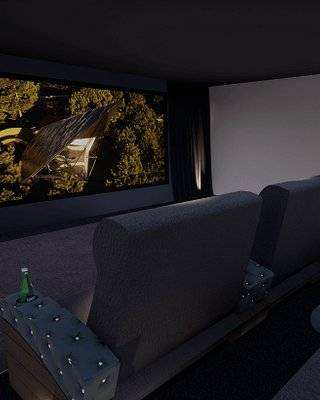
Acoustic treatment is fundamental to delivering a genuinely good home cinema room. The goal is to minimise unwanted reflections across all frequencies — no boomy, uncontrolled bass, no “chattery” rooms where speech is hard to follow. Imagine standing in a bare wooden room and clapping your hands — the echo reverberates back and forth, audible several times before it finally dies away. That effect is magnified considerably in a home cinema, where a great many competing sounds are happening simultaneously. Left untreated, the result is an overwhelming, bass-heavy room where dialogue becomes genuinely difficult to make out clearly.
Adding proper acoustic treatment to the walls reduces these effects immediately. We install a range of on-wall acoustic panels for existing cinema rooms that need remedial treatment, and we build acoustic treatment directly into the room’s construction for new cinema rooms from the outset.
Our Home Cinema & Home Theater Services

Home Cinema

Home Theater

Media Rooms

Smart Homes

Home Automation
Home Cinema Fabric Walls and Their Acoustic Benefit
Using our own track and fabric system, we build acoustic treatment directly into the fabric of the room itself, rather than adding it as a visible afterthought. The process runs as follows:
- Every wall has 100mm stud work built out from the structural wall.
- Acoustic fleece is installed alongside the speakers, within the resulting voids.
- Our track system is attached to the stud work.
- Acoustic material is installed over the fleece.
- The final wall finish fabric is installed over the top.
This approach lets us position acoustic treatment exactly where it’s needed — as part of our home cinema design process, we model the fully finished room beforehand to confirm the acoustic result before any construction begins. The same system also lets us conceal every speaker behind the fabric entirely, which is how our case studies consistently show rooms with no visible speakers at all, despite housing a full high-end surround system underneath. The range of fabrics available is genuinely extensive — silks, cottons and linens in essentially any colour — and we also offer fabrics finished with UV-reactive printing for clients who want something genuinely distinctive.
Reducing Sound Leakage from a Home Cinema Room
The approach above is excellent for improving in-room acoustics, and goes some way toward reducing sound transmission to the rest of the home. For genuinely sensitive environments — where a cinema sits close to bedrooms or shares a wall with neighbouring properties — we offer a more comprehensive specification aimed specifically at minimising sound leakage. The treatments below are applied in the order listed, to a bare structural shell, before cinema construction begins:
- The room is wrapped in mass-loaded vinyl (MLV).
- Stud walls are built out, set off the MLV layer rather than fixed directly to it.
- Stud walls are lined with two layers of acoustic plasterboard, bonded with Green Glue damping compound.
- Acoustic underlay is fitted to the floor (with a full floor isolation system available where required).
- The in-room acoustic treatments described above are then fitted over the top.
The result is a home cinema that genuinely allows the chosen surround sound system to perform at its best, while substantially reducing sound transmission into the rest of the home.
Frequently Asked Questions — Home Cinema Acoustic Treatments
What causes a home cinema to sound “boomy” or unclear?
Untreated reflective surfaces cause sound to bounce repeatedly around the room before dying away, exaggerating bass and making dialogue harder to follow. Acoustic treatment on the walls and ceiling controls these reflections directly.
Can speakers be fully hidden behind acoustic fabric walls?
Yes. Our track and fabric system is designed specifically to conceal speakers behind an acoustically transparent fabric finish, so a room can have a complete high-end surround system installed with no speakers visible at all.
What does it take to genuinely minimise sound leakage from a cinema room?
A comprehensive build-up: mass-loaded vinyl, stud walls set off that layer, two layers of acoustic plasterboard bonded with a damping compound, and acoustic floor underlay — applied to a bare shell before the room’s interior is built out.
What fabric options are available for acoustic walls?
A genuinely wide range, from silks to cottons and linens in any colour, including fabrics with UV-reactive printing for a more distinctive finish.
Home Cinema Design → · Home Cinema Design Details → · Home Cinema Installation → · Contact us to discuss your project →