
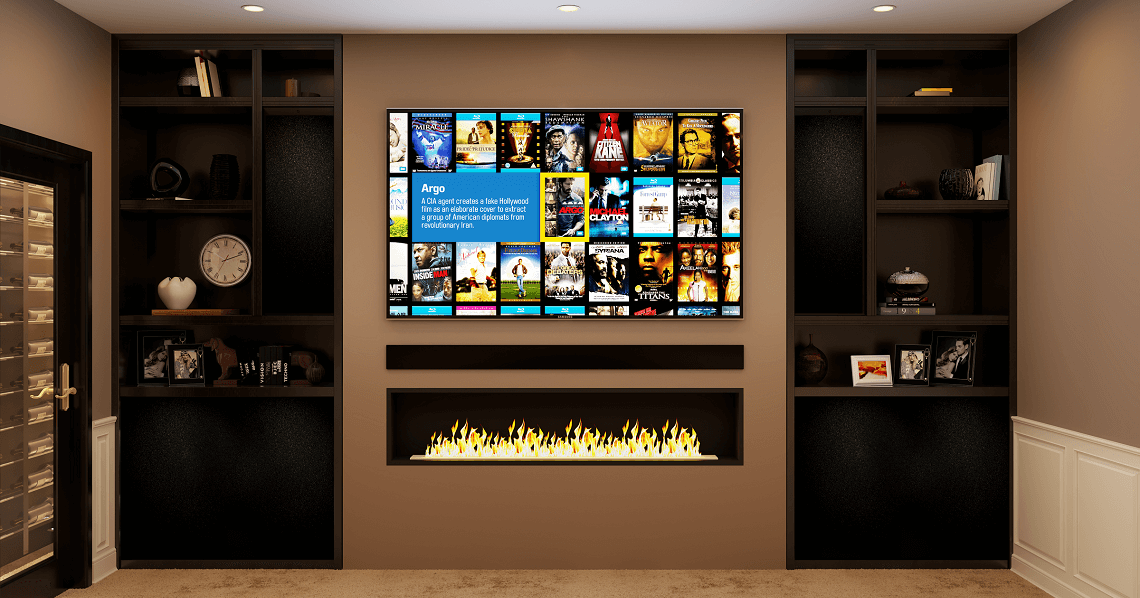
Media Room Design & Installation

Award-Winning Media Room Design & Installation for Luxury Homes
Bespoke media rooms for exceptional homes — combining premium audio, large-format display, Cineak lounge seating, Lutron lighting and Crestron control. A room that lives beautifully every day and performs extraordinarily when it matters. London, Cheshire and worldwide.
The Room That Does Everything, Designed Around How You Live
Not every exceptional home has a basement available for a dedicated cinema room. Not every client wants one. Many of the finest entertainment spaces we have designed are rooms that serve multiple purposes — a family sitting room with a retractable 4-metre screen, a games room with a bar and a pool table and a display that fills one entire wall, a living room where the lights adjust automatically when a film starts and the motorised blinds close without being asked. A media room is not a compromise. It is a different brief — one that demands a different set of design skills. The challenge is not acoustic isolation or light control in a sealed room. It is integrating outstanding AV performance into a space that also works as a beautiful living environment, where nothing looks like it belongs in a rack room and everything operates without thought. Custom Controls have been designing and installing media rooms alongside dedicated home cinemas since 1998.

Installation

Design

Calibration

Treatments

Seating
Our Prestbury, Cheshire home entertainment complex is our reference project for exactly this brief — a vast open-plan space in one of Cheshire’s finest halls, designed to accommodate a cinema with a 3.8m projector screen and Artcoustic speaker system, a pool table area with its own display and audio, a lounge seating area for nine, and a full kitchen with wine fridges and marble worktops. Cinema, games room, bar and entertaining space — all in one room, all controlled from a single system.
Room Acoustics — What Actually Matters in a Media Room
Acoustics in a media room split into two entirely separate conversations, and confusing them is one of the most common mistakes in this category.
Sound Transmission — The Construction Question
Structural sound isolation — preventing sound from leaving the room and disturbing the rest of the house — requires construction. Mass loaded vinyl, decoupled stud wall systems, Acoustiblok membrane, acoustic underlay in the floor, resilient bar ceiling constructions. These are the tools that stop bass energy travelling through walls and floors. They are highly effective and essentially impossible to retrofit into a completed room without significant building work. If your media room is part of a new build, a basement conversion or a major renovation, we specify structural isolation as standard — it is always worth doing at construction stage and almost never worth doing retrospectively. If your room is in an existing completed property, structural isolation is not a realistic option. We will tell you this honestly rather than specifying it inappropriately.
In-Room Acoustics — What Every Room Can Benefit From
In-room acoustic treatment is an entirely different matter — and it is relevant to every media room regardless of construction type. This is about how sound behaves within the room: the early reflections from hard surfaces that blur imaging and reduce clarity, the reverberation that makes dialogue hard to follow in an open-plan space, the bass unevenness caused by the room’s dimensions. A well-furnished media room is already doing a significant amount of acoustic work without anyone calling it treatment. A large area rug on a hard floor. Upholstered seating with high backs — particularly Cineak’s lounge sofas, which are acoustically beneficial as well as beautiful. Heavy curtains or motorised blinds. Bookshelves on rear walls. Soft furnishings chosen for comfort do genuine acoustic work simply by being present.
Where a room needs further improvement, we specify bespoke acoustic panels — designed and finished to complement the interior rather than announce themselves as technical installations. A fabric-wrapped absorption panel behind the seating position, finished to match the upholstery, is acoustically effective and visually seamless. We advise on in-room acoustic improvement for every media room we design, working with the interior designer — or taking on the interior coordination ourselves where no designer is involved — to ensure that acoustic and aesthetic decisions are made together.
Display Technology
The display is the anchor of the media room — the element everything else is designed around, and the one that most determines the character of the space when it is not in use as well as when it is.
Large Format Flat Panel
For media rooms where ambient light levels are higher than a dedicated cinema environment, a large flat panel display — 85 inches and above — is frequently the right choice. Modern OLED and Mini-LED panels from Sony, Samsung and LG achieve picture quality that would have been inconceivable a decade ago, with brightness levels that remain usable in a naturally lit room and black levels that reward dark-room viewing equally. Samsung’s The Frame range deserves specific mention for media room installations. When not in use, The Frame displays a curated artwork — making the display a deliberate aesthetic feature of the room rather than a black rectangle on the wall. For rooms where the display needs to disappear into the interior scheme when not in use, this is a genuinely elegant solution.
Motorised Projection Screen
For the most demanding installations — where a very large image is required and the room allows control of ambient light — a motorised projector screen descending from a ceiling cassette gives the room a display of three metres or more when in use and a completely clean ceiling when not. This was the configuration at our Prestbury installation — a full cinema-specification screen and Artcoustic speaker system at one end of the room, invisible when not in use, transformative when it is. For a room that also functions as a games room or entertaining space, the ability to make the cinema disappear entirely is a significant advantage.
Short-Throw Laser Projection
Ultra-short-throw laser projectors sit close to or against the wall and project a large image without a ceiling-mounted projector or long throw distance. They are increasingly relevant for media rooms where a ceiling installation is not possible or desirable, and image quality at this price point is outstanding.
Audio — Invisible Performance
The acoustic challenge of a media room is not achieving great audio — it is achieving great audio without the room looking like a cinema. No black speaker boxes. No visible subwoofer in the corner. Nothing that requires explanation to a visitor who does not know what they are looking at.
Artcoustic — Designed to Disappear or Make a Statement
Artcoustic is our most frequently specified audio brand for media rooms. Their wall-mounted speakers — as slim as 67mm in some models — sit flat against the wall and can be specified in any NCS or RAL colour, meaning they can be matched precisely to the wall paint, the upholstery or any other reference in the room. In a room painted in a soft neutral, an Artcoustic installation is effectively invisible. The customisation goes further than colour. Artcoustic’s front grilles are magnetically attached and fully interchangeable — replaceable with different fabric colours or printed with any digital artwork from Artcoustic’s curated gallery or the client’s own design. We have installed Artcoustic systems where the front speaker array carries a panoramic image that spans all three front channels — a piece of wall art that also happens to be a cinema speaker system.
Artcoustic’s Custom Soundbar range is particularly relevant for media rooms built around a large flat panel display. Custom Width soundbars can be specified to precisely match the width of televisions up to 100 inches, creating a completely integrated aesthetic — the speaker appears to be part of the display installation rather than an addition to it. Combined with colour-matched satellite speakers and a concealed subwoofer, this delivers surround sound performance in a living room that shows no evidence of having any. At our Prestbury installation, Artcoustic front channels are housed behind an acoustically transparent screen, with surround channels distributed around the room and a Trinnov processor handling the signal — a full cinema-specification system in an open-plan entertaining space.
Steinway Lyngdorf — When Only the Best Will Do
For clients for whom the audio system is as important as the visual, Steinway Lyngdorf represents the reference standard for a media room. Their speaker systems are designed for room-friendly placement — from space-saving on-wall speakers to freestanding models — with Bass Management allowing woofers to be positioned in room corners rather than demanding a specific placement. The system’s intelligence sits in the electronics, which carry RoomPerfect, Steinway Lyngdorf’s proprietary room correction technology, measuring the entire acoustic space and calibrating the system to deliver correct performance at every listening position — including positions at a pool table or bar that a conventional system would never be optimised for.
For media rooms where the brief demands the finest possible audio in the most architecturally discreet format, the Steinway & Sons Model S Soundbar is in a category of its own — awarded Best Soundbar at CEDIA Expo 2025, the world’s most powerful soundbar, with three Air Motion Transformer tweeters, three dedicated midrange drivers and two woofers driven by 1,600 watts of Lyngdorf amplification. Powered by Steinway Lyngdorf’s A1 or A2 digital amplifiers and paired with RoomPerfect calibration, it delivers what CEDIA judges described as “an open airy sound, precise imaging and deep bass we normally hear on high-end tower speakers” — in a single wall-mounted object of considerable design quality.
The Open-Plan Entertainment Room
The most ambitious media room brief we work with — and one of our favourites — is the open-plan entertainment space: a room large enough to accommodate a pool table, a bar, a lounge area and a cinema-quality screen that anchors one end. Our Prestbury, Cheshire project is exactly this: a room divided into three distinct areas — cinema, pool table and lounge — each with its own audio and display capability, all managed by a single control system and united by a Lutron lighting design that sets the mood for every activity.
Lighting Scenes — The Room’s Most Powerful Tool
Lighting design is the element that makes the difference between a room that has a pool table in it and a room that is a destination. Lutron lighting control allows every fitting in the space to be programmed into scenes — recalled instantly from a keypad, the Lutron app, or automatically by the Crestron system. In the Prestbury room, lighting scenes are programmed for each distinct activity: a pool scene with focused warm light above the table and the cinema end dimmed; a cinema scene where the whole room adjusts to the correct level for film viewing; an entertaining scene with the room bright and welcoming throughout; a sport scene with the lounge and bar areas active. Each recalled in a single touch, each setting every fitting in the room simultaneously.
Crestron Control — One System for Everything
Crestron is the control brain of the room — managing the display, the AV system, the Lutron lighting scenes, the motorised blinds and any other system in the space from a single bespoke interface, programmed to reflect exactly how the room gets used: Cinema, Sport, Pool, Entertaining — each one touch, each recalling the right source, lighting scene and audio configuration simultaneously. In a room with Artcoustic or Steinway Lyngdorf audio and a high-quality display, the source material matters as much as the hardware — Kaleidescape stores and plays back films at full uncompressed quality, picture and lossless Dolby Atmos audio that streaming cannot match, integrated with Crestron so that starting a title automatically recalls the cinema lighting scene and lowers the blinds.
Seating — Lounge Style, Cinema Performance
Media room seating needs to do something that dedicated cinema seating does not: it needs to look like furniture. Traditional high-back cinema recliners in fixed rows would look incongruous in a living room or entertainment space regardless of their quality. The seating in a media room needs to be something a client would choose for a living room — and then discover, at the touch of a button, is also a cinema seat.
Cineak — Belgian-made, hand-built and specialising in custom luxury seating for private cinemas, media rooms and living rooms — is our preferred recommendation for media room seating. Their Strato combines the plush comfort of a sofa with the functionality of a cinema seat, configured as a sofa, loveseat or chaise in any arrangement, adding motorised recline and adjustable headrest for Dolby Atmos listening positions when the room is in cinema mode. The Fortuny incliner provides a more structured cinema seat that still reads as luxury living room furniture — at Prestbury, the cinema seating uses the Cineak Intimo range, an informal front row allowing easy seating for four with bar stools behind for sporting events. The Trevia — wide, deep, designed for casual lounging — suits the periphery of an entertainment room, where comfort over long periods matters more than cinema precision. All Cineak designs integrate with Crestron — starting a film on Kaleidescape can automatically move the chairs to the stored cinema position, returning to upright when the film ends.
Media Room Design That Fits Real Family Life & Spaces
Twenty-five years of media room and home cinema experience sits behind every project we take on — including our award-winning Prestbury home entertainment complex, one of the finest open-plan entertainment rooms we have designed. We are dealers for both Artcoustic and Steinway Lyngdorf, the two audio brands most suited to high-performance media room installation, and we advise honestly on which is right for each project rather than defaulting to one. As certified Crestron and Lutron installers, we deliver the control and lighting combination that makes a media room genuinely effortless — the right scene for every activity, recalled in a single touch. We have been specifying Cineak seating since our earliest Dubai projects and know the range thoroughly, and our in-room acoustic expertise means we can improve audio performance through panel placement and soft furnishing choices without any construction work at all. Throughout, we coordinate directly with interior designers, joiners and main contractors to ensure the AV and the interior are designed together, not added to each other afterwards.
Media Room FAQs
- What is the difference between a media room and a home cinema?
A media room is a multi-purpose space, such as a family sitting room, a games room or a living room, that also delivers outstanding AV performance. It is a different brief from a dedicated cinema, because the challenge is integrating the technology into a room that still works as a beautiful living environment. We have designed media rooms alongside dedicated home cinemas since 1998. - How do you stop a media room looking like a cinema?
The speakers and technology are designed to disappear into the interior. Artcoustic wall-mounted speakers can be specified in any NCS or RAL colour to match the walls, subwoofers can sit behind acoustic cloth inside joinery, and the display can be a motorised screen, a flat panel or a Samsung The Frame that shows artwork when not in use. - Does a media room need soundproofing?
Acoustics in a media room are two separate questions. Structural isolation, which stops sound leaving the room, requires construction and is worth doing at new-build, basement or major renovation stage but is rarely realistic in a completed room. In-room treatment, which controls reflections, reverberation and bass, benefits every media room and can be done with furnishings and bespoke acoustic panels finished to match the interior. - What is the best display for a media room?
It depends on the room. A large flat panel of 85 inches or more suits rooms with higher ambient light, a motorised projection screen gives three metres or more when in use and a clean ceiling when not, and an ultra-short-throw laser projector suits rooms where a ceiling installation is not possible or desirable. - Can a media room be added to an existing home?
Yes. A media room does not need a basement or a sealed room. Many of the spaces we have designed are existing living rooms, games rooms and open-plan spaces, and we are straightforward about what is and is not realistic, for example structural isolation in a completed property. - How is a media room controlled?
A Crestron system manages the audio-visual experience and room lighting, with every source selectable from a single interface. One button press can transition the room from living space to cinema, selecting the source, adjusting the lighting and waking the amplification.
To see how room shape, concealed speakers, seating and lighting come together, read our guide to the home cinema design details that make the difference.