
Home Cinema Seating

Home Cinema Seating and Luxury Cinema Chairs for Every Room
Cinema Seats Specified Individually for Every Room, UK-Wide
Home theatre seating is the element most frequently specified last and least carefully — which is precisely why so many cinema rooms, even technically excellent ones, disappoint in the experience of actually sitting in them. A seat that reclines beautifully in a supplier’s showroom will foul the person behind it if the row spacing is wrong. A beautiful leather finish that looks perfect in isolation will look wrong in the room if the colour palette conflicts with the wall and carpet treatment. Choosing seating from a catalogue, independent of the room design, almost always produces a compromise.
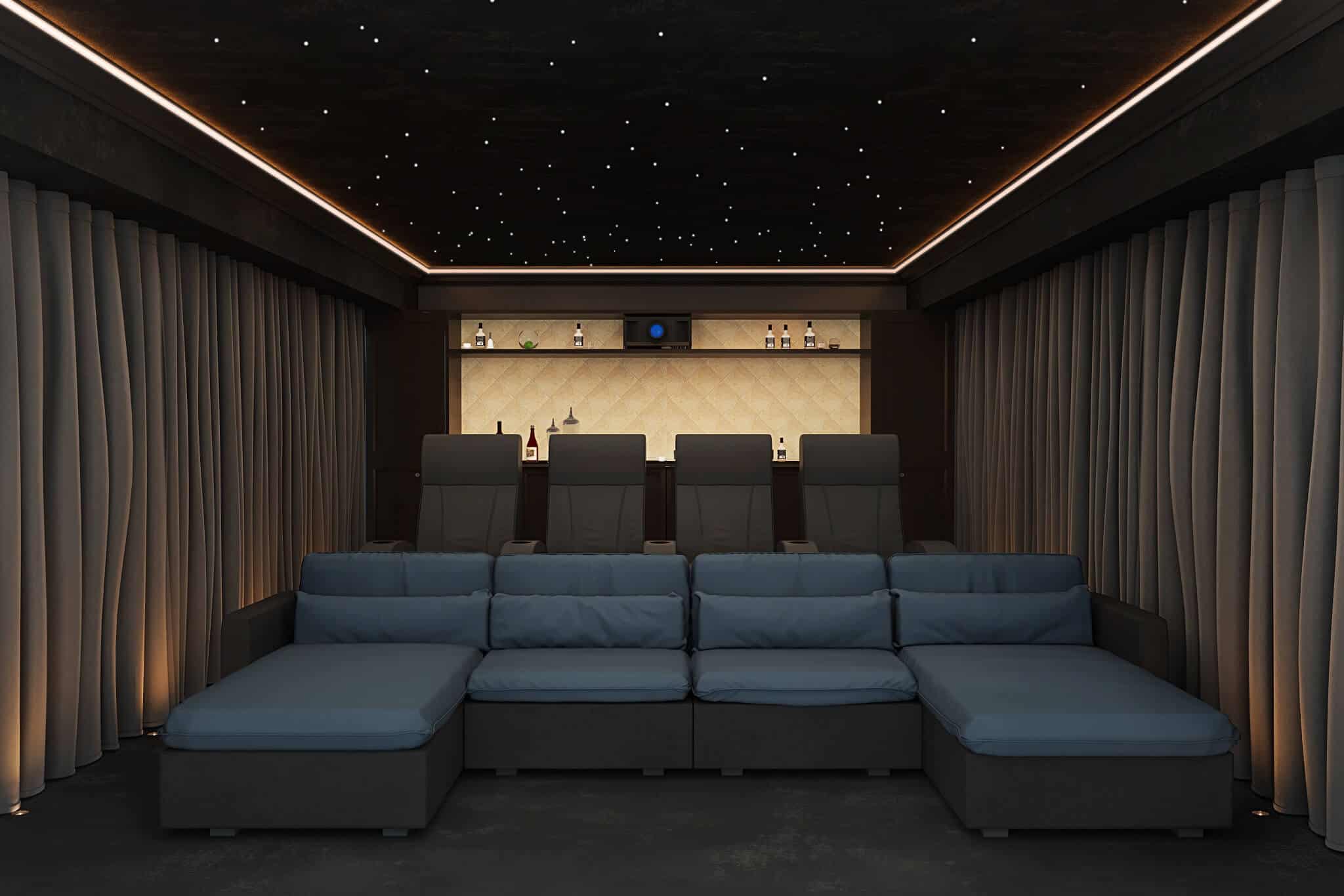
Not every room calls for rows of individual recliners, either. A growing number of our clients want something that reads as a proper sofa rather than a cinema seat — deep, upholstered, genuinely comfortable for an afternoon film with the family, but built to the same reclining, powered specification as dedicated theatre seating underneath. We design and specify both, and increasingly a combination of the two within the same room. Whether the brief calls for individual cinema room chairs, cinema couches, or a full room of cinema room furniture built as one considered scheme, every piece is chosen to match the room rather than picked from a catalogue in isolation.
We design, supply and install home cinema seating across the UK from our London and Cheshire offices, and internationally from Dubai to the French Alps. Seating is always specified alongside the rest of the room, and these are the services that shape it on every cinema we design.

Cinema Design

Calibration

Acoustics

Home Cinema

Crestron
At Custom Controls, seating is specified as part of the room design — not selected afterwards. We determine row positions, row heights and seat configurations during the acoustic and layout design phase, ensuring correct sightlines from every position, appropriate spacing for reclining without impact on the row behind, and aisle widths that meet both practical and building regulation requirements. The seating specification — including leather grade, stitching, headrest type, powered recliner mechanism, USB charging, cupholder configuration and LED base lighting — is agreed before the room is built, so that the seating arrives ready to install into a space designed to receive it.
What We Specify
Cinema room seating spans a wide range of formats, and the right cinema room seats for any given project depend entirely on how the room is used and who uses it. The main configurations we specify are as follows.
Single recliners. The most flexible configuration — individual motorised recliner seats, each with full independent control, ideal for cinemas where different viewers have different preferences and for rooms where the seat count may change over time.
Loveseat and sofa-style pairs. Two- and three-seat units with a shared centre console — cupholder, USB charging, storage — ideal for couples, families, or a front row that functions as a VIP position. For clients who want the room to read as a proper living space rather than a cinema, a deep reclining sofa seat gives exactly that look while still delivering full theatre-specification comfort and control. The shared console creates a sense of occasion without sacrificing individual comfort.
Day beds and chaise longues. Well suited to family cinemas and younger children, giving them somewhere to settle in or fall asleep while the rows behind keep a proper cinema feel. A relaxed front row also lets the second row see over the top without needing a large step up.
Row seating. Fixed-row configurations for larger cinemas, typically with a consistent recliner angle rather than fully motorised individual recline, and with shared armrests between adjacent seats. Row seating typically achieves a higher seat count for a given room area than individual recliner configurations.
Tiered platforms. For multi-row cinemas, we specify and manage the construction of tiered seating platforms — ensuring the structural specification meets the load requirements of the seating, and that the platform height delivers the designed sightlines from every seat.
The Cinema Chairs and Brands We Specify
We select cinema seating from a range of manufacturers, because every project is bespoke. Cineak, the family-run Belgian manufacturer, is our default recommendation for dedicated cinema rooms — an extensive, modular range with Italian leathers, motorised headrests and lumbar support, cooled cup holders, backlit Onyx tables and Crestron integration, and build quality we have seen hold up for well over a decade of near-daily use.
For design-led rooms we specify Moovia, which builds bespoke seating in Germany and Europe, and Vismara Design, the Italian luxury maker from Brianza. Cineca, based in Lancashire, suits rooms where space is tight thanks to its wall-away and zero-gravity mechanisms, and Home Cinema Modules builds seating to our own custom designs. For relaxed media rooms, a designer sofa such as B&B Italia’s Tufty Time is often the right answer. Our guide to the best home cinema seats compares each brand in detail.
Comfort, Leather and Haptics
The details that make a cinema seat comfortable over a long film are mostly hidden. We specify dual or triple motors so the backrest, footrest and headrest move independently, a motorised articulating headrest so viewers can watch comfortably at full recline, and power lumbar support on full recliners. Upholstery is full grain or top grain leather, or a fabric chosen with the interior designer — never bonded leather, which peels with regular use.
Tactile transducers can be built into the seat frame so bass is felt as well as heard. We specify ButtKicker transducers, mounted on isolators and driven by a dedicated amplifier from the room’s low-frequency effects channel, so the effect is confined to the seats rather than the floor and walls. It is one of the most noticeable upgrades we install in any cinema room.
Layout, Row Spacing and Risers
Row spacing decides how many seats a room will actually hold. We work from the seat’s fully reclined depth plus a walkway of around 50cm, which for full power recliners usually gives a row pitch of around 2m; wall-hugger mechanisms let the back row sit closer to the rear wall. A second row sits on a riser calculated from the screen height, viewing distances and seated eye height — in most residential rooms roughly 30–45cm.
Screen distance, row positions and seat choice are worked out together at cinema design stage, alongside the speaker layout and acoustic treatment. Our Ultimate Guide to Home Cinema Seating covers screen distance, layouts and seating ideas in more depth.
Finish and Specification
We work with specialist cinema seating manufacturers offering full leather customisation — colour, grade, perforation, contrast stitching, headrest style and logo embossing where required. LED base lighting, integrated into the base of each seat or row platform, provides both a practical aisle lighting function and a significant aesthetic contribution to the room — particularly when Lutron-controlled and dimmed to match the lighting scheme of the space. We specify and install the LED system as part of the overall Lutron lighting design for every cinema room.
Control and Integration
Motorised seating is integrated with the room’s Crestron control system rather than left as a separate set of buttons. A single button press, or starting a film on Kaleidescape, can move the seats into their viewing position as the lights dim and the projector starts, then return them upright when the film ends. Power and control cabling to every seat position is planned at design stage and routed through the riser, so nothing is visible in the finished room.
Working with Your Interior Designer
Where an interior designer is involved in the cinema room, we share seating specification details — fabric samples, finish options, colour references — at the design stage, allowing the seating to be considered as part of the overall interior scheme rather than as an afterthought. Several of our most beautiful cinema rooms have emerged from exactly this collaboration. Read more about how we work with architects and interior designers →
Home Cinema Seating FAQs
- What is the best home cinema seating?
Cineak is our preferred brand for dedicated cinema rooms, for its breadth of range, build quality and control integration. Moovia, Vismara Design, Cineca, Home Cinema Modules and B&B Italia each suit particular briefs — the right choice depends on the room, the interior scheme and how the space will be used. - Do you supply home cinema seating across the UK?
Yes. We design, supply and install home cinema seating from our London and Cheshire offices for projects across the UK, and internationally including Dubai and the French Alps. Seating is normally specified as part of a full cinema room project. - How much space do home cinema chairs need?
Allow the seat’s fully reclined depth plus a walkway of around 50cm. For full power recliners that usually means a row pitch of around 2m, and a second row normally sits on a riser of roughly 30–45cm so every seat has a clear view of the screen. - Should cinema seats be leather or fabric?
Both work well. Full grain or top grain leather is hard-wearing and easy to care for; fabric can be warmer, more comfortable and more personal, with a modest acoustic benefit. Bonded leather should be avoided, as it peels with regular use. - Can home cinema seating be controlled by Crestron?
Yes. A single button press, or starting a film on Kaleidescape, can move the seats to their viewing position alongside the lights and projector, and return them upright when the film ends. - Can cinema seats have bass shakers?
Yes. Tactile transducers can be built into the seat frame so bass is felt as well as heard. We specify ButtKicker transducers, mounted on isolators and driven by a dedicated amplifier from the room’s low-frequency effects channel, so the effect is confined to the seats rather than the floor and walls. - Can seating be a mix of recliners and sofas?
Yes. We design and specify individual recliners, loveseat and sofa-style pairs, day beds, row seating and tiered platforms, and increasingly a combination within the same room, all built to a powered, reclining specification and chosen to match the room.
Home Cinema Installation → · Home Cinema Design Details → · Best Home Cinema Seats → · Seating Guide → · Cinema Design → · Discuss your cinema seating →