Best Home Cinema Seats: Luxury Brands Compared
Luxury Cinema Seats Compared for UK Homes
Updated September 2026 · Custom Controls · Home cinema specialists since 1998
Cinema seats are the one part of a home cinema that every guest touches, and the one part most often chosen last. Projectors and processors are replaced every few years; a good set of seats will be used several times a week for a decade or more, so the difference between a well-chosen seat and a poor one compounds over thousands of hours of viewing. This guide compares the luxury cinema seating brands we specify for UK homes — Cineak, Moovia, Vismara Design, Cineca, Home Cinema Modules and Fortress — explains what separates a premium seat from a showroom recliner, and sets out how we match seating to the room rather than the other way round.
It is written for clients planning a dedicated cinema room or media room in a substantial property, and for the architects and interior designers working with them. For screen distance, sightlines and layout ideas, see our companion Ultimate Guide to Home Cinema Seating.
Why the Seat Matters More Than the Spec Sheet
A cinema room is judged on how it feels to sit in for three hours, not on its equipment list. Poor seating undermines everything else in the room: a headrest that tips the head away from the screen makes a large image tiring to watch, a seat that is too tall blocks the row behind, and a recliner that needs more depth than the room allows forces a compromise on screen size or row count. Even the sound suffers, because the listening positions the system is calibrated for are set by where the seats are.
That is why we specify seating as part of the room design, never as a furniture purchase made once the room is finished. Row positions, row heights, recline depth and seat widths are fixed during the layout and acoustic design phase, alongside the screen and speaker positions, so that every seat has a clear sightline, sits within the calibrated listening area and has room to recline fully without touching the row behind.
The seat is also the part of the room clients interact with every time they use it — the controls, the cup holders, the charging, the lighting. Getting those details right, and integrating them with the room’s control system, is what makes the cinema feel effortless rather than technical.
What to Look For in a Luxury Cinema Seat
Before comparing brands, it helps to know what actually separates a premium cinema seat from a domestic recliner. The differences are mostly hidden — inside the frame, under the upholstery and in the mechanism — which is why two seats that look similar in a photograph can feel and last completely differently. These are the points we check on every specification.
Frame, Foam and Mechanism
The frame and mechanism decide how a seat will feel in ten years’ time. Premium manufacturers build on steel mechanisms or engineered hardwood frames, use high-density foams that hold their shape rather than flattening within a few seasons, and fit quiet, dual or triple motors that move the backrest, footrest and headrest independently. A single-motor seat that moves back and footrest together is cheaper to build, but it cannot give each viewer the position they actually want.
The mechanism also sets how much floor space the seat needs. A conventional recliner grows considerably in depth as it opens, so it needs clearance behind it as well as in front. Wall-away (or wall-hugger) mechanisms slide the seat forward as it reclines, allowing the back row to sit much closer to the rear wall — often the difference between fitting a second row or not. Zero-gravity mechanisms raise the knees level with the heart, a position many people find more comfortable over a long film.
Leather Grades: Full Grain, Top Grain and Bonded
Leather is described in grades that are easy to misread. Full grain leather is the outer layer of the hide left intact, with its natural markings, and it is the most durable grade, developing a patina with age. Top grain covers the top cut of the hide and includes corrected grain, which has been lightly sanded and pigmented for a uniform finish; a good top grain leather is hard-wearing and consistent from seat to seat, which matters across a row of eight.
Below these sit split leather — the fibrous under-layer, often coated and embossed and sold simply as “genuine leather” — and bonded leather, which is made from shredded leather scraps bound together with synthetic material. Bonded leather can contain as little as 20% leather fibre, and it delaminates and peels with regular use. It has no place in a cinema that will be used daily. On the seating we specify, the contact surfaces are genuine full grain or top grain leather, or a fabric chosen with the interior designer, and clients can usually supply their own material.
Power Headrest and Lumbar Support
When a seat reclines, the head goes back with it — and a fixed headrest then points the viewer’s eyes at the ceiling rather than the screen. A motorised articulating headrest corrects this, bringing the head forward so the viewer can watch comfortably at full recline without straining the neck. For a large projected image, where the eye has to travel across a wide field of view, it is one of the most noticeable comfort features a seat can have.
Power lumbar support is the other adjustment worth specifying on full recliners. It lets each viewer set the support in the small of the back independently, which makes a real difference through a long film and for viewers of very different heights sharing the same row. Both features are available across the premium ranges below; on a project we check them at the showroom or on a sample seat before the order is placed.
Comfort features are only part of the picture: the seat has to be designed into the room, its acoustics and its control system. These are the services that shape the seating on every cinema we design.

Seating

Cinema Design

Home Cinema

Acoustics

Crestron
Haptics: ButtKicker Transducers and D-BOX Motion
Tactile feedback adds a physical layer to the soundtrack, and there are two distinct approaches. Tactile transducers — we specify ButtKicker — are fitted to the seat frame on isolating mounts and driven by a dedicated amplifier from the room’s low-frequency effects channel. They convert bass into vibration felt through the seat itself, isolated from the floor and walls, and they work with every film and source without any special content. It is one of the most noticeable upgrades we install, particularly in rooms where subwoofer output has to be more restrained than the content calls for.
D-BOX, developed by D-BOX Technologies of Longueuil, Canada, goes further by physically moving the seat. Actuators hidden under the seat drive pitch, roll and heave in time with motion code written by D-BOX’s designers for each title, and a D-BOX Connect subscription gives access to the coded library. It is immersive for action films but divides opinion for drama, and it has to be designed into the seat and riser from the start. We recommend trying both before deciding — many clients find transducers alone give the impact they want without the seat moving.
Control Integration
Motorised seats should be part of the room’s control system, not a separate set of buttons. On the rooms we build, seating integrates with Crestron: a single button press, or starting a film on Kaleidescape, moves the seats into their viewing position alongside the lights, screen masking and projector, and returns them upright at the end. Seat lighting and base lighting can be tied into the Lutron lighting scenes so that the whole room dims together.
Integration needs planning at design stage — power and control cabling to every seat position, contact closure or network control from the manufacturer, and a riser designed to route it all out of sight. Retrofitting it to seating that was bought without it is rarely as neat.
The Luxury Cinema Seating Brands We Specify
We select seating from a range of manufacturers because every project is bespoke. The brands below are those we specify for UK and international projects, ordered broadly from our default recommendation to more specialist choices. Each has a distinct character, and the right one depends on the room, the interior scheme and how the space will be used.
Cineak — Our Default Choice
Cineak is a family-run Belgian manufacturer and our default recommendation on the majority of dedicated cinema rooms. The range is extensive — over a dozen seating families, from the traditional Fortuny recliner and the more contemporary Nero, to the triple-motor Largo with motorised storage tables, the relaxed Intimo and Cosymo sofas, and the Strato modular sectional. Most ranges are modular, so arm styles, seat widths, loveseats and chaise longues can be combined to fit the room precisely.
Upholstery uses Italian stitched leathers and French fabrics, or the client’s own material, and the options list is deep: dual and triple motors on illuminated preset keypads, motorised articulating headrests, electronic lumbar support, heating and cooling ventilation through perforated leather, USB-C and wireless charging, cooled cup holders and backlit Onyx side tables. Build quality is the deciding factor for us — we still maintain Cineak installations more than ten years old that are in near-daily use and look as good as the day they were fitted.
Cineak is on our projects from the Cheshire glass-walled cinema to the Ascot reference cinema, where twelve Fortuny seats sit in two rows with backlit Onyx tables. It integrates with Crestron and Kaleidescape, and is the seat we recommend when the brief is simply the best all-round cinema experience.
Moovia — German Bespoke Design
Moovia was founded in 2003 in Nagold, Germany, originally as a projection screen and cinema accessory supplier, and now builds bespoke cinema and media room seating in Germany and elsewhere in Europe. Its approach is design-first: collections such as Chesterfield, Stockholm, Milano, Marbella and Dallas each have a distinct aesthetic, and every element — dimensions, armrests, materials, stitching, lighting and control — can be specified to suit the room.
Moovia’s design service is a real strength on complex projects. It produces 2D and 3D seating layouts, drops the seating into the cinema’s CAD drawings, creates photorealistic renderings and mock-ups, and supports the preparation and installation of the room. We specify Moovia where the interior designer wants the seating to be a statement piece, or where the room doubles as a living space and conventional cinema seats would look out of place.
Vismara Design — Italian Luxury
Vismara Design is an Italian luxury furniture maker from Brianza, the heart of Italy’s furniture industry, specialising in furniture for home entertainment — cinema seating, billiard tables and bespoke private cinemas and games rooms. Its home cinema collections include Onassis, a modern and linear design; Luxor and Luxor Tech, with a bold look and lacquered wood details; Chest, inspired by the nineteenth-century Chesterfield; Kubrik; and Comfort, with ergonomic head cushions.
Seats come with single or double reclining mechanisms, in single, loveseat, chaise longue or daybed configurations, in straight or curved rows, and in a wide choice of leathers, nubucks and fabrics. The accessory list is aimed squarely at entertaining — refrigerated cup holders, heaters, USB charging, touch-sensitive light controls, tables, lamps and cocktail bar drawers. We specify Vismara where the brief calls for classic Italian luxury and craftsmanship, and where the cinema is part of a wider entertainment space.
Cineca — Lancashire-Based and Space-Efficient
Cineca is a UK company based in the Ribble Valley, Lancashire, with its seats bespoke-built in a European factory. Its ranges — Siena, Modena, Amalfi, Milan, Como and the Savona modular sofa — are designed around the practical constraints of UK rooms. The Milan uses a steel three-way motorised wall-away mechanism, which lets the seat sit close to the wall behind it, and the Amalfi uses Cineca’s own dual-motor zero-gravity mechanism for a reclined position most cinema seats cannot reach.
Upholstery covers fabrics and two genuine Italian leathers, or designers can supply their own, with contrast or tone-on-tone stitching and a choice of normal, wide or wedged armrests. A battery pack option allows powered recline where there is no socket, and contact-closure control makes integration straightforward. We specify Cineca where floor space is tight — a basement, loft or small cinema room where a conventional recliner would cost a row.
Home Cinema Modules — Custom UK Builds
We specify Home Cinema Modules regularly where a room needs seating built to a custom design rather than chosen from a range. In our Cheshire garage cinema, seating for six was arranged as two double sofas flanked by individual chairs, built by Home Cinema Modules to our design, and its sofa options offer proper theatrical seating in a more relaxed format.
It is a good fit where the room has an unusual footprint, where the client wants the look of a sofa with the function of a cinema seat, or where a project needs a practical, well-built alternative to the European design-led brands. As with every seat we specify, the layout, recline depth and control integration are designed with the room.
Fortress — Hand-Built in California
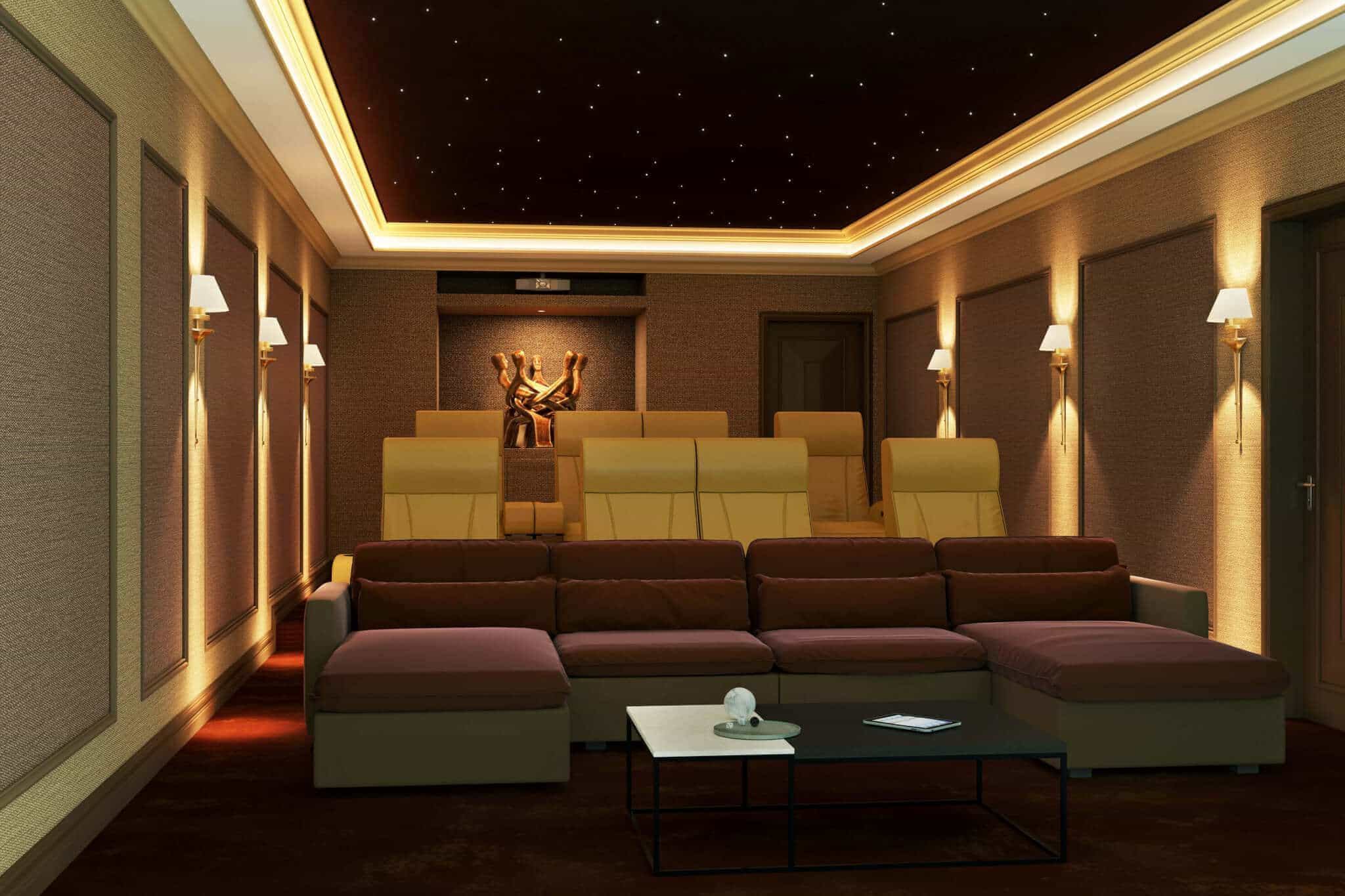
Fortress Seating builds its seats by hand at its factory in La Verne, California. Frames are made from alder hardwood and birch plywood to ANSI/BIFMA standards, cushioned with high-density foam and memory gel foam over flex webbing rather than springs, and double-stitched to prevent seams splitting. The catalogue runs to dozens of collections, from Matinee and Palace to Kensington and Manhattan, in top grain leather or fabric.
Fortress will build custom configurations — curved and semicircular rows are made to a template of the client’s room and often tested in plywood before the final frame is built. It suits clients who want a traditional American theatre look and a highly bespoke layout. For UK projects, lead times, shipping and compliance with UK furniture fire regulations need to be confirmed at the outset, which is part of why we tend to favour European manufacturers.
B&B Italia and Designer Sofas
Not every room needs cinema seats at all. For relaxed, family-led media rooms we often specify B&B Italia’s Tufty Time, a modular sofa system that can be built into traditional sofas, chaise longues, corner units and islands. In our Lake Windermere boathouse cinema, Tufty Time sofas across two levels create an informal room that still delivers genuine performance from its Artcoustic and Sony system.
Designer sofas give up the motorised recline, cooled cup holders and integration of dedicated cinema seats, so we treat them as a deliberate choice for a particular brief rather than a budget alternative. Footstools, ottomans and even a matching bean bag for younger viewers add flexibility, and the soft upholstery contributes useful absorption to the room’s acoustics.
What About Valencia, Octane and Other US Brands?
Search for cinema seats online and much of what appears comes from the US market — brands such as Valencia, Octane, Seatcraft and Palliser, sold mainly online and through US retailers. Some are well made for the price, and several offer power headrests, lumbar support and D-BOX options. For a UK project, though, they bring practical questions: UK availability and after-sales support, shipping and lead times, and compliance with the Furniture and Furnishings (Fire) (Safety) Regulations that apply to upholstered furniture sold in the UK.
They are also a different class of product to the seating above. The seats we specify are built to order, upholstered in the leather or fabric chosen for the room, sized to the room’s layout and integrated with the control system — and they are supported locally for the life of the cinema. For a high-end cinema room, that is almost always the better long-term choice.
Recliners, Sofas, Day Beds or a Mix
The format of the seating matters as much as the brand. Individual recliners give every viewer full control and suit dedicated screening rooms and serious film fans. Cinema sofas and loveseats seat more people in the same width and make the room feel more social. Day beds and chaise longues suit families with young children, giving them somewhere to settle in or fall asleep while the rest of the room keeps a proper cinema feel.
In practice, many of our best rooms mix formats. In the Ghana reference cinema, Cineak Intimo day beds on the front row sit ahead of Cineak Vedette recliners on the rows behind; in the Surrey eight-seat cinema, individual recliners on the front row sit in front of two-seat sofas on a raised rear row. Mixing styles lets one room work for a formal screening and a relaxed family film night.
Planning the Layout Before Choosing the Seat
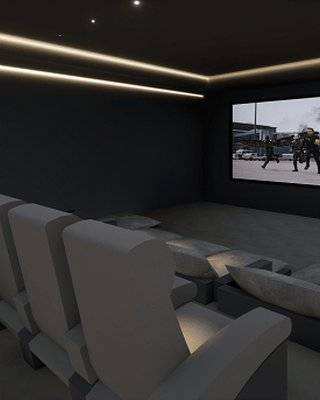
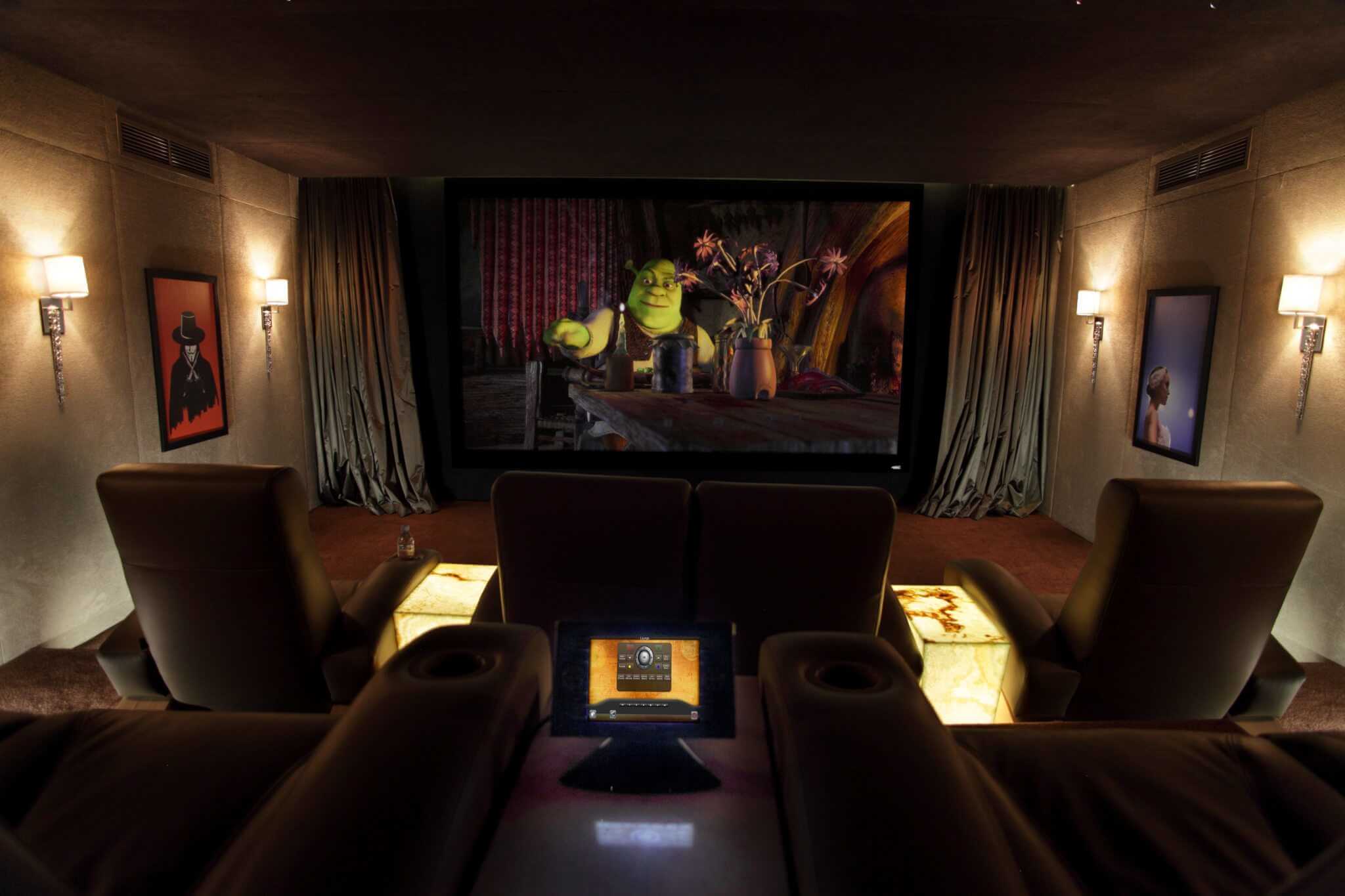
The seat has to fit the room, so layout comes first. The key measurement is row pitch — from the back of one row to the back of the next. Allow the seat’s fully reclined depth plus a walkway of around 50cm; for full power recliners that usually gives a row pitch of around 2m or a little more. A second row normally sits on a riser so heads in front do not cut into the image, calculated from the screen height, viewing distances and seated eye height, and in most residential rooms it works out at roughly 30–45cm.
Seat width, arm style and whether seats share armrests all change how many fit across the room, and aisle widths need to work practically and meet building regulations. We work all of this through at cinema design stage, alongside the room’s dimensions, screen size and speaker layout, so the seating is ordered to suit a room built to receive it.
Matching Seating to the Room’s Acoustics
Seating is part of the acoustic design as well as the layout. Every seat position is a listening position, so the surround speakers are set level with each row and the calibration is optimised across the seats rather than for a single sweet spot. Upholstered seats — and the people sitting in them — absorb sound, which the acoustic treatment has to account for, and tall seat backs can shadow the surround speakers of the row behind if the heights are not planned together.
Riser construction matters too. Built as a sealed, damped platform, it becomes part of the room’s acoustic design rather than a hollow drum that resonates with the bass, and it can house step lights, cable routes and, where specified, the transducer amplification. Final calibration is carried out with the seats installed, measuring across every row.
How We Specify Seating on a Project
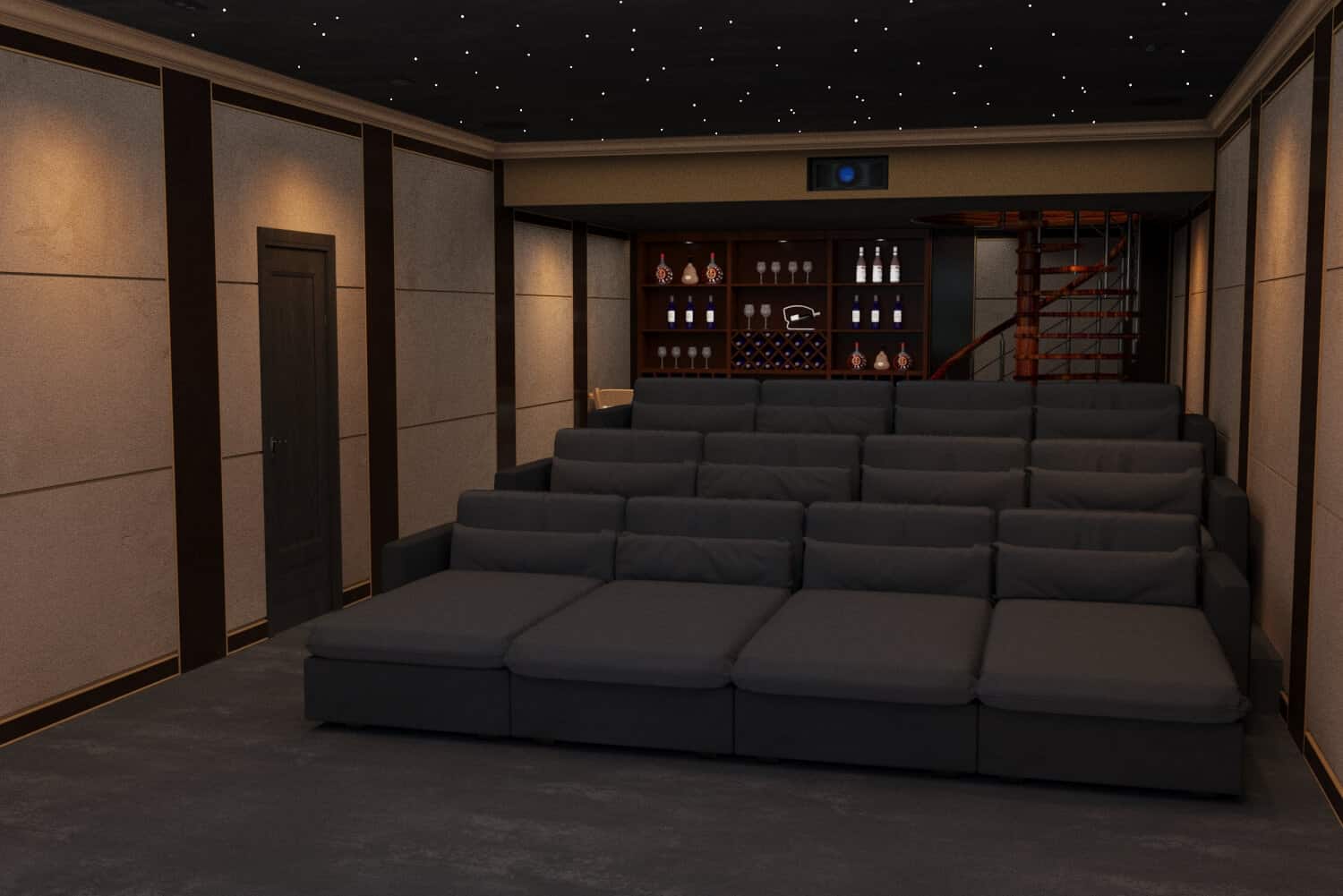
Seating is specified in the same design process as the rest of the cinema. Once the room layout is agreed, we shortlist the brands and ranges that fit the brief and the room, and arrange for clients to try seats or samples wherever possible — comfort is personal, and nothing replaces sitting in the seat. Fabric and leather samples go to the interior designer so the seating is chosen as part of the overall scheme.
The final specification covers mechanism, headrest and lumbar options, leather grade, stitching, cup holders, charging, lighting, haptics and control integration, and it is agreed before the room is built. Power and control cabling are then run to every seat position, the riser is built to suit, and the seating arrives ready to install into a room designed to receive it. After handover, we look after it with the rest of the system.
Frequently Asked Questions — Home Cinema Seats
What are the best home cinema seats?
There is no single best seat, only the best seat for a given room and brief. For dedicated cinema rooms we specify Cineak on the majority of projects, for its breadth of range, build quality and control integration. Moovia and Vismara suit design-led rooms where the seating is a statement piece, Cineca suits rooms where space is tight, and B&B Italia suits relaxed, sofa-led media rooms.
Is bonded leather acceptable for cinema seating?
No. Bonded leather is made from leather scraps bound into a backing with synthetic material, and it delaminates and peels with daily use. For a seat that will be used several times a week for a decade or more, specify full grain or top grain leather, or a quality fabric.
Do cinema seats need a power headrest?
For full recliners it makes a real difference. As the back reclines, a fixed headrest tips the head away from the screen; a motorised articulating headrest brings the head forward again so the viewer can watch comfortably fully reclined without straining the neck. Power lumbar support adds further adjustment for long films.
What is the difference between ButtKicker and D-BOX?
ButtKicker transducers are fitted to the seat frame and convert the low-frequency content of the soundtrack into vibration, so they work with any source. D-BOX uses actuators under the seat to physically move it in pitch, roll and heave, following motion code written for each title, and needs a D-BOX subscription for its coded library.
Can cinema seating be controlled from a Crestron system?
Yes. Motorised seating from the manufacturers we specify can be integrated with Crestron, so a single button press, or starting a film on Kaleidescape, moves the seats to their viewing position and returns them upright when the film ends.
How much space do reclining cinema seats need?
Allow the seat’s fully reclined depth plus a walkway of around 50cm. For full power recliners that usually gives a row pitch of around 2m, and a second row normally sits on a riser of roughly 30–45cm. Wall-hugger and wall-away mechanisms let the back row sit closer to the rear wall.
Home Cinema Seating → · Ultimate Guide to Home Cinema Seating → · Cineak Seating Guide → · Home Cinema Installation → · Discuss your project →