
Home Cinema Design

Award-Winning Home Cinema Design & Cinema Acoustics
Cinema Room Design, Perfected Before Building
Most home cinema installations go wrong at the design stage — or rather, because there was no design stage. Equipment is selected, a room is nominated, and the speakers and projector are installed into a space that was never intended for cinema. The result performs below its potential, regardless of the quality of the hardware, because the room is working against the system rather than with it. Our design process exists to prevent this. Every dedicated cinema room we design begins with acoustics and works outward from there — the room shape, the speaker layout, the acoustic treatment, the screen size, and only then the equipment specification. The sequence matters. Equipment choices depend on the acoustic environment they are going into. Getting that environment right is the foundation everything else is built on.

Home Cinema

Calibration

Acoustics

Seating

Lighting Design
What Our Design Process Covers
Room shape and dimensions. Rectangular rooms with parallel surfaces produce standing waves — bass resonances at specific frequencies that cause some notes to boom and others to disappear. We design rooms with controlled dimensions (using the ITU-R BS.1116 and EBU Tech 3276 room ratio guidelines as a starting point, modified for each project), non-parallel rear walls where the space allows, and ceiling heights that support the correct positioning of Dolby Atmos height speakers. Room shape is the single most important acoustic decision we make.
Sound isolation. A cinema operating at reference level (around 85dB SPL with peaks to 105dB) produces significant bass energy that travels through structure. For rooms adjacent to bedrooms, living spaces or external walls, acoustic isolation — decoupled floor, wall and ceiling constructions with appropriate mass and damping — is essential. We specify isolation to the level the brief requires, from basic secondary wall construction to fully floating room-within-a-room builds for the most demanding projects.
In-room acoustic treatment. Once the room is built, acoustic treatment addresses the behaviour of sound within it. Absorption panels reduce early reflections and control reverberation time. Bass traps control modal energy at the room boundaries. Diffusion panels at specific positions prevent the flatness that too much absorption produces. We design treatment using acoustic modelling software and position every panel according to the specific geometry of the room, not by template or convention.
Speaker layout and screen position. The position of every speaker — left, centre, right, surrounds, height channels, subwoofers — is determined by the room geometry, the seating positions and the Dolby Atmos or Auro-3D specification. Screen size is determined by the viewing distance and desired field of view, not simply by what fits. We produce speaker layout drawings for every project, which go to the acoustic contractor as a precise construction specification.
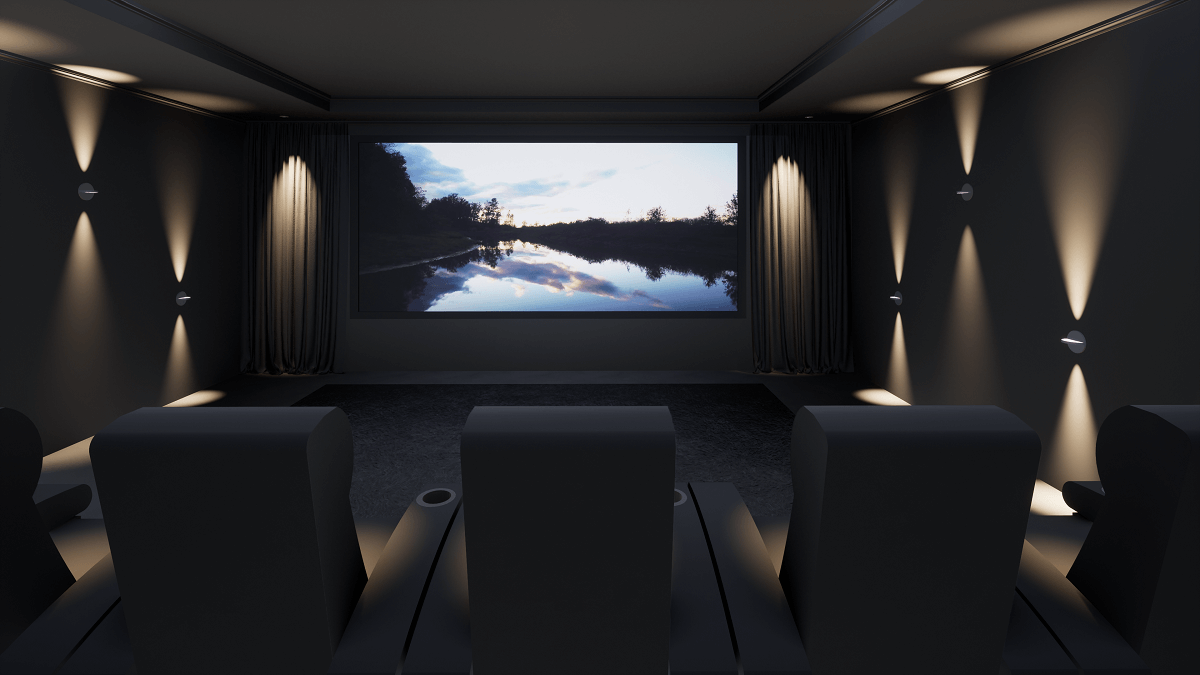
3D renders and client approval. Before construction begins, we produce photorealistic 3D renders of the completed room — seating arrangement, screen, wall treatments, ceiling design, aisle lighting, soft furnishings. Clients see exactly what they are building before a single decision is irreversible. We iterate the renders with the client and, where relevant, with an interior designer or architect, until the brief is perfectly met — read more about how we work with the design team →. This process eliminates surprises and ensures complete satisfaction with the finished room.
Construction documentation. Every Custom Controls cinema design is accompanied by a full set of construction drawings — stud wall specifications, cavity depths and filling for concealed speakers, electrical and data requirements, conduit routes, acoustic underlay specifications, joinery details. These go to the contractor as a working document, not a rough guide. The precision of the construction documentation determines the precision of the finished room.
Working with Architects and Interior Designers
We regularly work within existing design teams on cinema rooms that form part of a larger renovation or new build project. Our acoustic and AV drawings are produced in a format compatible with most architectural CAD workflows, and we are accustomed to the coordination requirements of projects where multiple consultants are involved. We can attend design team meetings, provide specifications at RIBA Stage 2 and 3, and coordinate with the main contractor throughout construction.
Where a client does not have an existing design team, we manage the interior design of the cinema room directly — working with trusted soft furnishing and joinery suppliers to deliver a room that is as beautiful as it is technically excellent.
Our Portfolio
We have designed cinema rooms across London, Cheshire, Dubai, Nigeria, Portugal, France and the Alps, ranging from intimate four-seat basement rooms to an 18-seat IMAX Enhanced screening room in Dubai — one of the finest private cinemas in the world, built around a 6.4m screen and 13.2.14 Atmos configuration. Other highlights include a 5m curved-screen home theater in Dubai with a full Artcoustic system and star ceiling, a classically designed 10-seat room in Hampstead with a fibre optic ceiling, and our Trinnov-processed cinema in Africa, one of the most technically ambitious rooms we’ve delivered. View the full portfolio → See also our selected home cinema installations, 40 home cinema room ideas and our guide to the home cinema design details that make the difference, from room shape and isolation to concealed speakers, seating and lighting.
Design and Calibration — Two Sides of the Same Process
Acoustic design determines the room’s potential. Calibration realises it. A room designed with controlled dimensions, appropriate isolation and carefully placed acoustic treatment reaches calibration in better condition than a compromised one — and the calibration result reflects that. The two stages are not independent: design decisions we make in the acoustic modelling phase directly affect what our calibration engineers encounter on the day they measure the finished room. Our calibration service covers full Dolby Atmos audio calibration using Trinnov Altitude, Dirac Live or Anthem ARC depending on the processor, and ISF-standard video calibration using professional spectrophotometer measurement tools. Every system we design, build and install is fully calibrated before handover — audio and video. Read more about our calibration process →
Home Cinema Design FAQs
- Why does a home cinema need to be designed before construction?
Most home cinema installations go wrong at the design stage, or because there was no design stage. Equipment is selected, a room is nominated and the system is installed into a space never intended for cinema, so the room works against the hardware. Every cinema we design begins with acoustics and works outward: room shape, speaker layout, acoustic treatment, screen size and only then equipment. - What room dimensions work best for a home cinema?
Rectangular rooms with parallel surfaces produce standing waves that make some bass notes boom and others disappear. We design rooms with controlled dimensions, using the ITU-R BS.1116 and EBU Tech 3276 room ratio guidelines as a starting point, non-parallel rear walls where space allows, and ceiling heights that support Dolby Atmos height speakers. - Does a home cinema need sound isolation?
Usually. A cinema at reference level, around 85dB SPL with peaks to 105dB, produces significant bass energy that travels through structure. Beside bedrooms, living spaces or external walls we specify decoupled floor, wall and ceiling constructions, from basic secondary wall construction to a fully floating room-within-a-room. - What acoustic treatment does a cinema room need?
Absorption panels reduce early reflections and control reverberation, bass traps control modal energy at the room boundaries, and diffusion at specific positions prevents the flatness that too much absorption produces. We design treatment using acoustic modelling software and position every panel for the specific geometry of the room. - Will I see the cinema before it is built?
Yes. Before construction begins we produce photorealistic 3D renders of the completed room, including seating, screen, wall treatments, ceiling design and aisle lighting, and iterate them with you and any interior designer or architect until the brief is met. - What documentation do you provide for the builder?
Every design comes with a full set of construction drawings, including stud wall specifications, cavity depths and filling for concealed speakers, and speaker layout drawings that go to the acoustic contractor as a precise construction specification. - Can you work with my architect and interior designer?
Yes. We work with architects and interior designers from the earliest stage, and for clients without a design team we manage the cinema design ourselves as a standalone commission.