
Residential Lighting Design

Luxury Residential Lighting Design
Expert lighting design, Lutron and Crestron lighting control, and automated shading — for homes that deserve to be seen at their best. London, Cheshire, the Alps and worldwide.
Home Lighting Design That Transforms Every Room
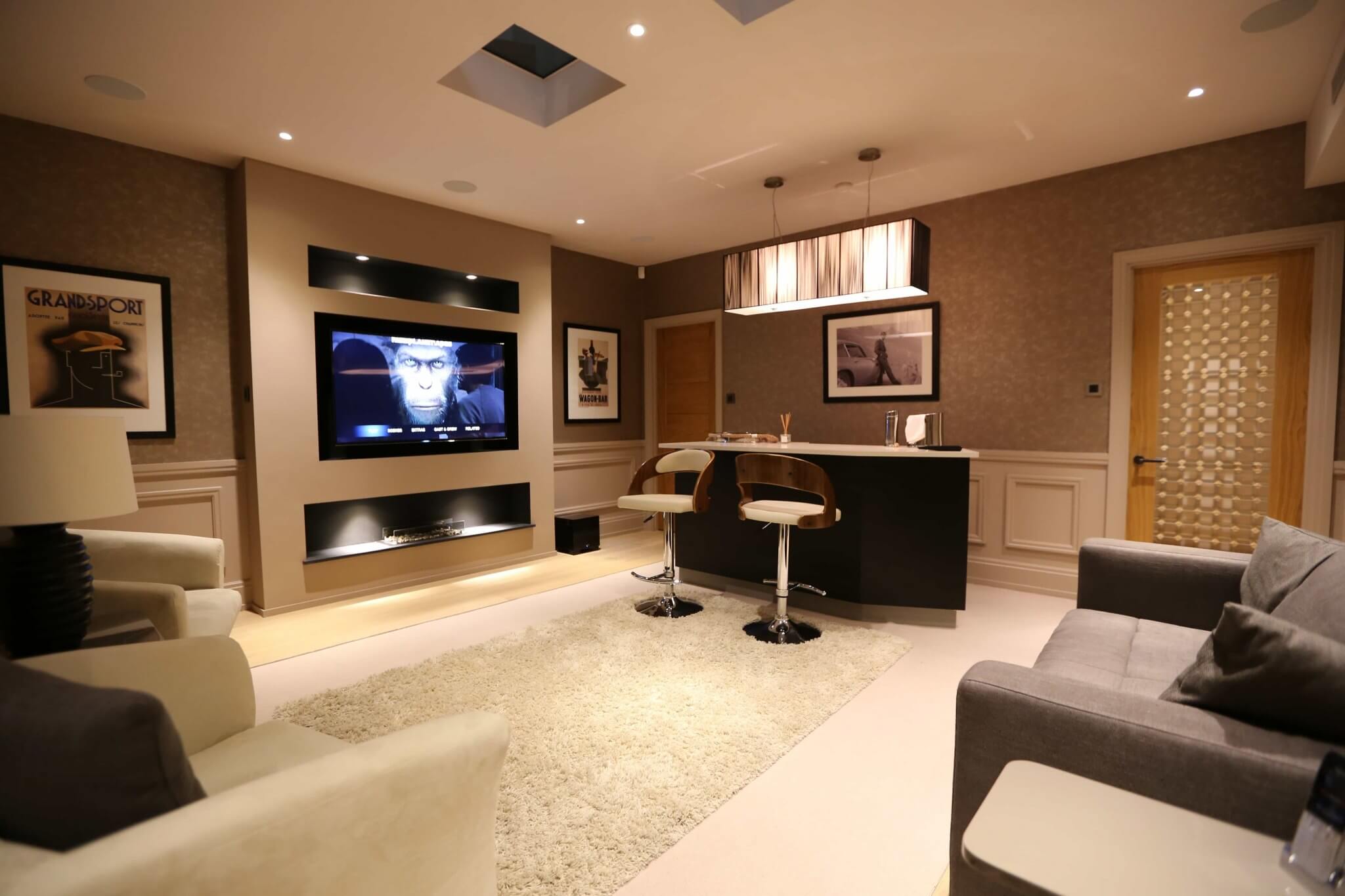
Architecture creates a home. Furniture and materials give it character. Lighting determines whether you ever truly see either of them. The difference between a well-lit home and a poorly lit one is not about brightness — it is about depth, warmth, balance and the ability to make every space feel exactly right for what is happening in it. A room lit by a single central downlight will always look flat, clinical and slightly unwelcoming, regardless of how much has been spent on the interior. A room lit in layers — with carefully positioned ambient, task, accent and decorative sources working in concert — has an entirely different quality. It is alive. It has shadow and texture. It rewards being in it.
Great residential lighting design is neither simple nor accidental. It requires decisions about fitting types, positions, beam angles, colour temperatures, lux levels and the relationship between adjacent spaces — all made before a ceiling is plastered. Getting it right demands experience, attention to detail and the discipline to resist the temptation to add more light when less, placed correctly, would do more. Custom Controls have been designing and installing lighting systems for luxury residential properties since 1998. We work closely with architects, interior designers and directly with clients to create schemes that serve both the function and the atmosphere of every space — and then deliver them through the finest lighting control systems available.

Smart Home

Music Systems

Mood Lighting

Security & CCTV

Wifi & Networks
Choosing the Right Light Fittings
The range of residential light fittings available is enormous, and the choice for any given position in a scheme depends on the ceiling construction, the room function, the architectural style, the designer’s brief and the control system being used. These are the principal types we specify and install.
Recessed Downlights
The workhorse of modern residential lighting. Available in fixed and adjustable versions — fixed downlights provide vertical illumination directly below; adjustable (“eyeball”) downlights can be tilted to redirect their beam toward a wall, artwork or other feature. Beam angle is critical: a narrow 15–25° beam creates a tight, dramatic pool of light suitable for accent purposes; a wider 40–60° beam provides the gentle general illumination of ambient light. Anti-glare bezels and deep-recessed trims significantly improve perceived quality. At this level of project, we always specify high-CRI (90+) LED downlights — lower CRI fittings make materials and finishes look flat and slightly wrong.
Cove and Pelmet Lighting
Concealed LED strip lighting recessed into a cove at the ceiling perimeter, or behind a pelmet above a window or piece of furniture, produces a gentle indirect glow that reflects off the ceiling or wall and fills the room with soft, shadow-free light. Cove lighting is one of the most elegant ways to provide ambient illumination — the source is invisible, the light feels architectural rather than added, and the effect is considerably warmer and more welcoming than ceiling downlights alone. It is also particularly well-suited to Lutron’s Lumaris LED tape system, which can provide both RGB colour and tunable white within the same concealed profile.
Wall Washers and Grazers
Wall washers are positioned to illuminate a vertical surface evenly from top to bottom, typically mounted 300–500mm from the wall depending on ceiling height. Wall grazers are positioned much closer — 50–150mm — and create a raking light across the surface that dramatically emphasises texture: the grain of stone, the relief of plasterwork, the weave of a fabric wall covering. Both are architectural decisions that need to be designed into the ceiling layout from the outset, not added afterwards.
Pendants and Chandeliers
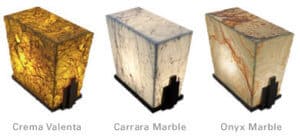
Hanging fittings work best over defined areas — a dining table, a kitchen island, a desk — where their downward light falls precisely where it is needed and their visual presence anchors the space. Pendant height matters enormously: too high and the fitting looks timid; too low and it obstructs. Over a dining table, the bottom of the shade should typically sit 700–800mm above the table surface. For chandeliers in entrance halls or over stairwells, proportion relative to the volume of the space is everything — a fitting that looks generous in a supplier’s showroom can disappear in a double-height hallway.
Wall Lights and Sconces
Wall lights serve both ambient and decorative functions. Positioned on shorter walls, they balance the room and counteract the long-wall dominance that ceiling-only schemes tend to produce. They also provide a layer of light at eye level rather than from above — a quality that is inherently more flattering and more comfortable for the people in the room. Well-positioned wall lights on a dimmer, used alongside ambient ceiling light, give a living room or bedroom an evenness and warmth that ceiling-only schemes never quite achieve.
LED Tape and Architectural Profiles
Linear LED tape, installed in purpose-made aluminium extrusions with diffuser covers, has transformed what is possible with hidden architectural lighting. Coves, reveals, stair risers, under-cabinet runs, behind headboards, inside joinery — almost any architectural element can be lit from within if the profiles are installed at the right stage of construction. The quality of the tape matters considerably: cheap tape produces visible hot spots, colour inconsistency and rapid degradation. We specify only professional-grade tape with high CRI and consistent lumen output throughout the run.
Exterior and Landscape Lighting
The boundary between interior and exterior lighting is one of the most frequently neglected transitions in residential design. A beautifully lit interior that looks out onto a dark garden at night becomes a mirror — the view disappears entirely. Carefully designed exterior lighting — uplighting trees, grazing garden walls, illuminating paths and terraces at low level — extends the visual depth of a room dramatically and makes the garden a genuine feature of the interior experience after dark.
Colour Temperature and the Quality of Light
Colour temperature — measured in Kelvin (K) — describes the warmth or coolness of a light source, and it has a profound effect on how a space feels and how materials within it appear. Getting colour temperature wrong is one of the most common and most avoidable mistakes in residential lighting.
For the main living spaces of a luxury home — sitting rooms, dining rooms, bedrooms, entrance halls — we almost always specify 2700K. This replicates the quality of traditional incandescent and candle light: golden, flattering to skin tones, rich on natural materials like timber, stone and linen, and inherently warm and welcoming. At 2700K, a room in the evening feels like a home rather than a showroom. In spaces where visual accuracy and task performance matter more than atmosphere — kitchens, bathrooms, dressing rooms, home offices — 3000K is more appropriate. It is still within the warm white range but provides a slightly crisper, more neutral light that makes colour matching, food preparation and detailed work easier without introducing the cold, bleaching quality of anything above 4000K. For reference, 4000K and above starts to feel distinctly commercial — adequate for an office or a car showroom, rarely appropriate in a home. Consistency within a space matters as much as the temperature itself. Mixing sources of significantly different colour temperatures — a 2700K ambient layer with 3000K accent spots, for instance — creates a subtle discord that is hard to identify but easy to feel. A carefully designed scheme specifies consistent temperature throughout each layer of each space. For clients who want the ultimate flexibility, Lutron’s Lumaris tunable white LED tape allows the colour temperature of concealed lighting to shift automatically through the day — beginning at a cool, energising 4000K in the morning and warming gradually through the day to a deeply warm 1800K in the evening, replicating the arc of natural daylight. The effect on wellbeing and sleep quality is measurable, and the automation is seamless.
Lighting Levels — and Why Flexibility Matters More Than Numbers
Recommended residential lux levels provide a useful starting point: living rooms typically 100–300 lux for ambient illumination; dining rooms 150–200 lux; kitchens 300–500 lux at preparation surfaces; bedrooms 50–150 lux for general ambience; bathrooms 300 lux general, up to 750 lux at the vanity mirror. These figures come from CIBSE guidance and the accumulated practice of experienced lighting designers, and they reflect genuine human needs — a level that supports comfortable use of a space without glare or eye fatigue. But in a luxury residential context, the fixed lux level is almost the wrong way to think about lighting. What matters far more is the range available — and the ability to move through it effortlessly.
A dining room at 200 lux is appropriate for a formal dinner. The same room at 20 lux, with only the candles on the table and a barely perceptible warm glow from the cove above, is somewhere entirely different — intimate, still, beautiful. A living room at full ambient brightness is functional for a family afternoon. The same room at 5% — lights dimmed so far that they give almost no measurable lux at all, just a whisper of warm amber from a wall sconce and a faint glow along the skirting — is another place entirely, and one that no number of lamps or fixed fittings could create. This is precisely what a well-designed lighting control system makes possible. The numbers matter at the design stage — they ensure sufficient light is available when needed. What defines the daily experience of a great lighting scheme is not the maximum level but the full range, and the ease with which you can move through it.
Lighting Control — Lutron and Crestron
A lighting design is only as good as the system used to control it. The finest fittings in the world, positioned with perfect precision, will disappoint if they are controlled by standard wall switches — fixed at full brightness, impossible to balance between circuits, and incapable of the scene-setting that transforms a house into a home.
We are certified dealers and installers for Lutron, the world’s most respected manufacturer of residential lighting control systems. Lutron’s systems — including Homeworks QSX for the most demanding homes and RadioRA 3 for wireless retrofit installations — give complete, flicker-free dimming control over every circuit in a property. Scenes can be programmed for every occasion and every room: Morning. Dinner. Cinema. Goodnight. Each recalling precisely the right level on every circuit simultaneously, at the touch of a single keypad button or automatically, triggered by time, occupancy or daylight sensors. Lutron’s Palladiom, Alisse and Vierti keypad ranges are themselves objects of considerable design quality — available in dozens of finishes and configurations, flush-mounted, and designed to complement the interior rather than interrupt it. They are a far cry from the plastic switches that most lighting systems rely on.
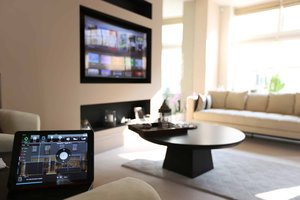
For homes where lighting control forms part of a broader smart home system, Lutron integrates natively and deeply with Crestron — the most powerful home automation platform available. In this configuration, Lutron handles the lighting and shading with the precision and reliability that only a dedicated lighting system can provide, while Crestron provides the unified control interface for AV, climate, access and security. It is the combination we specify most frequently on our most demanding projects, and the one that delivers the most complete and seamless result. Lutron also manages motorised window treatments — roller blinds, blackout blinds, Roman blinds, sheers and curtains — integrated into the same scene-based control as the lighting. At the press of a single button, the lights dim and the blinds descend. The daylight is managed as consciously as the artificial light. This is lighting design completed.
Working with Architects, Interior Designers and Directly with Clients
Lighting design decisions made late are lighting design decisions made badly. The position of every downlight, cove, wall washer and in-floor uplight needs to be determined before a ceiling is plastered, before an architrave is fitted, before a kitchen is installed. Once those elements are in place, the options narrow dramatically — and expensively. We are most effective when we are involved from the design stage. Working alongside an architect or interior designer — reviewing plans, attending design meetings, producing lighting layout drawings and circuit schedules — we can ensure that the control system, the fitting positions and the construction programme are all coordinated from the outset. We produce Lutron integration drawings compatible with most architectural CAD formats, and we are accustomed to working within the design hierarchies of significant residential projects where multiple consultants are involved.
For clients approaching us directly, without an existing design team, we can manage the lighting design as a standalone commission — from initial consultation through layout design, fitting specification, control system design, installation and commissioning. We work with a number of trusted lighting designers and interior architects and can recommend the right collaborator for projects where an independent design eye is appropriate.
Lighting Design Worldwide
Light behaves the same in Dubai as it does in Kensington. The design principles are universal — but the context is not.
We have designed and installed residential lighting systems across London, the Home Counties, Manchester, Cheshire, the French and Swiss Alps, Dubai, Morocco, France, Spain and West Africa. Each market brings its own specific considerations: the extreme solar gain of a Dubai villa, where blackout shading and automated lighting scenes must work together to manage both daylight and energy use; the thick stone walls of an alpine chalet, where wireless Lutron systems eliminate the need for recabling; the protected status of a London townhouse, where fixings must be made without disturbing historic fabric. Our pre-build methodology means that lighting control systems for international projects are fully programmed and tested at our UK workshop before shipping — arriving on site ready to install rather than ready to commission. For projects in Dubai, we have established relationships with local lighting fixture suppliers, main contractors and specialist trades built over years of active project delivery. For alpine and European projects, our Alps team, based in Montriond in the Haute-Savoie, provides local engineering support alongside the design and programming expertise of our UK office.
Whether your project is a Mayfair apartment, an Alderley Edge new build, a Dubai villa or an alpine chalet, the standard we bring to the lighting is the same. Contact us to discuss your project.
Start the Conversation
Whether you are at the design stage of a new home, renovating an existing property or looking to upgrade the lighting in a completed house, we would like to hear about your project. We offer free initial consultations at our London and Cheshire offices, at the Lutron Experience Centre in London, or at your property. Contact Custom Controls to discuss your lighting design project.