
Meyer Sound Reference Audio

Meyer Sound Dealer & Installer | Reference Home Cinema Audio
World-Class Meyer Sound Systems for Luxury Home Cinemas
Established 1979 · Berkeley, California · Used by Skywalker Sound, Pixar, Warner Bros, DreamWorks, 20th Century Fox · 100+ Patents · The Choice of Academy Award-Winning Sound Designers & Audiophiles
Meyer Sound is not a consumer speaker brand that happens to have professional applications. Meyer Sound is a professional sound engineering company that has expanded into luxury residential cinema and high-end audio — bringing 45+ years of film mixing studio technology, Oscar-winning studio partnerships, and breakthrough acoustic engineering directly into discerning homes.
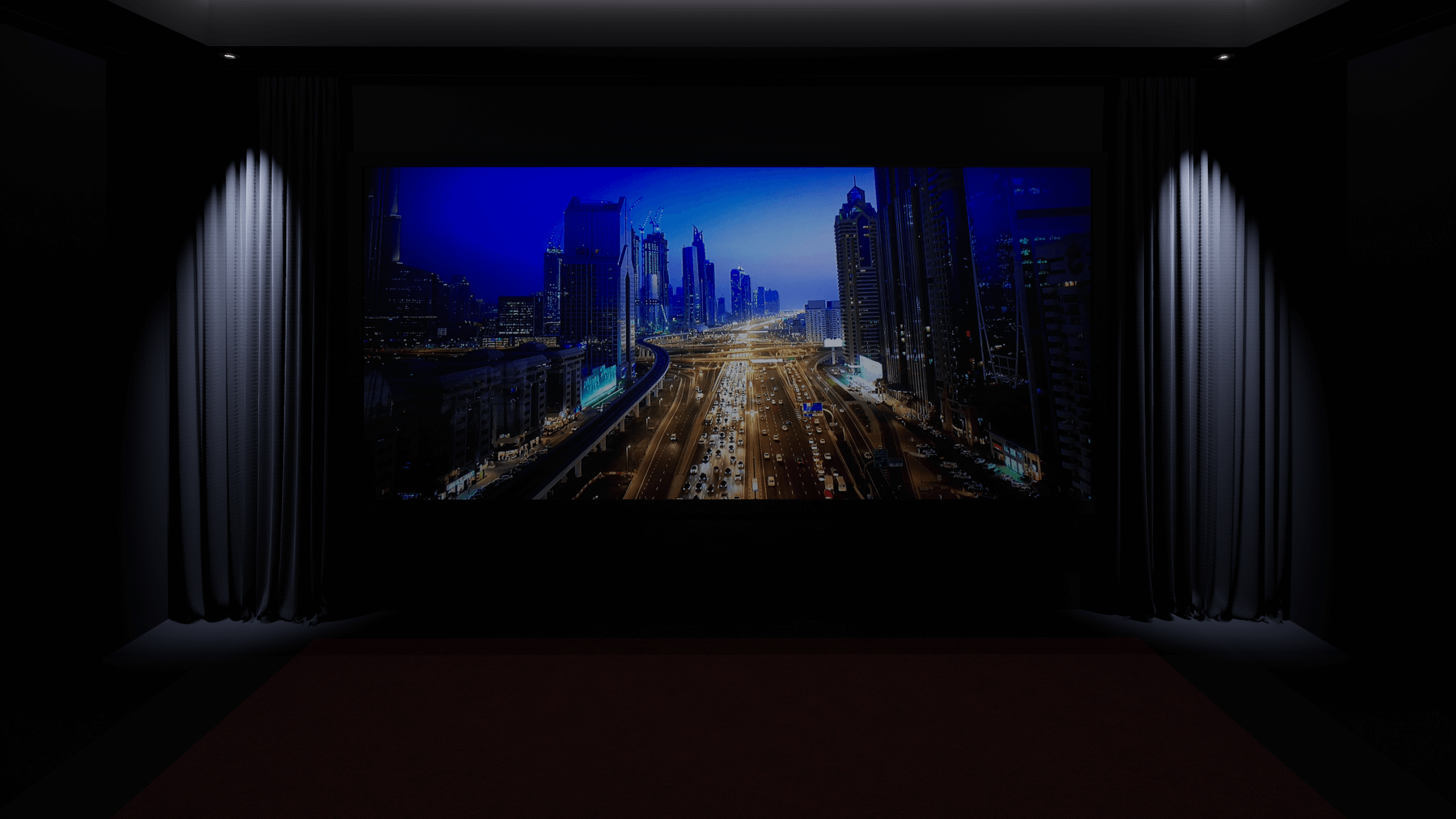
We specify Meyer Sound for cinema rooms and listening rooms where the brief is reference performance, and we design the room, the acoustic treatment and the calibration around the loudspeakers from the first drawing. Every system is measured and calibrated in the finished room before handover, and integrated with the rest of the home so that a single press sets the lighting, the screen and the sources. The result is studio-grade sound in a room that still looks and feels like part of the house.

Home Cinema

Cinema Design

Calibration

Acoustics

Hi-Fi
A 45-Year Partnership with Hollywood
Meyer Sound’s history is inseparable from cinema itself. Founded by John Meyer in 1979, the company’s first major film project was building the original 650 subwoofer for Francis Ford Coppola’s groundbreaking 70mm theatrical release of Apocalypse Now in 1980. That achievement established Meyer Sound as the reference standard for film audio reproduction.
Today, Meyer Sound systems are installed in the sound mixing stages of every major film studio. If a blockbuster from Pixar, Warner Bros, DreamWorks, 20th Century Fox, or Lightstorm Entertainment is being mixed, it’s happening on Meyer Sound speakers. The directors, sound designers, and Academy Award-winning mixers who created this year’s Oscar winners all mixed on Meyer monitors.
When you install Meyer Sound in your home cinema, you’re installing the monitoring standard that shaped the soundtrack of modern cinema. Your home theater will reproduce films exactly as creators intended — no coloration, no compromise, no translation loss.
Meyer Sound in Hollywood’s Most Prestigious Facilities
Skywalker Sound, Marin County, California — George Lucas’s legendary post-production facility has earned 18 Academy Awards for Best Sound using Meyer Sound monitoring systems exclusively. Pixar Animation Studios — Pixar’s sound design team monitors on Meyer Sound systems. Warner Bros. Studios — multiple mixing stages use Meyer Sound cinema systems for the “truest translation of the film mix.” DreamWorks Animation uses Meyer monitoring exclusively for theatrical and streaming content. 20th Century Fox — the Newman Scoring Stage, where John Williams composes, is equipped with Meyer Sound Bluehorn reference monitors. Dolby World Headquarters also runs Meyer Sound systems, reflecting the deep technical partnership between the two companies.
These are working facilities where the monitoring has to be trusted, because every creative decision made in the room is judged through the loudspeakers. In a home cinema the aim is not to copy a mixing stage but to bring the same accuracy into a room designed for the household, so a film is reproduced as its makers heard it rather than as a speaker flatters it.
The Meyer Bluehorn Reference Audio System
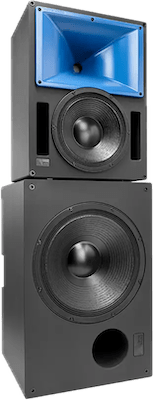
The Meyer Sound Bluehorn System represents a fundamental breakthrough in audio reproduction. After six years of intensive research, Meyer Sound achieved an unprecedented U.S. patent on proprietary digital signal processing technology that solves a problem that has plagued every loudspeaker since the beginning of audio reproduction: phase distortion.
All loudspeakers introduce phase shift — a fundamental acoustic flaw. When a signal enters a speaker, different frequencies arrive at different times. Highs are delayed, lows are advanced, and the midrange cancels. This phase distortion is invisible in frequency response charts but audible as loss of clarity, collapsed soundstage, and listening fatigue.
The Bluehorn System applies advanced digital modeling to achieve absolute phase accuracy across the entire audio bandwidth using patented DSP algorithms in the dedicated Bluehorn 816 processor, providing full-bandwidth (25 Hz to 22 kHz) phase correction. Bluehorn achieves linear amplitude and phase response across 27 Hz to 20 kHz — both simultaneously, which is extraordinary. Most reference monitors achieve linearity in either amplitude or phase, but not both across full bandwidth. Overall system latency is less than 50ms — notably fast for the processing needed to correct phase down to 25 Hz.
Each Bluehorn System is configured as a three-way design, drawing on the latest driver, processing and amplifier technologies from Meyer Sound’s Cinema Series and line array loudspeakers, together with Galileo GALAXY processing. Its phase-correcting algorithms model the behaviour of the whole system and restore the original timing relationships between frequencies while adding minimal latency — and the response remains neutral and transparent at any output level. John Meyer has described it as the greatest step forward since the company’s HD-1 studio monitor.
When you watch a film mixed on Meyer Sound Bluehorn in a Bluehorn-equipped home cinema, you hear exactly what the sound mixer heard: uncompromising dialogue clarity, three-dimensional soundstaging with film-mixing accuracy, timbral accuracy so instruments sound like instruments, and fatigue-free listening because there is zero phase distortion for your ears to compensate for.
Meyer Sound Cinema Series for Home Theater
Acheron Designer screen channel loudspeakers, developed in partnership with Skywalker Sound, deliver full-range, high-SPL cinema reproduction in a compact form factor. HMS Cinema Surround Systems (HMS-5, HMS-10, HMS-12, HMS-15) provide scalable immersive audio, all incorporating Meyer’s exclusive IntelligentDC technology for bi-amplified, self-powered performance with traditional installation ease. Cinema Subwoofers — the compact X-400C, high-power X-800C, and reference-grade X-1100C — integrate seamlessly with Meyer screen channel speakers, extending bass reproduction while maintaining phase coherency. And Ultra Reflex, Meyer’s newest innovation, is the first screen channel loudspeaker solution designed for direct-view LED, OLED or high-end LCD displays — for rooms where projection isn’t practical.
Component choice follows the room. Screen channel loudspeakers are matched to the screen and the viewing distance, the surround system to the number of rows and seating positions, and the subwoofers to the volume of the room and the bass level required, with the acoustic design settling speaker placement before any equipment is ordered. Where the display is direct-view LED or OLED rather than a projection screen, Ultra Reflex is the option designed for it.
Meyer Sound Amie & Bluehorn for High-End HiFi & Music Listening
Meyer Sound’s expertise in studio monitoring translates directly to music reproduction. The Amie Precision Studio Monitor and Bluehorn System, developed for mastering studios and film scoring facilities, deliver uncompromising accuracy for music listening — from classical symphonies to jazz to contemporary pop. Unlike consumer speakers designed to flatter or colour the audio, Meyer monitors reveal the recording exactly as the mastering engineer heard it.
Meyer Amie, developed specifically for Skywalker Sound’s request for “precision translation, exceptional power, and great price point,” is the first new Meyer studio monitor in 25 years — and the first designed explicitly for both film and music applications, with flat frequency and phase response, extremely low distortion and more headroom than any reference monitor in its class. It’s available in scalable configurations: stereo pairs for dedicated listening rooms, LCR systems for larger spaces, and full surround systems for immersive music listening. Meyer Bluehorn for Music represents the absolute pinnacle — installed in film scoring studios where composers like John Williams and Hans Zimmer compose and review orchestral music with studio-reference accuracy, and increasingly specified by audiophiles and professional musicians for dedicated home listening rooms.
Professional studio monitors are designed not to flatter or colour audio, but to reveal it. A Meyer monitor doesn’t make music sound better — it makes it sound true. That honesty is uncomfortable if you’ve been listening to coloured speakers, but it becomes addictive once your ears adjust.
Designing a Meyer Sound System with Custom Controls
Meyer Sound systems require thoughtful specification. Room size, ceiling height, acoustic treatment, viewing distance and screen size all influence which Meyer components work best — this is where partnership with an experienced custom integrator matters. Custom Controls designs and specifies Meyer Sound cinema systems for homes across London, Cheshire, the Alpine region and Dubai, working directly with Meyer Sound’s design validation team to specify systems that meet SMPTE ST202/RP200 cinema audio standards whatever the room size. Our process covers consultation to understand your room and expectations, design recommending the right Meyer components and speaker placement, acoustic planning integrating room treatments with Meyer speakers, integration coordinating with Crestron and Lutron systems, commissioning and calibration working with Meyer Sound specialists, and training so you understand how to get the best performance.
For music listening, a Meyer Amie or Bluehorn system requires different specification again — room acoustics, listening distance, furniture placement and treatment all centred on the sweet spot between the speakers rather than a screen. We design integrated HiFi systems combining Meyer reference speakers with acoustic treatment, source components, whole-home control integration and calibration working with Meyer Sound’s own commissioning team, and we guide clients honestly on whether Amie or Bluehorn best serves their listening habits and expectations — not simply toward the more expensive option.
Meyer Sound FAQs
- What makes Meyer Sound different from a consumer speaker brand?
Meyer Sound is a professional sound engineering company, founded in 1979, whose loudspeakers are used in the mixing stages of major film studios. It has expanded into residential cinema and high-end audio, bringing studio monitoring technology into the home. - What is the Meyer Sound Bluehorn system?
Bluehorn is a three-way reference system with patented digital signal processing in a dedicated Bluehorn 816 processor. It corrects phase across the full audio bandwidth, achieving linear amplitude and phase response across 27 Hz to 20 kHz with system latency of less than 50ms. - Which Meyer Sound speakers suit a home cinema?
The Cinema Series includes Acheron Designer screen channel loudspeakers, HMS Cinema Surround Systems, X-400C, X-800C and X-1100C cinema subwoofers, and Ultra Reflex for direct-view LED, OLED or high-end LCD displays. The right combination depends on room size, ceiling height, viewing distance and screen size. - Can Meyer Sound be used for music listening and HiFi?
Yes. The Meyer Amie studio monitor and the Bluehorn system were developed for mastering studios and film scoring facilities and suit dedicated listening rooms, in stereo pairs, LCR or full surround configurations. - Does a Meyer Sound system need a specially designed room?
The room should be designed around the loudspeakers. Room size, ceiling height, acoustic treatment, viewing or listening distance and screen size all influence which components work best, so we design the room, the treatment and the calibration together from the first drawing. - How is a Meyer Sound system integrated and calibrated?
Every system is measured and calibrated in the finished room before handover and integrated with Crestron and Lutron, so a single press sets the lighting, the screen and the sources.
Home Cinema Installation → · High-End HiFi Systems → · Trinnov Home Cinema → · Discuss your project →