Designing the Dream Specification Home Cinema: A Reference Installation
When a cinema room becomes a sanctuary for film
A true luxury home cinema is not simply a large room with a projector and some speakers. It is an integrated sensory experience — a purpose-built sanctuary where every component, every measurement, every material choice exists in service of a single purpose: to reproduce cinema as it was intended to be seen and heard.
This article documents a complete dream specification for a 16-seat private cinema that sits alongside the world’s most demanding commercial installations. It represents the pinnacle of residential cinema design — a project with a technical specification that has been refined through decades of professional cinema design.

Cinema Design

Reference Audio

Lighting Control

Integration

Installation
The Brief: Purpose-Built Cinema for 16 Seats
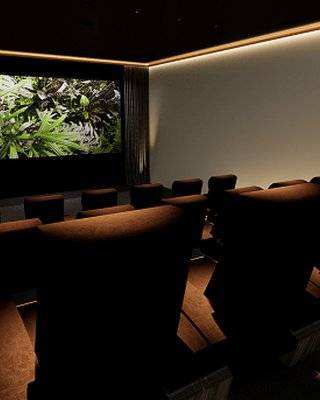
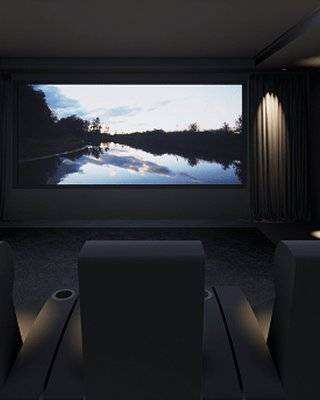
The starting point is uncompromising: a dedicated room built from the ground up, with no compromise on projection quality, audio fidelity, or viewing comfort. The room measures 7 metres wide, 9 metres deep, and 3.3 metres to the ceiling — proportions that accommodate a 250-inch CinemaScope screen with optimal viewing distances for all 16 seats across three staggered rows.
This is not a living room cinema. This is a dedicated facility, built to the same acoustic and optical standards as a professional screening room at a major film studio.
Projection: The Christie Eclipse G3 — The World’s Only True HDR Projector
The foundation of any cinema is light — specifically, the ability to reproduce the full dynamic range of a cinematically mastered image without compromise. For that reason, the dream specification specifies the Christie Eclipse G3, a 6-DLP projector with 30,000 lumens, 20,000,000:1 contrast ratio, and native 4K/120fps capability.
What separates the Eclipse G3 from every other residential projector is True HDR capability. Most projectors can display HDR content, but they compress the dynamic range to fit the limitations of the projector’s lamp or laser. The Eclipse G3 uses an RGB pure laser engine that allows it to maintain full HDR metadata — the actual data that cinematographers use to grade theatrical releases — without tone-mapping or compromise.
Supporting the projector is the madVR Envy Extreme MK3 video processor, a dedicated post-processing engine that handles dynamic HDR tone mapping, motion interpolation via Motion AI, and automatic aspect ratio detection. Combined with a Panamorph anamorphic lens capable of automated 2.39:1 stretch, the result is a projection system that can reproduce theatrical CinemaScope releases with pixel-perfect accuracy.
The Screen: Seymour-Screen Excellence 250″ CinemaScope
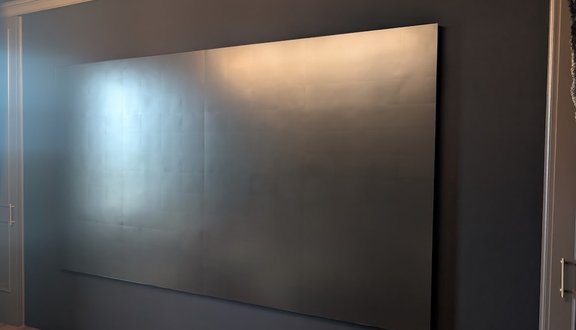
The screen is not simply a white surface. The Seymour-Screen Excellence Reference Fixed screen specified here is a 250-inch fixed installation (5.5m × 2.3m) in the 2.39:1 CinemaScope aspect ratio. It uses Enlightor-Neo acoustically transparent material, which allows sound from the behind-screen speakers to pass through without measurable frequency response coloration — a critical requirement for a reference cinema.
The frame is aircraft-grade aluminium with an InfiniteBlack velvet border that eliminates reflections and light spill. The tensioning system ensures the screen surface maintains perfect flatness across its entire width, eliminating the keystoning and sagging that compromises lower-cost screens.
Audio: Meyer Sound Bluehorn Reference System — Skywalker Sound Calibre
Where the projection system handles the image, the audio system handles everything else: dialogue, music, effects, ambience, and the spatial immersion that separates a cinema from a television. For this reason, the dream specification uses Meyer Sound exclusively throughout — the same reference loudspeakers used in Skywalker Sound’s screening rooms and Dolby’s official demo facilities.
Meyer Sound’s philosophy is rooted in a single principle: linear frequency response. Most loudspeaker manufacturers optimize for presence — they boost the frequencies humans find most noticeable, which makes the speakers sound impressive in a showroom. Meyer Sound instead measures response in an actual room, then designs cabinets and drivers to achieve a flat response curve across the entire audible spectrum. The result sounds initially subtle compared to consumer speakers, but after a few minutes of listening, the ear adjusts — and the absence of coloration becomes apparent. You hear the film, not the speakers.
The LCR System Behind the Screen
Three Meyer Sound Bluehorn systems sit behind the acoustically transparent screen, handling all front-channel content: dialogue, centre-screen effects, and the anchor for the surround field. The Bluehorn is a fully self-powered, three-way system with a 12-inch woofer, compact midrange, and compression-driver tweeter. The crossover design ensures perfect phase coherence across frequencies — a critical requirement for dialogue clarity and centre-image stability.
Surround Fields: Meyer Sound HMS-15 Cinema Surrounds
Eight Meyer Sound HMS-15 surrounds, placed strategically along the side and rear walls, create the enveloping sound field. The HMS-15 is designed specifically for cinema, not music — its directional characteristics are optimized to avoid focusing sound directly at listeners, instead creating a diffuse ambient field that enhances immersion without drawing attention.
Height Channels: Meyer Sound HMS-10 Ceiling Arrays
Six Meyer Sound HMS-10 ceiling speakers handle the Dolby Atmos height channels, creating the vertical dimension that modern cinema requires. Atmos-mastered content uses height information to place sounds above the listening plane — a rain storm can literally surround you from above, or a helicopter can pass overhead with spatial precision.
Subwoofers: Meyer Sound X-800C Distributed Array
Six Meyer Sound X-800C self-powered subwoofers are placed throughout the room in a distributed array. This approach solves the fundamental problem with bass in domestic spaces: standing waves and room modes that create dead spots and boomy regions. By distributing bass output across the room, standing waves are minimized, and bass response becomes uniform throughout the seating area.
Each X-800C is self-powered with 1,240 watts of amplification and includes built-in DSP for room correction. Combined with Trinnov’s spherical harmonics processing, the result is bass that feels tight, controlled, and immersive without being destructive.
Tactile Feedback: ButtKicker LFE Transducers
Sixteen ButtKicker LFE transducers — one per seat — deliver low-frequency tactile feedback. These are not subwoofers, but bass transducers that convert the lowest frequencies into physical vibration felt through the seat. Professional cinema has used tactile systems for decades. They add a dimension of immersion that audio alone cannot achieve: you feel explosions, earthquakes, and engine rumbles.
The ButtKickers are fed from a dedicated LFE channel, allowing the Crestron system to control their intensity independently of the audio system — perfect for late-night viewing when bass needs to be felt but not heard.
Audio Processing: Trinnov Altitude32
The nervous system of the audio system is the Trinnov Altitude32 processor, a professional audio DSP that handles Dolby Atmos, DTS:X, and Auro3D decoding alongside spherical harmonics room correction. Trinnov measures the room acoustically and derives a correction profile that optimizes frequency response, time alignment, and spatial accuracy across the entire listening area.
This is not room correction in the consumer sense — adjusting bass and treble knobs. This is reference-grade calibration that aligns the timing of each speaker to within microseconds and ensures flat response across all frequencies at all listening positions.
→ Read our complete guide to Meyer Sound systems in luxury home cinema →
Seating: Cineak Intimo + Moovia Lyon Theater Recliners
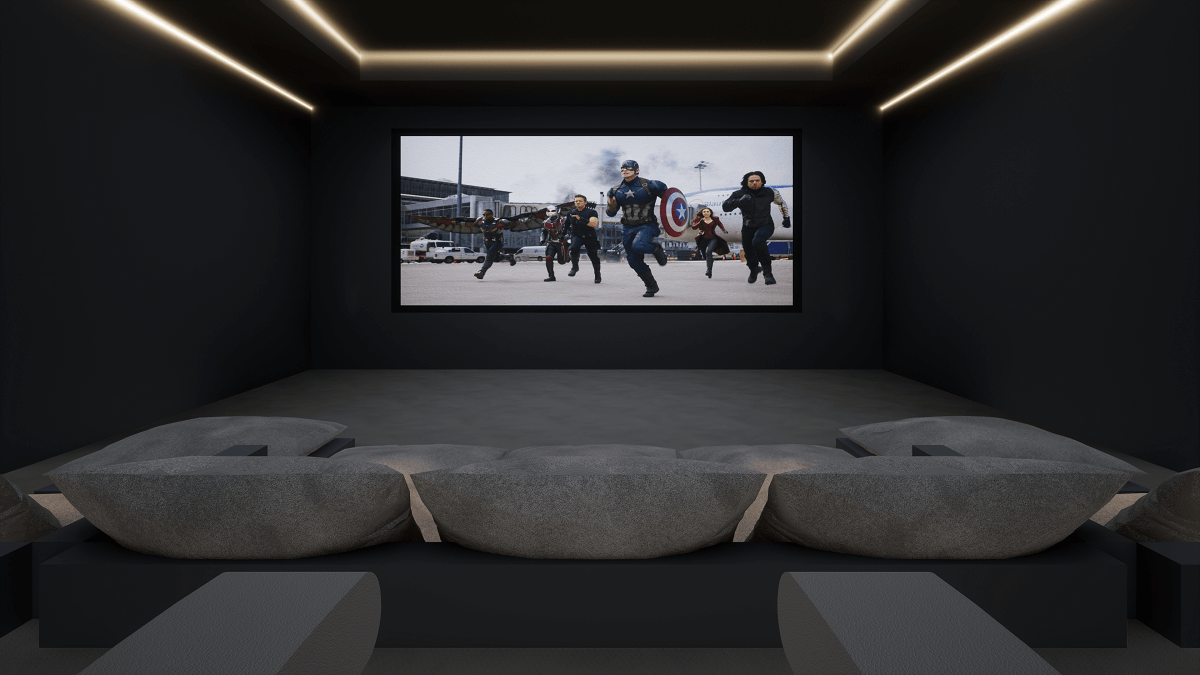
Sixteen positions across three rows: six Cineak Intimo lounge seating units on the floor, followed by two rows of five Moovia Lyon motorized theater recliners on 30cm and 60cm risers respectively.
The Cineak Intimo is not a traditional cinema seat. It is a motorized chaise daybed designed for ultimate relaxation — fully motorized backrest, footrest, and headrest with velvet and leather upholstery. The wide seats accommodate two viewers comfortably, or one viewer in true luxury. These are the flagship seating positions.
Behind them, the Moovia Lyon recliners provide traditional cinema seating with full motorization and Crestron integration. Each seat has independent lumbar support, headrest adjustment, and recline motors — allowing viewers to customize their position in real time. The leather upholstery matches the Cineak Intimo for visual continuity.
All seating is positioned for optimal sightlines to the 250-inch screen. The front row views the screen at approximately 40° above horizontal. The second row, elevated 30cm, views at approximately 25°. The third row, elevated 60cm, views at approximately 10° above horizontal. No viewer sees the head of anyone in front of them — a fundamental requirement of cinema design.
Room Construction: Floating Floor, Isolated Double-Wall, Acoustic Ceiling
A cinema is only as good as its acoustic isolation. No amount of speaker quality can overcome sound leakage to adjacent rooms or vibration transmitted through the building structure. For this reason, the dream specification requires complete acoustic isolation: a floating floor decoupled from the building structure, isolated double-wall construction with acoustic batt insulation, and a suspended acoustic ceiling.
The floating floor is constructed on vibration isolators, ensuring that no vibration from bass or seat motors transmits to the floor structure. The walls are built with a 150mm air gap between inner and outer surfaces, filled with rockwool acoustic absorption. The gap is critical: sound striking the outer wall loses energy crossing the air gap, bounces off the inner wall, and loses more energy crossing back. By the time sound reaches the outside, it has been reduced by 60+ decibels.
The acoustic ceiling uses Simplified Acoustics BDP (Binary Amplitude Diffusion) panels, the same material used in the CEDIA 2025 demo room featuring the Christie Eclipse G3. BDP combines absorption with diffusion: some frequencies are absorbed (eliminating flutter echo), while others are diffused (scattering reflections). The result is a ceiling that sounds natural, not dead.
A separate projection booth (3m × 2.5m) sits behind the cinema, connected via an acoustically sealed projection port with optical-grade AR-coated glass. The booth is itself isolated, with suspended flooring and acoustic treatment, so projector fan noise does not enter the cinema.
A separate utility room houses the external liquid chiller for the Christie Eclipse G3. The Eclipse requires active cooling to maintain laser output — the chiller is vibration-decoupled and thermally isolated, so heat and vibration do not affect the cinema space.
HVAC: Silent and Isolated
The cinema requires climate control, but traditional HVAC systems are a source of constant low-frequency noise. The dream specification uses an isolated HVAC system with vibration decoupling, acoustic baffling on intake and exhaust, and careful ductwork design to eliminate turbulence. The system is tuned to produce no audible airflow inside the cinema — target background noise level: 25 dBA or less.
Acoustic Treatment: Simplified Acoustics BDP Panels
Beyond room construction, active acoustic treatment fine-tunes the frequency response. Simplified Acoustics BDP panels are placed strategically on walls and ceiling to control reflections and standing waves. The panels are calibrated for the specific room dimensions — bass traps in corners absorb problematic low frequencies, while diffusion panels in the middle frequencies maintain acoustical liveliness.
The calibration process is critical. Too much absorption makes the room sound dead; too little introduces reflections and flutter echo. Professional acoustic design and installation is essential to achieving the correct balance.
Source & Control: Kaleidescape, Crestron, Lutron
The media server is a Kaleidescape Terra + Strato V system, a lossless 4K HDR library with Dolby Atmos bitstream support. Kaleidescape allows the owner to legally build a personal library of theatrical releases in pristine quality, organized with full metadata and artwork. Streaming services compress video and audio; Kaleidescape preserves the original theatrical masters.
Room control is handled by Crestron, using an MC4-R processor and TSW-1070 touch panels. A single button press recalls a complete scene: projector on, lights down, screen down, seats motorized to viewing position, audio system armed with Atmos decoding active. The interface is intuitive — the owner does not need to be technical to operate the system.
Lighting is controlled by Lutron HomeWorks QSX, allowing precision dimming of all room lighting down to complete blackout. Scenes can be pre-programmed: movie mode turns off all lights instantly, game mode maintains subtle accent lighting, intermission mode brings lights to 40% for comfort.
Calibration & Integration: The Final Mile
A cinema is not complete on opening night. It requires professional calibration and integration — a process that takes weeks, not hours.
Video Calibration is performed by an ISF (Imaging Science Foundation) Level III calibrator working with Christie’s on-site commissioning team. Using reference test patterns, the calibrator optimizes projector parameters for colour accuracy, contrast, and gamma curve — ensuring the projector reproduces the cinematographer’s original intent.
Audio Calibration involves Trinnov’s 3D room correction measurement and Meyer Sound’s on-site alignment. Microphone arrays are placed at multiple seating positions; the Trinnov system measures response, derives a correction profile, and applies it in real time. Meyer Sound engineers verify that all speakers are time-aligned and that frequency response is flat throughout the room.
System Integration means full programming of Crestron automation, testing of all source handshakes (disc player, streaming, Kaleidescape), commissioning of the Atmos decoder, and training the owner to operate the system. A poorly integrated cinema frustrates users; a well-integrated cinema is invisible — the owner presses one button and everything works.
Why This Specification Matters
This dream specification is not theory. It is based on real installations, with reference points including the CEDIA 2025 Sound Room 7 (a flagship demo installation featuring the Christie Eclipse G3 and Meyer Sound systems) and Dolby’s official Cinema reference installations.
Every choice has been made with a single purpose: to reproduce cinema as it was intended. The Christie Eclipse G3 faithfully reproduces the cinematographer’s colour grading. The Meyer Sound systems reproduce dialogue with clarity and music with fidelity. The Trinnov processing ensures all frequencies reach the listener’s ear in perfect phase and timing. The room construction isolates this sanctuary from the outside world.
A cinema at this specification level can reproduce a theatrical release with greater fidelity than most commercial cinemas. The image quality matches or exceeds a Dolby Cinema installation. The audio quality rivals a premium commercial theatre. The viewing comfort surpasses any public cinema on Earth.
This is what a true luxury home cinema looks like — a reference installation where cost is driven by scope, room construction and equipment tier. Every project is different, so we provide a free, detailed quotation for your own.
Read our complete guide to home cinema installation and design →
Movie Aspect Ratios Explained → · Learn more about Meyer Sound reference audio systems →