Sonus Faber Loudspeakers — The Complete Guide
Sonus Faber Suprema, Aida and Il Cremonese Ex3me
Updated June 2026 · Custom Controls · Authorised Sonus Faber dealers and installers
Sonus faber — Latin for “handcrafted sound” — has spent over four decades pursuing an idea that runs counter to much of high-end audio engineering: that a loudspeaker should be treated as a musical instrument, not simply a transducer. Founded in Vicenza, Italy in 1983 by Franco Serblin, the company draws explicitly on the region’s centuries-old tradition of violin making — the curved “lute” cabinet shape that defines so many Sonus faber models is a direct homage to Antonio Stradivari and the luthiers of Cremona. The result is a sound that the brand describes as “Natural Sound”: rich, textured and emotionally engaging rather than clinically analytical. This guide explains the engineering behind three of the most remarkable loudspeakers Sonus faber has ever built — the flagship Suprema, the full-range Aida, and the Il Cremonese Ex3me — and where the rest of the range fits for a serious hi-fi system.

Hi-Fi

Calibration

Acoustics

Home Cinema

Crestron
The Sonus Faber Philosophy — Natural Sound as an Engineering Goal
Where some loudspeaker manufacturers pursue measured neutrality as the highest goal, Sonus faber’s engineering is built around a different question: does this sound like real instruments and real voices, with the texture, warmth and emotional weight that recordings actually carry? The company’s “Voice of Sonus faber” — its signature tweeter and midrange pairing, refined and carried through almost every collection in the range — is the clearest expression of this philosophy. Natural materials run through every tier: solid wood, leather and metal are not styling choices applied after the engineering is finished, but materials chosen in part for their acoustic behaviour, in the same way a violin maker chooses a particular spruce for a soundboard.
This is not a brand that treats the cabinet as a necessary evil to be made acoustically invisible at any cost. Sonus faber’s curved lute-shaped enclosures — wood, leather-topped, often with substantial hand-finishing — are tuned the way an instrument maker tunes a violin body: not for zero resonance, but for the right resonance, contributing warmth and richness rather than coloration. It is a genuinely different design philosophy from the aerospace-engineering approach taken by some rival manufacturers, and it is why a well-matched Sonus faber system has a character that listeners describe as involving and alive rather than simply accurate.
Suprema — The Most Ambitious Project in Sonus Faber’s History
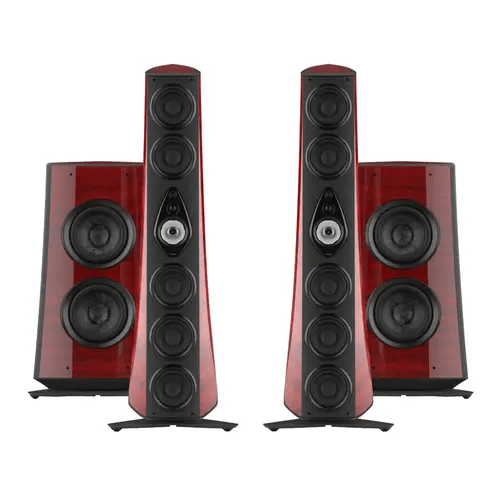
Introduced to mark the company’s 40th anniversary, Suprema is described by Sonus faber’s own engineering team as “the F1 of loudspeakers” — a project undertaken without the usual budget constraints, specifically so its innovations could trickle down into the rest of the range. It is, by a wide margin, the most technically ambitious thing the company has ever built.
A four-tower system. Suprema is not a conventional pair of floorstanders. The system comprises two main column loudspeakers in Sonus faber’s signature lute shape — tracing its lineage directly back to the original 1993 Guarneri — paired with two separate, passive subwoofers in an elliptical cabinet shape derived from the Stradivari, plus a fully discrete, pure-analogue external active crossover that blends the two pairs together. Separating the bass towers from the main columns means the main speakers never have to compromise their cabinet design or driver layout to accommodate deep bass — and the subwoofers can be positioned independently in the room for the best low-frequency response, regardless of where the main columns need to sit for the best soundstage.
The Camelia midrange and a cork acoustic chamber. Suprema’s main column is a 4.5-way sealed design built around three newly developed drivers: a midrange with a cellulose-pulp diaphragm shaped, in Sonus faber’s words, like a camelia flower — a form chosen specifically because its organic shape avoids the resonances typical of a conventional circular diaphragm — alongside a new mid-tweeter and super-tweeter, both using treated silk domes. Remarkably, the chamber housing the tweeters and midrange is built from recycled cork — the first time any high-end loudspeaker has used cork to form an internal acoustic volume. Cork was chosen because its acoustic properties suit the chamber’s organic, non-parallel-wall shape in a way that wood could not be made to achieve, while contributing the natural resolution and tonal quality the design called for.
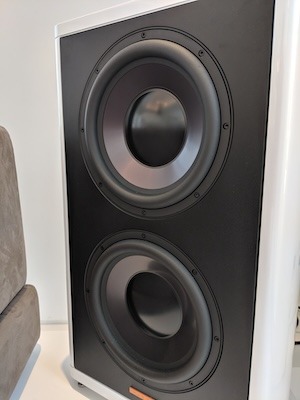
Subwoofers built for infrasonic reproduction. Each Suprema subwoofer houses a pair of 15-inch drivers with forged carbon-fibre membranes and a neodymium magnet motor system, engineered specifically for clean reproduction at the lowest audible frequencies and to optimise in-room bass response independent of where the main columns are positioned. The entire system — main columns and subwoofers — sits on decoupling feet developed in partnership with IsoAcoustics, integrated directly into the structure rather than added afterwards, isolating every internal component from floor-borne vibration.
Materials and finish. Suprema combines carbon fibre for its rigidity, multi-layered wood for its harmonic properties and CNC-machined solid aluminium for its mechanical stability — three materials selected for three different jobs, brought together in a single design rather than treated as competing choices. Each front panel is finished in leather crafted in partnership with Poltrona Frau, the Italian luxury furniture house, using a chromium-free tanning process. It is, in the most literal sense, a hand-built loudspeaker — and Sonus faber has confirmed that production is intentionally limited.
Aida — The Reference Collection’s Standard-Bearer
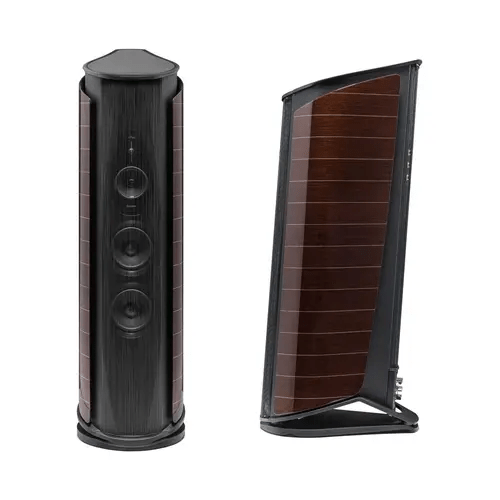
Before Suprema existed, Aida was Sonus faber’s undisputed flagship — and it remains the benchmark against which every other loudspeaker in the range is measured, still built to a standard that most manufacturers reserve for a single halo product rather than a standing collection model. Where Suprema splits bass duties across separate towers, Aida takes the harder route of integrating everything, including genuine infrasonic extension, into a single pair of cabinets — a materially different engineering problem, solved with a correspondingly different set of solutions.
A lyre-shaped cabinet with a built-in infra-woofer. Aida’s dual-curvature cabinet — drawing on the shape of a lyre rather than Suprema’s lute — houses a genuinely ambitious 3⅔-way driver array: the “Voice of Sonus faber” tweeter and midrange pairing, two 220mm sandwich-cone woofers, and a 320mm Nano Carbon Fibre and foam-core infra-woofer dedicated purely to the lowest octaves, all in one enclosure. Sonus faber’s Tuned Mass Damper technology — suspended masses that vibrate in antiphase to cancel unwanted resonance, a principle borrowed directly from skyscraper engineering — controls the cabinet vibration that a driver array this ambitious would otherwise generate, delivering the clean, low-noise bass foundation the rest of the design depends on.
The Sound Field Shaper — sound reproduction facing backwards. Aida’s most distinctive feature is a second, rear-facing driver array built into the back of the cabinet — its own tweeter and a pair of midrange drivers, run at carefully controlled, independently adjustable output levels. Rather than trying to eliminate the room’s contribution to the sound entirely, the Sound Field Shaper deliberately excites the space behind and around the speakers, reconstructing a sense of depth and ambience closer to a live acoustic space than a conventional forward-firing design can achieve on its own. It is a genuinely unusual approach for a flagship loudspeaker, and one that rewards a room where placement and rear-wall treatment have been considered as part of the same design exercise as the speakers themselves.
Stealth Ultraflex and full tri-amplification. Aida’s patented Stealth Ultraflex reflex system reduces distortion and port noise while allowing a smaller acoustic chamber than a conventional reflex design would need — freeing up internal volume for the infra-woofer and Sound Field Shaper alike. Three separate pairs of binding posts make Aida fully tri-ampable for clients who want to drive the tweeter, midrange and bass sections from independent amplifier channels, and — as with Suprema — the entire cabinet sits on Zero Vibration Transmission decoupling feet, isolating the whole system from floor-borne vibration before it ever reaches the drivers.
Il Cremonese Ex3me — A Reference Loudspeaker Built to Disappear
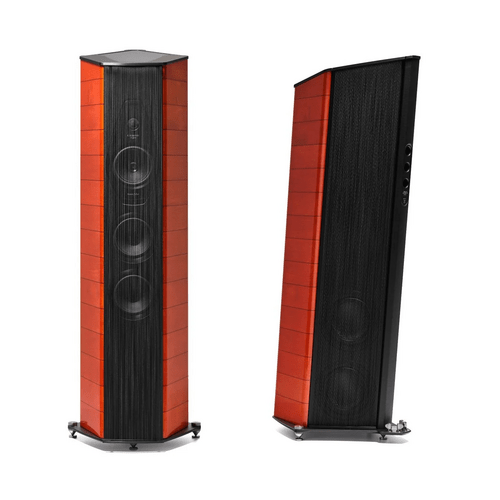
If Suprema represents Sonus faber’s furthest reach into uncompromising scale, Il Cremonese Ex3me represents the brand’s most extreme pursuit of precision. Originally developed from the Il Cremonese platform as a 30th-anniversary concept speaker, it has remained in the catalogue for good reason: this is a loudspeaker engineered specifically to avoid interpreting the music at all, to the point that Sonus faber states it is capable of serving as an extremely high-performance professional studio reference monitor — an unusual ambition for a brand built on warmth and musicality.
The Rhomboidal Diamond cabinet. Il Cremonese Ex3me keeps the model’s distinctive five-sided “Rhomboidal Diamond” cabinet shape — a deliberate departure from the traditional Sonus faber lute or lyre silhouette. The absence of parallel internal walls eliminates the standing waves and internal reflections that a conventional box shape can introduce, while two “Dampshelf” elements — solid billet aluminium plates at the top and bottom of the cabinet — add rigidity and further lower resonance.
A Beryllium DLC tweeter. In place of Sonus faber’s classic silk-dome Damped Apex Dome tweeter, Il Cremonese Ex3me uses a 30mm beryllium dome treated with Diamond-Like Carbon — a Chemical Vapour Deposition process that coats the beryllium diaphragm in a layer with some of the structural properties of diamond. The result addresses beryllium’s familiar weakness: an exceptionally stiff, fast and detailed tweeter without the slightly metallic edge that an untreated beryllium dome can carry.
A 3.5-way driver array engineered for both extremes. Below the tweeter sits a 150mm midrange driver with a neodymium magnet system, two 180mm woofers housed in an independent acoustic chamber fitted with Sonus faber’s “Stealth Reflex” ports, and — the design’s signature feature — two 220mm side-firing infra-woofers built from nanocarbon-fibre and Nomex honeycomb composite, dedicated purely to the lowest octaves. With a frequency response specified from 25Hz to 35kHz and a sensitivity of 92dB, Il Cremonese Ex3me is engineered to extract reference-level performance from both ends of the audible spectrum simultaneously — an unusually difficult brief that most loudspeaker designs trade off against each other.
The Rest of the Range — Where Suprema and Il Cremonese Technology Trickles Down
Sonus faber’s R&D team has been explicit that Suprema’s role is partly strategic: a no-budget-limit platform whose innovations are deliberately fed back into more accessible collections. The current Sonetto G2 collection is the clearest example — the first range below the Reference and Homage collections to incorporate acoustic technologies developed specifically for Suprema, including elements of the Camelia midrange concept and the cork chamber principle.
Reference Collection — Lilium. Alongside Aida and Il Cremonese Ex3me, covered in full above, Lilium completes the Reference Collection’s full-range floorstanders — carrying the brand’s most advanced driver and crossover technology in a more conventional, if still substantial, footprint for clients who want Reference-level engineering without the scale of Aida or the studio-reference brief of the Ex3me.
Olympica Nova Collection. The second generation of the Olympica family — originally launched in 2013 — the Olympica Nova range (Nova I through Nova V, plus centre and on-wall models) brings a meaningful share of Sonus faber’s flagship engineering into a more domestically scaled collection, and remains one of the most popular ranges among clients building a serious two-channel system without committing to Reference Collection scale.
Heritage Collection. Models including the Electa Amator, Minima Amator, Maxima Amator and Concertino sit closest to Sonus faber’s original 1980s designs in spirit — compact, classically proportioned cabinets that prioritise the brand’s earliest design language while incorporating current driver and crossover technology.
Sonetto and Sonetto G2 Collection. Sonus faber’s R&D manager has described Sonetto as the brand’s “democratic” range — aiming for the highest quality achievable within a genuinely cost-conscious package. Sonetto was the first collection below Olympica, Homage and Reference to feature the full “Voice of Sonus faber” tweeter and midrange configuration, and the second-generation Sonetto G2 range carries Suprema-derived technology further down the line-up than ever before.
Lumina and Gravis. Lumina is Sonus faber’s most accessible current collection — minimalist, compact and built around the same core materials and design values as the rest of the range — while the Gravis subwoofer series extends low-frequency performance for any of the brand’s stereo or home cinema systems.
Building a Two-Channel System — Matched Subwoofers
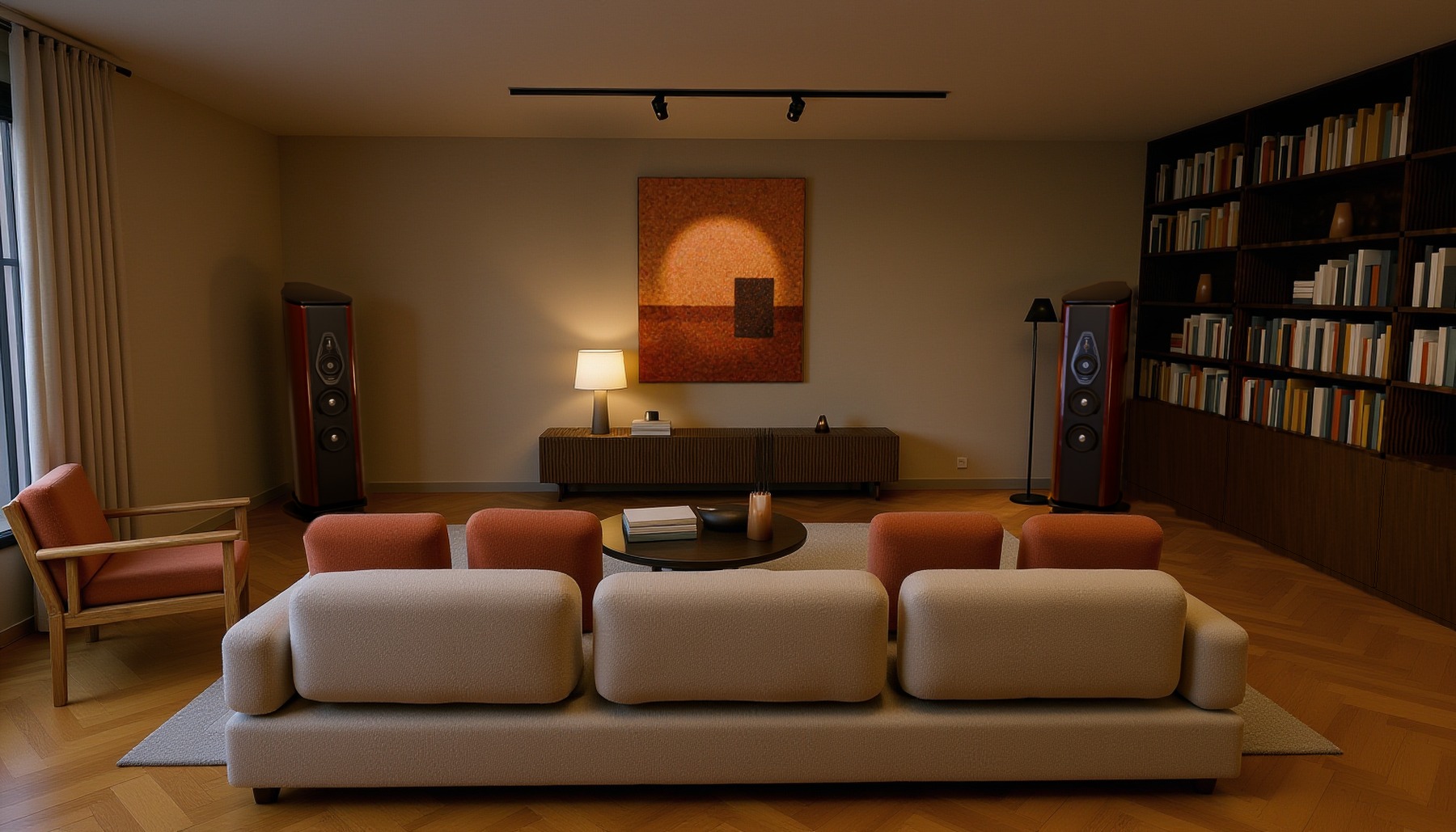
A serious Sonus faber two-channel system is rarely just a pair of speakers. Even Suprema, the brand’s most ambitious statement, is built from the outset as a four-tower system — two main columns and two separate, purpose-built subwoofers, integrated through a dedicated external crossover rather than left to the main speakers alone. That design decision reflects a wider truth about high-end stereo systems: separating deep bass reproduction from the main columns lets each half of the system do one job supremely well, rather than asking a single cabinet to be excellent at both micro-detail and room-shaking low frequencies at once.
For models below Suprema — Il Cremonese Ex3me, Aida, Lilium and the Olympica Nova range — that same principle still applies, just built from separate components rather than a single integrated design. Sonus faber’s own Gravis subwoofer series exists precisely for this purpose, and we specify it in preference to third-party subwoofers wherever the brief allows, for a simple reason: a subwoofer built by the same engineering team, to the same “Natural Sound” philosophy, integrates tonally with the main speakers in a way a mismatched third-party sub rarely manages, however capable it is on paper. Getting the pairing right comes down to three things done properly — a crossover point set to hand off cleanly between the main speakers and the subwoofer with no audible seam, subwoofer placement chosen for even in-room bass response rather than convenience, and level-matching calibrated by ear and by measurement rather than left at a factory default. Where a client’s room and budget call for two subwoofers rather than one — as with Suprema’s own twin-tower approach — stereo bass reproduction becomes possible too, adding a further degree of realism that a single, summed-mono subwoofer can’t replicate.
Amplification — Pairing with McIntosh
Sonus faber has never built its own amplification, which makes the choice of electronics driving the speakers arguably the single most consequential decision in any Sonus faber system. Our standard recommendation, and the pairing we specify most often on serious two-channel builds, is McIntosh — where we are authorised dealers ourselves. It is not a casual suggestion, but a genuinely natural one: McIntosh and Sonus faber have shared a corporate home under the McIntosh Group for years, and the two brands’ engineering teams have collaborated closely enough that a McIntosh amplifier voiced for warmth and musicality is, in a very real sense, speaking the same design language as a Sonus faber cabinet tuned for the same qualities.
McIntosh’s signature autoformer output stage — a design the brand has refined since the 1940s — is a large part of why the pairing works so well in practice. Rather than coupling the amplifier’s output directly to the speaker terminals, an autoformer transformer sits between the two, allowing the amplifier to deliver its full, specified power cleanly regardless of how a speaker’s impedance shifts across the frequency range. Sonus faber’s Reference and Homage collections, including Il Cremonese Ex3me and Suprema, are demanding, dynamically complex loads precisely because their driver arrays span such an ambitious frequency range — exactly the kind of load where an autoformer-equipped McIntosh amplifier continues to deliver effortless, undistorted power where many conventional amplifier designs begin to struggle. Beyond the technical case, there’s a simpler one: the iconic blue-meter McIntosh faceplate and the handcrafted Sonus faber cabinet are both built around the idea that high-end audio equipment should look as considered as it sounds — a genuinely complementary aesthetic pairing as much as a sonic one.
Specifying Sonus Faber in a Custom Controls System
A Sonus faber system rewards exactly the kind of careful system-building a Suprema or Il Cremonese Ex3me installation deserves: room acoustics considered before speaker positioning is finalised, and source components matched to the warmth and texture the brand is known for rather than fighting against it. As authorised Trinnov and Steinway Lyngdorf dealers, we are equally comfortable specifying precision room correction around a Sonus faber system where the room demands it, or building a purist, correction-free signal chain where the room and the brief call for it.
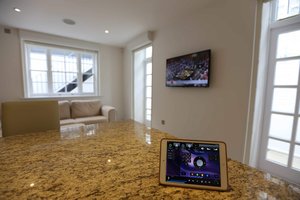
Every Sonus faber system we install can be brought into the same Crestron environment as the rest of the home — a single, elegant interface for source selection, volume and listening scenes, alongside lighting, blinds and climate control, so a system built around genuine handcrafted engineering is never let down by an inconvenient way to use it.
Frequently Asked Questions — Sonus Faber Loudspeakers
What makes Sonus Faber’s Suprema different from other flagship loudspeakers?
Suprema is a four-tower system — two main lute-shaped columns and two separate subwoofers, linked by a fully discrete external crossover — rather than a conventional pair of floorstanders. It introduces new driver technology including a cellulose-pulp Camelia midrange and the first use of recycled cork to form a loudspeaker’s internal acoustic chamber.
What makes Aida different from a conventional pair of floorstanders?
Aida carries a rear-firing Sound Field Shaper array — its own tweeter and midrange pair, independently adjustable, that reflects controlled ambient energy into the room to widen the soundstage. It also houses a skyscraper-derived Tuned Mass Damper for cleaner bass, a built-in 320mm infra-woofer, and full tri-amplification via three separate pairs of binding posts.
What is special about the Il Cremonese Ex3me?
Il Cremonese Ex3me is engineered for an unusually precise, uninterpreted sound — Sonus faber states it can serve as a professional studio reference monitor. It combines a Diamond-Like Carbon-treated beryllium tweeter, a five-sided Rhomboidal Diamond cabinet that eliminates parallel internal walls, and dedicated side-firing infra-woofers for the lowest frequencies.
How does Sonus Faber’s design philosophy differ from other high-end speaker brands?
Sonus faber treats the loudspeaker cabinet itself as part of the instrument, tuning natural materials like wood for the right resonance rather than pursuing total acoustic inertness. The result is what the brand calls “Natural Sound” — warm, textured and musically engaging rather than purely analytical.
Which Sonus Faber collection is right for my room?
It depends on room size, budget and ambition. The Sonetto and Sonetto G2 collections deliver genuine Sonus faber engineering at a more accessible scale; Olympica Nova steps up to a more domestically proportioned serious hi-fi specification; the Reference and Homage collections, including Aida, Lilium, Il Cremonese Ex3me and Suprema, represent the absolute state of the art. We assess the room and the brief together before recommending a specific model.
Can a Sonus Faber system be integrated with a smart home system?
Yes. We integrate Sonus faber systems into the same Crestron environment as the rest of the home, so source selection, volume and listening scenes sit alongside lighting, blinds and climate control in a single interface.
Related Pages
Hi-Fi System Design & Installation → · Trinnov Home Cinema → · Steinway Lyngdorf → · Crestron Smart Home Integration → · Contact Us →