Magico Loudspeakers — The Complete Guide
Magico M, S and A Series Loudspeakers Explained
Updated June 2026 · Custom Controls · Authorised Magico dealers and installers
Magico is not a loudspeaker brand that chases trends. Founded in Hayward, California in 2004 by Alon Wolf, the company has spent two decades pursuing a single, uncompromising goal: a loudspeaker enclosure and driver platform that adds nothing of its own to the music. No cabinet coloration, no resonance, no compromise dressed up as character. The result is a range — A Series, S Series and the flagship M Series — that has become the speaker of choice for the most demanding two-channel systems we design. This guide explains the engineering behind Magico, why the M Series sits at the top of the high-end audio world, and how to know which Magico range is right for your system.

Hi-Fi

Calibration

Acoustics

Home Cinema

Crestron
The Magico Philosophy — Why Aluminium and Carbon Fibre, Never Wood
Alon Wolf’s starting point was a rejection of the material almost every other loudspeaker manufacturer relies on: MDF. A wooden cabinet is cheap to produce and easy to shape, but it is not stiff, and it does not couple properly with a driver under load — the screws securing the driver to the chassis can only be torqued so far before the fixing strips, leaving the driver imperfectly seated in the enclosure. The result is a cabinet that absorbs and stores some of the energy the driver is trying to put into the room, then releases it later as its own resonance — coloring the sound in a way that is impossible to engineer out.
Magico’s answer was to build enclosures the way an aerospace engineer would build an airframe: from aircraft-grade 6061-T6 aluminium, machined to extreme tolerances, braced internally with the same tensioning principles used in aircraft structures, and — in the flagship M Series — combined with carbon fibre skins bonded to an aluminium honeycomb core. The goal in every case is the same: a cabinet stiff enough and inert enough that it contributes nothing of its own to what you hear. When a Magico cabinet is correctly designed, the only thing producing sound in the room is the driver — not the box around it.
This same philosophy extends to the choice of a sealed, acoustic-suspension enclosure across the entire range rather than a ported design. Ported speakers can extend bass response further for a given cabinet size, but they do so at a cost: the rolloff below the port’s tuning frequency is steep, and the venting itself introduces a secondary, less controlled sound source. A sealed enclosure rolls off more gently and, critically, more linearly — which is why Magico’s bass, even at high output, retains its shape, pitch definition and ability to follow a bassline rather than blurring into undifferentiated low-frequency energy.
The M Series — Magico’s Flagship and the Reason the Brand Exists
The M Series is where Magico’s engineering philosophy is expressed without compromise. Every material, every driver technology and every manufacturing process the company has developed eventually finds its way into an M Series loudspeaker first — the rest of the range exists, in large part, to bring a version of that technology to a wider range of rooms and budgets.
M9 — The Flagship
The M9 is Magico’s statement loudspeaker: a four-way, six-driver floorstanding design and the showcase for the company’s most significant cabinet innovation — the world’s first loudspeaker enclosure built from inner and outer carbon-fibre skins bonded to an aluminium honeycomb core. Modelled extensively using Finite Element Analysis before a single panel was cut, the M9’s enclosure doubles structural stiffness over a conventional aluminium cabinet while reducing weight, allowing the cabinet to behave as a single, acoustically inert structure rather than a collection of panels working against each other. The M9 uses an outboard active crossover, separating frequencies at 120Hz with 24dB-per-octave Linkwitz-Riley filters to maintain phase coherence between the bass section and the rest of the speaker. For a client who wants the absolute current state of the art in dynamic loudspeaker design, with no compromise anywhere in the signal path, the M9 is the answer.
M7
The M7 is a four-way, six-driver floorstander that brings the M9’s design language — and a great deal of its engineering — into a more achievable footprint. It is, in effect, the M9’s semi-active architecture made more accessible without diluting the things that make the M Series what it is: the same tweeter platform, the same driver cone technology, and the same obsessive approach to cabinet rigidity.
M6
The M6 is a three-way, five-driver floorstander built around an enclosure that introduced gently arched carbon-fibre side panels mated to edgelessly rounded aluminium faceplates, top, bottom and spine — a construction Alon Wolf describes as the realisation of a diffractionless cabinet shape he first attempted to build over 25 years ago, only now achievable with modern composite manufacturing. The M6’s tweeter is a refined version of the diamond-coated beryllium dome used across the M Series, and its bass driver uses the same large underhung motor system developed for Magico’s reference Q7 Mk II — tuned specifically for the M6’s enclosure to maximise both the quality and the quantity of low-frequency output.
M3
The M3 brought the M Series’ core technologies — the 28mm diamond-coated beryllium tweeter, an all-graphene midrange and bass cone design, and a carbon-fibre side panel enclosure — into a more compact, more attainable floorstander. It remains the most sophisticated entry point into genuine M Series engineering, and for many rooms, it is the point at which the law of diminishing returns above it becomes a question of personal ambition rather than measurable performance.
M2
The M2 takes the M6’s monocoque carbon-fibre enclosure concept and applies it to the smallest model in the current M Series line-up, with a structural strength-to-weight ratio Magico states is 60 times greater than a traditional cabinet design. For a system where floor space or room scale rules out the larger M Series models, the M2 is the way to bring genuine M Series engineering into a smaller room.
The S Series — Reference Performance Without the M Series Footprint
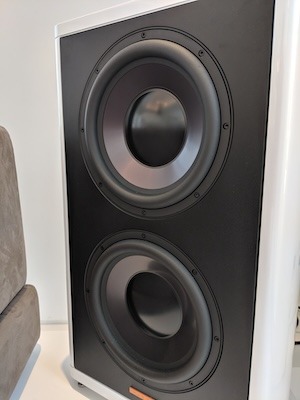
The S Series sits between the A Series and the M Series, and its purpose has shifted significantly over the past two years: rather than a simplified M Series, the latest S Series generation is explicitly designed to push M Series technology — measurement methodology, driver materials, crossover components — down into a more conventional curved-aluminium cabinet format.
The current range-topper, the S7, replaced the original model in 2026 with an entirely new design rather than a refresh. Its three-piece woofer array, vertically aligned to reduce floor-bounce interference, is built around Magico’s Nano-Tec Gen 8 cones — an aluminium-honeycomb core sandwiched between graphene-reinforced carbon-fibre skins — and crossed over using components from Mundorf, including, for the first time in the S Series, Duelund CAST PP capacitors. The S7’s tweeter is drawn directly from the M Series: a 28mm diamond-coated pure-beryllium dome carried over rather than reinterpreted for a lower tier. Magico’s engineering team used a Near-Field Scanner robot to map the S7’s complete 3D acoustic output and laser vibrometry to track down cabinet vibrations invisible to conventional measurement — the same R&D process the company developed for the M Series, applied in full to its middle tier.
Below the S7 sit the S5, S3 and S2 — a range that gives a system designer real flexibility in matching scale to room size without stepping outside Magico’s reference-level engineering standards. The S3, in particular, redefined what the S Series could do when it launched in 2023, drawing directly on technology developed for the flagship M9 and setting a new benchmark for the tier below the M Series. In the dedicated listening room of our award-winning Dubai estate, a pair of S5 Mk II loudspeakers is partnered with a Magico Ssub M subwoofer and driven by Soulution 511 and 520 electronics — S Series engineering delivering reference-level two-channel performance in a room that is still fully integrated into the estate’s Crestron control system.
The A Series — Genuine Magico Engineering at a More Accessible Scale
The A Series exists to answer a specific question: how much of what makes a Magico a Magico can be preserved at a meaningfully lower cost than the S and M Series? The answer, consistently, is more than expected. The A Series uses a flat-panelled 6061-T6 aircraft-grade aluminium enclosure rather than the curved, more labour-intensive cabinets of the S and M Series, and a beryllium tweeter platform shared with the M Series, without the diamond coating used further up the range.
The range-topping A5 is a three-way, five-driver floorstander featuring Magico’s first 5-inch pure midrange driver — sized specifically to match the dispersion characteristics of its 1.1-inch beryllium tweeter — alongside three 9-inch woofers using a refined Nano-Tec cone construction. Below it, the A3 floorstander and A1 standmount bring the same engineering principles — sealed aluminium enclosures, in-house beryllium tweeters, Nano-Tec driver cones, Magico’s Elliptical Symmetry Crossover topology — into smaller rooms and more modest budgets, without ever feeling like a different brand. For a serious two-channel system in a room where the S or M Series would be physically or financially out of scope, the A Series is the honest answer.
What Every Magico Shares — The Technology That Defines the Brand
Beryllium tweeters. Magico designs and builds its own tweeters in-house, using pure beryllium for its exceptional stiffness-to-weight ratio — a property that allows the diaphragm to move as a true rigid piston well beyond the audible range, rather than flexing and breaking up at high frequencies the way a conventional metal or fabric dome can. The M Series tweeter is additionally diamond-coated for even greater rigidity; the technology trickles down through the S and A Series in progressively less elaborate but closely related forms.
Nano-Tec and graphene driver cones. Magico was the first loudspeaker manufacturer to use graphene in driver cone construction — a one-atom-thick carbon lattice claimed to be roughly 100 times stronger than high-carbon steel relative to its thickness. Combined with carbon fibre in a sandwich construction around a honeycomb or foam core, the result is a cone that is simultaneously stiffer and lighter than conventional alternatives, allowing faster, more accurate transient response with lower distortion.
The Elliptical Symmetry Crossover. Every Magico model uses the company’s proprietary crossover topology, built from components sourced from Mundorf of Germany, using 24dB-per-octave Linkwitz-Riley filters to maximise bandwidth while preserving phase linearity. Magico’s position is that crossovers should be optimised for single wiring rather than compromised to support bi-wiring — a deliberate, considered engineering decision rather than a cost-saving one.
Sealed enclosures throughout. No Magico model uses a port. Every cabinet, from the A1 to the M9, is a sealed acoustic-suspension design, chosen specifically for its linear bass rolloff and superior pitch definition over a ported alternative.
Specifying Magico in a Custom Controls System
Magico loudspeakers reward a system built around them rather than installed despite the room. A pair of M Series or S Series floorstanders deserves amplification with genuine current delivery — Magico’s recommended power ranges run comfortably into four figures of wattage for the larger models — alongside source components, room acoustic treatment and speaker positioning that are all specified to the same standard as the speakers themselves. As authorised Trinnov and Steinway Lyngdorf dealers, we are equally comfortable building a Magico-based two-channel system around precision room correction where the room itself cannot be fully treated acoustically, or specifying a purist, correction-free signal chain where the room allows it.
Integration matters too. A Magico system in a Custom Controls installation is brought into the same Crestron environment as the rest of the home — a single source selection, volume and scene control alongside lighting, blinds and climate, with the system always ready rather than requiring a separate remote and a separate routine to use it.
Frequently Asked Questions — Magico Loudspeakers
What is the difference between the Magico M Series, S Series and A Series?
The M Series is Magico’s flagship range and the first home for every new technology the company develops — carbon-fibre and aluminium-honeycomb enclosures, the most advanced driver and crossover technology, and the largest scale. The S Series brings a significant proportion of that engineering — including, in the latest S7, the M Series tweeter platform — into a more conventional curved-aluminium enclosure at a more accessible scale. The A Series uses a flat-panelled aluminium enclosure and a related but distinct driver platform to bring genuine Magico engineering to smaller rooms and budgets.
Why does Magico only build sealed-enclosure speakers?
A sealed, acoustic-suspension enclosure rolls off in the bass more gently and more linearly than a ported design. Magico’s position is that this produces deeper-feeling, more accurate and easier-to-follow bass — even though the headline frequency-response number on paper can look more modest than a ported speaker of similar size.
Why aluminium and carbon fibre rather than wood?
Wood and MDF cabinets are not stiff enough to avoid storing and re-releasing energy from the driver as their own resonance, which colours the sound. Magico’s aluminium and carbon-fibre enclosures are designed to be acoustically inert, so the only sound source in the room is the driver itself.
Which Magico range is right for my room?
It depends on room size, the rest of the system and the level of performance you are targeting. As a general guide, the A Series suits a serious two-channel system in a moderately sized room; the S Series is the right specification for a larger room or a more ambitious brief where M Series scale is not required; the M Series is for a room and a system built specifically to deliver the absolute reference standard. We assess the room and the brief together before recommending a specific model.
Do Magico speakers need a particularly powerful amplifier?
Yes, generally. Magico’s sealed-enclosure designs are not the most sensitive speakers on the market, and the company’s own recommended power ranges typically call for serious current delivery, particularly for the larger S and M Series models. Amplifier matching is a key part of specifying a Magico system correctly.
Related Pages
Hi-Fi System Design & Installation → · Trinnov Home Cinema → · Steinway Lyngdorf → · Crestron Smart Home Integration → · Contact Us →