Rome Steinway Lyngdorf Cinema Install
Summary
- Converted villa, Rome — completed 2025
- Samsung The Wall, 3m × 2m, Lumagen Radiance Pro
- Steinway Lyngdorf P300 with RoomPerfect
- 4 × Steinway Lyngdorf A2 amplifiers (8 channels)
- IW-66 L/R, 2 × IW-26H centre, 2 × IW-16 height
- 2 × Model O rear, 4 × LS-BW boundary woofers
- Kaleidescape, Apple TV, PlayStation 5, Bluesound Node with Roon
- RTI control system
- Lutron HomeWorks QS lighting and blinds
- Acoustiblok and QuietFiber false wall in acoustic fabric
A Reference Cinema Built Around Sound Quality
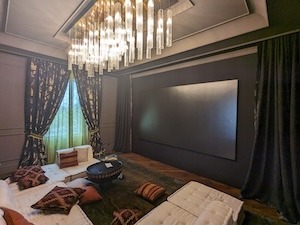
In 2025, Custom Controls completed a reference-level media room cinema in a converted villa in Rome, centred entirely on Steinway Lyngdorf loudspeakers, electronics and RoomPerfect room correction. A 3m × 2m Samsung The Wall display sits at the front of the room, while a Steinway Lyngdorf P300 processor, four A2 amplifiers and a full in-wall speaker array are concealed behind a false wall finished in acoustic fabric. The project shows how premium loudspeaker engineering can define an entire media room design — from acoustic treatment through to system integration — when the starting point is sound quality rather than convenience.
The Brief
The client wanted a cinema that would serve as a reference point for both film and music playback in an older Roman villa. The space was acoustically challenging: high ceilings, mixed materials and the kind of resonance that defeats most off-the-shelf solutions. Steinway Lyngdorf speakers and RoomPerfect calibration became the foundation, and everything else — the room treatment, the equipment and the control — was designed to serve that starting decision.
The media room is one part of a much larger Steinway Lyngdorf home. The villa has ten dedicated two-channel stereo zones, each driven by Steinway Lyngdorf electronics, rather than a single feature room surrounded by lesser systems elsewhere, and 31 Bluesound zones handle distributed audio across the rest of the house. The cinema therefore had to meet the same reference standard as the listening rooms around it, while also delivering the scale and impact of a film soundtrack.
The Steinway Lyngdorf Approach
Steinway Lyngdorf was born from a partnership between Steinway & Sons, makers of concert grand pianos since 1853, and Peter Lyngdorf, one of the most influential figures in high-end audio engineering. Unlike consumer loudspeakers engineered for maximum bass or brightness, Steinway Lyngdorf speakers are voiced to reproduce recorded material with the kind of neutrality you would hear in a mastering studio or concert hall. Each speaker model is voiced to work as part of a complete system rather than as an individual product.
The amplification is fully digital from input to output: the signal stays in the digital domain throughout the chain, with no digital-to-analogue conversion until the last moment before the speaker driver moves. That removes an entire category of distortion that affects conventional amplifier designs. Combined with RoomPerfect room correction, the result is a system designed from the amplifier to the room as one.
To bring that system into a period villa, we worked across each of our core cinema disciplines: installation, room acoustics, calibration and whole-house integration of lighting and music. Each shaped a different part of the finished room, from the fabric wall to the calibration and the whole-house lighting, and together they formed the backbone of the project.

Home Cinema

Acoustics

Calibration

Hi-Fi

Lutron
Room Acoustics and Treatment
The cinema occupies a converted villa room roughly 6.5 metres wide, 9 metres deep and 3.8 metres high. The existing finishes were a mix of painted plaster, parquet flooring and period details that couldn’t be removed, so acoustic treatment had to be added rather than substituted. The client’s cinema also needed to sit inside the villa’s existing architecture without extensive structural work.
Our answer was a false wall that houses all the amplification, speakers and acoustic treatment, built from stud walls lined with Acoustiblok 6mm membrane and QuietFiber mineral wool and finished in acoustic fabric. As on every fabric wall we build, the cloth in front of the speakers is an open-weave acoustic fabric chosen so it doesn’t dull high frequencies on their way into the room, and any panel concealing equipment that may need future access is built removable, so a service visit never means cutting into a finished wall. The result is a room in which the technology disappears and the period architecture of the villa is left untouched. Once the media wall was in place, RoomPerfect took over, correcting digitally for what the room does rather than relying on absorption everywhere.
Samsung The Wall Display
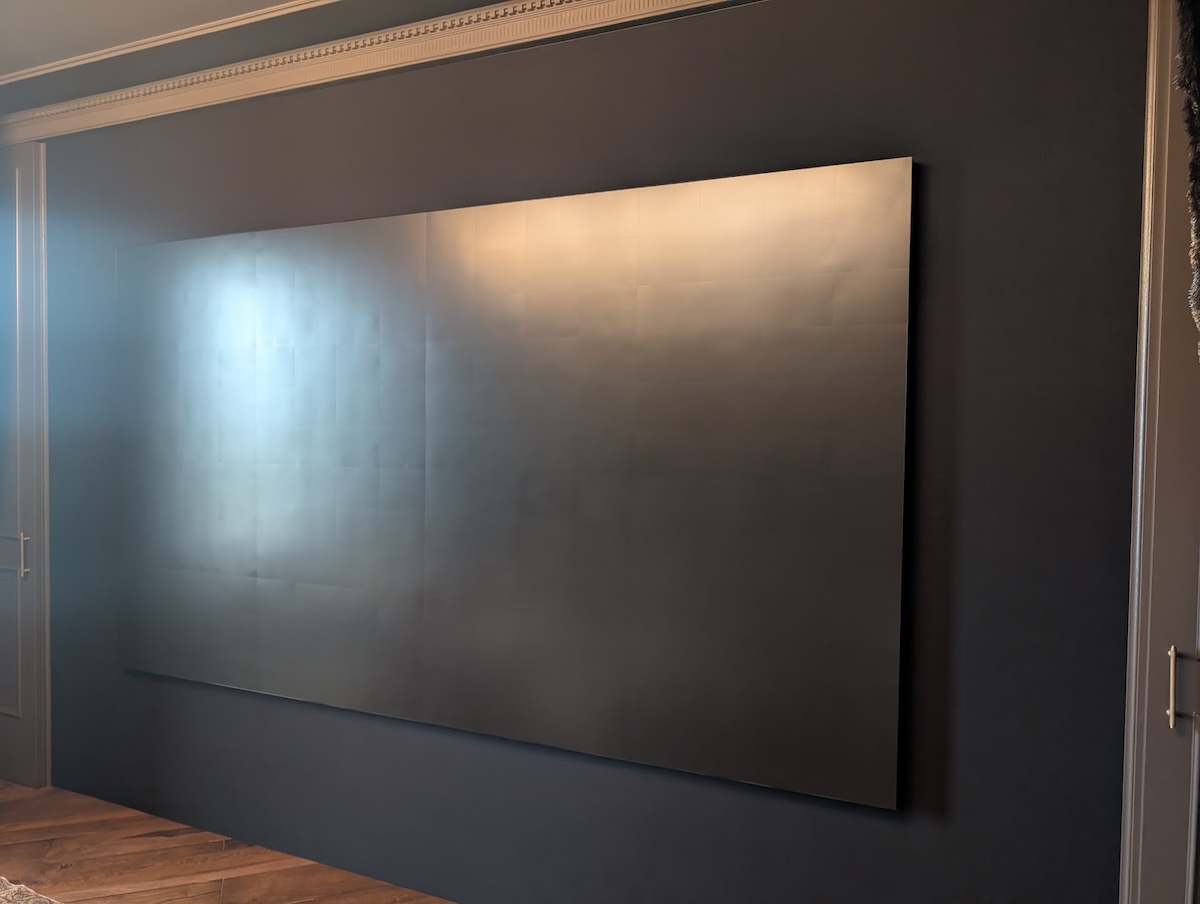
Rather than a projector and screen, the image comes from a Samsung The Wall direct-view LED display, built as a 4 × 4 module matrix measuring 3m × 2m. Because the display emits its own light, there is no projector to house and no screen material between the image and the viewer. The IW-66 left and right speakers are built into the false wall around it, with the two IW-26H centre speakers placed one above the screen and one below.
A Lumagen Radiance Pro video processor sits between the sources and the display, handling scaling for every input. Whether the source is a Kaleidescape film, an Apple TV stream or a PlayStation 5 game, it reaches the modular panel correctly scaled for the 3m × 2m image. Video processing of this kind keeps the picture consistent across very different sources without the client needing to change a setting.
The Loudspeaker System
Steinway Lyngdorf’s IW-66 in-wall speakers serve the left and right channels and are the foundation of the system. The IW-66 is built to studio monitor standards: linear frequency response across the audible spectrum, phase coherence and off-axis performance that respects the recording engineer’s intent. The two matching IW-26H centre speakers handle dialogue, and a pair of freestanding Model O speakers handle rear surround duties, acoustically integrated with the main pair through RoomPerfect’s correction. Two IW-16 in-ceiling speakers provide the height channels.
Bass comes from four Steinway Lyngdorf LS-BW boundary woofers, which handle frequencies below 80Hz. Each has two 15″ drive units, giving plenty of bass headroom. Most home cinema subwoofers are tuned aggressively — they’re designed to be heard as subwoofers — whereas the Steinway Lyngdorf system integrates seamlessly with the main speakers, so you hear bass from the entire soundfield rather than from a discrete box behind the screen.
Processing, Amplification and RoomPerfect
The Steinway Lyngdorf P300 processor handles decoding, room correction, bass management and delay alignment, and works with Dolby Atmos, DTS:X and stereo sources. Four Steinway Lyngdorf A2 amplifiers provide eight channels of fully digital amplification. RoomPerfect calibration is carried out during installation, and ensures the sound is correct throughout the room rather than at one seat.
Rather than measuring at a single point, RoomPerfect samples the room at multiple positions, builds a model of its acoustic behaviour as a whole and calculates corrections that optimise the entire listening area while preserving the natural character of the loudspeakers. Its Voicing system then allows the character of the sound to be adjusted without undoing the room correction — a flat reference mode for music, for example, or a slightly warmer presentation for late-night listening. Custom Controls are RoomPerfect Certified Professionals, one of a small number of UK installers to hold formal certification in the technology, and as with every system we install, calibration is a mandatory part of the handover rather than an optional extra.
Sources and Music
A Kaleidescape Ultra-high definition server provides the cinema’s film library, joined by an Apple TV and a PlayStation 5 for the children.
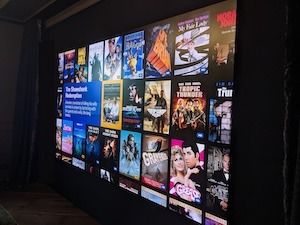
Kaleidescape downloads films to local storage before playback and delivers bit-for-bit lossless Dolby Atmos, Dolby TrueHD and DTS:X soundtracks, so there is no buffering, no dependency on internet connectivity during viewing and nothing lost to streaming compression. Leading streaming services encode 4K video at an average of around 8 megabits per second; Kaleidescape’s standard 4K encode averages around 65 megabits per second, and on a 3m × 2m image you see the difference immediately. Transient detail that streaming compression destroys is present, and the subtle atmospheric sounds in a quiet scene are intact.
Music comes from a Bluesound Node running Roon, accessing streaming services and the client’s NAS-based music library in lossless quality. Roon brings the local library and streamed music together in a single interface, with full album artwork and metadata. It connects for stereo and 3D audio playback and routes through the same Steinway Lyngdorf processing chain as the film sources. Because Bluesound also runs the villa’s 31 distributed audio zones, the cinema shares its music library and interface with the rest of the house rather than standing apart from it.
Integration and Control
The cinema is controlled by an RTI system, which integrates it with the villa’s wider smart home. Lighting and blinds are part of the whole-house Lutron HomeWorks QS system: lighting dims in coordination with cinema activation and motorised shading closes in sequence. The RTI interface shows cinema status — playback mode, volume and correction system state — without requiring manual adjustment during use.
The RTI remote is deliberately simple: power, input selection and volume. The sophistication — room correction, DSP routing and acoustic adaptation — runs invisibly in the background. The client never has to think about the system to enjoy it.
Why Steinway Lyngdorf for Reference Cinema
Most home cinemas start with budget or convenience as the primary constraint.
You choose a receiver, then speakers to match it, and you treat the room if it’s bad enough. The result works, but it’s compromised from the start.
A reference cinema starts with a single decision: what is the best loudspeaker for this purpose? Once that question is answered — here, Steinway Lyngdorf — everything else follows. The room is treated to support the speakers, the electronics are chosen for compatibility and the calibration process becomes methodical rather than iterative.
The Rome installation is built this way: a complete system in which every element exists to serve the loudspeakers’ engineering. Steinway Lyngdorf systems are engineered to reproduce music and film soundtracks exactly as the artist or director intended, and this room was designed to let them do so, sounding like what was recorded rather than what the room decided to do with it. For the client, that means sitting down to watch a film or listen to music and hearing exactly what was intended — no colouration, no room artefacts and no compromises. That’s what reference means.
A Reference Cinema in a Period Villa
The Steinway Lyngdorf cinema in Rome demonstrates that a reference-quality home cinema doesn’t require a purpose-built room in a new build. It requires starting with the right loudspeaker, understanding the room and committing to calibration. The villa’s architectural constraints became irrelevant once we had a system engineered to correct for them.
Custom Controls are authorised Steinway Lyngdorf dealers and RoomPerfect Certified Professionals. We design and complete reference cinemas, two-channel listening rooms and whole-home systems around Steinway Lyngdorf, with projects across London, Cheshire, the French Alps and internationally. If you’re planning a cinema where sound quality is non-negotiable, we can help.
Frequently Asked Questions — Steinway Lyngdorf Cinema, Rome
Which Steinway Lyngdorf equipment is used in the Rome cinema?
The room is driven by a Steinway Lyngdorf P300 processor and four A2 amplifiers, with IW-66 in-wall speakers for left and right, two IW-26H centre speakers above and below the screen, four LS-BW boundary woofers, Model O rear surrounds and two IW-16 in-ceiling height speakers.
What display does the cinema use instead of a projector?
A Samsung The Wall direct-view LED display, built as a 4 × 4 module matrix measuring 3m × 2m, with a Lumagen Radiance Pro video processor handling scaling.
How was the cinema built without major structural work to the villa?
We built a false wall that houses all of the speakers, amplification and acoustic treatment, lined with Acoustiblok 6mm membrane and QuietFiber mineral wool and finished in acoustic fabric, leaving the period architecture of the villa untouched.
What does RoomPerfect calibration do in this room?
RoomPerfect measures the room at multiple positions, builds a model of how it behaves acoustically and applies corrections optimised across the whole listening area rather than a single seat. Custom Controls are RoomPerfect Certified Professionals, and the calibration was carried out on site during installation.
Is the cinema part of a wider Steinway Lyngdorf home?
Yes. The villa also has ten dedicated two-channel stereo zones driven by Steinway Lyngdorf electronics, with 31 Bluesound zones handling distributed audio across the rest of the house.
Steinway Lyngdorf Installations → · Media Room Design → · Kaleidescape → · Fabric Walling → · Multi-Room Audio → · International Projects → · Home Cinema Installation → · Lutron Lighting Control →
Project Gallery
The front wall of the finished media room, with the 3m × 2m Samsung The Wall display switched off against the dark acoustic fabric of the false wall. The villa’s period cornice, panelled doors and parquet floor remain exactly as they were, with the new wall sitting within the original architecture. Behind the fabric are the IW-66 left and right speakers, the IW-26H centre speakers and the amplification, none of which is visible in the finished room.