
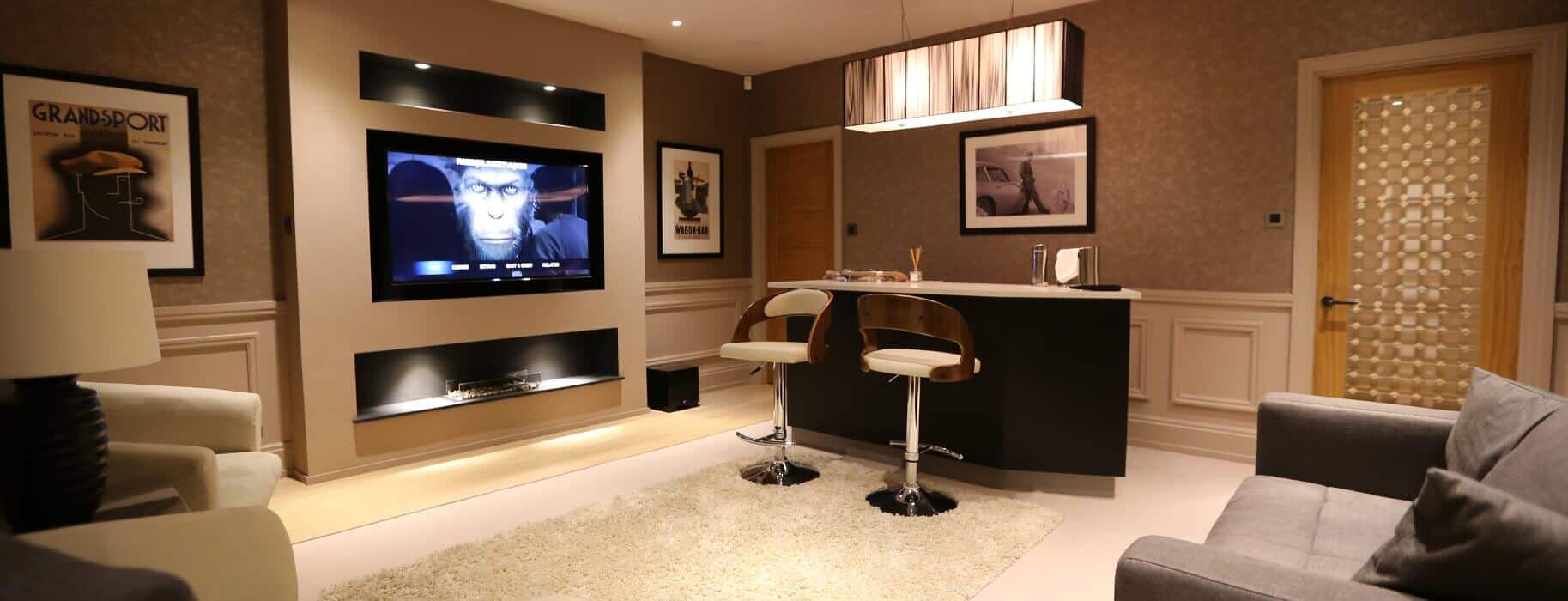
Audio Visual Installers

Audio Visual Installers — From Whole-Home AV to Dedicated Cinema
Every Tier of AV, Properly Specified for Your Property
“Audio visual installer” covers a genuinely wide range of work — from a single Sonos speaker in a kitchen through to a fully calibrated Dolby Atmos cinema room with its own fabric-walled acoustic shell. What separates a good result from a mediocre one is rarely the budget; it’s whether the right platform was specified for the brief in the first place, and whether every part of it was designed to work together rather than assembled piecemeal. Custom Controls have been audio visual installers since 1998, and we work across the full spectrum below — from Crestron’s whole-home platform at the top, down to dedicated hi-fi and bespoke cinema construction — recommending whichever tier genuinely suits your project rather than defaulting to the most complex option available.

Crestron AV

Multi-Room Audio

Hi-Fi

Home Cinema

Acoustics
Crestron — The Pinnacle Platform
At the top of what an audio visual installation can be sits Crestron — not because it’s the most expensive option available, but because it’s the only platform that genuinely removes every practical limit on scale, flexibility and integration at once. Where most AV systems are built around fixed connections between specific sources and specific rooms, Crestron treats the entire property’s data network as the distribution backbone. Any source, anywhere in the building, can reach any screen or speaker, anywhere else — with no fixed routing, no signal loss over distance, and no meaningful ceiling on how many zones the system supports. It’s the platform we reach for whenever a project’s ambition genuinely calls for it.
Crestron Video — DM NVX. Crestron NVX encodes video at its source and distributes it across the property’s own IP network to any number of receiving displays simultaneously — a Sky box, a Kaleidescape server, a games console or any HDMI device in the rack, reaching a screen anywhere in the building over standard Cat6 or fibre, the exact same infrastructure carrying the property’s data network. There’s no fixed matrix to manage: any encoder can feed any decoder, or group of decoders, at any moment, entirely under programme control. A film paused in one room continues from the same point in another. The same live sport plays on every screen in the house at once, or a different source plays in every room simultaneously — the choice is the household’s, not a constraint of the hardware. NVX handles genuine 4K HDR with full HDCP 2.2 compliance, and for larger estates, a single source rack in a central plant room can serve every building on the property over fibre, without duplicating equipment anywhere.
Crestron Audio — DM NAX. Crestron NAX takes the identical IP-based approach and applies it to audio. Rather than centralising every amplifier in one rack, NAX amplifiers sit close to the speakers they drive — in a ceiling void, a local cupboard — each one independently addressable over the network and fed digitally with no analogue signal path to degrade along the way. Every NAX channel plays a genuinely independent source: one zone on Spotify, the next on a radio station, a third pulling the audio track straight off an NVX video source in the same room. Streaming is built directly into each amplifier channel, so a zone needs no separate streaming device of its own — and Sonos or Bluesound zones sit alongside NAX zones on the exact same Crestron interface, giving a household access to whichever platform suits a given room without sacrificing single-point control of the property.
Crestron Control — Crestron Home. None of the above matters if the resulting system is a chore to actually use. Crestron Home ties NVX video, NAX audio, lighting, climate and security into a single interface — a wall keypad, a touchpanel, an iPad or the Crestron app — so a household controls the entire property the same way regardless of which system they’re actually adjusting. Selecting a film on a Kaleidescape library triggers the whole cinema scene in one action: screen down, lighting dimmed, correct input selected, sound system live. A morning routine starts audio in the bedroom and carries it into the kitchen without anyone touching a second control. It’s the difference between owning capable equipment and living with a system that actually gets used every day.
Audio-Only Distribution — Bluesound & Sonos
Not every project needs, or wants, a fully bespoke Crestron installation, and for audio-focused whole-home systems we specify Bluesound and Sonos — both genuinely capable platforms in their own right, built for exactly this purpose rather than adapted from a broader automation system.
Bluesound. It’s built around BluOS, a hi-res streaming platform supporting playback up to 24-bit/192kHz alongside MQA and DSD256, with more than twenty streaming services — Tidal, Qobuz, Spotify, Amazon Music and Deezer among them — available from a single controller app. The current POWERNODE streaming amplifier delivers 100 watts per channel of Bluesound’s DirectDigital amplification alongside HDMI eARC, letting it connect straight to a television and drive a full stereo or surround setup with no separate AV receiver required. For reference-grade sources, the Node ICON pairs a dual-mono ESS SABRE DAC architecture with MQA Labs’ timing-correction technology — genuinely serious two-channel performance built on the same whole-home platform as every other Bluesound zone in the property. FollowMe lets a listener carry their music from room to room at a single tap, and Bluesound’s ability to bring network streaming to existing “legacy” hi-fi components makes it a natural upgrade path for a client who already owns speakers or amplification worth keeping.
Sonos. It remains the benchmark for effortless whole-home audio, and the current range covers everything from a single bedroom speaker to a full home cinema setup. The Arc Ultra soundbar — Sonos’s current flagship — uses newly developed Sound Motion driver technology to deliver a genuine 9.1.4 Dolby Atmos experience from a single unit, extendable with Era 300 speakers for true surround placement and a Sub for real low-end weight. Trueplay room tuning measures a room’s own acoustic behaviour via microphone and adjusts the system’s EQ accordingly, and every Sonos zone syncs perfectly across the property via the Sonos app, with AirPlay 2, Spotify Connect and Bluetooth covering every practical way a household might want to get music playing. For genuinely private late-night viewing, Sonos Ace headphones take over a soundbar’s TV audio at a single button press, with head-tracking spatial audio replicating the room’s own surround field.
Hi-Fi — Where the Room Is Part of the Instrument
A genuinely excellent hi-fi system is inseparable from the room it’s installed in. Speaker placement relative to the room’s dimensions, the position of the listening seat, the treatment of the surfaces sound actually reflects off before it reaches the ear — every one of these decisions shapes the final result as much as the electronics themselves, which is exactly why we design a hi-fi installation around the room rather than simply placing equipment within it. Layout and control matter just as much as the acoustic engineering: a reference-grade system that’s awkward to actually use ends up switched off, so every installation we build is genuinely simple to operate day to day, whatever level of complexity sits behind the interface.
Crucially, a dedicated hi-fi room doesn’t need to sit apart from the rest of the property’s audio distribution system — it’s simply another zone within it, and the highest-end two-channel system integrates just as readily as any other room in the house. Source selection and playback are handled from the exact same touchpanel or keypad used throughout the property, and streaming from Roon or a shared music library reaches the listening room precisely as it reaches everywhere else, all sitting on the same Crestron AV platform where a client wants it. The reproduction itself remains entirely dedicated, reference-grade electronics with no compromise introduced by the wider system — the room simply gains the convenience of whole-home control on top of uncompromised sound, rather than existing as an isolated system nobody but the owner can operate. Equally, we design fully standalone two-channel systems for clients who want a listening room with no automation involved at all.
We are independent hi-fi designers and installers with no manufacturer targets to hit, and specify from Magico, Sonus Faber, Steinway Lyngdorf, Soulution, McIntosh, Bluesound, NAD and Lumin — often combining brands within a single system where that genuinely serves the room better than a single-brand solution would.
Home Cinema Installation — A Dedicated Discipline
Home cinema is the most demanding audio visual discipline we practise, and the one where design decisions made months before any equipment arrives determine the final result more than the equipment itself. Our full home cinema installation service draws on everything covered above — Crestron or a simpler control platform, genuinely excellent audio, a properly specified screen and projector — but the design stage is where acoustic and room construction problems get solved in their own right, not layered on as afterthoughts once a room is already finished.
Luxury Design. Every cinema project starts with the room’s actual geometry, not a catalogue of equipment. Screen size and seating distance are calculated together, so the finished image fills the correct field of view rather than simply being as large as the wall allows; speaker positions are planned against the room’s dimensions before a single stud goes up. Getting this stage right is what separates a room that merely contains a projector and some speakers from one that genuinely performs as a cinema.
Acoustic Modelling & Treatment Design. A full acoustic model, built before construction begins, identifies exactly where standing waves and early reflections will occur in the finished room’s specific dimensions — the same discipline behind every reference cinema we’ve built. Sitting in the intended seating position and checking where a mirror held against each side wall reflects the screen shows the first-reflection points that most need treating; the wall directly behind an acoustically transparent screen needs full, dark, absorbent coverage so sound isn’t bounced back through the fabric it just passed through. None of this is guesswork by the time construction starts — it’s calculated against the room’s actual measurements.
Room Construction & Fabric Walling. Where a room needs building from scratch or substantially altered, our own track-and-fabric wall system turns acoustic treatment into the room’s actual finish, not a set of panels added afterward. The process is consistent regardless of room size: 100mm stud work is built across the treated walls, acoustic fleece is fitted into the resulting voids alongside any speakers being concealed within them, our engineered track system is fixed to the studwork, mineral wool or fibreglass acoustic core is installed over the fleece, and the final fabric — colour-matched to the room’s design, RAL-specified where needed — is stretched drum-tight into the track’s interlocking jaws for a completely seamless finish with no visible seams, staples or seams to sag over time. Speakers, cabling and equipment disappear behind a wall that reads as a considered interior surface rather than a technical installation.
Cinema Installation. Every rack is pre-built and pre-programmed at our workshop before it reaches site — sources connected, routing tested, control programming verified against the design documentation. On-site work is installation, not on-site invention: projector and screen mounted to the calculated positions, speakers fitted within the fabric walls built to receive them, and every cable run completed exactly as designed at the outset.
Cinema Calibration. A finished room still needs calibrating before it performs as designed. Professional measurement — a calibrated microphone, spectrum analysis, and a processor capable of correcting for the room’s actual measured behaviour rather than a generic preset — accounts for every ambient factor construction alone can’t remove: speaker-to-room interaction, the acoustic effect of furnishings, and any lingering discrepancy between the model and the finished space. It’s the step that turns a well-built room into one that performs exactly as its design intended.
Audio Visual FAQs
- What’s the difference between Crestron AV and a system like Sonos or Bluesound?
Crestron NVX and NAX distribute both audio and video over the property’s own network and integrate directly with lighting, climate and security under one interface. Sonos and Bluesound are dedicated audio-only platforms, genuinely excellent for music distribution but not built to control the wider home. - Do I need a full Crestron system, or would Sonos or Bluesound suit my project?
It depends on the brief. If the goal is excellent audio throughout a property without wider home automation, Sonos or Bluesound is usually the right, more cost-effective answer. Crestron becomes the right choice once video distribution, whole-home control or integration with lighting and climate are part of what is needed. - Can Sonos or Bluesound integrate with a Crestron system later?
Yes. Both platforms can sit alongside Crestron NAX zones on the same Crestron interface, so a property can mix platforms according to what each room needs rather than being locked into one ecosystem. - What is fabric walling in a home cinema?
Fabric walling is an acoustic treatment and finishing system built into a cinema room’s construction: stud work, acoustic fleece and mineral wool core installed behind a taut fabric finish held in an engineered track. It conceals speakers and cabling while tuning the room’s acoustic behaviour, rather than being a decorative addition applied afterward. - Do you design hi-fi listening rooms?
Yes. In hi-fi the room is part of the instrument, so we specify the equipment and the room together, with acoustic treatment and calibration as part of the design rather than an afterthought. Read about high-end hi-fi → - Do you install dedicated home cinemas as well as whole-home AV?
Yes. We have been audio visual installers since 1998 and work across every tier, from a single Sonos speaker in a kitchen to a fully calibrated Dolby Atmos cinema room with its own fabric-walled acoustic shell. Read about home cinema installation → - Why does calibration matter even in a well-built room?
A well-built room still needs a final calibration step to perform as intended. Our Rome project shows how calibration can solve the acoustic problems of a room that the construction alone could not.
Crestron Audio Video Systems → · Multi-Room Audio → · High-End Hi-Fi → · Home Cinema Installation → · Contact Us →