Movie Room Ideas vs Dedicated Cinema: Which is Right for You?
Movie Room vs Dedicated Cinema: Design Compared
Every client who asks about a home cinema is really asking two questions at once, whether they realise it or not: what do I want this room to do, and what am I prepared to give up to get it? A dedicated cinema and a movie or media room solve the same basic desire — a serious film and TV experience at home — but they start from opposite design briefs. One sacrifices flexibility for immersion. The other sacrifices some immersion to stay useful for everything else a room needs to do. Neither is the compromise option; they are different answers to different households.
What Makes a Room a Dedicated Cinema
A dedicated cinema is built around one job: showing films and television as well as they can possibly be shown. Everything about the room is decided by that single purpose.
Isolation: the room sits apart from the rest of the house — a basement, a converted garage, a purpose-built extension — so volume and acoustic treatment aren’t constrained by neighbouring rooms.
Blackout: no daylight reaches the screen, which is what makes a large projected image and a genuinely cinematic contrast ratio possible.
Acoustic treatment: walls, ceiling and sometimes floor are treated with absorption panels and bass trapping, tuned to the room’s dimensions during design rather than added afterwards as a fix.
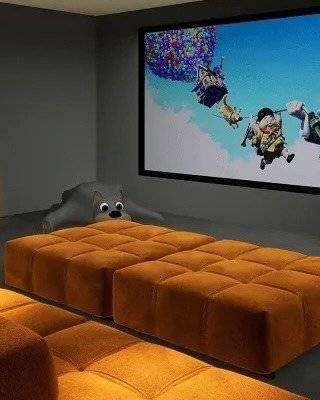
Fixed seating: rows of electric recliners positioned for optimal sightlines and acoustic symmetry, not sofas arranged for conversation.
The trade-off is obvious: a dedicated cinema is a single-purpose room. It earns its place in a floor plan only by being used often enough to justify that.
What a Movie or Media Room Offers Instead
A media room starts from a different brief: it has to work as a living space first, and as a cinema second. That might mean a family sitting room with a retractable screen, an open-plan space that combines a games area with film nights, or a snug where the TV disappears into the joinery until it’s needed. Not every exceptional home has a basement to spare, and not every client wants a room that only earns its keep once a week.
This isn’t a lesser version of a dedicated cinema — it’s a different design problem, and it demands a different set of skills. Sightlines have to work for a room used for reading and conversation as much as film. Lighting scenes have to serve half a dozen everyday uses, not just one. Speakers are chosen and positioned to disappear visually as well as sonically. Done properly, a media room delivers a genuinely cinematic experience for two hours in the evening, then reverts to being an excellent living room for the other twenty-two.

Cinema Design

Acoustics

Seating

Lighting Control

Crestron
Acoustics: The Real Dividing Line
More than screen size or seat count, acoustics is what actually separates these two room types. A dedicated cinema can be treated on every surface, isolated from the rest of the house, and tuned as a single acoustic space — there’s no compromise to negotiate. A media room shares walls, ceilings and sightlines with the rest of daily life, so the acoustic strategy has to be smarter rather than simply more aggressive: in-ceiling and in-wall speakers that stay out of the way, subwoofers positioned to avoid disturbing adjoining rooms, and room correction processing (Trinnov or Anthem, depending on the system) doing more of the work that physical treatment would otherwise handle. The result won’t match a fully treated dedicated room on paper, but a well-designed media room can still sound genuinely excellent — the difference is in how much of that performance comes from the room itself versus from the engineering around it.
It helps to separate two different acoustic questions. Sound transmission — stopping bass energy travelling through walls and floors to the rest of the house — is a construction question, answered with mass loaded vinyl, decoupled stud walls, acoustic membranes, acoustic underlay and resilient bar ceilings. These are highly effective, but essentially impossible to retrofit into a completed room without significant building work, so we specify them as standard in a new build, basement conversion or major renovation and say so plainly when a finished room cannot take them. In-room acoustics — the early reflections that blur imaging, the reverberation that makes dialogue hard to follow in an open-plan space, the bass unevenness caused by the room’s dimensions — can be improved in every room, dedicated or not.
Display Choices: Projector, Retractable Screen or Large TV
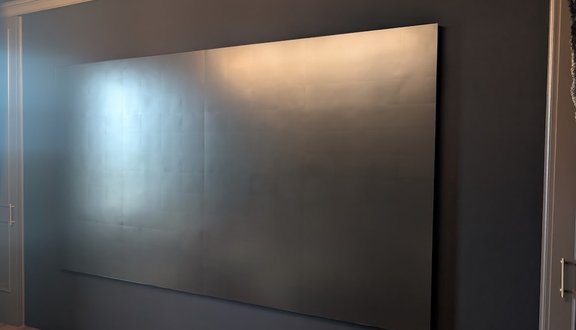
A dedicated cinema almost always means projection: a large acoustically transparent screen spanning the front wall, with the front speakers behind it so sound and image share the same position. A media room has to weigh the picture against everything else the room does. In our North London attic cinema, the room is a library by day; a hidden screen drops down in the window alcove as the projector lowers from a custom ceiling housing on a Future Automation lift, the blinds close and the lighting settles into its film scene — and when the film ends, the whole sequence reverses and the room returns to its everyday state.
Where the room is used in daylight, a large television is often the better answer. In our Kensington basement cinema, a 75-inch Samsung OLED was chosen over a projector because OLED delivers black levels and colour saturation that a projector cannot match in ambient light, and at the available seating distance the screen fills the field of view effectively. In a Chelsea living room, a Future Automation motorised mount pulls the TV and its attached Artcoustic soundbar out from the wall and rotates them, so every seat in the room gets the correct viewing angle and the audio follows the picture.
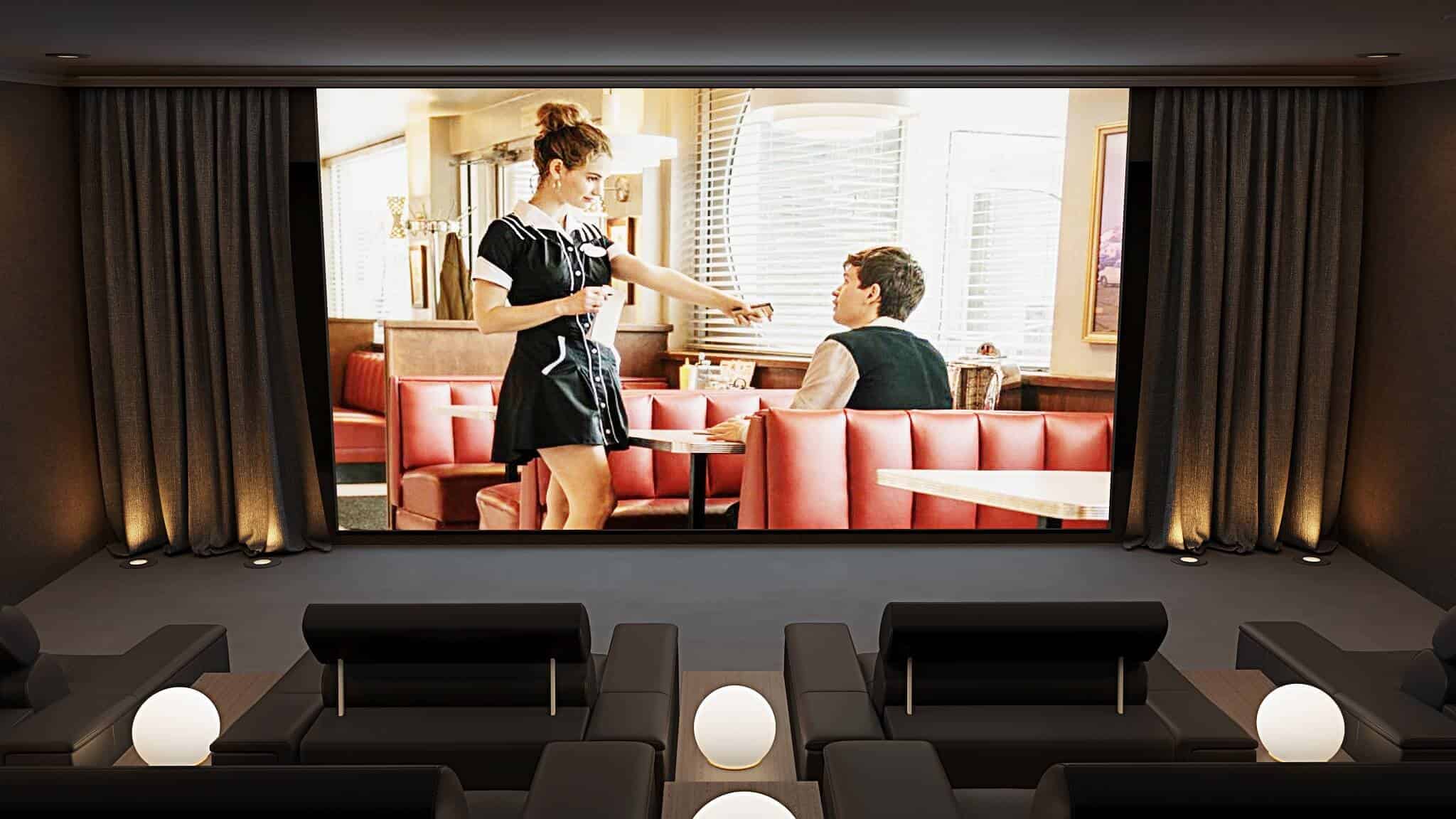
Hiding the Technology in a Media Room
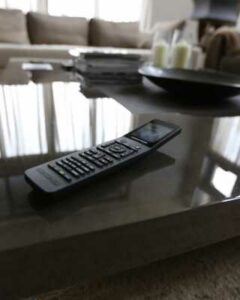
The defining skill in a media room is concealment. In a Belgravia living room cinema, the 75-inch TV is the only visible piece of equipment: the 5.1 surround system, including the subwoofer, is Sonance in-ceiling speakers plastered into the ceiling, and every source — Sky HD, Apple TV, Blu-ray and the AV receiver — sits in the property’s AV hub in the basement, distributed through the Crestron Digital Media system. Only the TV, a remote and a wall input plate remain in the room.
The Kensington room takes a different route to the same result. Every Artcoustic speaker is colour-matched to its surrounding surface, the subwoofer is integrated into a bookcase behind acoustic cloth, and custom Artcoustic absorber panels printed with bespoke artwork deal with the rear-wall reflection that would otherwise compromise surround imaging. When the system is off it is a reception room; when it is on it delivers Dolby Atmos from a full 5.2.1 speaker package. That is the standard a good media room should be judged by.
Seating and Sightlines
In a dedicated cinema, seating is designed outward from the screen: rows offset so no one sits directly behind anyone else, electric recliners for comfort over a two-hour film, positioned for acoustic symmetry as much as sightline. In a media room, seating is designed for the room’s everyday life first — a sofa arrangement that works for conversation, reading and entertaining — with the screen and speakers fitted around it rather than the reverse. Some compromise on the “perfect” cinema seat is the price of a room that works the rest of the time.
Lighting Control in Each Room Type
A dedicated cinema needs relatively few lighting scenes, but they need to be precise: near-total blackout for the film itself, a low bias-lighting scene behind the screen to ease eye strain, a brighter interval scene, and full lighting for cleanup. A media room needs considerably more scene complexity, because the same lighting system is doing several jobs across the day — entertaining, dining, reading, background ambience — on top of the cinema scene. This is where a properly programmed Lutron or Crestron lighting system earns its keep: one keypad press should be enough to shift the whole room from “family space” to “cinema” and back again.
In a media room the lighting also has to live alongside daylight. The attic cinema above is lit by retro squirrel-cage bulbs and daylight from double-aspect windows and a glass ceiling during the day, so the film scene has to close the blinds as well as dim the lights. Our home cinema lighting design guide covers the fittings, circuits and scenes in more depth.
Which Spaces in Your Home Actually Suit Each Approach
Basements, converted garages and unused lofts are natural homes for a dedicated cinema — they’re already separated from daily living space, so isolation and blackout come more easily. Open-plan living areas, family rooms and snugs suit a media room approach, where the space needs to keep earning its place in the house every day, not just on film nights. The right answer usually comes down to how the household actually lives: how often the room will be used purely for film, whether it needs to double as a space for guests, games or everyday relaxation, and how much of the floor plan can reasonably be given over to a single-purpose room.
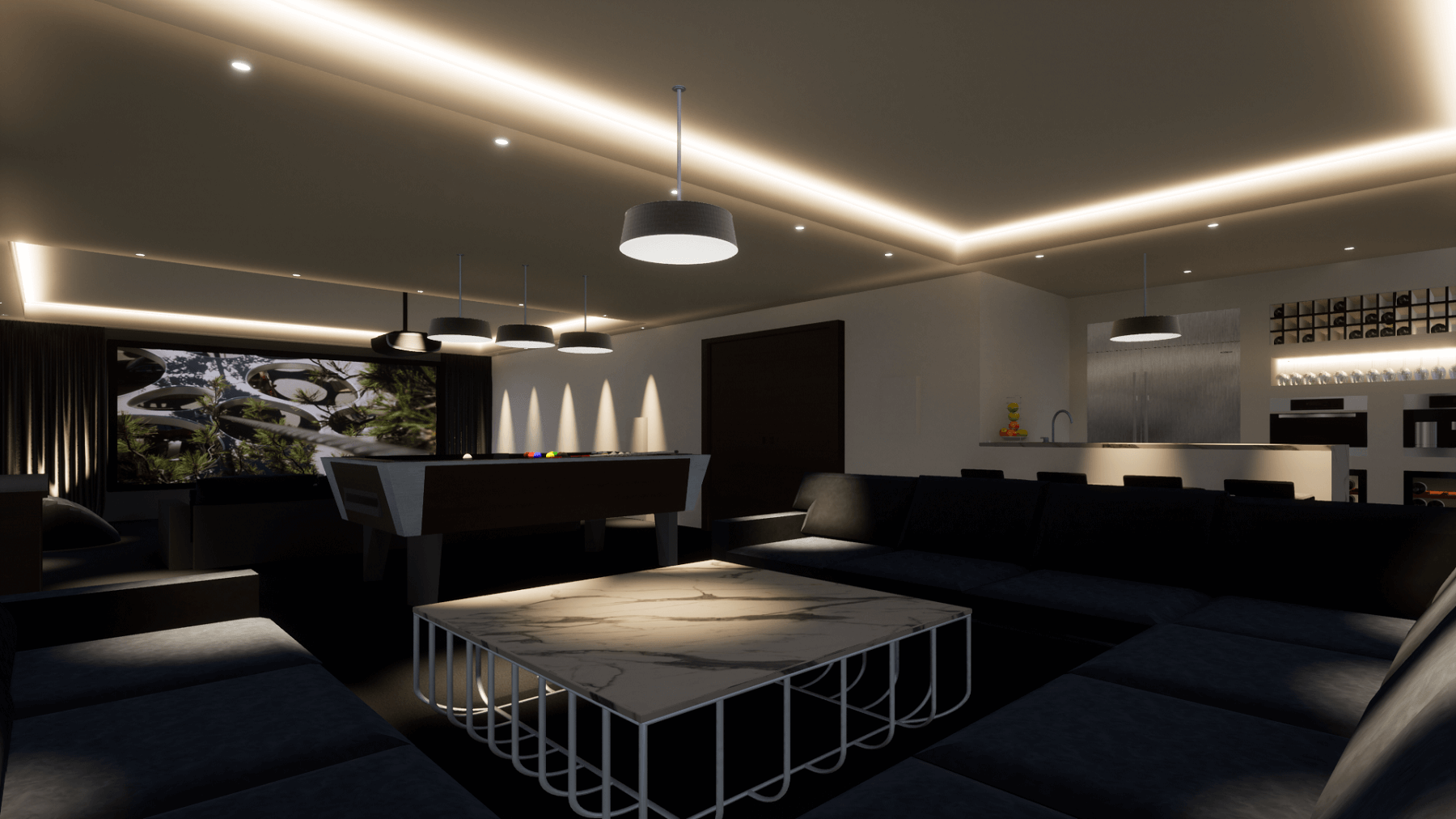
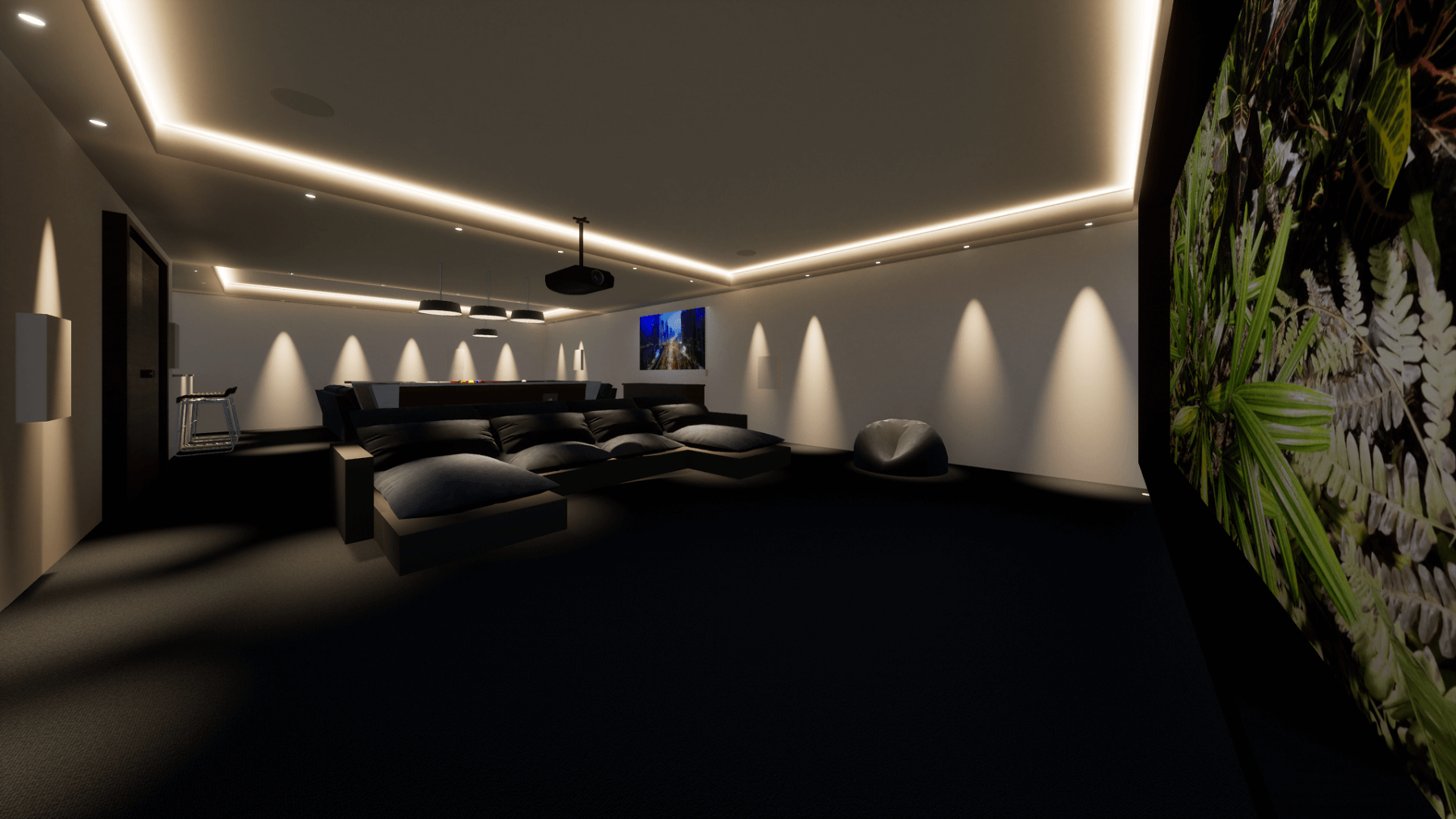
Open-Plan Entertainment Complex, Prestbury. Our reference project for combining a cinema with everyday living space. A 3.8m acoustically transparent screen and Artcoustic 5.2.2 speakers powered by a Trinnov system sit at one end of a single open-plan room, alongside a dedicated pool table zone with its own independent display and a lounge area seating nine. Crestron control and Lutron lighting scenes shift the whole space between a Saturday-afternoon sports and socialising room and a Sunday-evening cinema at the touch of a keypad. The same space includes a full kitchen with wine fridges and marble worktops, so cinema, games room, bar and entertaining space all sit in one room, controlled from a single system. One room, genuinely serving every occasion.
View the full Prestbury case study →
Can You Start with a Media Room and Upgrade Later?
To a point. Screens, projectors, seating and source equipment can all be upgraded incrementally without disturbing the rest of the room. Acoustic treatment and isolation are a different matter — both are far easier to build in from the start than to retrofit once walls, floors and ceilings are finished. If there’s any chance a media room might later become a more serious dedicated space, it’s worth discussing structural and acoustic first-fix requirements at the design stage, even if the full treatment isn’t installed straight away.
How Custom Controls Approaches the Decision
We don’t start any project by assuming a client wants a dedicated cinema or a media room — we start by understanding how the household actually lives, then design the room type that serves it best. Both approaches demand the same underlying expertise: acoustic design, calibrated audio and video, considered lighting, and control integration that hides the complexity behind a single button press. At Custom Controls, we’ve designed and installed both dedicated cinemas and open-plan media rooms since 1998. We hold five consecutive Crestron Integration Awards and are certified dealers for every major processor and control platform.
Frequently Asked Questions — Movie Rooms vs Dedicated Cinemas
What’s the real difference between a media room and a dedicated cinema?
A dedicated cinema is a single-purpose, isolated, fully treated room built around film and TV alone. A media room is a multi-purpose space — often a living room, snug or open-plan area — designed to deliver a strong cinema experience while continuing to serve everyday life.
Can a media room deliver genuinely cinema-quality sound?
Yes, within limits. Careful speaker placement, in-ceiling and in-wall speakers, and processor-based room correction can get a media room very close to a dedicated room’s performance. Full acoustic treatment and isolation, which only a dedicated room allows, is what closes the remaining gap.
Do I need a separate room, or can my living room work?
Many of our finest installations are living rooms and open-plan spaces rather than separate cinema rooms. The system is designed around the room’s other uses, with a retractable screen, concealed speakers and a lighting scene that transforms the space when needed.
Which spaces in a home suit a dedicated cinema best?
Basements, converted garages and unused lofts, because they’re already separated from the rest of the house — isolation and blackout are easier to achieve without disrupting other rooms.
Can I upgrade a media room into a full dedicated cinema later?
Screens, projectors, seating and electronics can be upgraded at any time. Acoustic treatment and isolation are much harder to add after the fact, so it’s worth planning for them at the design stage even if you start with a lighter specification.
How do I decide which approach is right for my home?
Consider how often the room will be used purely for film, whether it needs to double as a space for guests or everyday family life, and how much floor space you can reasonably dedicate to a single-purpose room. We work through this with every client during the design stage.