Kaleidescape Explained: Hardware, Movie Store and How to Choose Your System
A complete guide to the world’s only high-fidelity movie platform — from an installer who uses it on every serious cinema project
Published June 2026 · Updated June 2026 (Strato K) · Custom Controls · 25+ years installing home cinema systems
Most of the questions we receive about Kaleidescape fall into three categories: What is it exactly? Why does it sound and look better than streaming? And which hardware do I actually need? This guide answers all three. It is written by the team that specifies and installs Kaleidescape in home cinema rooms across London, Cheshire, Dubai and internationally — and who have watched clients audition it against streaming services more times than we can count. The reaction is always the same.
What Kaleidescape Actually Is
Kaleidescape is a movie platform built around a single premise: the studios create films at a quality level that no streaming service delivers to your home. Kaleidescape does. The company was founded in 2001 in Sunnyvale, California, and has spent over two decades building the only home entertainment system that the director community treats as the reference standard for home cinema playback. Martin Scorsese has been a Kaleidescape subscriber since 2007. Ben Affleck, Gary Rydstrom and a roster of mixing engineers and directors have given testimony to what it does that nothing else does. That is not marketing — it is a measure of how seriously the filmmaking community takes the quality gap.
The system works in two parts: a Strato movie player that connects to your display and audio system, and a Terra Prime movie server that stores your film library. Films are purchased or rented from the Kaleidescape movie store and downloaded to local storage. When you press play, the film plays back from your hard drive — not from the internet. There is no buffering, no degradation when the broadband is slow, and no compression applied to reduce file size for transmission. The file that plays is what the studio mastered from.
Why It Sounds and Looks Better Than Streaming — The Numbers
The quality gap between Kaleidescape and streaming is not marginal. It is structural.
Leading streaming services encode 4K video at an average of around 8 megabits per second. Kaleidescape’s standard 4K encode averages around 65 megabits per second — roughly eight times higher. The visual difference is most apparent in complex scenes: fast movement, fine texture, dark shadow detail. Streaming compression introduces softness, noise and banding that a high-quality projector on a large screen makes impossible to ignore. Kaleidescape eliminates these artefacts entirely, and with the arrival of Strato K and its 4K Cinematic format (below), the gap has widened further still.
The audio difference is equally significant. Streaming Dolby Atmos is lossy — encoded at a fraction of the bitrate of lossless Dolby Atmos on a Blu-ray disc or Kaleidescape download. Channel separation is reduced, transient detail is lost, and the subtle atmospheric information that gives a film its emotional weight is compressed away. Kaleidescape delivers bit-for-bit lossless Dolby Atmos, Dolby TrueHD and DTS:X — exactly what the mixing engineers recorded, played back without alteration by your Trinnov or Anthem processor. In a cinema room calibrated to a standard where these differences are fully resolved — and they will be, if the system is any good — the gap is not subtle.
One additional point that matters particularly for clients with properties in remote areas, chalets with unreliable broadband or boats: Kaleidescape works without internet connectivity during playback. The film is already on the drive. The internet is only needed to download it.

Installation

Design

Calibration

Treatments

Seating
Strato K — The New Flagship, Native 8K and 4K Cinematic
Launched on 18 June 2026, the Strato K is Kaleidescape’s most significant hardware release in years, and it changes the answer to “which player should I specify” for any genuinely ambitious cinema room. It is the first movie player certified by the 8K Association, and it introduces a format exclusive to Kaleidescape: 4K Cinematic.
4K Cinematic uses the Strato K’s 8K processing power to deliver full 4:4:4 chroma sampling at much higher bitrates than standard 4K — average bitrates of around 110 Mbps, more than five times what a typical 4K streaming service delivers, and noticeably higher than Kaleidescape’s own previous-generation 4K encode. Standard 4K streaming (and most 4K Blu-ray) uses 4:2:0 chroma, where every block of four pixels shares one set of colour information. 4K Cinematic gives every single pixel its own colour data. The practical result is smoother colour gradients, cleaner detail in skin tones and skies, and a complete absence of the banding artefacts that even good 4K sources can show in difficult scenes.
Strato K also unlocks native 8K playback in SDR and HDR10 for clients with 8K-capable displays, and downscales automatically to 4K for everyone else — so there is no penalty for specifying it ahead of an eventual display upgrade. It supports Dolby Vision for 4K Cinematic content and HDR10 for native 8K, with the full-time 4K60 onscreen interface Kaleidescape is known for. Audio remains fully lossless across Dolby Atmos, Dolby TrueHD, DTS:X and DTS-HD Master Audio, exactly as on every other current Strato player.
Strato K can run as a standalone player — its internal 1TB solid-state drive holds a handful of 8K, 4K Cinematic or standard 4K titles — or it can be grouped with one or more Terra Prime servers for full whole-home library access, exactly like the rest of the Strato range. For clients building a new cinema room from scratch in 2026, or upgrading an existing high-end installation, Strato K is now our default recommendation ahead of the Strato V wherever the rest of the system — projector, processor, screen — is capable of showing the difference.
The Hardware — Strato Players and Terra Prime Servers Explained
Kaleidescape’s current product range is more accessible than it has ever been. Here is every option and what it is for.
Strato K — The New Flagship, 8K and 4K Cinematic
As explained above: the first 8K Association-certified movie player, with the exclusive 4K Cinematic format at up to 110 Mbps and native 8K playback in SDR and HDR10. The correct specification for the most demanding new cinema rooms in 2026.
Strato V — The Established 4K Flagship
The Strato V remains an excellent player and our standard recommendation where 4K Cinematic and 8K are not required. It delivers 4K Dolby Vision playback with lossless audio decode alongside electronics and grounding topology specifically engineered for audiophile-grade audio performance. Player-side decode for high-bitrate audio codecs provides flexibility to maximise sound quality with any downstream processor or amplifier. It holds approximately ten 4K movies on internal solid-state storage, or connects to Terra Prime servers for a full library. Awards: CE Pro Brand Leader for Media Servers 2026 and Luxury Lifestyle Awards Winner 2026.
Strato E — Entry-Level 4K
The most accessible route into full 4K Kaleidescape quality. The Strato E delivers the same lossless audio formats as the Strato V — Dolby Atmos, Dolby TrueHD, DTS:X, DTS-HD Master Audio — and reference 4K video with Dolby Vision and HDR10. Internal storage holds approximately six 4K movies. The Strato E comes in a compact form factor, the same dimensions as the Mini Terra Prime (16.3cm square, 3cm high) — making rack mounting or behind-TV placement exceptionally clean. Downloads are available in minutes over Gigabit Ethernet. For cinema rooms with a strong system that does not require 8K or the audiophile electronics of the flagship players, the Strato E delivers everything that matters.
Strato M — Lossless 2K
The entry point to the Kaleidescape experience. The Strato M delivers lossless audio with Blu-ray quality 2K video — well suited to smaller displays, living room cinema systems or second properties. It includes full Kaleidescape movie store access, the cover art interface and native Crestron integration. For cinema rooms where the display is a television rather than a large-screen projector, the Strato M is the honest recommendation: the difference between 2K and 4K Kaleidescape on a 65″ television is small; the difference between lossless and lossy audio on any good audio system is not.
Terra Prime — Movie Servers for a Full Library
Terra Prime servers store the Kaleidescape film library and serve it to Strato players throughout the home. When a Strato player is grouped with a Terra server, its internal storage is disabled in favour of the server’s larger capacity, and the full Kaleidescape interface is enabled — the iconic cover shuffle view, the list navigation, parental controls and the full catalogue experience.
Terra Prime is available in several configurations. The Mini Terra Prime — the newest addition to the range — is the same compact size as a Strato E, holds 8TB of solid-state storage (approximately 125 4K movies), downloads a 4K film in as little as four minutes over 2.5 Gb Ethernet, and supports up to 25 simultaneous playbacks. It can be placed on a shelf, tucked behind a television or rack-mounted. The larger Compact Terra Prime and full-size Terra Prime offer greater capacity in HDD and SSD variants for larger installations. Up to four Terra servers can be grouped in a single system.
The Ultimate 4K System
For clients who want a complete, pre-loaded film library from day one, Kaleidescape offers the Ultimate 4K System: every available 4K film pre-loaded onto two Terra Prime 120TB servers alongside a Strato player. It is the most complete expression of the Kaleidescape concept — an entire cinematic library, ready to play on delivery, in the highest quality available.
Co-Star — Pairing Strato K and Strato V for Even Higher Performance
Co-Star is Kaleidescape’s pairing feature for clients who want to extract the absolute maximum from a Strato K or Strato V installation. Co-Star pairing combines two players acting in concert — one handling video processing, the other dedicated to audio decode and output — splitting the workload to reduce electrical noise and interference between the video and audio signal paths within a single chassis.
Co-Star pairing is supported on Strato K and Strato V, but only when those players are grouped with a Terra or Terra Prime server — a standalone Strato K or Strato V cannot Co-Star pair on its own. It is also worth knowing as an installer-level detail: if Co-Star pairing is implemented using a Kaleidescape Co-Star switch or a Crestron NVX, video output is limited to 4K, since neither of those devices currently supports the Fixed Rate Link bandwidth that native 8K video requires. For clients chasing the very last increment of performance from a reference-level two-channel or multichannel system, Co-Star is worth discussing with us directly — it is not something we specify by default, but it is the right answer for a specific class of demanding project.
The Kaleidescape Movie Store — What You Get and How It Works
The movie store is what makes Kaleidescape different from a Blu-ray player. It is a download store for films, TV series and concerts at full lossless quality — and it is the only commercial movie store in the world that sells at this quality level, now spanning 2K, 4K, 4K Cinematic and native 8K.
Films are available to purchase or rent. Purchases are permanent — tied to your Kaleidescape account, not to any individual hardware unit — and can be downloaded to up to five Kaleidescape systems registered to the same account. This means your film library follows you across multiple homes: your London property, your Cheshire house and your Alps chalet can all share the same purchased film collection. Purchased films can also be deleted from one system and re-downloaded at any time, making storage management straightforward even on a system with limited server capacity.
New releases appear on the Kaleidescape store day-and-date with physical Blu-ray in many cases. An early release and premium rental programme means selected titles are available to rent on Kaleidescape while still showing in cinemas — the same premium video-on-demand window that cinema chains have vigorously resisted but that Kaleidescape has navigated by positioning its quality level above what any conventional streaming service offers.
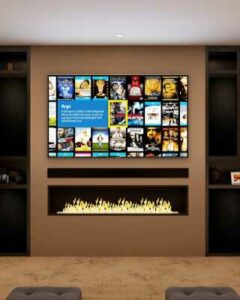
The store’s interface — the cover art grid view with its characteristic shuffle mechanism that groups related films by director, actor and genre — is one of the most pleasurable ways to navigate a large film collection that exists in the home entertainment category. A new AI-powered recommendation feature, kAI, adds personalised film discovery based on your viewing history and collection.
The store includes concerts and TV series alongside films, with the same lossless quality commitment throughout. For clients who have built a music library on Kaleidescape over the years, concert recordings at this quality level are revelatory.
Kaleidescape, Crestron and Lutron — The Fully Integrated Cinema Experience
Kaleidescape’s integration with Crestron and Lutron is where the platform genuinely pulls away from any alternative source — and where the investment in a properly integrated cinema room pays off in a way that no amount of hardware upgrading can replicate on its own.
Complete film control from Crestron. The entire Kaleidescape interface — browsing the library by cover art, selecting a film, navigating chapters, jumping to a favourite scene — is accessible directly from the Crestron touchpanel or app. There is no separate remote, no secondary interface to manage, no switching between control systems. The film library sits within the main cinema room control page alongside lighting scenes, source selection, blinds and temperature. One button, one interface, total control.
Playback state drives the entire room. Kaleidescape communicates its precise playback state — playing, paused, stopped, and end credits rolling — to Crestron continuously. Crestron processes these states and triggers corresponding Lutron events in real time. The practical result: press play on Kaleidescape and Lutron automatically transitions the room to its cinema scene — dimming every lighting circuit to the programmed viewing level, activating step lighting, dropping motorised blackout blinds. Pause the film and Lutron lifts the lights to a comfortable interval level. When the end credits begin, Lutron returns the room to its post-cinema scene without anyone touching a keypad. The room responds to the film; the occupants simply watch it.
This precise integration is formalised in an official Kaleidescape-published integration guide for Lutron RadioRA 3 and Homeworks QSX systems, which we follow as certified installers of both platforms — phantom keypads mapped to each Kaleidescape playback event, configured so that the lighting response is instantaneous and consistent on every installation we deliver.
Aspect ratio automation. Kaleidescape provides the aspect ratio of each individual film in its metadata. Crestron reads this and adjusts the screen mask automatically for every title — a 2.39:1 widescreen epic gets a different mask position than a 1.85:1 theatrical film. The client never needs to know what aspect ratio a film is in, or touch a control to adjust the mask. It simply happens.
Intermission and end credit markers. Kaleidescape annotates every film in its library with intermission cues and the precise frame where the end credits begin. These markers feed into Crestron and trigger scenes at exactly the right moment — an intermission lighting and temperature scene at the natural break in a long film, a post-credits scene activation at the correct point. No streaming service provides this data. No conventional Blu-ray player exposes it. It is exclusive to Kaleidescape, and it is one of the reasons that a properly integrated Kaleidescape installation feels qualitatively different from a system that simply plays films.
For a full explanation of how cinema room control systems work — and how Crestron, Lutron and Kaleidescape fit together in a complete installation — read our dedicated guide: Home Cinema Control Systems — How Crestron, Lutron and Kaleidescape Work Together →
Which System Should You Specify?
The right Kaleidescape system depends on your cinema room, your library ambitions and your other properties.
For a single high-performance cinema room with a Trinnov processor, a large screen and ambitions for the very best the format can deliver, the Strato K paired with a Mini Terra Prime or Compact Terra Prime is the right configuration in 2026. The 4K Cinematic format and native 8K capability ensure the system is specified for the format’s future as well as its present; the Terra server provides a library of sufficient depth to make the cover art interface genuinely enjoyable rather than nominal. Where 8K and 4K Cinematic are not a priority, the Strato V remains an excellent and slightly more economical flagship choice.
For a media room or living room cinema with a television and a competent surround sound system, the Strato E standalone is the honest recommendation. The same lossless audio advantage over streaming applies in full; the 4K picture quality on a television at normal viewing distances is indistinguishable from the flagship players. The cost difference is better spent on the audio system.
For whole-home multi-zone cinema with multiple rooms requiring independent film access, a Terra Prime server (Compact or full-size) with multiple Strato players is the correct architecture. The Terra server handles all playback requests simultaneously — up to 25 on a Mini Terra Prime — and all players access the same library.
For clients with multiple properties, the library portability of Kaleidescape is one of its most underappreciated advantages. A film purchased once downloads to the London house, the Cheshire estate and the Alps chalet. The cumulative value of a large Kaleidescape library across multiple high-quality cinema rooms, all sharing the same purchased content, is substantial.
Kaleidescape in Our Installations
We specify Kaleidescape on every cinema installation where the audio and video system is capable of revealing the quality it delivers — which, in our portfolio, is essentially every installation above the living room cinema tier. The Dubai 8-seat cinema, the Ghana 34.7.15 Trinnov installation, the Cotswolds outdoor C Seed 201″ cinema and multiple installations within the Dubai whole-estate Crestron system all use Kaleidescape. In the Cotswolds installation — where the display is a 5.11m C Seed and the audio system is a Trinnov Altitude 16 with Origin Acoustics speakers — there was only one meaningful answer to the question of source material.
If you are specifying a cinema room and would like advice on the right Kaleidescape configuration for your system, contact Custom Controls. We are authorised dealers and can supply and install the full Kaleidescape range, including the new Strato K.
Frequently Asked Questions — Kaleidescape
What is the difference between Strato K and Strato V?
Strato K is Kaleidescape’s newest flagship, launched June 2026, adding native 8K playback and an exclusive 4K Cinematic format with full 4:4:4 chroma at bitrates up to around 110 Mbps. Strato V remains an excellent 4K player with audiophile-grade electronics, but does not support 8K or 4K Cinematic. For new cinema rooms in 2026, Strato K is our default recommendation.
Does Kaleidescape need an internet connection to play films?
No, not during playback. Films are downloaded to local storage in advance, so an internet connection is only needed to download or rent content. This makes Kaleidescape particularly well suited to remote properties, chalets and boats with unreliable broadband.
What is Co-Star pairing?
Co-Star pairs two Strato K or Strato V players together — one for video processing, one dedicated to audio — to reduce electrical interference between the two signal paths. It is only available when both players are grouped with a Terra or Terra Prime server, and is reserved for the most demanding reference-level systems.
Can a Kaleidescape film library be shared across multiple properties?
Yes. Purchased films are tied to your Kaleidescape account, not individual hardware, and can be downloaded to up to five registered systems — meaning a single purchase can be enjoyed across a London home, a country estate and an Alpine chalet.
Kaleidescape Dealer Page → · Home Cinema Installation → · Trinnov Home Cinema → · Cinema Control Systems → · Movie Aspect Ratios Explained → · Contact Us →