Home Cinema & Theatre Room Renovation: The Complete Upgrade Guide
Cinema Room Upgrades: One Component to Full Refit
Published June 2026 · Custom Controls · 25+ years designing and installing home cinema rooms
One of the most common enquiries we receive is from clients who already have a home cinema — installed five, eight or ten years ago — and want to know what can be done to improve it. The answer is almost always: more than you think, for less than you expect. The cabling infrastructure that an existing cinema room already contains is the foundation for every upgrade. The room itself — the acoustic mass, the fabric walls, the tiered seating platform — has real value that can be built on rather than replaced. And the technology available today is genuinely, substantially better than what was available a decade ago. This guide covers every category of home cinema renovation in depth, from a simple electronics swap to a complete room transformation.
For inspiration on what cinema rooms can look like at their best, our Top 40 Home Cinema Ideas is the place to start — 40 real rooms from our portfolio spanning every size, budget and style.
1. Projection Upgrades — 4K Laser and the Case for a Bigger Screen
The projector is typically the component in an existing cinema room where the technology gap is largest and the upgrade benefit is greatest. Projectors installed five or more years ago are almost certainly 1080p HD models using lamp-based light sources. The difference between a good 2015-era projector and a current Sony or JVC 4K laser projector is not incremental — it is transformative.
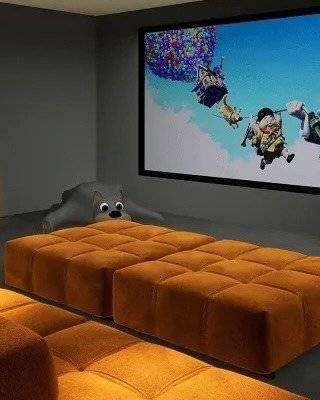
4K resolution and the bigger screen argument. The move from 1080p to native 4K delivers more than just sharpness. At 1080p, the recommended seating-to-screen ratio requires clients to sit further back to avoid seeing individual pixels — which means a ceiling on how wide the screen can realistically be before it stops looking clean. 4K removes that ceiling. Clients who previously had a 2.5m screen because sitting closer revealed the pixel grid can move to a 3.5m or 4m screen with the new projector and sit at the same viewing distance. The larger screen genuinely changes the cinematic experience — it fills more of the visual field, which is what immersion actually requires. We see this upgrade trigger a profound change in how clients use their cinema rooms: from occasional evening use to daily family use.
Laser projectors — consistent brightness, no lamp replacement, faster start. Lamp-based projectors dim progressively over their lamp life. A projector that was calibrated to a specific brightness level at installation is often running at 40–50% of that brightness three years later, with clients rarely noticing the gradual decline. Laser light sources maintain their brightness across their rated lifetime — typically 20,000 hours — which means the projector performs at day-one quality for its entire operational life. Practically, at four hours of daily use, 20,000 hours represents over thirteen years without a light source change. Laser projectors also reach full brightness within seconds of switch-on, compared to the two-to-four minute warm-up period that lamp projectors require. For clients whose cinema room has gradually become frustrating to use — the long wait, the dimming image — laser is the single most impactful upgrade available.
HDR and Dolby Vision. Current 4K projectors support High Dynamic Range including Dolby Vision — the same HDR format supported by Kaleidescape and the highest tier of streaming content. HDR delivers a wider range of brightness within the image: deeper blacks and brighter highlights simultaneously, within a single frame. This is visible as an increase in apparent depth and realism — not a sharper image, but a more three-dimensional one.
Our case studies that demonstrate the impact of current laser projection: the Ascot Trinnov cinema with Sony VPL-VW5000 4K laser, the Knutsford Cheshire cinema with Sony VW7000 and the Cheshire home entertainment complex.
2. Projector Screen Upgrades — Acoustically Transparent, Wider Format and Masking
The projector screen is frequently overlooked in cinema upgrade conversations and frequently makes a larger difference than expected.
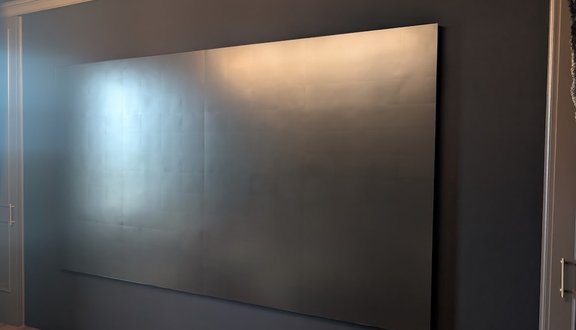
Moving to an acoustically transparent screen. Many older cinema rooms have a conventional projector screen with the centre speaker visible below it or mounted on the wall beside it. This means the audio and video are spatially misaligned — dialogue appears to come from below or beside the image rather than from the image itself. An acoustically transparent screen, positioned with the left, centre and right speakers directly behind it, corrects this misalignment completely. The front channel audio and the image share the same spatial reference. For clients who already have Artcoustic or similar speakers in their room, moving to an acoustically transparent screen is a relatively contained upgrade that meaningfully improves immersion. Screen Excellence produces the acoustically transparent screens we specify on the majority of our high-performance cinema installations.
Upgrading to a widescreen (2.35:1) format. Standard HD projector screens are 16:9 — the same format as a television. Films are shot in a variety of aspect ratios, most commonly 1.85:1 or 2.35:1 (widescreen). Showing a 2.35:1 film on a 16:9 screen means black bars fill approximately a quarter of the screen height. Upgrading to a widescreen 2.35:1 fixed-frame screen, sized to fill the full width of the front wall, allows those same films to fill the entire screen — a meaningfully different visual experience. The Sony and JVC 4K laser projectors we specify can scale 16:9 content to fill the wider screen, meaning television and streaming sources still fill the frame.
Automatic screen masking. The most elegant solution for clients who want both formats available is a motorised screen with automatic masking — variable-width panels that adjust to match the aspect ratio of each individual film. Our Crestron integration with Kaleidescape provides the aspect ratio of each film from the movie server metadata, driving the mask automatically. This is one of the details that distinguishes a properly finished cinema from an assembled one.

Home Cinema

Cinema Design

Calibration

Acoustics

Seating
3. Audio Upgrades — Electronics, Speakers and Room Correction
Audio upgrades divide into three categories that can be applied independently or together: electronics upgrades, speaker additions and replacements, and room correction.
Electronics — supporting modern audio formats. Older AVRs and processors do not decode Dolby Atmos or DTS:X. Many older cinema rooms have perfectly capable speakers but a processor that cannot deliver spatial audio to them. Replacing the processor while retaining the existing speaker array is often the most cost-effective first step — the existing speakers can handle Atmos height information once the processor is capable of providing it. The current Anthem MRX range handles Dolby Atmos and DTS:X across a range of channel counts and includes Anthem Room Correction (ARC Genesis) — a significant calibration improvement over older auto-calibration systems. For the most demanding installations, upgrading to a Trinnov Altitude processor delivers the reference standard in room correction and format decoding.
Adding height channels for Dolby Atmos. Many older cinema rooms were installed before Dolby Atmos was the standard. They have excellent front and surround speaker arrays but no height channels. Adding in-ceiling Artcoustic height speakers — connecting to the new processor via existing or newly installed cable runs — delivers the full three-dimensional audio envelope that modern film soundtracks are mixed for. The change is dramatic: films mixed in Atmos have ambient sounds, aircraft overheads and raindrops positioned with genuine height, which conventional surround systems collapse into a flat two-dimensional plane. This is one of the most cost-effective upgrades available to a room with good existing speaker infrastructure.
Adding front wide channels. Front wide channels — positioned between the front left/right and the side surround speakers — fill the transition zone that a standard 5.1 or 7.1 system leaves as a gap. Modern Dolby Atmos mixes increasingly use this zone for specific audio objects. Adding a pair of front wide channels to an existing room with good front and surround coverage improves the coherence of the soundfield across the full arc of the front hemisphere.
Replacing the full speaker system. For rooms where the existing speakers are genuinely outdated — or where clients want to step up to an Artcoustic performance level — a full speaker replacement is often more straightforward in an existing room than in a new build, because the void behind the screen and the fabric wall system are already in place. New speakers slot into the existing infrastructure. The calibration process on a high-quality processor like the Trinnov Altitude ensures the new speakers are perfectly integrated with the room acoustics.
Trinnov Optimizer and Lyngdorf Room Perfect. Two room correction systems stand apart from conventional AVR auto-calibration and deserve specific mention in the context of renovation upgrades. The Trinnov Optimizer uses a 3D measurement microphone to map the precise position, height and orientation of every speaker in the room, then applies time-aligned, frequency-corrected output to each channel. The result is that the room’s acoustic imperfections — boundary reflections, bass modes, frequency imbalances between seats — are systematically addressed. Lyngdorf’s Room Perfect technology takes a similar approach, measuring the room at multiple positions to build a correction model that works across the full seating area rather than optimising for a single sweet spot. Either system, applied to an existing room with decent existing speakers, delivers results that frequently exceed what clients expected when the room was first installed.
See the room correction difference in our Surrey cinema — Anthem ARC room correction on an Anthem MRX-720, applied to an Artcoustic 7.2.2 system in an acoustically managed room — and the Ghana 34.7.15 Trinnov installation for the reference standard in multi-seat consistency.
4. Source Upgrades — 4K Streaming, Kaleidescape and Modern Media
Source upgrades are the most accessible and often the most immediately impactful renovation category. The projector and speakers may be excellent; if the source is a ten-year-old Sky HD box and an aging Apple TV, the system is not delivering what it is capable of.
Kaleidescape — the reference source. Kaleidescape is the single most impactful source upgrade available to any cinema room with a 4K projector and a capable audio system. It stores and plays back films at full uncompressed quality — average video bitrates of 65 megabits per second, compared to approximately 8 Mbps for 4K streaming — with bit-for-bit lossless Dolby Atmos audio. For clients who have invested in a Trinnov or Anthem system and a quality projector, Kaleidescape is the source that finally allows the system to perform at the level it was designed for. It is available as a standalone Strato player or as a Strato player paired with a Terra Prime server for a full film library. Read our complete guide: Kaleidescape Explained — Hardware, Movie Store and How to Choose.
4K streaming and Apple TV 4K. For clients not ready for Kaleidescape, adding a current-generation Apple TV 4K brings Dolby Vision, HDR10 and Dolby Atmos from all major streaming services. It also supports AirPlay for music and video from iOS devices. A current Apple TV 4K is a meaningful upgrade over any streaming device installed before 2022.
Sky Glass and satellite TV. Current Sky Q and Sky Glass receivers deliver 4K HDR on an expanding range of content. For clients with older Sky HD boxes, upgrading to Sky Q at minimum provides HDR and improved picture quality on supported channels, as well as a more capable search and discovery interface.
HDMI infrastructure. One frequently overlooked source-upgrade blocker is the HDMI cabling infrastructure. Older installations often use HDMI 1.4 cables, which are limited to 1080p. A 4K HDR source routed through a 1.4 cable either fails to display or falls back to HD quality. As part of any source or projector upgrade, we check the existing HDMI cable runs and upgrade to Premium High Speed or Ultra High Speed HDMI where the 4K signal path requires it.
5. Room Acoustic Upgrades — Fabric Walls and Artnovion Acoustic Treatment
The acoustic environment of the room is the largest single variable in audio performance. This is as true for renovation projects as for new builds — and acoustic renovation is more achievable than most clients realise.
Replacing or refreshing the fabric wall system. Fabric walls in a cinema room serve three simultaneous functions: they conceal speakers and acoustic treatment, they absorb and diffuse sound, and they define the room’s aesthetic entirely. A fabric wall system that was installed a decade ago with a particular colour and texture choice can be completely transformed by replacing the fabric alone — keeping the existing track and structural system, stripping the old fabric and installing a new choice. This single change alters the entire atmosphere of the room for a fraction of the cost of a full renovation. The stretched-fabric track systems we use allow any fabric choice — velvet, leather, linen, acoustic mesh — to be installed to the same high standard regardless of room architecture. Fabric replacement gives a cinema room that has served a client well for ten years an entirely new character for a modest investment.
Adding in-room acoustic treatment panels. For cinema rooms without a full fabric wall system — or for existing rooms where the acoustic performance is audibly suffering from flutter echo, excessive reverberation or uneven bass response — acoustic treatment panels can be added to the room without structural work. Artnovion produces a range of high-performance acoustic panels that combine genuine acoustic function with considered aesthetic design — diffusers, absorbers and bass traps in geometric forms that contribute to a room rather than merely occupying it. Strategic placement of Artnovion panels at the first reflection points (the side walls at the listening position, the rear wall and the ceiling) addresses the most common acoustic problems in an existing room. In rooms where a full fabric wall system is not practical, Artnovion panels are the professional alternative.
Read more in our dedicated article on home cinema acoustic treatments and fabric walls.
6. Lighting Upgrades — Recessed LED, Star Effect Ceilings and Lutron Control
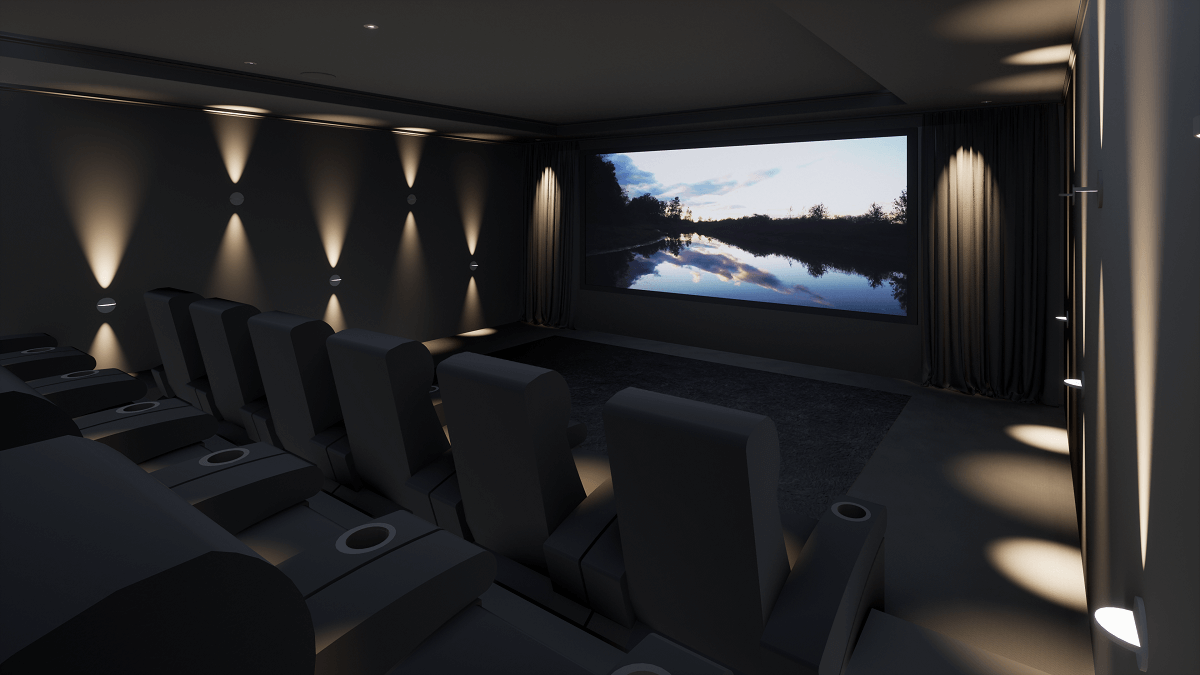
Lighting in a cinema room is not decorative — it is functional. The right lighting design allows clients to enter and navigate the room safely, creates the theatrical atmosphere before a film begins, and dims to the exact level that maximises the projector’s perceived contrast during viewing. Many existing cinema rooms have lighting that was installed as an afterthought or has never been properly programmed. A lighting upgrade is one of the most visible and immediately impactful renovations available.
Recessed LED downlighting. Recessed LED downlights above each seating position — narrow-beam, aimed precisely at the seats — create pools of light that allow the occupants to settle in, handle refreshments and read without casting light onto the screen. Dimmable LED downlights from a professional range (not domestic retail LED fittings, which do not dim smoothly at low levels) provide a warm glow at 1% that adds atmosphere without adding distraction. Switching to LED also ensures consistent colour temperature at all dim levels — one of the common failures of older halogen dimming systems in cinema rooms.
LED strip cove lighting. LED strip installed in ceiling coves, along stair risers and at the perimeter of the room provides the indirect ambient light that sets the pre-film atmosphere and allows navigation at minimal brightness. RGB-capable LED strip allows colour temperature and hue to be adjusted for different moods — a warm amber for relaxed evening viewing, a cooler tone for gaming or daytime use.
Fibre optic star effect ceilings. A star effect ceiling is one of the most requested lighting elements in a cinema room renovation. A fibre optic system — where hundreds or thousands of individual optical fibres terminate flush with a fabric ceiling and are backlit by a single light engine — creates a night sky effect that can stay on throughout a film without adding measurable light to the screen. Fiber Optics Technologies produce the star ceiling systems we specify. Fibre count, colour temperature and twinkling speed can all be specified to create anything from a subtle ambient background to a fully dramatic night sky. The light engine is positioned in the ceiling void; the only visible element is the fibres themselves, flush with the fabric surface. Adding a star effect ceiling to an existing room requires access above the ceiling — straightforward in rooms with a suspended acoustic ceiling, achievable but more involved in plastered ceiling rooms.
Lutron lighting control. A Lutron single-room lighting system is the ideal control layer for a cinema room renovation. Lutron’s RadioRA 3 system replaces existing light switches with wireless keypads — no rewiring required — and provides scene recall from keypads, remote control or the Lutron app. The cinema scene, the interval scene, the entry scene and the cleaning scene are all programmable and recallable from a single button press. For clients with Kaleidescape, the playback state integration means the room transitions automatically: play a film and the cinema lighting scene activates without the client touching a keypad.
See lighting design in practice in our dedicated cinema lighting article and case studies including the Cheshire cinema room with its multi-zone LED design and the Dubai family cinema with individually lit seating positions.
7. Seating Upgrades — Motorised Recliners and Bespoke Configurations
Cinema seating is the element clients interact with physically for the entire duration of every film. Older seating — whether a domestic sofa, basic fixed recliners or a first-generation motorised system — often represents the largest gap between the current room experience and what it could be. Seating upgrades require no electrical infrastructure changes and in most cases no structural work.
Cineak motorised seating. The Cineak range — Fortuny, Vedette, Intimo and Strato — provides a fully bespoke motorised seating solution that can be configured for any room layout. Every element is specified: fabric or leather, colour, armrest and base finish, cup holder design. Motorised backrests, footrests and headrests allow each occupant to find their personal position. Presets return all seats to their resting position when the room shuts down — ensuring the room always looks its best when entered. The Cineak range also allows practical accessories such as Onyx stone tables between seats — backlit to provide just enough ambient light to navigate the room during a film without raising the ambient level.
Tactile transducers. For clients who want to add physical immersion to an existing seating arrangement, tactile transducers — mounted under the seat bases and driven from the subwoofer channel of the amplifier — transmit bass energy as physical vibration through the seats. Explosions, engine sounds and low-frequency film score elements are felt as well as heard. They can be added to both sofas and individual cinema chairs and connect to the existing audio system without additional processing.
Our home cinema seating page covers the full Cineak range and the options in depth.
8. Control System Upgrades — One Button, Total Control
Many older cinema rooms have functional equipment but poor control. Multiple remote controls, manual source switching, lighting keypads that are not coordinated with the AV system — the friction of using the room daily erodes how much it gets used. A control system upgrade is the renovation that has the largest impact on everyday use.
Crestron integration. A Crestron control system manages every element of the cinema from a single touchpanel or iPad: projector, processor, sources, lighting, blinds and screen mask. One button press starts the projector, selects the source, dims the lights and adjusts the screen mask. Another button press pauses the film, lifts the lights slightly and activates the interval scene. A third press shuts the room down completely — projector cooling, seats returning to rest position, lights coming up. For clients with Kaleidescape, the automation goes further: the room responds directly to playback state, aspect ratio metadata and intermission cues. Read our guide to home cinema control systems for a full explanation of how Crestron, Lutron and Kaleidescape work together.
Lutron single-room systems. For cinema rooms that do not require a full Crestron integration, a Lutron RadioRA 3 single-room system provides wireless lighting control and scene programming at a lower integration cost. Keypads can be configured for up to four scenes per room and can trigger via the Lutron app from anywhere. For clients who want reliable, beautiful lighting control without whole-home automation, Lutron RadioRA 3 is the right answer.
Voice control integration. Adding Amazon Alexa or Apple Siri integration to an existing Crestron or Lutron system allows voice commands — “dim the lights to cinema mode” or “pause the film” — from anywhere in the room. For clients who visit their cinema rooms with guests unfamiliar with the interface, voice control provides a universally accessible fallback.
9. Infrastructure and Cabling Upgrades
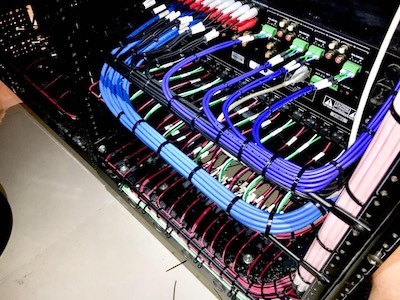
The cabling infrastructure in an existing cinema room is valuable — but may contain constraints that limit what the upgraded system can deliver. A renovation audit should always include an assessment of the existing cabling.
HDMI cable upgrades. As noted above, older HDMI cables frequently limit the system to 1080p. Upgrading the HDMI cable runs — or adding balun-based active HDMI extension systems for long runs — is a prerequisite for any 4K upgrade. We assess every existing run as part of our renovation survey.
Ethernet and network infrastructure. Streaming services, Kaleidescape, Crestron and Lutron all require reliable Ethernet connectivity. Many older cinema rooms have a single Ethernet drop or rely on WiFi. As part of a renovation we typically ensure the room has a wired Ethernet connection from the home network, with a local switch for the rack equipment — providing the bandwidth and reliability that streaming at reference quality demands.
Rack tidying and power conditioning. An equipment rack that has accumulated components across multiple system generations often becomes inefficient: cooling is compromised, cable management is poor, and power quality varies between components. A rack audit — removing obsolete equipment, reorganising for thermal management, adding a professional power conditioning unit — improves reliability and often has an audible effect on audio performance, since power conditioning reduces the interference that compromised mains supply introduces into the signal chain.
10. The Renovation Approach — What We Recommend
The right renovation sequence depends on where the existing system’s weakest point is. Our general recommendation for a cinema room installed more than five years ago:
If the projector is lamp-based and the image has dimmed: Start with the projector. A Sony or JVC 4K laser projector will transform the room immediately and durably. Pair with a new projector screen if the existing one is not acoustically transparent or is the wrong aspect ratio for the new projector.
If the processor does not support Dolby Atmos: Replace the processor first, add height channels to the existing speaker array, and calibrate with ARC Genesis or Trinnov Optimizer. This is the most cost-effective path to modern immersive audio in a room with a good existing speaker system.
If the room looks dated: Fabric replacement on the existing track system gives the room a completely new aesthetic without touching the structural elements. New lighting scenes via Lutron RadioRA 3 complete the transformation.
If the room is hard to use: A Crestron or Lutron control integration comes first. A room that is a pleasure to use gets used. A room that requires four remote controls does not.
If all of the above apply: A phased renovation programme — projector and screen first, processor and height channels second, control and lighting third, fabric and acoustic treatment fourth — allows the investment to be spread while the room improves at each stage.
Renovation Case Studies — Rooms That Show What’s Possible
The following projects from the Custom Controls portfolio illustrate the range of what a cinema room renovation can achieve:
Châtel, French Alps — A ski chalet basement space transformed into a dedicated cinema room with a 3.8m Screen Excellence ultrawide screen, Sony VW7000 laser projector, Artcoustic Dolby Atmos speaker package and Lutron lighting. A room that did not previously exist as a cinema, created from a blank basement shell — demonstrating what can be achieved when a renovation starts with good fundamentals and the right specification.
Berkshire Basement Cinema — A small 3.6m × 3.6m room that delivers a performance dramatically beyond its footprint. The tight volume actually works in the system’s favour — small rooms develop higher sound pressure levels more easily. A Sony laser projector, Artcoustic speaker package and full acoustic treatment in a compact space shows that a meaningful cinema upgrade does not require a large room.
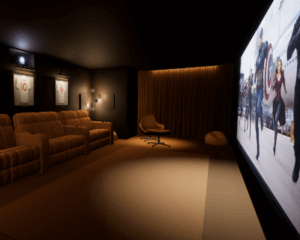
Modern Home Cinema — Cheshire — A 6m × 7m cinema room built as part of a new home entertainment complex featuring a comprehensive lighting design with individually controllable circuits, Cineak Fortuny motorised seating in dark grey leather, Krix speakers with Trinnov processing and full Crestron integration. The lighting design in particular — with curtain spotlights, row-specific circuits and colour-changeable LED strip — is a reference for what a properly considered cinema lighting upgrade looks like in practice.
Surrey Dedicated Cinema Room — A purpose-built 6m × 5.5m dedicated cinema room in Surrey with a 3.8m acoustically transparent Screen Excellence screen, Sony VPL-VW760ES 4K laser, Artcoustic 7.2.2 surround driven by an Anthem MRX-720 AVR with ARC room correction, eight electric recliners and Crestron control and lighting. This is our reference case study for what a mid-to-high budget cinema renovation delivers when every element — acoustic design, speaker placement, room correction and calibration — is executed properly.
Where to Start
A renovation begins with an honest audit of the existing room. Custom Controls offers a cinema room survey — assessing the projector, audio system, cabling infrastructure, lighting, control and acoustic environment — and produces a phased renovation recommendation based on budget and priority. There is no obligation and no predetermined specification; the recommendation is based on what the specific room needs to deliver its best performance.
If you have an existing cinema room and would like to understand what it could become, contact us. We work from London, Cheshire and the French Alps, travel internationally and have been doing this since 1998.
Frequently Asked Questions — Home Cinema Renovation
What’s the single best upgrade for an older cinema room?
It depends on the room’s weakest point, but if the projector is lamp-based and has dimmed over time, a 4K laser projector is usually the most transformative single upgrade — consistent brightness for its entire 20,000-hour lifespan, instant start-up and the ability to support a meaningfully bigger screen.
Can Dolby Atmos be added to an older cinema room without replacing the speakers?
Often, yes. If the existing front and surround speakers are good quality, replacing just the processor and adding in-ceiling height channels is usually the most cost-effective route to full Dolby Atmos performance.
Can a cinema room’s look be changed without structural work?
Yes. Replacing the fabric on an existing wall system — keeping the same track and structure — transforms the room’s entire character for a fraction of the cost of a full renovation, and acoustic treatment panels can be added to rooms without a full fabric wall system at all.
Do I need to upgrade my HDMI cables for a 4K projector?
Often, yes. Older HDMI cables, frequently HDMI 1.4, are limited to 1080p and will either fail to display 4K HDR content or fall back to HD quality. We check every existing cable run as part of any projector or source upgrade.
Home Cinema Installation → · Acoustic Design → · Trinnov Home Cinema → · Artcoustic Speakers → · Kaleidescape → · Cinema Lighting → · Top 40 Cinema Ideas → · Home Cinema Seating Guide → · Contact Us →