Home Cinema Room Size, Shape and Dimensions — The Complete Guide
THX volume tiers, golden ratios, room acoustics and why the right dimensions matter more than the equipment
Updated June 2026 · Custom Controls · 25+ years designing and acoustically modelling cinema rooms
The most common mistake in home cinema design is treating the room as a container for equipment. In reality, the room is as much a part of the audio system as the speakers or the amplifier. A poorly proportioned room creates bass modes that make certain frequencies unnaturally loud at some seats and almost inaudible at others. A square room is acoustically one of the worst shapes available. And a room that is too small for the chosen screen size, or too large for the chosen speaker system, will never perform well regardless of how good the equipment is. This guide covers everything you need to know about cinema room dimensions — the right sizes, the right shapes, the right proportions, and how to compensate when the available space is not ideal.
Our Home Cinema Services

Design

Calibration

Installation

Seating

Treatments
Room Volume — The THX Tiers Converted to Metric
THX — the audio certification company founded by George Lucas — defines four performance tiers for home cinema systems, each tied to a room volume and a corresponding viewing distance. These tiers represent decades of acoustic research into the relationship between room size, speaker output requirements and the listening experience. Converting them to metric gives a practical framework for specifying a cinema room in the UK.
THX Compact — up to 28m³, ~2.4m viewing distance. The smallest meaningful cinema room. A 28m³ volume equates to a room of approximately 3.5m × 4m × 2m — the size of a large bedroom. At this scale, a 5.1 speaker system is appropriate; the room volume is insufficient to benefit from a full surround array, and the viewing distance limits the practical screen width to approximately 2m. A well-specified system in this size room — with good acoustic treatment and professional calibration — delivers a genuine cinema experience. Do not underestimate what a small, well-designed room can achieve.
THX Select — up to 57m³, ~3m viewing distance. The entry point for a full 7.1.4 Dolby Atmos installation. A 57m³ volume equates to approximately 5m × 5.5m × 2.1m — a generous spare bedroom or a small basement room. At this scale, a 3m+ screen works well from the primary seating position, and a 7.2.4 Artcoustic speaker system has enough room to develop its full soundfield. This is the most common size range for the cinema rooms we install in London townhouses and Cheshire semi-detached properties.
THX Ultra — up to 85m³, ~3.6m viewing distance. The volume at which a cinema room begins to feel genuinely cinematic rather than impressive-for-a-home-room. An 85m³ volume equates to approximately 5.5m × 6.5m × 2.4m — a comfortable dedicated cinema room in a basement or an outbuilding. Screen widths of 3.5m–4m are appropriate at this scale, and a full 9.2.4 or larger Artcoustic system can deploy its full capability. This is the size range where a Trinnov Altitude 16 processor earns its specification — the room is large enough that the differences in bass management and multi-seat calibration accuracy become clearly audible.
THX Dominus — up to ~184m³, ~6m viewing distance. The upper tier — a cinema room scaled to approximate a commercial screening room. A 184m³ volume equates to approximately 7m × 11m × 2.4m. At this scale, two or three rows of seating are appropriate, screen widths of 4.5m–6m+ work correctly from the rear rows, and a full 13.2.14 IMAX Enhanced configuration is justified. Our Dubai IMAX installation — 7m × 11m × 4m ceiling — sits in this tier. The Ghana 34.7.15 installation at 5.5m × 12m is also in this tier.
The THX tiers are a useful starting point, but they are defined by volume alone — they say nothing about room shape, which has as large an effect on acoustic performance as room volume. This is where the real complexity begins.
Why Room Shape Matters — and Why Square Rooms Fail
Every enclosed room has natural resonant frequencies — frequencies at which sound waves travelling between parallel surfaces reinforce each other, creating a standing wave. At these frequencies, the room effectively becomes a second speaker: bass energy at that frequency accumulates at certain positions and cancels at others. The result is a frequency response that varies dramatically depending on where in the room you sit, with some bass frequencies dramatically over-represented and others almost absent.
The severity of these room modes depends on the room’s dimensions. The modal frequencies of a room are determined by a simple formula: the speed of sound (approximately 343 m/s) divided by twice the room dimension in each axis. A room that is 5m long has an axial mode at 34Hz. A room that is also 5m wide has the same mode at 34Hz — and in a square room, the modes from the length and width axes coincide and reinforce, making the problem twice as severe. Square rooms are therefore acoustically one of the worst shapes for bass reproduction: the coincident modes create bass imbalances that no amount of equalisation can fully address.
The goal in cinema room dimension planning is to choose dimensions whose modal frequencies are spread as evenly as possible across the bass frequency range. When length, width and height each produce a different set of modes, the modes fill in the gaps between each other rather than reinforcing — producing a much smoother bass response across the room and across seating positions.
The Three Room Shapes — From Ideal to Practical
The Ultimate Trapagon — the acoustic ideal
The finest acoustic room shape has no parallel surfaces. The walls taper slightly from screen to rear (the room is slightly wider at the back than the front), the ceiling descends gently from the screen wall toward the rear, and the rear wall is set at a slight angle to the front. In a finished room, these deviations from rectangular are imperceptible to a visitor — the room looks rectangular. But the non-parallel surfaces prevent standing waves from establishing themselves between opposite surfaces, and the asymmetry between axes produces a room with no coincident modes and a very smooth bass response. The addition of a modest amount of acoustic treatment then addresses the remaining reflections with ease. This is the shape we target when designing a cinema room from scratch — building the room to our specification within a new build or a conversion project.
The Normal Trapagon — the practical compromise
When the room’s structural constraints prevent a fully tapered design — existing walls, a fixed ceiling height, a rectangular basement slab — a Normal Trapagon keeps the walls closer to square while retaining the slight angular offset. The room still benefits from non-parallel surfaces on at least two axes, which reduces standing wave severity compared to a fully rectangular room. The Normal Trapagon requires a more deliberate acoustic treatment specification to compensate for the more regular geometry — particularly bass traps in the corners, which is where bass energy concentrates most severely. This shape covers the majority of cinema rooms we build within existing structures.
The Golden Cuboid — working with what you have
When the available space is a fixed rectangular room — a basement with structural walls that cannot be moved, a garage with a fixed footprint — the Golden Cuboid approach applies specific dimension ratios that minimise the coincidence of modal frequencies in a rectangular space. The classical acoustic research identifies several preferred dimension ratios; the most practical for cinema rooms in UK residential properties are:
- Bolt ratio (1 : 1.14 : 1.39) — height : width : length. For a room with a 2.4m ceiling, this gives approximately 2.4m × 2.7m × 3.3m — a small room, but correctly proportioned.
- Louden ratio (1 : 1.4 : 1.9) — height : width : length. For a 2.4m ceiling: 2.4m × 3.4m × 4.6m. A more useful size for most cinema installations.
- EBU ratio (1 : 1.25 : 1.6) — the European Broadcasting Union’s recommended control room proportions, equally applicable to cinema rooms. For a 2.4m ceiling: 2.4m × 3m × 3.84m.
In practice, when we are given a fixed rectangular room that does not match a preferred ratio, we construct a false wall at the screen end of the room — building a void behind the projector screen that houses the front speaker array — and adjust the depth of that void to bring the internal room length closer to a preferred ratio. This is a standard part of our construction approach for any cinema room in an existing rectangular space. The false wall depth can typically be adjusted by 20–40cm without significantly impacting the room’s seating capacity, and that adjustment can meaningfully improve the room’s modal distribution.
Ceiling Height — Often the Most Constrained Dimension
Ceiling height is the dimension over which clients have the least control — it is determined by the structure above. It is also, acoustically, the most important axis to consider because the vertical mode is the most likely to coincide with horizontal modes in rooms with standard UK residential ceiling heights of 2.1m–2.4m.
A 2.1m ceiling has an axial mode at approximately 82Hz — squarely in the bass frequencies that matter most for cinema audio. A 2.4m ceiling shifts this to 71Hz. Neither figure is inherently problematic, but both need to be considered against the room’s length and width modes to ensure there is no coincidence.
The ideal minimum ceiling height for a dedicated cinema room is 2.4m to the acoustic ceiling (the stretched fabric ceiling below the structural slab). This requires a structural slab at approximately 3m to accommodate the acoustic ceiling void housing in-ceiling height speakers, lighting conduit and acoustic absorption. For rooms with lower structural ceilings — very common in London basements — we work with what is available, adjusting the room length and width targets to avoid modal coincidence with the ceiling dimension.
Where ceiling height permits, a slight slope from screen to rear — even 10–15cm of drop over the full room length — converts a rectangular vertical section into a tapered one, with significant acoustic benefit. This is the ceiling equivalent of the Trapagon principle applied to the vertical axis.
Viewing Distance and Screen Size — The Relationship
Room length determines viewing distance, which determines the appropriate screen width. The THX recommendations, and our own experience across hundreds of installations, support the following general guidance:
- 4K laser projection: Minimum viewing distance approximately equal to screen width. A 3.5m screen works comfortably from 3.5m.
- 1080p projection: Minimum viewing distance approximately 1.5× screen width. A 3.5m screen needs seating at 5.25m minimum.
- THX reference viewing angle: The screen should subtend approximately 36° of horizontal field of view at the primary seating position. This equates to a viewing distance of approximately 1.6× the screen width.
- Maximum comfortable viewing angle: THX recommends no more than 45° of horizontal field of view. Above this, viewers in the front row must move their heads to follow action across the full screen width.
The THX formula for TV sizing — screen diagonal (inches) ÷ 0.835 — gives the ideal viewing distance in inches for a 4K set. For a 77″ TV this gives approximately 92 inches (2.3m). This is the maximum distance for pixel-level detail to be visible; the recommended distance for an immersive cinema experience is typically closer.
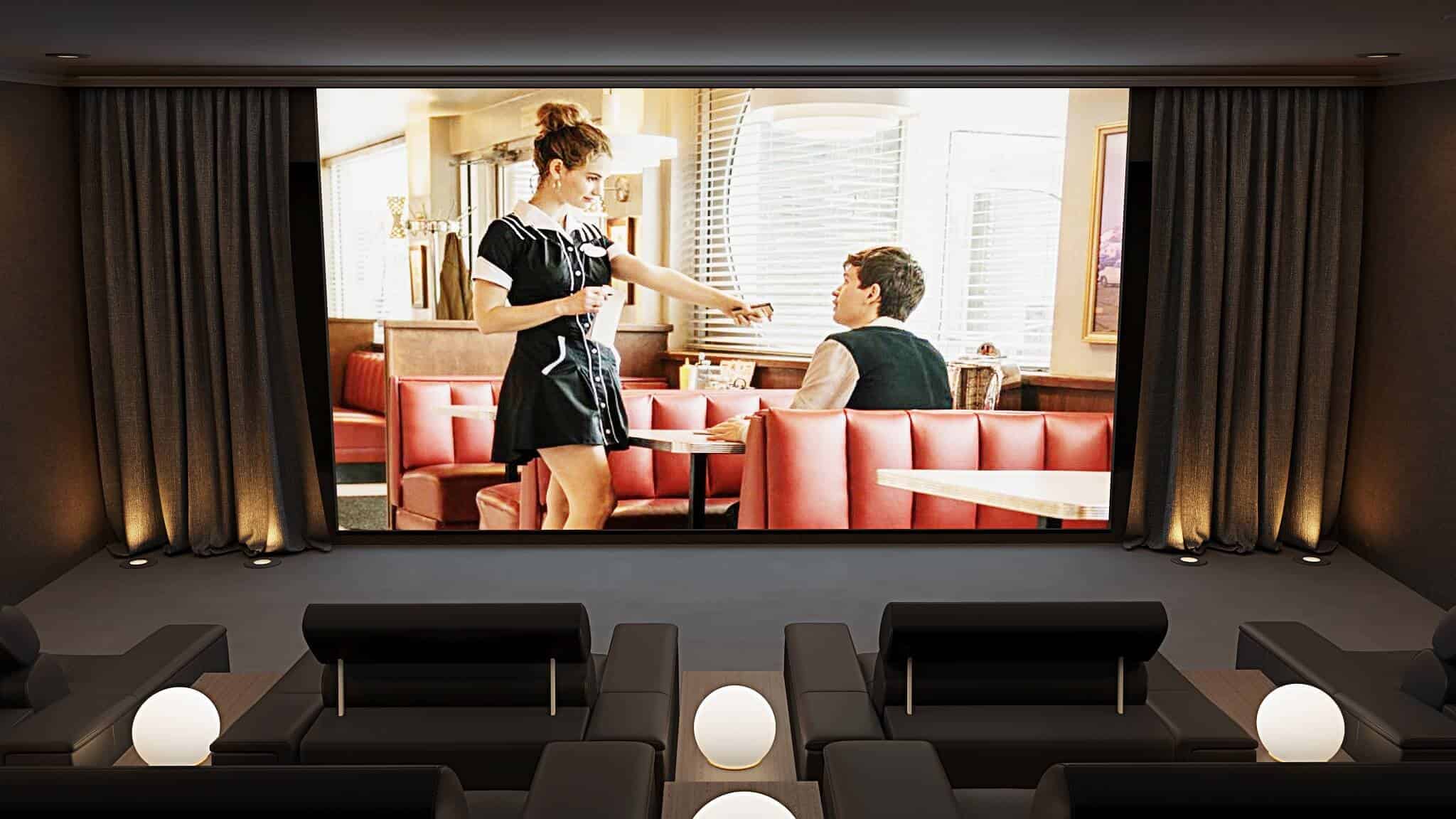
For projector installations, screen height positioning matters as much as viewing distance. The THX recommendation — which we follow — is that the viewer’s sightline should strike the centre of the screen with no more than 15° of upward tilt. For a 2.35:1 screen with its lower centre of mass (compared to 16:9), this typically means the bottom edge of the screen sits at approximately 60–70cm from the floor, placing the screen centre at approximately 100–115cm — close to seated eye level.
Seating Layout — Rows, Tiers and Sightlines
Once the screen size and viewing distance are established, seating layout follows from a set of consistent principles:
Row spacing. Allow a minimum of 1m between rows (front edge of rear row to front edge of row in front) for comfortable passage. For motorised reclining seats — Cineak and similar — allow 1.2m–1.4m to allow full recline without encroaching on the row behind.
Platform height. Each additional row of seating should be raised by 25–30cm above the row in front to clear sightlines over the heads of seated viewers. The platform should extend far enough forward that a viewer in the rear row has an unobstructed view of the full screen width and height, including the bottom edge of the screen.
Lateral sightlines. Viewers in the outermost seats of each row should have the screen centre within 30° of their direct sightline — beyond this, the off-axis viewing angle introduces perceptible colour shift on most projector screen materials. For a 3.8m wide screen, this limits the practical seat spread to approximately 4.5m at the front row viewing distance.
Aisle width. Allow 60–80cm on each side of the seating arrangement for circulation. This space also serves as the acoustic treatment zone — the side wall reflections at the primary listening position are one of the most important early reflections to manage, and the 60–80cm of wall space adjacent to the seating is where Artcoustic on-wall speakers and absorption panels are positioned.
How We Model a Room Before Building It
Every cinema room design at Custom Controls begins with an acoustic model of the space. We use room acoustic simulation software to calculate the modal distribution of the proposed room dimensions, identify any problematic coincidences, and model the effect of different treatment configurations on the room’s frequency response and decay time.
The simulation output informs the construction specification: the false wall depth, the ceiling slope, the treatment positions and the bass trap locations are all determined by the model before a single cable is pulled. For new build projects, we produce the construction drawings that the architect and contractor follow. For conversions, we specify the stud wall dimensions and treatment package as part of the installation contract.
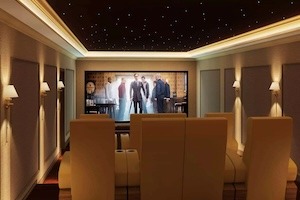
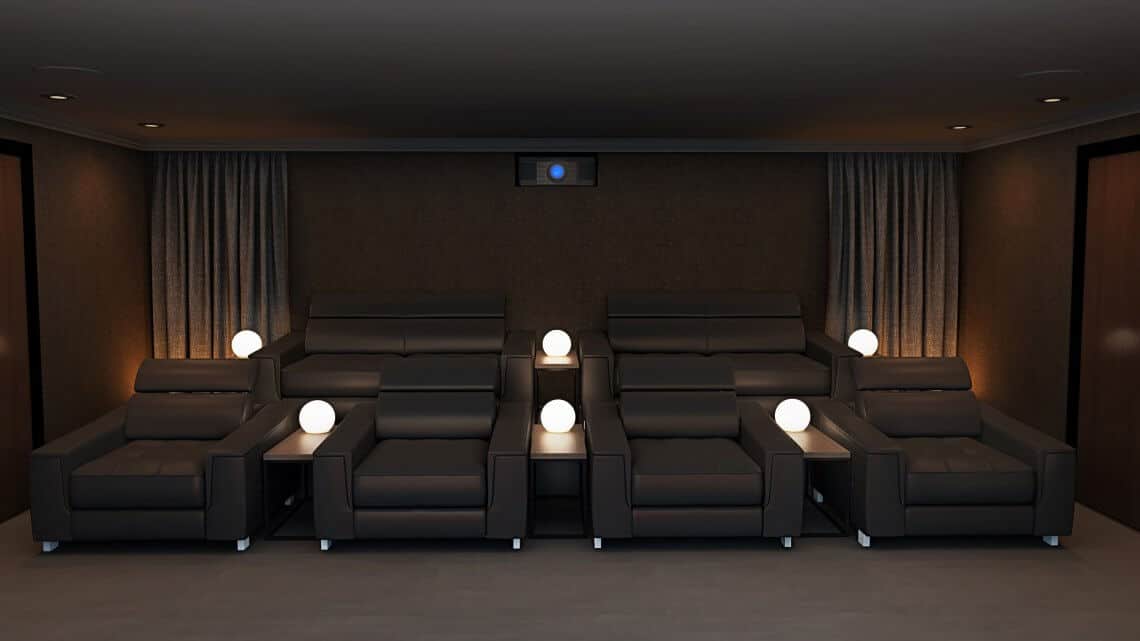
The 3D render of the finished room — which we produce for every project — overlays the acoustic design with the interior design, allowing clients to see exactly how the room will look before work begins. Room shape and acoustic performance are invisible in a finished cinema room; the quality of the experience is not.
Room Dimension Examples from Our Portfolio
Real home cinema rooms from our portfolio, illustrating how the dimension principles apply in practice:
3.6m × 3.6m × 2.1m — Berkshire basement cinema. A square room — acoustically the most challenging shape — compensated by careful false wall placement, full perimeter bass trap treatment and Trinnov room correction. The small volume actually works in the system’s favour for SPL output.
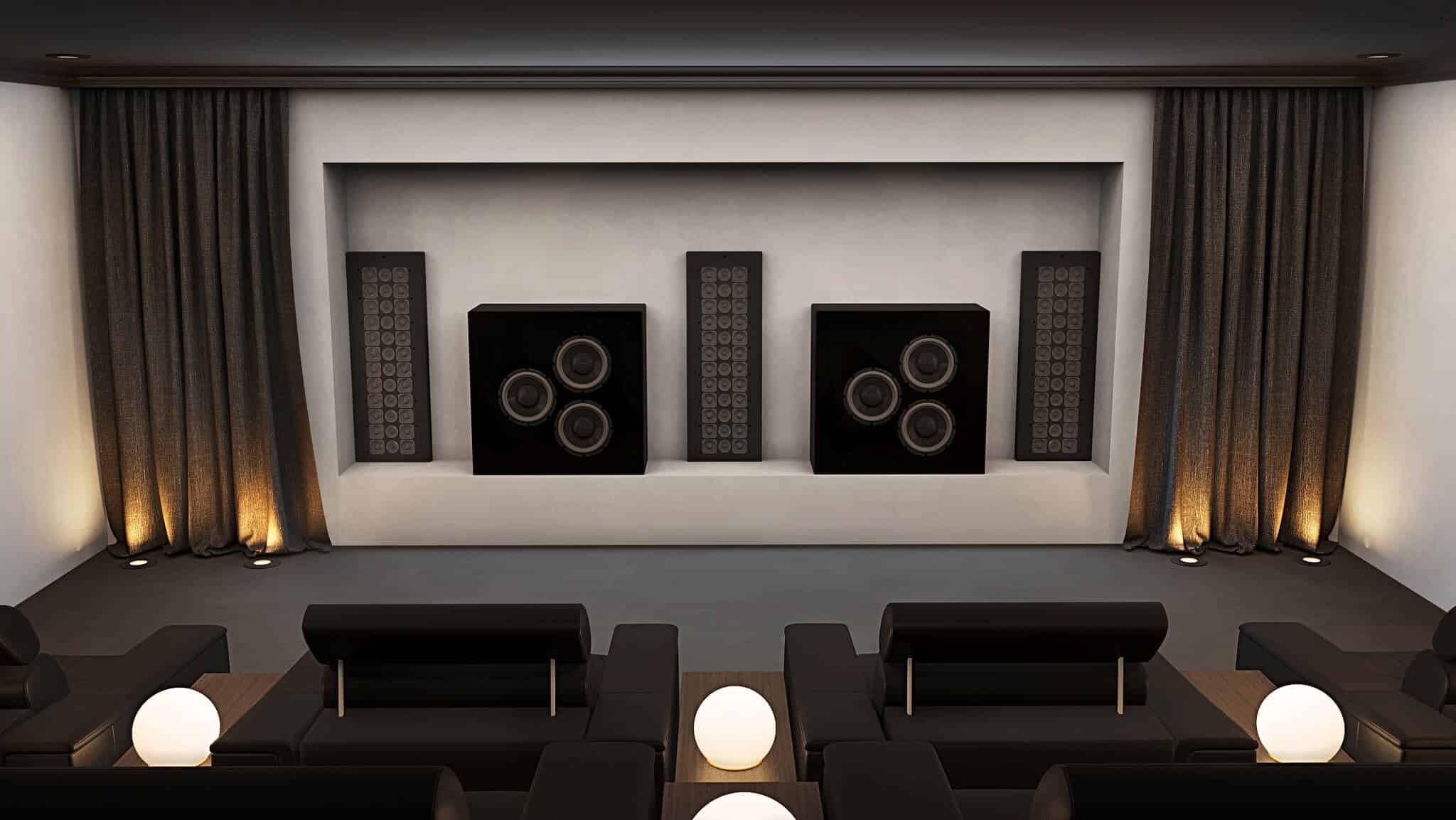
6m × 8m × 2.4m — Knutsford, Cheshire cinema. A well-proportioned room running into a bay window. 4.5m Screen Excellence screen; six reclining seats in a single row; Artcoustic speaker package colour-matched to Little Greene paint.
6m × 7m × 2.4m — Cheshire home entertainment complex. A near-golden cuboid. Full fabric wall treatment managing the rectangular geometry; Krix speakers with Trinnov processing achieving consistent performance across six seats in two rows.
5.5m × 6.5m × 4m — Ascot 15.3.8 cinema. A purpose-designed room with the full height available — the 4m ceiling allows genuine height speaker separation for Atmos, contributing to the overhead imaging that distinguishes this installation. Trinnov Altitude 16 managing a 15.3.8 Artcoustic system.
7m × 11m × 4m — Dubai IMAX cinema. THX Dominus tier. 6.4m screen; 18 seats in three rows on tiered platforms; Trinnov Altitude 32 with 48 Artcoustic speakers in a 13.2.14 configuration. The room was designed from first principles with the IMAX Enhanced certification requirements driving every dimensional decision.
What to Do When the Room Is Not Ideal
The available space is rarely ideal. Basements are often square or close to it. Garages have fixed footprints that may not match preferred ratios. Loft conversions have sloped ceilings that complicate acoustic modelling. These are all solvable problems — but they require acoustic compensation rather than hoping the equipment will overcome the room.
The standard compensation toolkit, applied in combination based on the specific room’s modal analysis:
- False wall depth adjustment — the single most effective tool for modifying a room’s effective length without structural changes
- Bass traps in all four floor-to-ceiling corners — reduces bass mode severity across all frequencies, particularly effective below 200Hz
- Broadband absorption at first reflection points — side walls adjacent to the listening position, ceiling above the listening position, rear wall
- Trinnov or Anthem room correction — addresses remaining frequency response irregularities after physical treatment, applying digital correction that physical treatment cannot achieve
- Subwoofer positioning — a single subwoofer at the front of the room drives the axial length mode hardest; multiple subwoofers in specific positions can partially cancel the room mode rather than reinforcing it
No room — however constrained — is beyond acoustic improvement. Our Berkshire basement is a square room that performs better than many larger, better-proportioned rooms we have auditioned, because the physical treatment and Trinnov correction are applied correctly. The room cannot be changed; the acoustic behaviour of the room can always be improved.
Frequently Asked Questions — Home Cinema Room Dimensions
Why are square rooms bad for home cinema?
Because the length and width axes produce identical resonant frequencies that coincide and reinforce each other, making bass mode problems twice as severe as in a rectangular room with non-matching dimensions.
What is the ideal ceiling height for a dedicated cinema room?
A minimum of 2.4m to the acoustic ceiling, which typically requires a structural slab at approximately 3m to accommodate the void for height speakers, lighting and acoustic absorption.
Can a square or poorly proportioned room still work as a cinema room?
Yes. False wall depth adjustment, corner bass traps, first-reflection absorption and digital room correction can all compensate for non-ideal geometry — our Berkshire basement cinema is a square room that outperforms many larger, better-proportioned spaces because of this treatment.
How is the right screen size determined from room dimensions?
Viewing distance should be roughly equal to screen width for 4K projection, or around 1.5 times the screen width for 1080p, with the THX reference viewing angle of around 36 degrees as a useful cross-check.
Getting Started
If you are in the planning stage for a cinema room — whether a new build, a conversion or an existing room — the acoustic design should be the first conversation, before equipment is selected and before construction begins. Custom Controls offers an acoustic design consultation that produces a full room model, dimension recommendations and treatment specification for your specific space.
Contact us to discuss your room. We work from London, Cheshire and the French Alps, travel internationally and have been acoustically designing cinema rooms since 1998.
Home Cinema Acoustic Design → · Home Cinema Design Details → · Ultimate Cinema Design Guide → · Projector Guide → · Screen Guide → · Trinnov Room Correction → · Acoustic Treatments → · Home Cinema Seating Guide → · Contact Us →