Home Cinema Projector Screens — The Complete Guide
Fixed or retractable, acoustically transparent, widescreen, masking and how to get the size right
Updated June 2026 · Custom Controls · 25+ years specifying and installing cinema screens
The projector screen is one of the most consequential decisions in a cinema room design, and one of the most commonly underspecified. Clients frequently focus on the projector and the speaker system — both of which are visible in showrooms and have obvious specifications to compare — while treating the screen as an afterthought. In practice, the screen material, format, mounting method and acoustic transparency have a larger effect on the daily experience of the room than almost any other single element. This guide covers every decision you need to make.
Our Home Cinema Services

Design

Calibration

Installation

Seating

Treatments
The Most Important Decision: Acoustically Transparent or Standard?
In a dedicated cinema room, this is the first and most significant choice. An acoustically transparent screen allows the front-left, centre and front-right speakers to sit directly behind it — meaning the sound appears to come from the image itself. A standard screen places the centre speaker below or beside the TV or screen, creating a spatial mismatch between what you see and where you hear it.
In a properly designed cinema room with a full front speaker array, there is no meaningful argument for a standard screen. Acoustically transparent material has no visible effect on the image — the acoustic perforations or weave structure are too small to resolve at normal viewing distances — and the spatial coherence between audio and video that it enables is one of the defining qualities of a reference-level cinema experience.
Custom Controls specifies Screen Excellence acoustically transparent fixed-frame screens on the majority of our dedicated cinema installations. Screen Excellence produces the highest quality acoustically transparent screens available, with a range of gain values, woven structures and frame systems to suit any room. Their Enlightor 4K material is optimised for 4K projection, maintaining image sharpness through the screen surface without the slight blurring that older acoustically transparent materials could introduce.
The exception is living room and multi-use installations where a retractable screen is required. In this case a standard retractable screen is typically the correct choice — the room is not configured to allow speakers behind the screen, and the retractable format takes priority over acoustic transparency.
Fixed or Retractable?
Fixed screens are the right choice for any dedicated cinema room. They are always perfectly positioned — no mechanical drift, no misalignment after years of use — allow a larger maximum size than retractable screens, and can be mounted with a speaker void directly behind them. The fabric frame is always taut and flat. They cost less than motorised retractable screens of comparable quality.
Retractable screens are the right choice for living rooms and multi-use spaces where the screen needs to disappear when the cinema is not in use. A motorised retractable screen rolls into a ceiling cassette at the touch of a button — or automatically as part of a Crestron scene — leaving the room completely clean. The trade-off is mechanical complexity (motors, limit switches and guide rails that require occasional adjustment), a maximum practical size somewhat below fixed screens, and the impossibility of positioning speakers directly behind the screen surface. For a living room cinema where aesthetics when the system is off are a priority, these are worthwhile compromises.
HD (16:9) or Widescreen (2.35:1)?
Standard HD projector screens are 16:9 — the same format as a television. Most films are shot in a wider aspect ratio: 1.85:1 or 2.35:1. Showing a 2.35:1 film on a 16:9 screen produces black bars at the top and bottom of the image, reducing the effective screen area by approximately 25%.
A widescreen 2.35:1 fixed-frame screen eliminates those bars for widescreen films — the entire screen surface is filled with image. The wider format also has a more cinematic quality in itself: the horizontal sweep of the image more closely matches the natural horizontal range of human peripheral vision, which contributes to immersion.
The practical consideration is room height. A 2.35:1 screen is significantly shorter for a given width than a 16:9 screen. In a room with a ceiling height under 2.6m, a very wide 16:9 screen may not fit vertically — but the same width in 2.35:1 format fits comfortably. This makes widescreen format particularly useful in rooms with lower ceiling heights where a wide screen is desired.
For clients who want both formats — widescreen for films, 16:9 for television and streaming — the answer is screen masking (see below) or a projector with anamorphic lens capability.
Our dedicated article on movie aspect ratios explains this in more depth.
Screen Masking — the Elegant Solution for Multiple Formats
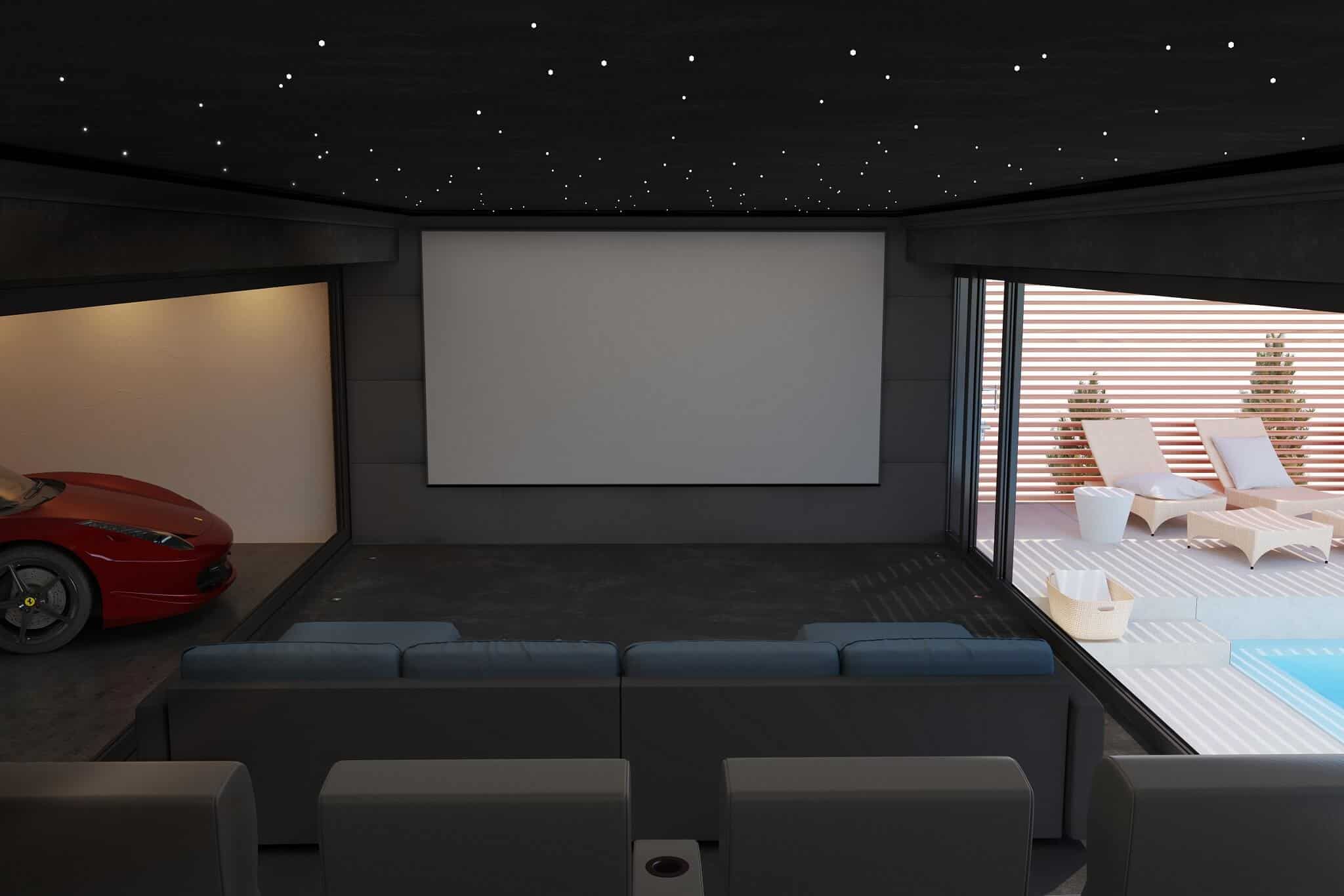
A motorised masking system uses motorised black velvet panels to cover the unused portions of the screen surface depending on the content’s aspect ratio. A 2.35:1 film fills the full screen; 16:9 content has the side panels close to convert it to the correct format; 1.85:1 content is handled by small top and bottom adjustments. The result is a screen that always appears exactly the right size and shape for the content being displayed, with no visible screen material outside the active image area.
Masking has a secondary benefit beyond aesthetics: the black velvet panels absorb any light scatter from the edges of the projected image, improving the perceived contrast of the image — particularly in dark scenes where any stray light outside the screen boundary is visible and distracting.
The most sophisticated masking implementation pairs the screen masking system with Kaleidescape and Crestron. Kaleidescape provides the aspect ratio of each film in its metadata; Crestron reads this and drives the mask motors to the correct position automatically. The client never needs to select an aspect ratio or adjust the mask — it simply happens when each film starts.
Screen Gain — What It Is and When It Matters
Screen gain is the measure of how much of the projected light is reflected back to the viewer compared to a reference flat white surface (gain 1.0). A screen with gain 1.3 reflects 30% more light to the viewer than a 1.0 gain surface.
Higher gain sounds like a straightforward benefit — more brightness — but it comes with a trade-off: higher gain screens have a narrower viewing cone, meaning the image dims noticeably for viewers seated off-axis. In a cinema room with multiple rows and off-axis seating positions, a gain of 1.0–1.1 is typically the correct specification. The projector brightness should be selected to suit the screen and room size, not compensated for by high screen gain.
For rooms with good light management and an appropriate projector specification, Screen Excellence 1.0 gain material delivers the most accurate, consistent image across all seating positions. For rooms with some residual ambient light, a modest gain of 1.1–1.2 can help without materially compromising the viewing angle.
Curved Screens
A curved projector screen wraps slightly around the viewer, reducing the head and eye movement required to take in the full image width. In very large rooms with screens above approximately 4m wide, curvature can reduce visual fatigue on long viewing sessions. It also has an acoustic benefit — a curved screen wall with matching curved rear wall creates a room shape that reduces standing wave formation and bass mode build-up.
Curvature requires careful projector specification and setup: the projector must support the specific radius of the screen’s curvature, and keystoning must be managed precisely. For screens up to 4m, the benefit is modest and most installations use flat screens. Above 4m and in very large rooms, curvature is worth considering. Our Megève cinema is a reference installation using a curved screen in a large purpose-built room.
How to Size a Screen for Your Room
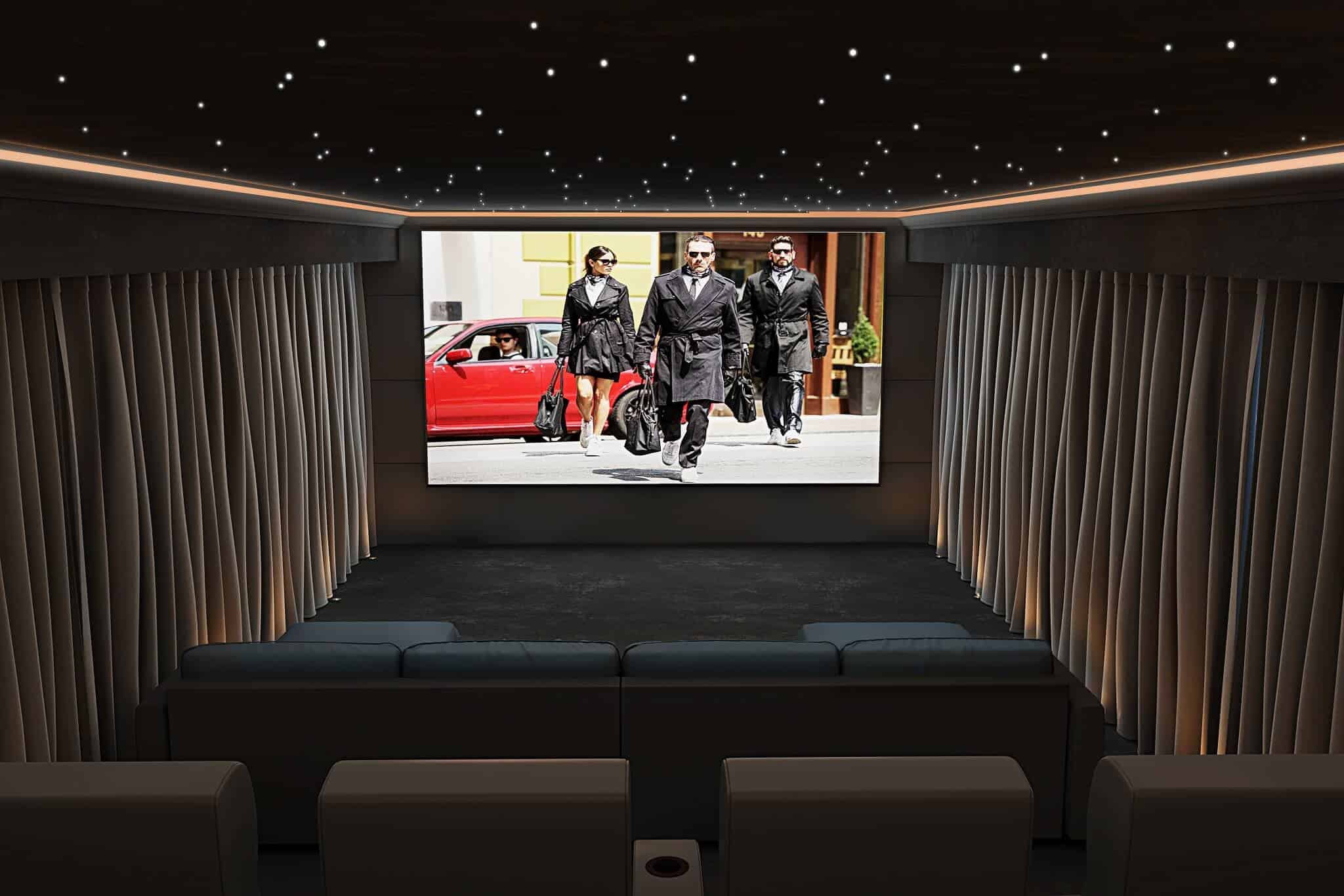
Screen sizing is determined by the viewing distance — the distance between the front row of seats and the screen. The recommended relationship between viewing distance and screen width depends on the projector’s resolution:
- 4K native projector: viewing distance approximately equal to screen width. A 3m screen works well from 3m.
- 1080p projector: viewing distance approximately 1.5× screen width. A 3m screen needs seats at approximately 4.5m to avoid the pixel structure being visible.
This is why upgrading from 1080p to 4K directly enables a larger screen in the same room — the pixel visibility constraint is removed, allowing clients to sit closer or fit a wider screen at the same seating distance. Clients upgrading from an older HD system frequently move from a 2.5m screen to a 3.5m or 4m screen with the 4K projector, and the effect on the cinematic experience is transformative.
For screen height positioning: once the screen width is determined and the screen height is calculated from the aspect ratio, position the screen so that approximately one third of the wall space above the screen is blank and two thirds below. This places the screen at a natural viewing height from seated positions without requiring heads to tilt upward uncomfortably.
Which Screen Brand Do We Specify?
Custom Controls specifies Screen Excellence as our primary screen brand for dedicated cinema rooms. Screen Excellence produces both acoustically transparent and standard fixed-frame screens, retractable screens and masking systems to a quality level that matches the projectors and speaker systems we install alongside them. Their Enlightor 4K material is the acoustically transparent material we specify for 4K laser installations. For the most demanding client briefs, their masking systems are the most precisely engineered available at the residential level.
Screen Case Studies
4.5m acoustically transparent fixed, 2.35:1 — Ascot, Ghana. The largest practical size in standard residential cinema rooms; Artcoustic front array behind the screen.
3.8m acoustically transparent fixed, 2.35:1 — Cheshire garden cinema, Scottish estate cinema, Châtel chalet. The most common high-performance specification for rooms in the 6m–8m depth range.
4m curved, acoustically transparent — Megève, France. A reference installation demonstrating the curved screen approach in a very large purpose-designed space.
Retractable ceiling cassette — Primrose Hill, Hampstead. Living room cinema installations where the screen disappears completely when not in use.
Frequently Asked Questions — Home Cinema Screens
Should a dedicated cinema room always use an acoustically transparent screen?
Yes, where the room has a full front speaker array. There is no meaningful image-quality downside, and the spatial coherence between audio and image it enables is one of the defining qualities of a reference-level cinema room.
What screen gain should I specify?
For a room with multiple rows and off-axis seating, a gain of 1.0–1.1 is typically correct, since higher-gain screens narrow the viewing cone and dim noticeably for viewers off to the side. Projector brightness should be matched to the room rather than compensated for with high screen gain.
How do I work out the right screen size for my room?
With a 4K projector, viewing distance should be roughly equal to screen width. With 1080p, viewing distance should be around 1.5x the screen width to avoid visible pixel structure — which is why upgrading to 4K often allows a meaningfully larger screen in the same room.
What is screen masking and do I need it?
Motorised masking panels cover the unused portion of the screen depending on content aspect ratio, so the active image area always fills the visible screen exactly. It’s most valuable for clients who want both widescreen film and standard 16:9 content to look correctly framed without manual adjustment.
Home Cinema Installation → · Projector Guide → · Movie Aspect Ratios → · Kaleidescape → · Discuss your project →