Home Cinema Control Systems: Which One is Right for Your Room?
Cinema Control Systems Compared: RTI to Savant
Published May 2026 · Custom Controls · Certified installers of RTI, AVA, Crestron Home, Control4 and Savant since 1998
You have spent considerable time and money designing and equipping your home cinema. The projector is specified, the speaker system is chosen, the acoustic treatment is planned. And then someone mentions that you need a control system — and suddenly you are faced with a new set of decisions, a new vocabulary and a market full of competing claims. The control system is the interface between you and your cinema. It is what you pick up to start a film, dim the lights, lower the screen and switch sources. In a well-designed system, this happens in one action. In a poorly chosen or poorly programmed one, it happens in six. That difference — between pressing one button and pressing six — is not a minor convenience. It is the difference between a cinema that gets used every evening and one that gathers dust because it is too complicated to be bothered with.
This guide covers the five systems we work with most frequently for dedicated home cinema rooms: RTI, AVA, Crestron Home, Control4 and Savant. We have installed all of them, programmed all of them and supported clients using all of them. What follows is our honest assessment — no commercial bias, no affiliate arrangements.
Before the Systems: What a Cinema Control System Actually Does
A home cinema control system does two things. It consolidates: taking control of every device in the room — projector, screen, AV processor, amplifier, media server, streaming source, lighting, motorised blinds — and presenting it through a single interface. And it automates: turning those individual device commands into single-button macros, so that pressing “Watch Film” switches every device to the right state simultaneously rather than requiring you to operate each one in sequence.
Without a control system, a fully specified home cinema can require four, five or six remote controls — each operating independently, each requiring knowledge of which order to switch things on, each failing to respond if its batteries are flat or its line-of-sight is blocked. This is not a theoretical problem. It is why some of the best-equipped cinema rooms in the country go largely unused.
The better systems go further. They integrate with the room’s lighting and motorised blinds so that starting a film automatically dims the lights and closes the blackout blinds. They remember where you paused. They give everyone in the household — including people who are not technically minded — an interface that requires no explanation.
What differentiates the systems from one another is the flexibility of the programming, the quality of the hardware interface, the ease of expanding to other rooms, and what drives the cost.
The Systems — An Overview
A word on how we have assessed each system. We have scored each one on a 1–5 rating for flexibility, ease of use for the end user, and remote control quality. Cost varies with the scope of each project, so rather than rating it, we set out what drives the cost of each system — and provide a free, detailed quotation for your own room.
RTI — The Specialist’s Choice for Cinema Rooms
RTI (Remote Technologies Incorporated) is one of the most widely used control systems in dedicated home cinema installations in the UK. Pulse Cinemas — one of the UK’s most respected cinema specialists — describes RTI as their recommended weapon of choice for AV and home cinema control, citing the right mix of ease of use and installation speed, with the power to control even the largest and most complex systems. That summary is accurate in our experience.
RTI operates through a central processor — the RP series for residential installations — which communicates with devices using IP, RS-232, IR and relays. The programming platform, Apex, is a professional-grade tool that allows a skilled programmer to create completely bespoke interfaces with custom graphics, macros of unlimited complexity, conditional logic and bidirectional device feedback. The end-user experience can be as simple or as sophisticated as the project requires — and crucially, as the client requires. A household where the primary user is not technically minded gets a four-button interface. A client who wants granular control of every parameter gets a more detailed one. RTI accommodates both without compromise.
The Remote Hardware
RTI’s handheld remote range is one of its strongest features. The T3x and T3v — their flagship touchscreen handhelds — are well-built, responsive and comfortable to use. The T3v includes a built-in camera for video calling and intercom. For wall-mounted control, the KX series keypads allow room control from a fixed panel. All remotes operate via RF rather than infrared, meaning they do not require line-of-sight to a device — a significant practical advantage in a dark cinema room where pointing at a hidden equipment rack is impractical.
Flexibility and Integration
RTI integrates with an extremely broad range of AV and smart home devices. It connects natively with Lutron lighting and shading systems — a combination we specify regularly, where RTI handles the cinema control and Lutron manages the room’s lighting and blinds as part of the same interface. It also integrates with Crestron, KNX, most major AV brands and a wide range of climate and security systems.
One important note: RTI was acquired by AVPro Global in 2025, a development that has raised questions in the installer community about the platform’s long-term roadmap. At the time of writing, RTI continues to operate as before and support has been maintained. We are monitoring the situation and will update our recommendation if circumstances change.
RTI at a Glance
| What drives cost | Programming depth, the number of devices controlled and the handhelds and keypads specified. Scope-led rather than fixed. |
|---|---|
| Flexibility | ⭐⭐⭐⭐⭐ — Unlimited with skilled programming. One of the most configurable platforms available. |
| Ease of use (end user) | ⭐⭐⭐⭐⭐ — Entirely determined by the programmer. A well-programmed RTI system is effortless. |
| Remote control quality | ⭐⭐⭐⭐ — Solid, well-designed handhelds. RF operation is a genuine practical advantage. |
| Single-room suitability | ⭐⭐⭐⭐⭐ — Purpose-built for exactly this use case. Scales to whole-home if required. |
| Best for | Dedicated cinema rooms where bespoke programming, broad device integration and RF remote operation are priorities. |

Home Cinema

Crestron

Smart Home

Lutron

Calibration
AVA — The Most Impressive New Remote in Years
AVA is a Swiss-American company that has produced what is genuinely the most interesting handheld cinema remote currently available. It is relatively new to the UK market — distributed by Pulse Cinemas — but it has attracted significant attention from installers and clients who have seen or handled it, for good reason.
The Cinema Remote
The AVA Cinema Remote is the world’s first Google-certified remote control — machined from a single piece of aluminium, with a high-density 4-inch touchscreen and an ultra-narrow bezel, powered by an octa-core processor running AVA OS based on Android. The hardware quality is exceptional. It feels more like a premium smartphone than a remote control — which is intentional. The anodised aluminium body, the weight distribution, the way the screen wakes immediately when you pick it up — all of it signals a quality of engineering that most remote controls do not approach.
The Dynamic Keypad is AVA’s most distinctive hardware innovation — a secondary display and physical keypad combination that adapts its layout to whichever device is being controlled. Icons shift to match the activity: navigating a streaming service looks different from controlling volume, which looks different from adjusting the lighting. In practice, this means your thumb goes to where it expects the right button to be, regardless of what you are controlling. It is a small thing described on paper and a significant thing experienced in a dark cinema room.
The AVA Nano Brain — a compact hub just 3 inches across — brings all AVA remotes into synchronisation for multi-room setups, with IP control, a 360° infrared blaster and HDMI CEC. For simpler single-room installations, the Cinema Remote’s onboard octa-core processor handles device control directly without requiring an external processor — a genuine differentiator for straightforward cinema rooms where budget or complexity constraints make a full processor installation less appropriate.
AVA OS and the Flows Automation System
AVA Flows is the platform’s automation layer — no coding, no complex programming, just a visual interface for creating scenes that trigger multiple devices simultaneously. “Watch Film” can dim the lights, lower the screen, switch the AV processor to the right input and start the Kaleidescape server — all from one tap. The simplicity of the setup process is deliberate: AVA is designed to be configured quickly by the installer and used effortlessly by the client, without the programming depth of RTI or Crestron.
That simplicity is both the system’s strength and its limitation. For straightforward cinema rooms and living room AV systems, AVA delivers a premium experience with faster deployment than a traditional control system. For very complex installations — large multi-room systems, unusual device integrations, highly customised interface requirements — RTI or Crestron will still be the more appropriate platform.
AVA in the UK Market
In the UK, AVA is distributed exclusively by Pulse Cinemas — one of the most respected AV distributors in the country — and is available in anodised black or silver. Several leading UK cinema installers, including UK Home Cinemas, now specify AVA as a standard recommendation alongside RTI and Control4. Its momentum in the UK market is significant and growing.
AVA at a Glance
| What drives cost | Mainly the number of remotes and hubs specified. Processor-free operation keeps simple single rooms straightforward. |
|---|---|
| Flexibility | ⭐⭐⭐ — Excellent for standard cinema and AV control; limited for highly complex or unusual integrations. |
| Ease of use (end user) | ⭐⭐⭐⭐⭐ — The most intuitive interface currently available. The Dynamic Keypad is genuinely clever. |
| Remote control quality | ⭐⭐⭐⭐⭐ — The finest handheld cinema remote currently on the market. Hardware quality is exceptional. |
| Single-room suitability | ⭐⭐⭐⭐⭐ — Designed specifically for this use case. Processor-free operation for simple rooms is a genuine advantage. |
| Best for | Clients who prioritise remote quality and ease of use above programming depth. Premium single-room and living-room cinema installations. |
Crestron Home — Premium Platform, Cinema-Ready
Crestron Home is not a cinema-specific control system — it is a whole-home automation platform that handles cinema alongside AV, lighting, climate, security and access. But its relevance to cinema rooms is significant, particularly for clients whose installation forms part of a larger smart home project.
We have covered Crestron Home in detail in our complete guide, so here we will focus on what specifically applies to cinema room use.
Cinema Control Within Crestron Home
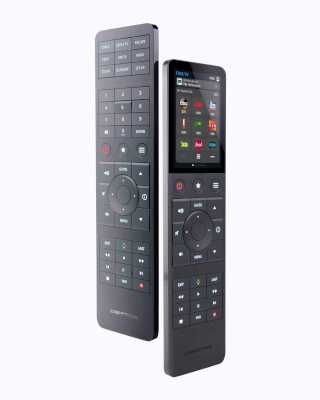
Crestron Home controls all AV sources, the projector, the screen, the AV processor and the room’s lighting and shading within the same platform. A cinema scene — “Watch Film” — can be programmed to set every device to the right state, including Lutron-controlled lighting and motorised blinds, in a single action. The interface is presented on wall-mounted Crestron touchscreens, the Cevo Mini Remote, or the Crestron Home app on any iOS or Android device.
The Cevo Mini Remote — refreshed in 2025 with a new design and OS 4.8 expanding its shading capabilities — is a compact handheld that handles volume, lighting, shading and source selection without requiring a touchscreen. It is a well-made piece of hardware, though it does not match the physical quality of the AVA Cinema Remote. For clients who already have Crestron Home managing the rest of their home, using the same platform for the cinema room is a logical choice — one interface, one app, one system.
When Crestron Home is the Right Cinema Choice
Crestron Home makes most sense for cinema rooms that are part of a larger Crestron Home installation — where the client already uses Crestron for lighting, climate and security and wants the cinema to be part of the same ecosystem. For a standalone cinema room where no broader smart home system exists, RTI or AVA will typically deliver a better result at lower cost.
Crestron Home at a Glance
| What drives cost | Whole-home scope — the processor, touch screens, licensing and integration across lighting, climate, shading and security. |
|---|---|
| Flexibility | ⭐⭐⭐⭐ — Extensive within the Crestron Home framework. Unlimited in Crestron Custom. |
| Ease of use (end user) | ⭐⭐⭐⭐⭐ — The Crestron Home app and OS 4.9 interface are intuitive and consistent. |
| Remote control quality | ⭐⭐⭐⭐ — Cevo Mini Remote is well-made. Wall-mounted touchscreens are excellent, and Crestron’s newer 80 Series touch screens have been introduced and are listed in its current range. |
| Single-room suitability | ⭐⭐ — Can be done, but the cost is hard to justify for a single-room installation with no broader smart home context. |
| Best for | Cinema rooms that form part of a larger Crestron Home installation. The wrong choice for a standalone room without an existing Crestron ecosystem. |
Control4 — The Accessible Whole-Home Platform
Control4 is the most widely used professional smart home platform in the UK, and it is a common choice for cinema rooms that form part of a broader home automation project. Like Crestron Home, it is a whole-home system rather than a cinema-specific one — but at a lower cost and with faster deployment than either Crestron option.
Cinema Control in Control4
Control4 handles cinema AV control — source selection, volume, projector control, screen control — alongside lighting, climate and security. The interface is presented via the Control4 app, wall-mounted touchscreens and, for handheld control, the Control4 Halo Touch remote — a well-regarded touchscreen handheld that competes directly with RTI’s handhelds at a similar price point.
The Control4 system is template-driven rather than fully bespoke — which means deployment is faster and less expensive than RTI or Crestron Custom, but the interface has less scope for the kind of deep customisation that RTI allows. For most residential cinema rooms, the templates are more than sufficient. The limitation becomes apparent only on unusual or complex projects where the template constraints are hit.
Control4’s integration library covers over 12,000 third-party devices — one of the broadest in the industry. Most projectors, AV processors, streaming devices and smart home systems have a Control4 driver, which makes integration relatively straightforward even for less common equipment choices.
Control4 at a Glance
| What drives cost | The controller, licensing and number of rooms. Template-driven deployment keeps programming lighter. |
|---|---|
| Flexibility | ⭐⭐⭐ — Template-driven. Excellent for standard configurations; less adaptable for unusual requirements. |
| Ease of use (end user) | ⭐⭐⭐⭐ — Clean, consistent interface. Less bespoke than RTI but immediately accessible. |
| Remote control quality | ⭐⭐⭐⭐ — Halo Touch is a strong handheld. Good build quality and responsive touchscreen. |
| Single-room suitability | ⭐⭐⭐ — Works well for single rooms but the platform is more cost-effective when scaled to multiple rooms. |
| Best for | Cinema rooms as part of a broader Control4 whole-home installation, or clients who want a proven, broadly compatible platform at a mid-range price point. |
Savant — Beautifully Designed, Elegantly Simple
Savant has built its reputation on the quality of its user interface and the elegance of its hardware. It sits at the premium end of the whole-home market and is particularly favoured by clients and interior designers for whom the visual quality of the system’s interface is as important as its technical capability.
The Pro Remote X2
The Savant Pro Remote X2 features an aluminium body, elevated backlit physical buttons, a 3.1-inch 480×800 resolution touchscreen, and Siri voice control integration. It is the most physically elegant system remote currently available from a traditional whole-home platform — and it is designed to be optimised per room, with personalised home screens that give quick access to the scenes, channels and services used most frequently in that specific space. The tactile buttons alongside the touchscreen is a design decision that some users prefer over a pure touchscreen approach — there is something satisfying about a physical button for volume that pure touchscreen systems cannot replicate.
One honest limitation: compared to Control4 or Crestron, Savant’s interface offers less depth of customisation for clients who want granular control and access to detailed settings — it prioritises elegance and simplicity over configurability. For a cinema room, this is rarely a problem. For a complex multi-system installation requiring unusual integrations, it can be.
Savant at a Glance
| What drives cost | Whole-home scope, hardware and integration. The premium is best absorbed across a whole-home installation. |
|---|---|
| Flexibility | ⭐⭐⭐ — Less configurable than RTI or Crestron. Strong on standard integrations; weaker on complex or unusual requirements. |
| Ease of use (end user) | ⭐⭐⭐⭐⭐ — Beautifully designed interface. Simplicity is its defining characteristic. |
| Remote control quality | ⭐⭐⭐⭐⭐ — Pro Remote X2 is exquisitely designed. Physical buttons alongside the touchscreen is a genuine differentiator. |
| Single-room suitability | ⭐⭐ — Possible but cost is hard to justify for a single room; Savant earns its premium across a whole-home installation. |
| Best for | Clients who prioritise interface elegance and remote design above programming depth. Premium whole-home installations where aesthetics matter as much as capability. |
Head-to-Head: How They Compare
| System | What Drives Cost | Flexibility | End-User Ease | Remote Quality | Single-Room Value |
|---|---|---|---|---|---|
| RTI | Programming depth, device count | ⭐⭐⭐⭐⭐ | ⭐⭐⭐⭐⭐ | ⭐⭐⭐⭐ | ⭐⭐⭐⭐⭐ |
| AVA | Remote and hub count | ⭐⭐⭐ | ⭐⭐⭐⭐⭐ | ⭐⭐⭐⭐⭐ | ⭐⭐⭐⭐⭐ |
| Crestron Home | Whole-home scope | ⭐⭐⭐⭐ | ⭐⭐⭐⭐⭐ | ⭐⭐⭐⭐ | ⭐⭐ |
| Control4 | Controller, licences, rooms | ⭐⭐⭐ | ⭐⭐⭐⭐ | ⭐⭐⭐⭐ | ⭐⭐⭐ |
| Savant | Whole-home scope, hardware | ⭐⭐⭐ | ⭐⭐⭐⭐⭐ | ⭐⭐⭐⭐⭐ | ⭐⭐ |
Which System Should You Choose?
For a dedicated cinema room with no existing smart home system
RTI or AVA — these are the two systems designed most specifically for this use case. RTI if you want maximum flexibility and a wide range of integration options; AVA if remote hardware quality is the priority and the installation is relatively straightforward. Both deliver outstanding cinema control at a lower cost than the whole-home platforms.
For a cinema room as part of a new Crestron smart home installation
Crestron Home — integrating the cinema into the same platform as the rest of the home makes practical sense. One system to learn, one app, one support relationship. The cost is justified when it is spread across the whole home rather than absorbed by a single room.
For a cinema room as part of a new Control4 installation
Control4 — same logic as above. The platform scales well, the Halo Touch remote is a good handheld, and the 12,000+ device driver library means virtually any cinema equipment will integrate without issues.
For clients who prioritise aesthetics and interface design above all else
Savant or AVA — both produce the finest-looking hardware in the category. Savant for a whole-home installation where the Pro Remote X2 will be used throughout the property; AVA for a cinema-first installation where the Cinema Remote’s physical quality is the defining characteristic.
For an existing cinema room that needs upgrading from multiple remotes
RTI or AVA — both can integrate with existing AV equipment without requiring hardware replacement. A retrofit control installation using either platform can transform an underused, overcomplicated system into something effortless without touching the AV equipment itself.
A Note on Programming Quality
The most important thing we can tell you about any of these systems — and the thing that most discussions of control systems do not say clearly enough — is that the system is only as good as the person who programs it.
RTI in the hands of an inexperienced programmer produces a confusing, unreliable interface. RTI in the hands of a skilled programmer produces the most effortless cinema experience available. The same is true of every system on this list. Crestron Home configured carelessly produces a system that misses its potential. Configured well, it is outstanding. Control4 with a poor driver implementation produces exactly the frustrating multiple-remote experience it was supposed to eliminate.
This is not a criticism of any system. It is the reality of professionally installed control, and it is why the choice of installer matters as much as the choice of system. We are certified installers for all five systems covered in this guide and have been programming control systems for home cinema since 1998. If you are trying to decide which system is right for your room, we are happy to discuss it without obligation.
Frequently Asked Questions
What is the best control system for a home cinema room?
For a dedicated single room, RTI and AVA are our most frequent recommendations. RTI for maximum flexibility and broad integration; AVA for remote hardware quality and simplicity. For cinema rooms forming part of a whole-home installation, Crestron Home, Control4 or Savant are more appropriate depending on which platform is being used for the rest of the property.
Can a cinema control system also control my lighting and blinds?
Yes. All five systems covered here integrate with lighting and motorised blinds. For Lutron-controlled lighting and shading, Lutron integrates natively with RTI and Crestron Home — a combination we specify regularly, where Lutron handles the lighting and the control system handles the AV.
What is the AVA Cinema Remote?
The AVA Cinema Remote is a premium aluminium touchscreen handheld running AVA OS on an octa-core processor. It features a 4-inch HD touchscreen, a Dynamic Keypad that adapts physically to each device, voice control via a built-in microphone and speaker, and native IP control without requiring a separate processor. It is the world’s first Google-certified remote control and the finest handheld cinema remote currently available.
Does a home cinema control system need a separate processor?
Usually yes — RTI, Crestron Home, Control4 and Savant all require a central processor or hub. AVA can operate processor-free for simpler installations using the Cinema Remote’s onboard processor. For larger or more complex systems, a dedicated processor is always the more robust architecture.
Talk to Us About Your Cinema Control
We install and program all five systems covered in this guide and have been designing home cinema control systems since 1998. Whether you are specifying a new cinema room, upgrading an existing system or trying to decide which platform is right for a wider smart home project, we are happy to talk it through without any obligation.
Contact Custom Controls to discuss your cinema control requirements. →
Related Reading
- Home Cinema Installation — The Complete Service
- Home Cinema Acoustic Design
- Home Cinema Audio & Video Calibration
- Crestron Home: The Complete Guide (2026)
- Crestron vs Lutron vs Control4 — Expert Comparison
- Crestron Home Automation
- Lutron Lighting Control
- Kaleidescape Movie Servers
- Trinnov Home Cinema Processors