Crestron Home: The Complete Guide (2026)
Published May 2026 · By Custom Controls · 25+ years as a certified Crestron dealer
Everything there is to know about Crestron Home
If you are researching smart home systems, you have almost certainly encountered Crestron Home. It appears on premium AV company websites, in luxury home specification documents and in conversations with architects and interior designers who know what the top of the market looks like. But what exactly is it? How does it differ from “full Crestron”? What does it actually do? And — the question most people are really asking — is it right for your home?
This is the most comprehensive guide to Crestron Home available from a UK installer. We have been Crestron certified dealers since 1998 and have installed Crestron systems — Home and Custom — in hundreds of properties across London, Cheshire, Dubai, the Alps and beyond. What follows is an honest, independent assessment based on that experience.
Contents
- What is Crestron Home?
- Crestron Home vs Crestron Custom — the real differences
- What Crestron Home controls
- Crestron Home OS in 2026 — what’s new
- Hardware — touchscreens, remotes and keypads
- Crestron Home and Lutron
- Is Crestron Home right for your project?
- How much does it cost in the UK?
- Why the installer matters as much as the system
- Frequently asked questions
What is Crestron Home?
Crestron Home is Crestron’s residential automation platform — a whole-home control system that brings lighting, shading, AV, climate, security and access under a single, unified interface. It runs on Crestron’s own hardware, is configured using a dedicated dealer app rather than bespoke programming, and delivers its interface through the Crestron Home app on iOS and Android, wall-mounted touchscreens, handheld remotes and physical keypads.
Crestron Home sits within a company that has been building professional control systems since 1969. Crestron manufactures the vast majority of their own hardware — processors, touchscreens, keypads, dimmers, shading motors, AV distribution equipment — which gives their systems a level of integration and reliability that companies relying on third-party components cannot match. When a Crestron Home system communicates between its own components, it does so using protocols optimised for exactly that purpose. The result, when properly installed, is a system that is genuinely seamless.
It is worth being clear about what Crestron Home is not. It is not the only Crestron residential product — Crestron also offers fully bespoke “Custom” programming for projects that require it. And it is not a consumer product — it cannot be purchased at retail, installed without a certified dealer, or self-configured by a homeowner. It is a professional system that requires professional installation and is priced accordingly.
Crestron Home vs Crestron Custom — The Real Differences
This is the question we are asked most frequently by clients who have done their research. The answer matters because the two systems are meaningfully different — not just in price and deployment time, but in what they can do and who they are right for.
Crestron Home
Crestron Home is configured using the Crestron Home configuration app — a dealer-only tool that allows an installer to set up a complete whole-home system without writing a line of code. The interface seen by the homeowner is consistent across all Crestron Home installations — clean, intuitive and well-designed, but working within a defined visual and functional framework. Updates are delivered automatically over the air via Crestron’s servers. The system can be monitored and adjusted remotely by the dealer, which means most issues can be resolved with a phone call rather than a site visit.
The strengths of Crestron Home are speed, consistency and accessibility. A certified Crestron Home dealer can deploy a complete whole-home system in a fraction of the time required for a custom project, which translates directly to cost. The interface works well from day one. Over-the-air updates mean the system improves over time without intervention. And the remote management capability means ongoing support is efficient and responsive.
The constraints are real but are often overstated. Crestron Home works within a framework — there are limits to interface customisation, and integration with unusual or legacy third-party devices depends on the availability of an extension driver. For the vast majority of residential projects, these constraints are entirely irrelevant. The framework is broad enough to accommodate most integration requirements, and the quality of the result is outstanding.
Crestron Custom
Crestron Custom is programmed from scratch by a certified Crestron programmer using Crestron’s proprietary language. There are no templates, no frameworks and no limits. Every function, every macro, every interface element is coded. If a device has an IP address, a serial port or a relay, it can be integrated. Interfaces can be designed completely bespoke — to any visual specification, in any style, with any layout.
The defining characteristic of Crestron Custom is unlimited flexibility. A project that requires a fully bespoke touchpanel interface designed to complement a specific interior scheme, or that needs to integrate with an unusual building management system, or that has automation requirements too complex for any template-driven approach — Crestron Custom is the only answer. It is also the configuration we specify for the most demanding projects where the interface itself is a design object, not just a control tool.
The cost of Crestron Custom reflects the programming time involved. A complex custom project can require hundreds of hours of skilled programming work. Changes and additions after commissioning require the programmer to update the code, test it and reload it — a process that can take time and cost money on a complex system. This is not a criticism of the platform; it is simply the reality of fully bespoke engineering.
Which is right for your project?
| Factor | Crestron Home | Crestron Custom |
|---|---|---|
| Configuration method: | Dealer app — no coding. | Bespoke programming |
| Interface customisation: | Within a defined framework. | Unlimited — any design |
| Third-party integration: | Via extension drivers. | Virtually unlimited |
| Deployment time: | Faster. | Longer |
| Post-installation changes: | Fast — via dealer app. | Requires programmer |
| Over-the-air updates: | Yes — automatic. | Manual |
| Remote monitoring: | Yes — built in. | Yes — with additional setup |
| What drives the cost: | Hardware scope and dealer-app configuration time. | Hardware scope plus bespoke programming hours |
| Best for: | Most luxury residential projects. | Most demanding, complex, bespoke |
Our honest recommendation: for the majority of luxury residential projects in the UK, Crestron Home delivers an exceptional result at a meaningfully lower cost than Crestron Custom, with faster deployment and better ongoing support characteristics. Custom is the right answer when the project genuinely requires what only Custom can provide — not simply because it carries a more prestigious label.

Crestron

Smart Home

Lutron

Climate Control

Multi-Room Audio
What Crestron Home Controls
Crestron Home is a genuine whole-home platform. These are the systems it manages.
Lighting
Crestron Home controls all lighting circuits via Crestron’s own dimmer and switch modules — wall-mounted or rack-mounted depending on the installation. Scenes can be programmed for every room and every occasion, recalled from any control point in the home. The system supports astronomical scheduling — automatically adjusting lighting based on sunrise and sunset — and occupancy-based automation via Crestron sensors. The dimming quality from Crestron’s own LED modules is excellent, with no flicker and smooth transitions across the full range. For projects where lighting is specified through Lutron, Crestron Home integrates with Lutron’s systems directly — see the dedicated section below.
Shading
OS 4.8 (December 2025) brought significant improvements to shading control within Crestron Home, introducing unified whole-home shade management that aligns more closely with how lighting is handled in the platform. Shading can be controlled by room, by group or across the entire property — and integrated into lighting scenes so that blinds and lights respond together to a single command. Weather-based shading automation — introduced in OS 4.4 using the Tempest Weather System — allows shades to respond automatically to real-time sunlight intensity, wind speed and rain, protecting both the interior and the shading hardware without requiring manual intervention.
Audio and Music
OS 4.6 (July 2025) placed music at the centre of the Crestron Home experience, overhauling multi-room audio control with faster access, smarter controls and deeper personalisation. Crestron Home supports Crestron’s own audio distribution equipment — delivering any source to any room — alongside native integration with streaming services including Apple Music. The interface presents music intuitively across all control points, and the system remembers preferences per room and per user. For clients with high-end audio requirements, Crestron Home integrates with premium audio sources and supports integration with systems like Sonos and Steinway Lyngdorf.
Video Distribution
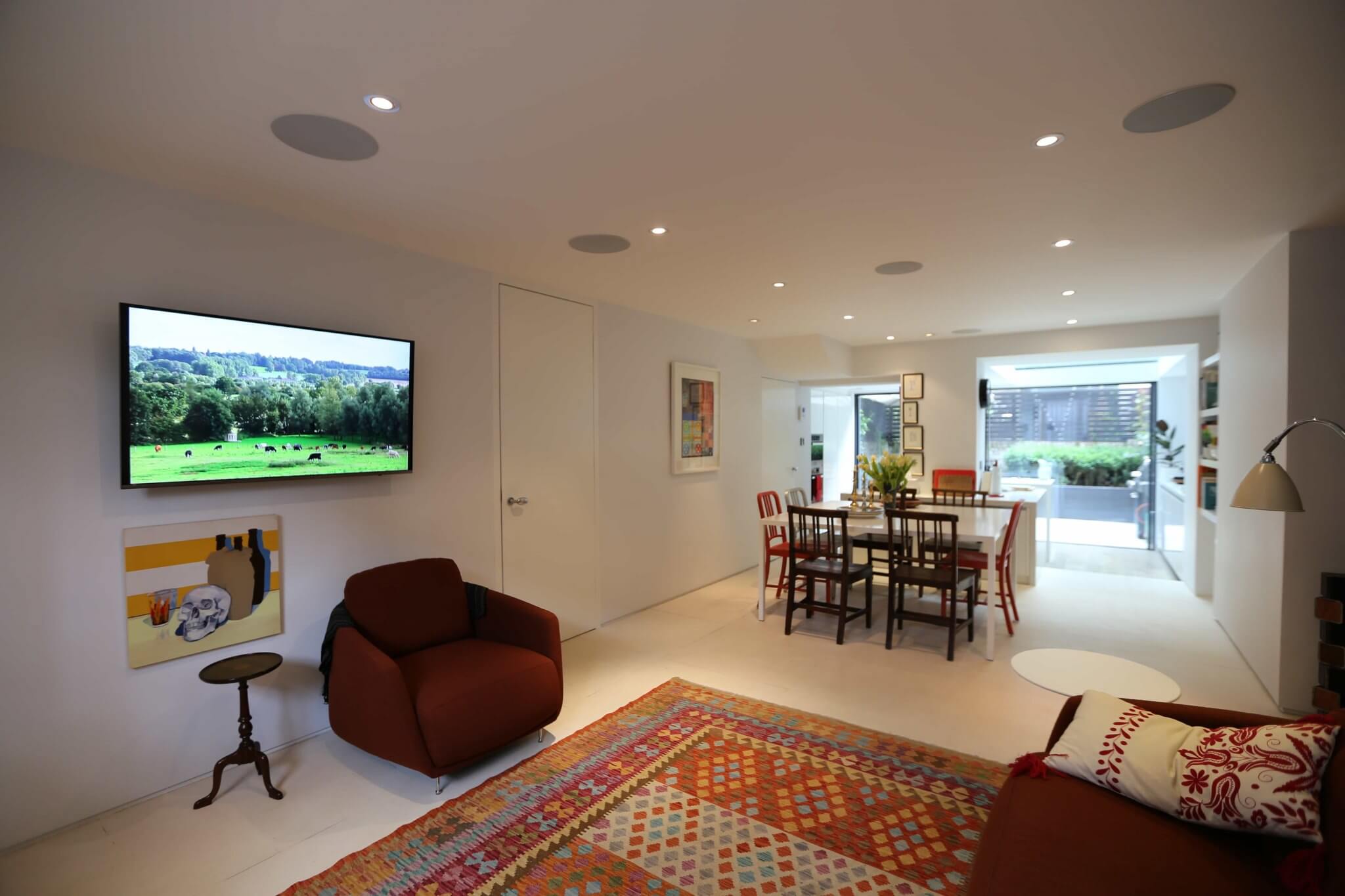
Any video source — streaming, satellite, Blu-ray, Kaleidescape — distributed to any display in the property via Crestron’s NVX AV-over-IP platform. Sources are selected from any control point; the system handles switching, scaling and audio routing automatically. Crestron’s video distribution is technically superior to almost anything else available at this level — 4K, HDR, virtually zero latency, and scalable to any number of sources and displays.
Climate
Crestron Home integrates with a wide range of HVAC systems via its growing library of extension drivers — including Airzone (updated in OS 4.4 to eliminate the need for complex configuration) and CoolAutomation. Room temperature, humidity, underfloor heating and air handling can all be managed from the same interface as lighting and AV. Scheduling and occupancy-based automation ensure rooms are at the right temperature when they need to be, without wasting energy when they do not.
Security and Access
Crestron Home supports video doorbell integration, CCTV cameras, alarm panels, door locks — including Crestron’s own EX Locks and the Yale Pro 2 Deadbolt — and access control. The Smart Access feature, updated in OS 4.9, supports recurring and temporary access codes — useful for domestic staff, contractors, housekeepers and holiday guests who need time-limited entry. All access events are logged and visible in the app.
EV Charging and Energy
OS 4.4 introduced EV charging integration via the Phoenix CHARX and a TIG driver, allowing homeowners to monitor and control home EV charging from within the Crestron Home app. Tesla vehicle integration — via a driver from Intrinsic Dev — extends this to HVAC preconditioning, charging status and lock settings directly from the Crestron interface. Energy usage monitoring gives a whole-home view of consumption, supporting more informed decisions about usage and efficiency.
Crestron Home OS in 2026 — What’s New
Crestron Home is an actively developed platform. The OS has received regular significant updates throughout 2025 and into 2026, each adding meaningful new capability. Here is the current picture.
OS 4.9 — January 2026
The most recent release adds Smart Access enhancements including recurring and temporary access for door locks — allowing time-limited access codes for contractors, domestic staff and guests without requiring permanent access. This was a frequently requested feature from clients managing properties with regular household staff or seasonal visits.
OS 4.8 — December 2025
Whole-home shading takes centre stage. OS 4.8 introduces unified shade control across the entire property — the same logic that has governed lighting scenes in Crestron Home now applies to shading, so blinds and lights can be managed together in a truly integrated way. Cevo Mini Remote support is expanded, giving clients a single handheld device for volume, lighting, shading and entertainment without needing to reach for a touchscreen.
OS 4.6 — July 2025
A comprehensive overhaul of multi-room audio. Faster access to music from any control point, improved personalisation per room and user, and deeper integration with streaming services. Apple Music integration is native — no additional apps, no switching interfaces. This update elevated Crestron Home’s music control from functional to genuinely elegant.
OS 4.4 — April 2025 (announced at ISE 2025)
The most feature-rich update of the cycle. Weather-based automation via the Tempest Weather System allows shades, outdoor systems and climate to respond dynamically to hyperlocal real-time weather data — sunlight intensity, wind, rain — without manual input. EV charging integration brings home energy management into the Crestron ecosystem. Expanded KNX integration simplifies projects where existing KNX infrastructure needs to be retained. The DGE-1000 Digital Graphics Engine — announced at ISE 2025 — allows the Crestron Home interface to be displayed on large third-party screens, combining display, control and streaming in a single device.
80 Series Touchscreens — Now Available
Crestron’s new 80 Series touchscreens for residential applications, announced in January 2026, are now released and available through authorised Crestron dealers. Built with native Crestron Home OS integration, PoE+ and Wi-Fi connectivity and advanced proximity sensing, the 80 Series represent a significant step forward in wall-mounted control panel design — more adaptable, more visually refined and more capable than their predecessors. For clients specifying a new installation, they are the touchscreens we now recommend.
Hardware — Touchscreens, Remotes and Keypads
Crestron designs and manufactures its own control hardware — one of the clearest advantages the platform has over competitors that rely on third-party interfaces.
Touchscreens
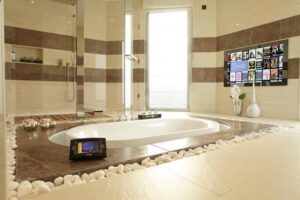
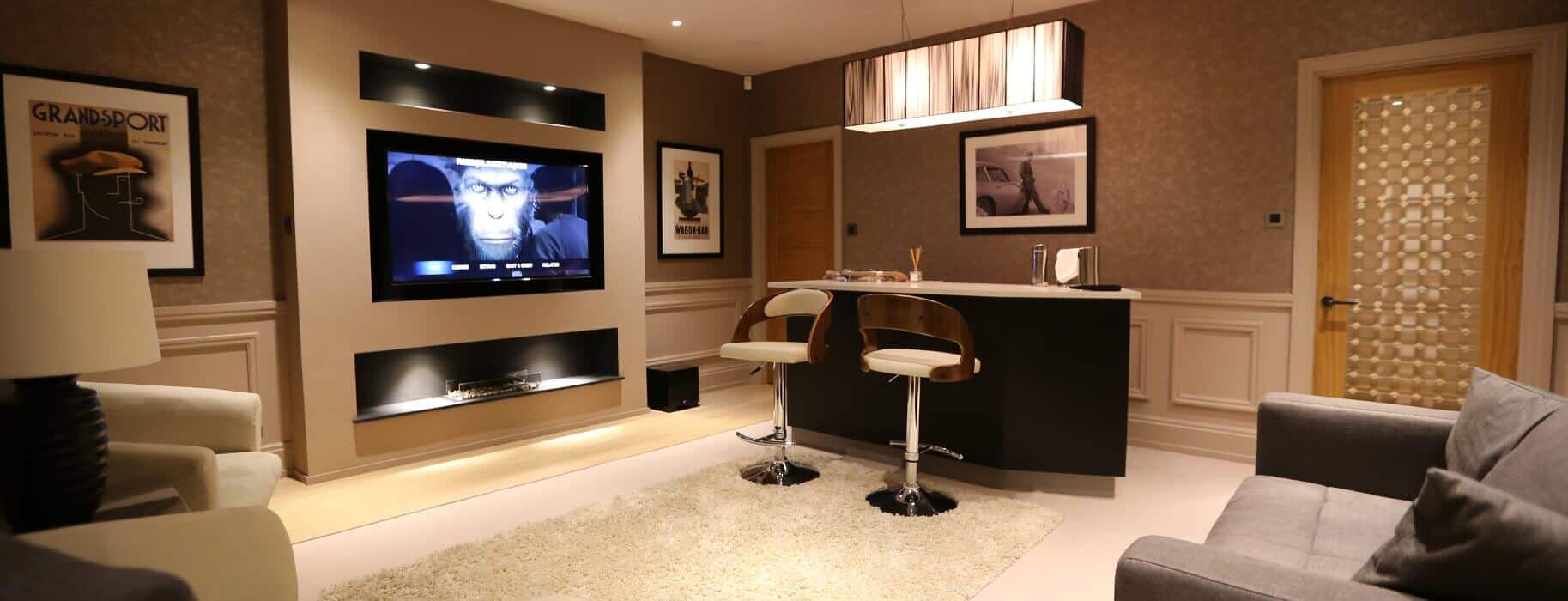
Wall-mounted touchscreens are the centrepiece of most Crestron Home installations — displaying the full system interface in a format that is intuitive for every member of the household. The current range includes various sizes from compact 5-inch panels to large 24-inch displays, all running native Crestron Home OS. The new 80 Series adds proximity sensing — the screen wakes as you approach — and improved PoE+ connectivity that simplifies installation. For clients who want the interface on a larger display anywhere in the home, the DGE-1000 graphics engine enables the Crestron Home interface on any compatible third-party screen.
The Cevo Mini Remote
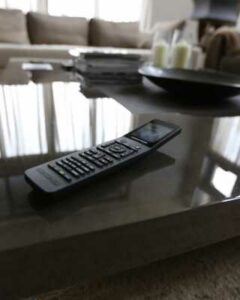
The Cevo Mini Remote — refreshed at ISE 2025 with a new white finish, ergonomic textured back and updated navigation buttons — is a handheld device that puts lighting, shading, volume and entertainment control in the palm of the hand. OS 4.8 significantly expanded its shading capabilities, making it a genuinely comprehensive single-device controller. A new horizontal charging dock keeps it accessible without requiring it to be plugged in. For clients who prefer a handheld control to a wall-mounted touchscreen in certain rooms — a primary bedroom or a media room — it is an excellent option.
Keypads and Dimmers
Crestron’s residential keypad and dimmer range spans styles from understated to architectural — flush-mounted, available in multiple finishes and button configurations. These provide physical control of lighting scenes, AV sources and system functions without requiring a touchscreen. For rooms where a touchscreen is not appropriate — a master bathroom, a guest room, a service corridor — keypads provide reliable, tactile control that does not depend on battery charge or a screen to navigate.
The Crestron Home App
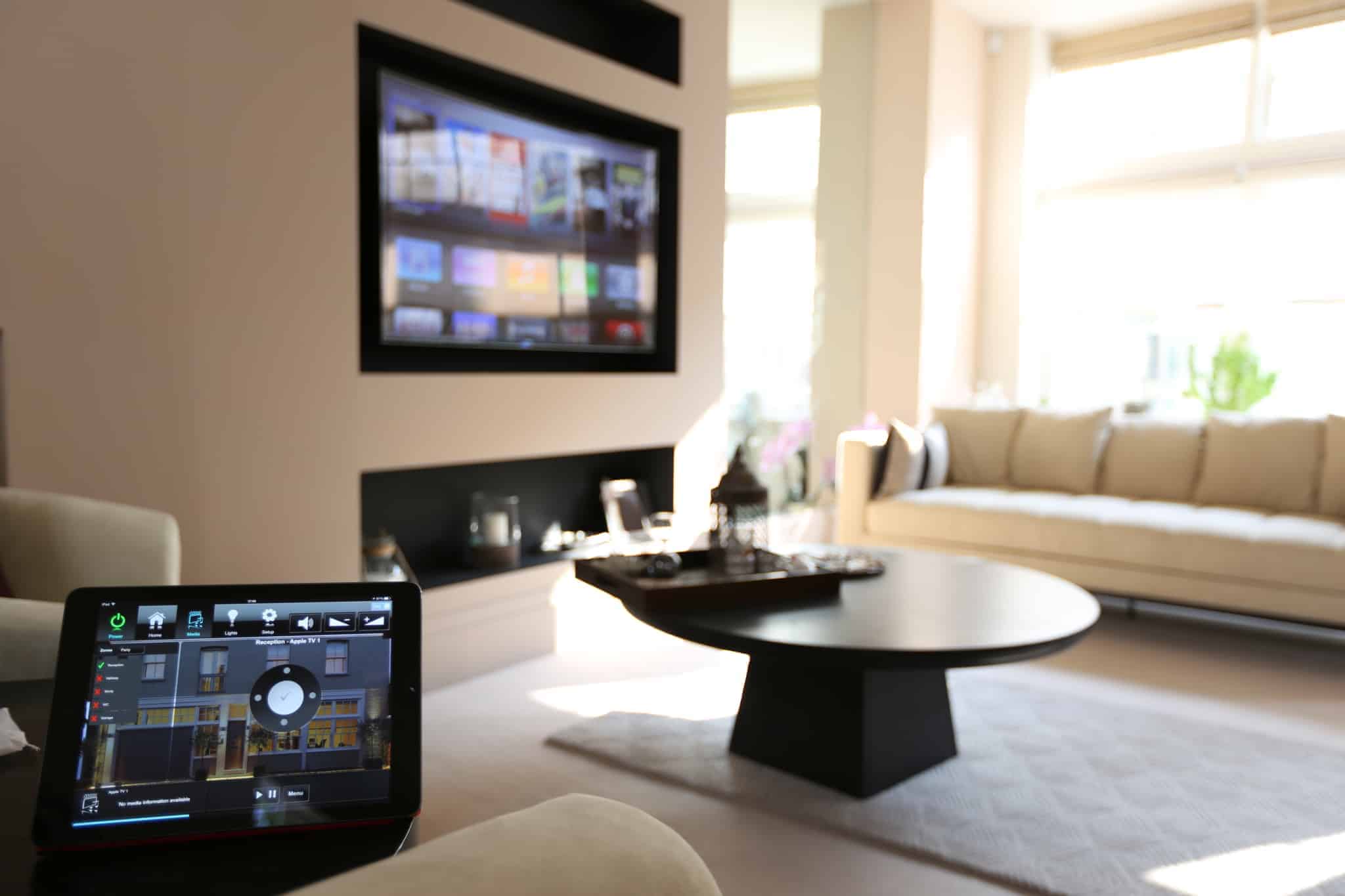
The iOS and Android app provides full remote access to the system — from anywhere in the world, as long as the processor has an internet connection. Lighting, shading, temperature, security, music and video can all be monitored and controlled remotely. Geofencing allows the system to respond automatically as the homeowner approaches or leaves the property. The app interface is consistent with the touchscreen experience — the same layout, the same logic, the same behaviour — so there is no learning curve when switching between devices.
Crestron Home and Lutron — Better Together
This deserves a dedicated section because it is one of the most frequently asked questions we receive — and because the answer is nuanced.
Crestron Home includes its own capable lighting control using Crestron dimmer modules. For most projects, this is perfectly adequate. But for clients for whom the quality of the lighting experience is a high priority — the smoothness of the dimming curve, the design of the keypads, the depth of scene programming, the integration of motorised shading — we almost always recommend pairing Crestron Home with Lutron for the lighting layer.
The reason is simple: Lutron has spent over sixty years doing one thing, and they do it better than anyone else. Their dimming technology, their keypad design — the Palladiom, Alisse and Vierti ranges — and their motorised shading systems represent the pinnacle of what dedicated lighting control can be. Crestron is the most capable and flexible automation platform available. Combining the two gives you the best lighting system in the world inside the best automation platform in the world.
Crestron Home integrates natively with Lutron Homeworks QSX and RadioRA 3. Lutron manages all lighting and shading circuits; Crestron Home provides the unified interface and automation logic. From the homeowner’s perspective, it is one system — one app, one keypad command, one scene. Behind the scenes, each platform is doing what it was born to do.
Custom Controls have been delivering Crestron and Lutron combined installations since the late 1990s. It is our most frequently specified configuration for significant residential projects, and the one we are most experienced in delivering.
Is Crestron Home Right for Your Project?
Based on our experience across hundreds of installations, here is our honest assessment of when Crestron Home is — and is not — the right answer.
Crestron Home is the right choice if:
- You want a premium whole-home automation system with a proven, intuitive interface
- Your project is a new build, renovation or retrofit of a luxury home of any size
- You want multi-room AV, lighting, climate and shading under a single control interface
- You value fast deployment and efficient ongoing support over bespoke programming depth
- Your integration requirements are within the Crestron Home extension ecosystem — which now covers the vast majority of common residential devices and systems
- You want over-the-air updates that keep the system current without additional cost or site visits
Crestron Custom may be more appropriate if:
- Your project requires a completely bespoke touchpanel interface — designed to match a specific interior scheme rather than working within a defined visual framework
- You have unusual integration requirements that are not covered by the Crestron Home extension library
- The project involves significant legacy infrastructure — older building management systems, unusual protocols or proprietary third-party hardware — that requires custom driver development
- The scale and complexity of the project is such that the customisation depth of a bespoke system is genuinely necessary
It is worth noting that many of the largest and most prestigious homes we have worked on have used Crestron Home rather than Custom — because Crestron Home, in 2026, is capable enough for all but the most extreme requirements. The days when Custom was the only serious option for a substantial residential project are behind us.
How Much Does Crestron Home Cost in the UK?
We are asked this constantly, and we will give a straight answer — with the caveat that every project is different and a meaningful quotation requires understanding the scope.
The cost of a Crestron Home installation for a mid-size luxury home in the UK — covering whole-home lighting, multi-room audio, video distribution to four to six rooms, climate integration and security — is driven by the size of the property, the number of AV zones, the complexity of the integration and the tier of hardware specified. Larger properties, more AV zones, more complex integration, higher-specification hardware and the addition of Lutron for lighting and shading will all increase the scope.
Projects combining Crestron Home with Lutron Homeworks QSX across a large London or Home Counties property — with eight to twelve AV zones, full Lutron lighting and shading, home cinema and enterprise networking — are considerably larger undertakings, and our Dubai and alpine projects vary widely again with the scale of the estate and the systems it needs.
The right number for your project depends entirely on what you need the system to do. We provide free, detailed consultations and itemised quotations without obligation. There are no hidden costs and no vague estimates — just an honest breakdown of what the system requires.
Contact us to discuss your project and get a quotation.
Why the Installer Matters as Much as the System
This is the point that most Crestron Home articles do not make — because most Crestron Home articles are written by manufacturers or trade publications rather than installers who live with the consequences of a badly configured system.
Crestron Home is configured using a dealer app. It does not require custom programming. But it does require an installer who understands networking at a level most electricians do not, who knows how to design an AV distribution system that will perform correctly under load, who understands the acoustic and calibration requirements of a multi-room audio system, and who has the experience to anticipate integration edge cases before they become problems on site.
A Crestron Home system configured by an inexperienced dealer can be frustrating — slow to respond, unreliable under certain conditions, with automations that don’t quite work as expected and interfaces that don’t quite reflect how the household actually lives. The same system, configured by an experienced dealer, feels effortless. The difference is not the hardware. It is the expertise behind it.
Custom Controls have been Crestron certified dealers since 1998. We have installed Crestron systems in properties ranging from London apartments to Dubai estates. We are five-time Crestron Integration Award winners — including Best International Project. We know what good looks like, and we know how to deliver it consistently.
Frequently Asked Questions
What is Crestron Home?
Crestron Home is Crestron’s streamlined residential automation platform — a whole-home control system covering lighting, shading, AV, climate, security and access, configured using a dedicated app rather than bespoke programming. It delivers a premium smart home experience with faster deployment and lower cost than a fully custom Crestron system, without compromising on quality or reliability.
What is the difference between Crestron Home and Crestron Custom?
Crestron Home is configured using a dealer app — consistent, fast to deploy and working within a defined framework. Crestron Custom is programmed from scratch, giving unlimited flexibility and the ability to integrate virtually any device or create any interface. For most luxury residential projects, Crestron Home delivers everything the client needs. Custom is reserved for the most complex, unusual or bespoke requirements.
What is the latest version of Crestron Home OS?
OS 4.9, released January 2026. Significant recent updates include OS 4.8 (December 2025 — expanded whole-home shading, Cevo Mini Remote), OS 4.6 (July 2025 — music and personalisation overhaul), and OS 4.4 (April 2025 — weather automation, EV integration, DGE-1000 graphics engine).
Can Crestron Home work with Lutron?
Yes — and this is one of our most frequently specified configurations. Lutron handles all lighting and shading control with its characteristic precision; Crestron Home provides the unified platform for AV, climate and security. From the homeowner’s perspective it is one seamless system. We have been delivering this combination for over 25 years.
How much does Crestron Home cost in the UK?
The cost of a whole-home Crestron Home installation depends on the size of the property, the number of AV zones, the complexity of the integration and the hardware specified. Larger and more complex projects — particularly those combining Crestron Home with Lutron Homeworks QSX across a large property — are considerably bigger undertakings. We provide free, detailed, no-obligation quotations. Contact us to discuss your project.
Does Crestron Home need a professional installer?
Yes. Crestron Home must be installed and configured by a certified Crestron dealer. The quality of the installer is as important as the hardware — a well-configured system is transformative; a poorly configured one is not. We have been certified Crestron dealers since 1998 and are five-time Crestron Integration Award winners.
Talk to a Crestron Home Specialist
We offer free consultations for prospective Crestron Home projects — at our London office, our Cheshire office, at the Crestron Experience Centre in London, or at your property. There is no obligation and no sales pressure — just an honest assessment of what the right system for your project looks like.
Contact Custom Controls to discuss your Crestron Home project.