Sonic Sanctuary: A Zen Room for a Luxury Bunker
Zen Room Design for Underground Living
Published October 2026 · Custom Controls · Smart home, lighting and audio integrators since 1998
A luxury bunker is built to keep people safe, but safety alone does not keep people well. Spend more than a few days below ground and the absence of daylight, weather, birdsong and moving air starts to tell, however good the finishes are. This design brief sets out a room that answers that problem directly: a Sonic Sanctuary, a zen room that brings light, sound, scent, air and touch together into one system so that the people using it can step out of the bunker and, for an hour, feel as though they are somewhere else entirely. The brief was written for a private client building a bunker beneath a country estate. As with every project of this kind, the client’s identity and the location stay confidential, and discretion is part of the service we provide. What we can share is the thinking: the technology, the evidence behind it and the engineering that makes it work underground.
Why Subterranean Spaces Need a Sensory Room
The people who know most about living without a window are the crews of polar research stations, and decades of research on them point to the same pressures: isolation, confinement, monotony and the loss of a normal day and night. Studies of Arctic and Antarctic stations link those conditions to disturbed sleep, low mood, irritability and friction within the group, and they show that the design of the habitat itself, from its lighting to its sense of space, affects how well people cope. A bunker shares every one of those conditions, and it adds the knowledge of why you are there. Environmental psychology offers the other half of the argument. Stress reduction theory and attention restoration theory both hold that natural scenes, sounds and textures help the nervous system recover, and laboratory work supports that. In one Swedish study, people recovered from a stressful task faster when they listened to nature sounds than when they listened to road traffic or ambient noise, measured by the fall in their skin conductance. A bunker cannot offer a garden, but it can offer a room engineered to deliver the same cues, and that is the purpose of the Sonic Sanctuary.
The risk to design against is the uncanny: an artificial nature experience that feels synthetic, looped or claustrophobic does more harm than good. Every decision in this brief is aimed at believability, from sound that really arrives from above to air that actually moves when the wind blows.

Lighting

Climate

Audio

Acoustics

Smart Home
The Health Benefits of Regular Sessions
The case for a room like this rests on what meditation, slow breathing and time in natural surroundings do for the body and mind, and the evidence is stronger than many people expect. A major review published in JAMA Internal Medicine pooled 47 randomised trials involving more than 3,500 people and found moderate evidence that meditation programmes improve anxiety, depression and pain. In a 2022 trial in JAMA Psychiatry, eight weeks of mindfulness-based stress reduction proved as effective at reducing anxiety as escitalopram, a widely prescribed anti-anxiety medication, across 276 adults with diagnosed anxiety disorders.
The benefits are physical as well as psychological. A 2017 meta-analysis found that mindfulness practice reduces physiological markers of stress, including cortisol, blood pressure and heart rate. Sleep improves too: in a randomised trial of older adults with sleep problems, mindfulness training improved sleep quality considerably more than a programme of sleep hygiene education. Even very short practice counts. In a Stanford study, five minutes a day of slow, exhale-focused breathing for a month improved mood more than the same time spent in mindfulness meditation, and lowered resting breathing rate. The American Heart Association has gone as far as to say that meditation may reasonably be considered alongside established lifestyle measures to reduce cardiovascular risk, while noting that larger trials are still needed.
The common thread in all of this research is regular practice. A single session can lower heart rate and leave someone calmer for the rest of the day, but the lasting changes in anxiety, sleep and blood pressure come from returning to it, day after day. That is the real purpose of the Sonic Sanctuary. By removing every barrier to practice, from finding a quiet space to knowing what to do once you are in it, the room makes a daily 30-minute session easy to keep up. Below ground, where sleep, mood and relationships are all under more pressure than usual, that habit may be worth more than any other feature of the bunker. The room supports wellbeing; it is not a treatment for any medical condition, and anyone with a health concern should continue to follow their doctor’s advice.
The Design Brief: Outcomes, Not Settings
Nobody wants to set a colour temperature, a fan speed and a diffuser schedule before they can relax. The brief therefore turns the usual control logic around. The user chooses an outcome, a journey such as Dawn Forest Reset, Midnight Alpine Rain or Deep Sleep Drift, and the room runs every system to deliver it over the length of the session. Lighting, spatial audio, scent, airflow, temperature, humidity and the seats all follow one timeline, written once and recalled at a touch, so the experience feels authored rather than assembled. The services below carry most of that work, and each one is designed to disappear behind the experience it creates.
Light: Artificial Skylights and Circadian Lighting
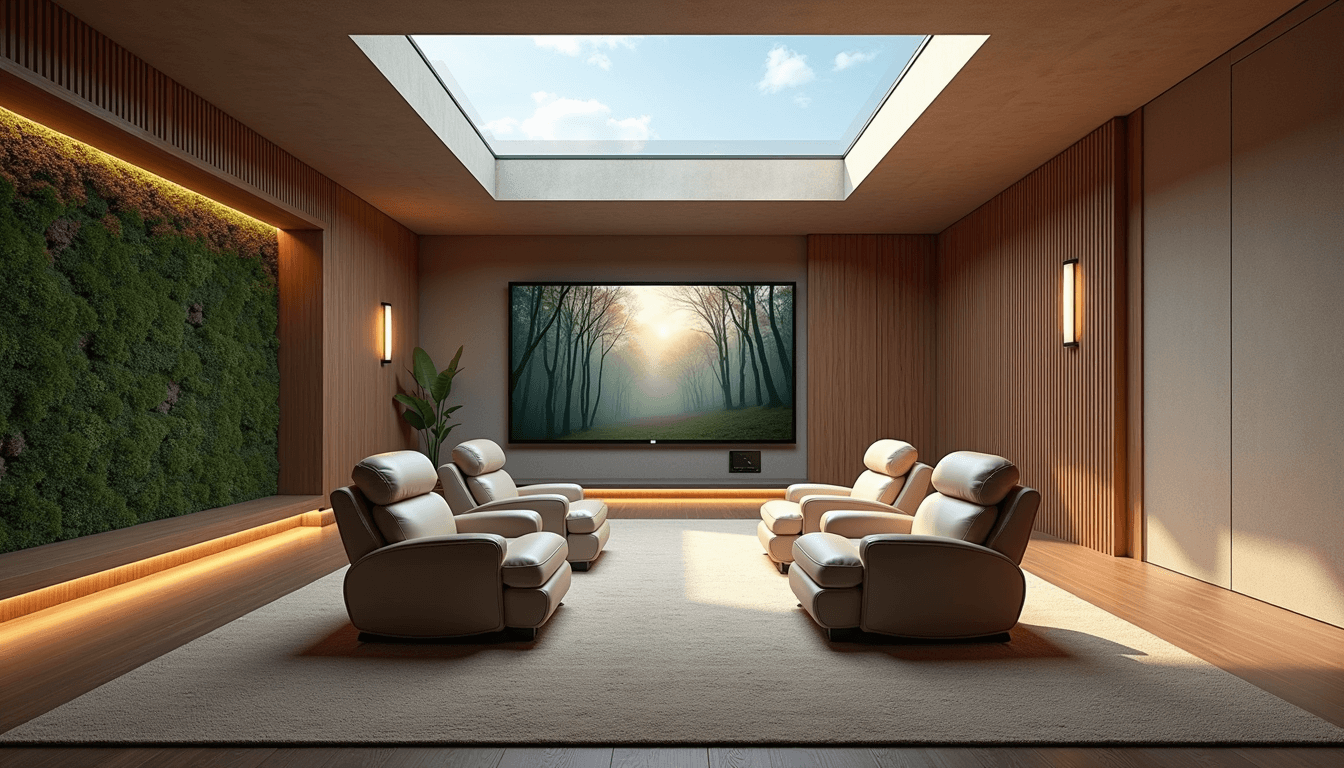
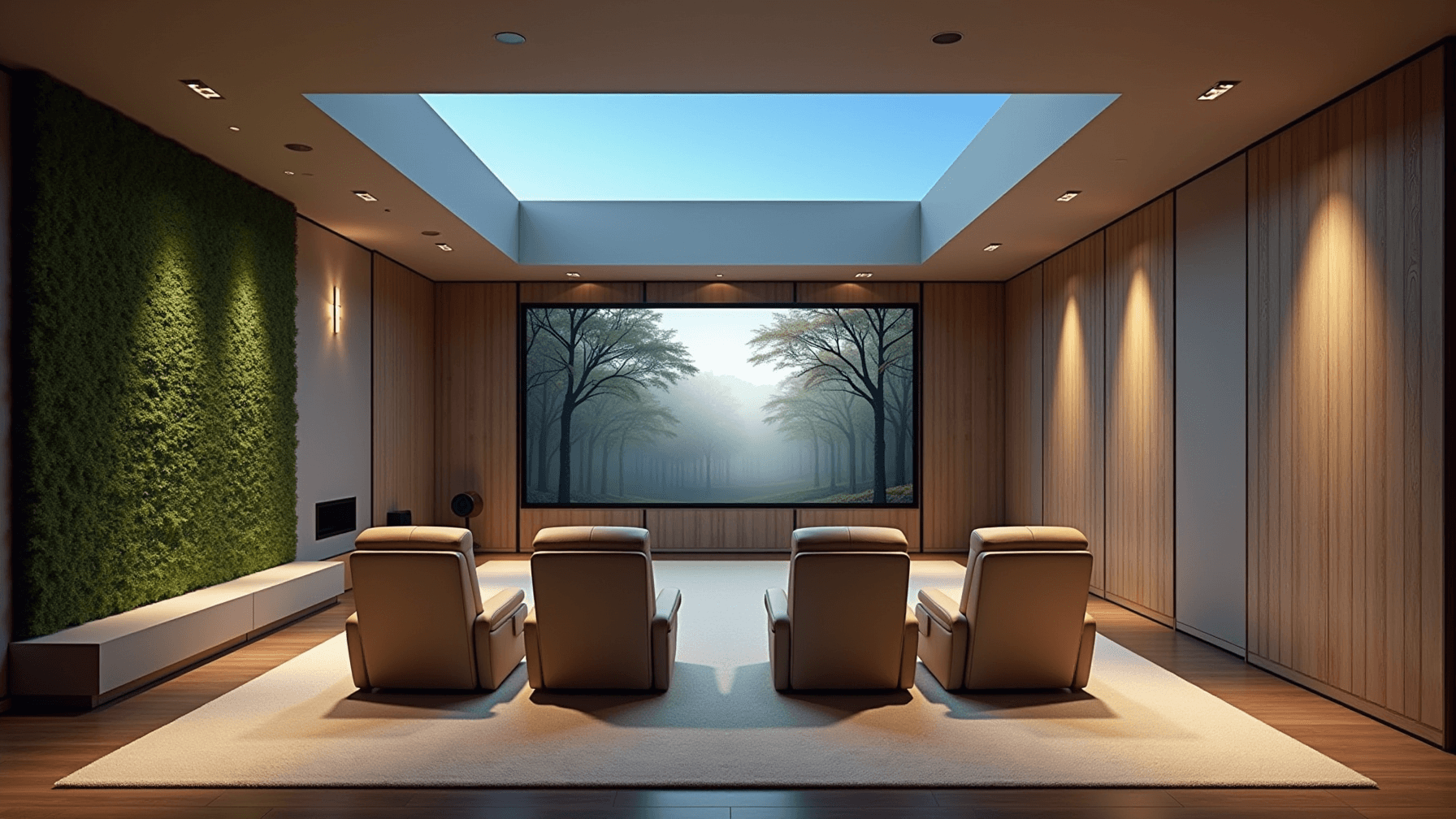
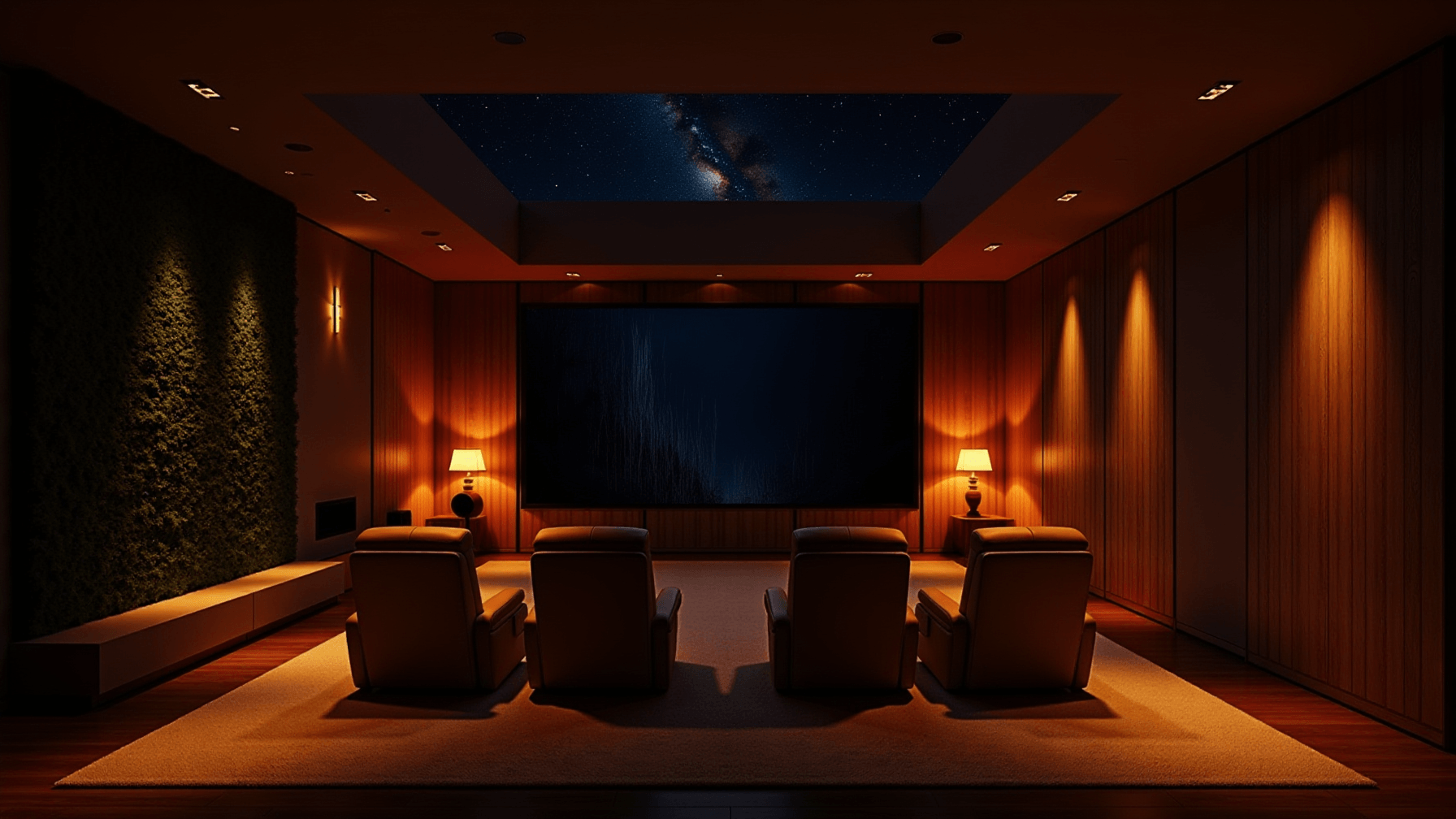
Light does two jobs in this room. The first is psychological: it has to read as daylight, not as a lamp. Artificial skylights such as CoeLux reproduce the optical effect of Rayleigh scattering, the process that makes the sky blue, so the ceiling appears to open onto a deep sky with a distant sun casting sharp, directional light. In a windowless space that sense of depth and direction is one of the most powerful cues the room can give, and it is the centrepiece of the ceiling design.
The second job is biological. The rest of the lighting is tunable white, controlled through Lutron HomeWorks QSX, so the colour temperature and intensity follow a circadian lighting programme: bright and cool in the morning, warm and dim in the evening, with very little blue light after dark. Underground, this room can act as the bunker’s clock. The dawn journey becomes the household’s daily sunrise, and the evening journey winds the body down towards sleep.
Quality matters as much as colour. Every driver is specified to be flicker-free at deep dimming levels, following the guidance in IEEE 1789, because flicker that nobody consciously notices can still cause headaches and fatigue in a room designed for stillness. Display walls or ceiling canvases showing slow canopy movement, drifting cloud or a night sky are calibrated to the same white point as the room lighting, so screen and room read as one view rather than two light sources competing.
Sound: Spatial Audio and Field Recordings
Standard stereo breaks the illusion the moment you close your eyes. The room is designed around immersive, object-based spatial audio, with loudspeakers in the ceiling, walls and floor and subwoofers decoupled from the structure, so rain falls from above, wind moves through the trees behind you and a stream runs past at floor level. The source material is just as important: long, high-resolution ambisonic field recordings captured on location, or a generative engine that never repeats, because a loop that the ear recognises after ten minutes undoes everything else the room achieves.
The room itself has to stay out of the way. A recording of a forest already contains the forest’s acoustic, so the room is treated to be acoustically dead, with a very short reverberation time, to stop its own reflections being layered on top. Background noise is the other enemy. We set a design target of NR15 or lower, with every amplifier, processor and display controller housed in a ventilated rack outside the room, and the acoustic treatment concealed behind fabric so the room looks calm as well as sounding it.
Solo or Together: A Zen Room for Couples and Families
The Sonic Sanctuary is designed to work at two scales. For one person, the experience can be completely personal: headphones or speakers built into the headrest carry content that needs a separate signal to each ear, such as binaural beats, while the room provides the light, scent and air around them. That means one member of the household can run a deep meditation journey without imposing it on anyone else.
The room is equally equipped for group sessions, and this is where it earns its place in a family bunker. The spatial audio, lighting, scent and airflow fill the whole room, so a couple or a family can share the same journey and relax as a unit. Time spent together without screens or conversation, in a calm and beautiful space, is valuable anywhere; below ground, during a long stay, it may be one of the most important things a bunker can offer.
Within a shared session, each seat is still its own zone. Individual controls let each person adjust the vibration intensity and seat temperature of their own seat, so a child who runs cold or a partner who dislikes vibration is catered for without changing the programme for everyone else.
Anatomy of a 30-Minute Session
Sessions are built around 30 minutes, long enough to reach a deep state of relaxation and short enough to fit into any day, although every journey can be shortened to ten minutes or extended to an hour. A Dawn Forest Reset shows how the systems work together across that time. In the first five minutes, the arrival, the user settles into a warm seat beneath a soft dawn sky, with the faintest note of pine in the air and the sound of the bunker giving way to a distant woodland. The radar and the user’s wearable take a baseline reading of heart rate and breathing while nothing is being asked of them.
From about the fifth minute, the breath stage begins. The light, the airflow and the sound start to swell and fall at the user’s resonance breathing rate, slowing gradually from their natural pace, and heart rate usually begins to fall within a few minutes. From around the twelfth minute comes the deep stage: the soundscape thins to a few distant birds and moving leaves, a quiet isochronic layer sits beneath it, the seats pulse very slowly and the air cools by a fraction. This is where the AI does most of its work, holding the user in the deep stage for as long as their heart rate variability stays high, and easing back if their readings show they are not yet settled.
The final five minutes are the return. The sky brightens towards full morning, the scent lifts to fresh fir and juniper, the seats ventilate gently and the birdsong builds, so the user comes back to the day alert rather than drowsy. As they stand, the touchscreen shows a short, optional summary of the session: how far their heart rate fell, how their heart rate variability changed and how slowly they were breathing at the deepest point. Over weeks, those summaries become a record of how regular practice is changing the user’s resting numbers, which is one of the most motivating reasons to keep coming back.
Entrainment, Breath Pacing and Vibroacoustics
Brainwave entrainment is often oversold, so the brief treats it carefully. Binaural beats only work when each ear hears a slightly different tone, which means they require headphones or headrest speakers; played through room loudspeakers, the two tones simply mix in the air. The evidence for them is moderate: a meta-analysis of 22 studies found a medium overall effect on anxiety, attention and pain, with longer exposure working better. For room-wide sessions we use isochronic tones instead, which work through loudspeakers, layered quietly beneath the nature soundscape rather than replacing it.
Breath pacing has the strongest evidence of any technique in the room. Slow breathing at around six breaths a minute, the so-called resonance frequency, reliably increases heart rate variability, a marker of a calm, parasympathetic state. The Sonic Sanctuary paces breathing without a voice or a screen: the light gently swells and fades, the airflow rises and falls and the sound breathes with them, so the whole room leads the user towards that rhythm.
Vibroacoustic transducers in the seats turn the low end of the soundtrack into physical sensation, from the rumble of distant thunder to a slow pulse beneath a meditation. We present this as part of the experience rather than as a therapy. A 2022 randomised crossover trial found that adding 40 Hz vibration to nature sounds did not improve heart rate variability beyond the nature sounds alone, and it raised heart rate during the session, so intensity is kept low, tied to the content and always under the user’s control.
Scent: Forest Bathing Through the Air System
Scent is the sense most directly wired to memory and emotion, and it completes the illusion. The journeys draw on three families of blend: forest bathing blends of hinoki, sugi and pine, inspired by the Japanese practice of shinrin-yoku; petrichor accords that recall rain on dry earth; and alpine blends of Siberian fir, black spruce and juniper. Natural timber such as hinoki or cedar in the room’s joinery adds a quiet, permanent background note. A small Japanese study found that vaporising hinoki oil in hotel rooms overnight increased natural killer cell activity in the people sleeping there, though the evidence base for health effects remains limited.
How the scent is delivered matters more than the oils themselves. Ultrasonic diffusers are excluded: they release water mist carrying dissolved minerals, which research from the University of Alberta has shown can raise fine particulate levels indoors, and they add humidity the climate system cannot control. Instead, cold-air nebulising diffusers inject scent into the room’s supply air, under the control system’s direction, so each scent can be brought in, held and faded in step with the journey. Ozone treatment is excluded too, because ozone reacts with the terpenes in pine, fir and citrus oils to form formaldehyde and ultrafine particles. Between sessions the room is cleared with activated carbon filtration and a high air-change purge.
Touch: Thermal Comfort, Radiant Warmth and Micro-Breezes
Wind in the trees sounds wrong in still air. Low-noise, variable-speed directional fans concealed in the ceiling and walls are synchronised with the soundtrack, so a gust in the recording arrives as a gentle, cool movement of air across the skin, and a storm builds as a stronger, gustier flow. Rain journeys add a slow rise in humidity and a small drop in air temperature, handled by a dedicated humidifier and dehumidifier so the change is controlled and fully reversed afterwards. Humidity and room air temperature change slowly, so these effects are programmed as long arcs across the session rather than sudden events.
For fast changes, the brief moves the heat to the body. Heated and ventilated seats can make a person feel warmer or cooler within moments, far quicker than the air in the room can follow, so the programme can deliver the chill of a forest at dawn or the warmth of a sunlit clearing on cue. Radiant panels in the ceiling and walls add the sensation of sun on the skin while the air itself stays cool and crisp, which is exactly the combination of a bright winter’s day in the mountains. All of it runs through the same climate control logic as the rest of the bunker.
Control: Choosing a Journey
A room this capable needs a proper interface to choose from it. A Crestron touchscreen at the entrance and a handheld screen at the seats let users browse the journeys, preview what each one does, set their personal preferences for vibration and temperature, and see how far through a session they are. Once a journey starts, the screen dims to black so it never competes with the experience, and a simple physical keypad by the seats handles the essentials: pause, volume and end session.
Behind the interface sits the adaptive engine described below, so the screen is also where each user manages their profile: which wearable they use, which goals they want a session to work towards and how much the room is allowed to adapt on their behalf. Guests can use the room without a profile at all, choosing a journey and letting it run exactly as written. The control logic is designed and programmed through our home automation work, so the sanctuary is part of the bunker’s wider system rather than a standalone gadget.
Everything runs locally. In a bunker, an internet connection cannot be assumed, so every soundscape, video, scent programme and user profile is stored and processed on site, with a content library large enough that a long stay never becomes repetitive.
AI and Biometrics: Sessions That Adapt in Real Time
The most powerful idea in the brief is a room that listens to the body and adjusts the session to suit it. It draws on two sources of data. The first needs nothing worn at all: contactless 60 GHz radar sensors in the ceiling can measure breathing and heart rate without wearables or cameras, so there is no imaging in a private space and nobody is asked to strap anything on. The second is the wearable the user already owns. Garmin’s Health SDK streams heart rate, enhanced beat-to-beat intervals, respiration rate, Pulse Ox and stress level from a Garmin watch in real time, which gives the room both a live signal and context on arrival: a high stress score or a depleted Body Battery tells the system a great deal about how the session should begin. Commercial use of that stream is licensed through Garmin Health.
Garmin is not the only option. A Polar H10 chest strap transmits beat-to-beat intervals over Bluetooth and is the reference choice where heart rate variability needs to be measured accurately. An Apple Watch can stream live heart rate to a companion app while a session runs, and WHOOP can broadcast heart rate over Bluetooth. For meditation, a Muse EEG headband adds a view of brain activity alongside heart rate and breathing, which shows how settled the mind is as well as the body. Not every device streams live, though. Oura data, for example, syncs after the event, so it is best used for context such as the previous night’s sleep rather than for steering a session as it happens.
With that data, each user chooses a goal rather than a setting: lower stress, a lower heart rate, higher heart rate variability, deeper meditation or a guided breathwork session. Breathwork is where the feedback earns its place. Resonance breathing works best at an individual rate, usually somewhere between about four and a half and six and a half breaths a minute, and the system can find each person’s rate in a short assessment session, then pace every future session to it through light, airflow and sound. During a session the AI runs a closed loop. If heart rate is not falling, it slows the breath pacer, lengthens the exhale, warms the seat or softens the soundscape; once heart rate variability rises and stays up, it moves the journey on to its deeper stages.
The same intelligence works between sessions as well as during them. Through the day, the system monitors each user’s health statistics, synced locally from their wearable: stress levels, heart rate, Body Battery, the previous night’s sleep and, where the device records it, overnight heart rate variability. When the readings show stress running high for a sustained period, a short or broken night or a heart rate that has not settled, the AI recognises that a session would be of benefit and suggests one through a discreet notification on the user’s phone or watch, or on the touchscreens around the bunker. It also chooses the programme to achieve the goal: a breathwork session paced to the user’s resonance rate to bring down a stressful afternoon, a Deep Sleep Drift to make up for a poor night, or a gentle Dawn Forest Reset to restart a difficult morning. The recommendation is an invitation rather than an alarm, and each user decides how often the system may prompt them, or switches the suggestions off entirely.
Over time the system learns what works for each person, building a personal baseline and noting which journeys, scents and temperatures bring their heart rate down fastest, so each session works better than the last. In a group session, the room sets a shared tempo while each person’s seat and headrest audio adapt to them individually. All of the processing runs on site, with no cloud service, and every user’s data stays in the bunker. Biometric and health data is treated as special category data under UK and EU data protection law, so each user opts in, can see what is held and can delete it at any time. The system is designed for relaxation and wellbeing, not medical diagnosis.
Bunker Engineering: Air, Power and Isolation
Underground, the room has to be engineered as carefully as it is designed. Acoustically, it is built as a room within a room, with a floated floor and decoupled walls and ceiling, so that ventilation plant, pumps and generators elsewhere in the bunker cannot be heard. Every duct entering the room is attenuated, and air speeds at the grilles are kept low enough to be silent.
Air needs the most thought. A protective bunker is normally held at a slight positive pressure, with its supply air drawn through filtration that removes nuclear, biological and chemical contaminants. Essential oil vapour would load the activated carbon in those filters and reduce the capacity held in reserve for a real threat, so the Sonic Sanctuary is given its own recirculating carbon filtration and held at a slightly lower pressure than the corridor outside it, so that scent stays in the room while the bunker as a whole stays protected. Carbon dioxide and oxygen are monitored continuously, because a group relaxing in a sealed room will raise carbon dioxide quickly, and the ventilation responds automatically.
Power and safety complete the picture. Sessions can be scheduled to run from battery storage with generators off, giving true silence, which in turn calls for a fire strategy suited to both the batteries and the scent oils, which are flammable. Spare scent cartridges and filter media are stocked for a long stay, and preserved moss is specified rather than a living wall: in a sealed space, living planting adds humidity load and a risk of mould and spores.
Designing a Sanctuary for Your Home
The Sonic Sanctuary was designed for a bunker, but very little of it depends on being underground. The same combination of circadian lighting, spatial audio, scent, climate and adaptive control works just as well in a basement, a wellness suite beside a pool or gym, a dedicated meditation room or a quiet spare bedroom. In a room with windows, the artificial sky can give way to the real one, with motorised blinds and curtains framing the view and closing for darkness when the journey calls for it. What makes the space work is not any single product but the integration: one system, designed as a whole, so that every element follows the same journey.
That is the work we have done for high-end homes since 1998, and as five-time Crestron Integration Award winners, unique in EMEA, we design lighting, audio, climate and control as a single experience rather than a collection of separate trades. Every project starts with a conversation about how the space will be used, who will use it and how they want to feel when they leave. The technology follows from that brief, never the other way round, and the room is programmed, tested and refined until each journey feels effortless.
If you are planning a bunker, a basement or a wellness space and would like to explore a sanctuary of your own, contact us for a confidential discussion. We are happy to work alongside your architect, interior designer and building services engineer from the earliest stages of design, which is when a room like this is easiest and most cost-effective to get right.
Luxury Bunker Zen Room: Frequently Asked Questions
- What is a sonic sanctuary?
It is our name for a zen room that combines spatial audio, circadian lighting, scent, airflow, temperature and vibration into one system, so that users choose a journey and the room delivers the whole experience around them. - What are the health benefits of a zen room session?
Research on meditation and slow breathing shows benefits for anxiety, mood, sleep, blood pressure and stress hormones such as cortisol, particularly with regular practice. The room is designed to make a daily session easy, and it supports wellbeing rather than treating any medical condition. - How long is a session?
Sessions are built around 30 minutes, which is long enough to reach a deep state of relaxation, but every journey can be shortened to ten minutes or extended to an hour. - Do binaural beats work through room speakers?
No. Binaural beats need a slightly different tone in each ear, so they only work through headphones or headrest speakers. For group sessions through the room loudspeakers we use isochronic tones instead. - Is essential oil scent safe in a sealed bunker?
It can be, if it is delivered and cleared properly. We use cold-air nebulising diffusers rather than ultrasonic units, avoid ozone treatment, give the room its own carbon filtration so the bunker’s protective filters are not loaded, and purge the air between sessions. - Can a couple or family use the zen room together?
Yes. The room is equipped for group sessions, with spatial audio, lighting, scent and airflow filling the whole space, while each seat keeps its own vibration and temperature controls. Individuals can also use headphones or headrest speakers for a personal session. - Can the zen room use my Garmin or Apple Watch?
Yes. The room can take live heart rate and other data from a Garmin watch, an Apple Watch, a Polar chest strap or a WHOOP band, and it also has contactless radar sensors, so no wearable is needed. The data is used to adapt each session to your goal, such as lowering your heart rate or pacing your breathing. - Can the zen room tell me when I need a session?
Yes. The system monitors health statistics from your wearable through the day, such as stress, heart rate and sleep, and suggests a session when it would be of benefit. It then chooses the programme to match the goal, for example breathwork to lower stress or a sleep journey after a poor night. - Does the room work without an internet connection?
Yes. All content, programmes and user profiles are stored and processed on site, so the room works fully offline, which is essential in a bunker. - Can a zen room like this be built in an existing basement?
Yes. The same approach works in a basement or any windowless room, although the acoustic isolation, ventilation and ceiling depth for an artificial skylight need to be assessed at survey. - Why is the client not named?
Projects of this kind are confidential by nature. We never identify the client or the location of a protective space, and we only share the design thinking behind it.
Circadian Lighting → · Climate Control → · Multi-Room Audio → · Home Automation → · Contact Us →