
Motorised Blinds and Curtains

Motorised Blinds and Curtains for Luxury Homes
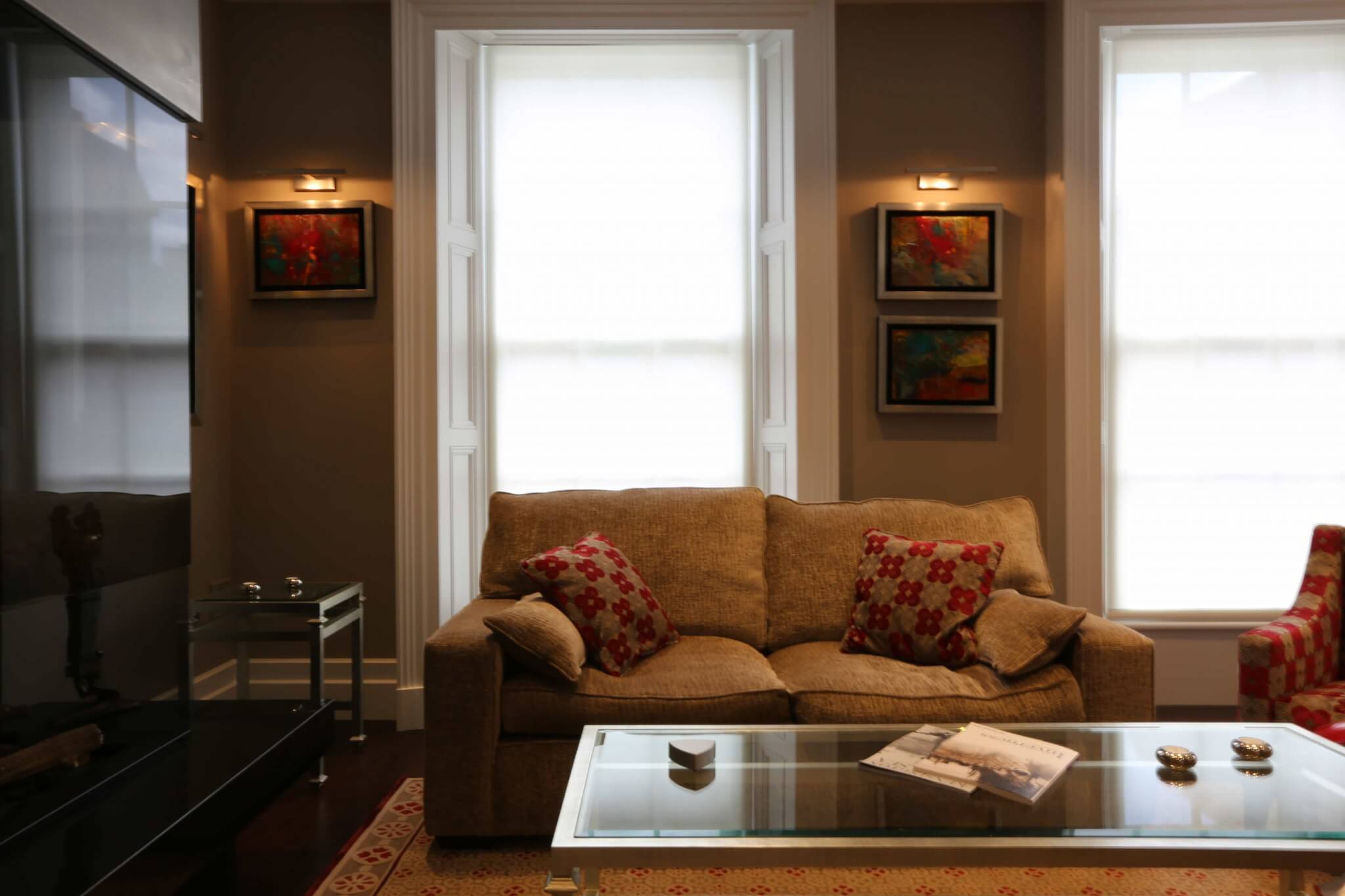
Motorised roller blinds and curtains, integrated with your lighting control and positioned automatically by the sun. Designed and installed with Lutron HomeWorks QSX and Crestron, for homes in London, Cheshire, the Alps and worldwide.
Automated Shading That Follows the Sun
A motorised blind is easy to buy and hard to specify. A remote-controlled blind from a retailer opens and closes. A specified shading system moves in step with the lighting, the cinema, the heating and the sun, from one keypad or one app, and does so quietly and identically in every room, every day. The difference is not the motor. It is the control system behind it, and the decisions made at the window before the ceiling is closed.
Custom Controls design and install motorised blinds and curtains as part of the lighting control system, which is how Lutron’s shading ranges are intended to be used and how we have specified them since becoming Lutron dealers and installers in 1998. For homes that run on Crestron, we also add Crestron blind controllers to electric blinds, so the blinds respond to the same scenes as everything else. Whichever platform runs the house, the aim is the same: daylight managed as deliberately as electric light.

Lighting

Design
Smart Home

Climate

Crestron
Roller Blinds, Curtains and Layered Shading
Shading is not one product. Roller blinds suit most windows and give the cleanest line, with fabrics that run from open-weave sheers that preserve the view, through translucent and room-darkening weights, to full blackout. Motorised curtains and drapery tracks suit bedrooms, formal rooms and large glazed walls, with straight and curved tracks, centre or side draw, and recessed tracks that conceal the entire mechanism in new construction. The best rooms often combine two layers, a sheer for the day and a blackout or drapery for the night, each on its own control, so the room can be set for glare, privacy or darkness independently.
Lutron’s Palladiom is its flagship roller blind, and Sivoia QS is its motorised drapery system. Both are programmed through the same Lutron Designer software as the dimmers and keypads in the house, which is what allows a blind to belong to a scene rather than being operated separately. Our Lutron Palladiom shading page covers the range, its hardware and its finishes in detail.
Palladiom hardware is designed to be seen rather than hidden. The roller tube is a 50mm carbon-fibre shaft and the brackets are milled from solid aluminium or brass in seven finishes, which coordinate with Palladiom keypads and thermostats, so the shading reads as part of the architecture. Sivoia QS drapery tracks can be built for straight runs, corners and curved walls, with left, right, centre or tandem draw, and they drive loads of up to 80kg, which covers everything from a pair of bedroom curtains to floor-to-ceiling drapery. Any fabric the interior designer specifies can be used, in pinch-pleat or ripple-fold construction.
Sun Tracking With Natural Light Optimization
Natural Light Optimization, or NLO, is Lutron’s sun-tracking feature, and it is the reason a Lutron shading system can run a house without being operated. It works from the property’s latitude and longitude and the orientation of each window, calculates the position of the sun, and moves each shade between three positions: Direct Sun, No Direct Sun and Night. As the sun crosses the sky and the seasons change, the shade positions follow it automatically.
NLO launched on HomeWorks QSX in 2019 with horizontal tilt blinds and was extended to roller shades, including Palladiom, Sivoia and Triathlon, from late 2024. It includes four pre-programmed templates, and the settings for each window can be offset and fine-tuned, which is where the real work lies. A south-facing kitchen, a west-facing living room and a bedroom shaded by a mature tree need different positions and different offsets, and the right values come from surveying each window and watching the system through a day of sun rather than accepting a default.
What it delivers is easy to describe and difficult to match by hand. Glare is reduced at the working surface and the television while the view is kept. Direct sun, which fades fabrics, artwork and timber, is kept off furnishings. Solar heat gain through large glazing is managed before it reaches the cooling system, which is why we coordinate shading with climate control on large glazed homes. And because the positions follow the sun through the seasons, low winter sun is treated differently from high summer sun. Lutron also describes NLO as suited to working alongside circadian lighting, which is how we use it: our circadian lighting design and the shading programme are written together.
One limitation is worth stating plainly. Because NLO works from the calculated position of the sun, it does not measure the actual light in the room, so it cannot know whether the sky is overcast. We set positions that work in full sun without making a dull day gloomy, and every shade can be adjusted from a keypad or the Lutron app at any time.
Fabrics, Privacy and Light Control
Fabric choice is a lighting decision. An open-weave sheer on a north-facing window keeps the view and softens the light almost invisibly, while the same fabric on a south-facing window may do very little against direct sun. Room-darkening and blackout fabrics suit bedrooms and cinema rooms, where complete light exclusion is the point. Because every blind is made to order, we choose fabric once the lighting design and window orientation are known, and we advise window by window rather than room by room.
Large Glazing, Skylights and Awkward Windows
Some of the most demanding briefs involve windows that resist standard solutions. Floor-to-ceiling glazing spanning 3 metres or more needs systems designed for the loads involved, and the Palladiom wired system covers single windows up to 3.6m by 3.6m. Corner glazing needs tracks that turn cleanly, bay windows need tracks factory-bent to their geometry, and skylights, roof lights and pitched glazing need tensioned or cable-guided systems that operate against gravity without drift. Each is specified from a survey of the actual opening rather than from a catalogue size.
Integration With Lighting, Cinema and Climate
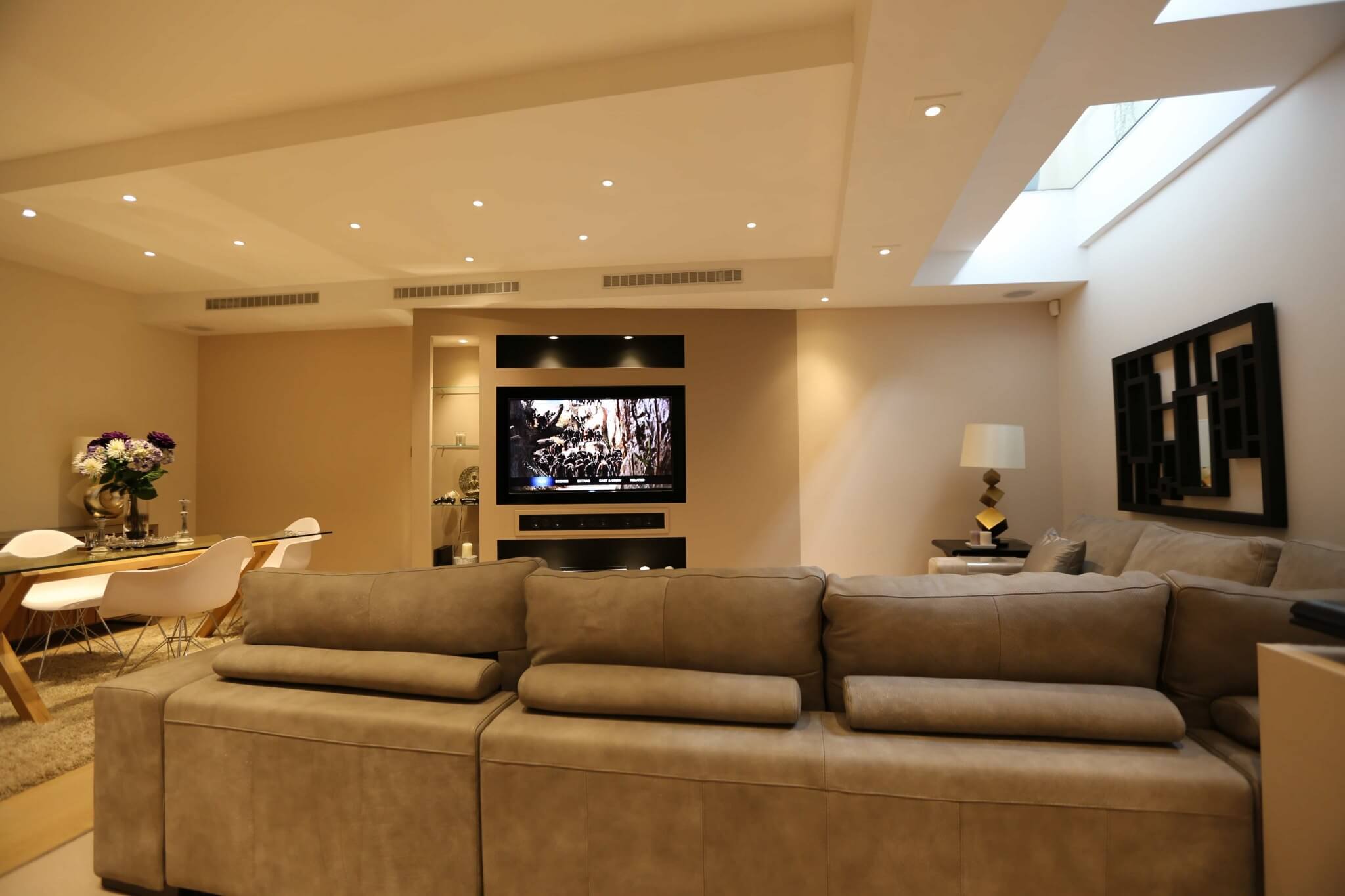
Because the shading is part of the control system, scenes recall light and shade together. A Cinema scene dims the lighting and lowers the blinds in a single press, a Goodnight scene closes the bedroom and draws the curtains, and a Morning scene opens them. In the Rome Steinway Lyngdorf cinema, the HomeWorks system dims the lighting in coordination with the cinema starting and closes the motorised shading in sequence. In a dedicated home cinema, closing the shades completely removes light leakage that would otherwise reduce the projector’s contrast.
Climate is the third part of the same conversation. Blinds that lower automatically against direct summer sun reduce the load on cooling, and the shading programme and the climate control can be written to work together. In Crestron homes, Crestron lighting and window coverings bring electric blinds into the same interface as lighting, audio, video and heating.
Wired or Wireless, New Build or Retrofit
In a new build or major renovation, wired Palladiom is the specification-grade choice, with the deepest HomeWorks QSX integration, and the key decisions are made before plastering: power to the window heads, recesses and pockets, and where drapery tracks are concealed in the ceiling. Where wiring to every window head is impractical, wire-free Palladiom runs on six D-cell batteries per blind, with three to five years of battery life, and a notification arrives through the Lutron app when they need replacing.
Wire-free shading needs only the bracket fixings of a conventional blind, so it suits period properties and listed buildings where new cable runs are restricted. Our guide to Lutron in listed buildings covers this in detail.
Survey, Specification and Commissioning
Window dimensions are surveyed precisely, because Lutron’s manufacturing tolerances are tight and every blind is made to order and arrives pre-configured for the project. Our teams handle the full process: bracket fixing, blind hanging, motor commissioning, programming of scenes and Natural Light Optimization parameters, and final calibration of hembar alignment across each window wall so a bank of blinds moves as one.
We also take over and reprogramme existing shading installations, replacing older motors, upgrading fabrics or integrating existing shading into a new HomeWorks QSX system. We offer free initial consultations at our London and Cheshire offices, at the Lutron Experience Centre in London, or at your property. Contact us to discuss your windows.
Motorised Blinds and Curtains FAQs
- What is the difference between retail motorised blinds and a specified shading system?
A retail motorised blind opens and closes on a remote or app. A specified shading system is part of the home’s control system, so blinds and curtains belong to the same scenes as the lighting, cinema and heating, move in step across a window wall, and can follow the sun automatically. - Can motorised blinds follow the sun automatically?
Yes. Lutron’s Natural Light Optimization uses the property’s latitude, longitude and window orientation to calculate the position of the sun, and moves each shade between Direct Sun, No Direct Sun and Night positions through the day and across the seasons. - Does sun tracking need light sensors?
No. Natural Light Optimization works from the calculated position of the sun. That means it does not measure the actual light in the room or know whether the sky is overcast, so we set positions that work in full sun, and any shade can be adjusted from a keypad or the Lutron app. - Can existing electric blinds be integrated into the control system?
Often, yes. In a Crestron home we add Crestron blind controllers to electric blinds, as we did for the Silent Gliss blinds in a City Road apartment, so the blinds respond to the same keypads and touchpanels as the lighting. - Can motorised blinds be fitted to skylights, large glazing and bay windows?
Yes. Large floor-to-ceiling glazing, corner windows, skylights, roof lights and bay windows are all covered, using systems rated for the loads involved, tensioned or cable-guided variants for angled glazing, and factory-bent tracks for curved windows. - Should I choose wired or wire-free blinds?
Wired Palladiom suits new builds and major renovations where power can be taken to the window head. Wire-free Palladiom suits retrofits and period properties, runs on batteries that last three to five years, and needs no new cable runs. - Can motorised blinds be used in a listed building?
Yes. Wire-free shading needs only the same bracket fixings as a conventional blind, so the automation and scene control are available without new cabling through protected fabric. - Do the blinds work with cinema and lighting scenes?
Yes. Blinds and curtains are programmed into the same scenes as the lighting, so a Cinema scene can dim the lights and close the shading in one press, and a Goodnight scene can close the bedroom curtains.
Lutron Palladiom Shading → · Lighting Control → · Circadian Lighting → · Crestron Window Coverings → · Contact Us →