What Size TV Is Best for a Media Room or Home Cinema?
Size the TV From the Seats, Not the Wall
Published November 2026 · Custom Controls · Home cinema and media room specialists since 1998
The best TV size for a media room has no single answer in inches. It is set by how far the seats are from the screen. A 65-inch television can look enormous from a snug sofa two metres away and disappointingly small from the back of a long living room, and the same 85-inch set that feels like a cinema in one room barely registers in another. Choosing the size from the width of the wall, or from the biggest television in the shop, is the most common reason a new media room feels underwhelming.
The industry answer is to size the picture by the angle it fills in front of the viewer. That angle, the horizontal field of view, is what decides whether a television reads as an object on the wall or as a window into the film or the match. The film and television standards bodies publish guideline angles, and once the main seating distance is known, the right size follows from simple geometry.
This guide explains how that works for televisions in media rooms, living rooms and smaller cinema rooms. It gives a quick-reference table and a calculator that takes your room dimensions and seating, suggests a TV size, and checks it against the width and height of the wall. It is deliberately independent of any manufacturer: the geometry is the same for every television. For dedicated cinema rooms with projection screens, our guides to home cinema design and cinema room size and dimensions carry the same calculator set up for a cinema.

Media Rooms

Home Cinema

Cinema Design

Lighting

Calibration
The Short Answer: Viewing Angle Sets the Size
Two guidelines are used more than any others. SMPTE, the Society of Motion Picture and Television Engineers, recommends that the screen fills at least 30 degrees of the viewer’s horizontal field of view. THX recommends about 36 degrees for the best seats, and up to 40 degrees for a more immersive image. For a media room, where the television is used for news, sport and gaming as much as for films, the 30 to 36 degree range is the sweet spot: large enough that a film feels like an event, comfortable enough for an afternoon of sport.
For a 16:9 television, that works out at roughly 25 inches of diagonal per metre of viewing distance at 30 degrees and 29 inches per metre at 36 degrees. The table below shows the result for common sofa distances, measured from the screen to the eyes of the people in the main seats.
| Sofa distance | 30° (SMPTE minimum) | 36° (THX recommended) | Typical TV choice |
|---|---|---|---|
| 2.0 m | 48″ | 59″ | 55–65″ |
| 2.5 m | 61″ | 73″ | 65–75″ |
| 3.0 m | 73″ | 88″ | 75–85″ |
| 3.5 m | 85″ | 103″ | 85–100″ |
| 4.0 m | 97″ | 117″ | 98–100″ or projection |
| 4.5 m | 109″ | 132″ | Projection screen |
Two things stand out. First, most people sit further back than they think: a typical sofa three metres from the wall needs a 73-inch television just to reach the SMPTE minimum, and closer to 85 inches for a properly cinematic picture. Second, the sizes climb quickly with distance. Somewhere around four metres the right picture size moves beyond what a television can sensibly provide, and a drop-down projection screen becomes the better partner for the TV.
Screen Size Calculator
Enter your room and where the main seats will be. Sizes are worked out from the viewing angle at the seats, then checked against the room.
Why Viewing Angle Matters More Than Inches
A television’s diagonal size on its own says very little about how it will feel in the room. What the eye responds to is how much of the field of view the picture fills. Below about 30 degrees, the television reads as an object: its frame, the wall around it and the rest of the room all stay in view, and the brain treats the picture as something being looked at. As the angle grows, the surroundings fall into peripheral vision and the picture starts to feel like a space being looked into. That is what turns a living room into a media room.
It also explains why the sound has to be planned with the picture. A larger television pushes the left and right speakers further apart, and the surround speakers have to sit in the right relationship to the sofa for the soundstage to match what is on screen. In the media rooms we design, the television size, the speaker positions in the joinery and the seating plan are fixed together on one drawing, as described in our media room ideas.
The angle can also be too large for a room that is lived in. Beyond roughly 40 degrees, the eyes have to move to follow action across the screen, tickers and score graphics drift to the edge of comfortable vision, and a long afternoon of sport or news becomes tiring. That is why a media room usually sits at the lower end of the range, and a dedicated cinema at the upper end.
Media Room, Living Room or Cinema Room
The right point in the range depends on how the room is used. In a family living room the television is one element among many, the sofa may not face it squarely, and it is watched in daylight with people talking. Here 30 degrees from the main seat is a good target, and anything larger should be checked against how the room looks with the television off.
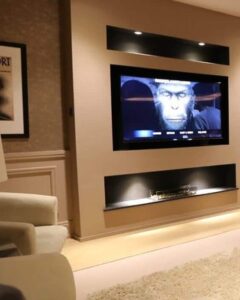
A media room shifts the balance towards the screen. The seating faces it, the lighting is designed around it and the room is used as often for films and sport as for anything else, so 30 to 36 degrees from the main seats is the usual target, and the calculator above uses that range by default. In a small cinema room built around a television, where the room can be darkened and the seats face the screen, the THX figure of 36 to 40 degrees is achievable with the largest televisions from about two and a half metres.
The comparison between a multi-use media room and a dedicated cinema is covered in more detail in our guide to media rooms versus dedicated cinemas.

Resolution: How Close Can You Sit to a 4K TV?
Older advice about TV size was mostly about hiding the picture’s structure. With standard definition, sitting too close made the lines and pixels visible, so the recommended distances were long and the screens small. Resolution has since removed most of that limit, and it is now the viewing angle rather than the pixel count that should drive the decision.
The arithmetic is simple. A person with normal eyesight can resolve detail down to about one arcminute, a sixtieth of a degree. A 1080p picture is 1,920 pixels wide, so at a 32-degree viewing angle each pixel is already about one arcminute across, and above that the pixel structure becomes visible to a sharp-eyed viewer. A 4K picture has 3,840 pixels across, which keeps each pixel below one arcminute up to a viewing angle of about 64 degrees, far wider than anyone sits in practice. At the 30 to 40 degrees a media room is designed for, 4K is the right resolution, and it means the sofa can sit closer to a large television than older rules allowed.
The quality of the source matters as much as the panel. Broadcast and some streamed content is still delivered at lower resolution and compressed heavily, and a very large television shows those limits more clearly. A good streamer, a 4K source for films and careful calibration of the television’s picture modes all make more difference at 85 inches than at 55.
Brightness, Daylight and Viewing Angles
A media room is usually lit by daylight for much of the time, and that is where televisions have a clear advantage over projection. A modern television stays bright and contrasty with the blinds open, but its position still matters. A screen facing a window, or with a window behind the sofa, shows reflections that wash out dark scenes; the best position puts the windows to the side of the screen, with motorised blinds that close as part of a Film scene.
Panel technology affects how the picture looks from the sides of the room. Self-emissive panels hold their contrast and colour well off-axis, while many LCD panels lose contrast as the viewer moves to the side. In a room where people sit across a wide corner sofa or at a kitchen island, it is worth checking the picture from the end seats, not just the centre, and it is one more reason to set the seating out before choosing the television.
Lighting is the other half of the picture. Downlights reflecting in the screen and bright sources in the eyeline of the sofa reduce perceived contrast more than any panel specification. A low bias light behind the television and lighting scenes that bring the room down for films keep the picture at its best, as covered in our guide to living room lighting.
TV Height and the Fireplace Problem
Width is only half the check. A television also has to sit at the right height. As a guide, the bottom of the picture sits around 0.6 metres above the floor in a room with one row of seats, so the centre of the screen is close to seated eye level and nobody has to tilt their head back. Larger televisions are tall: an 85-inch screen is about 1.06 metres high, and a 98-inch one about 1.22 metres, so in a room with a low ceiling the height can become the limiting dimension. The calculator checks this too.
A television mounted high over a fireplace is the most common compromise in British living rooms. It puts the picture well above eye level for anyone seated, which feels wrong after a few minutes of a film. A lower mounting position, a motorised mount that brings the screen down and forward when it is on, or a projection screen that drops in front of the chimney breast for films all keep the picture where it belongs.
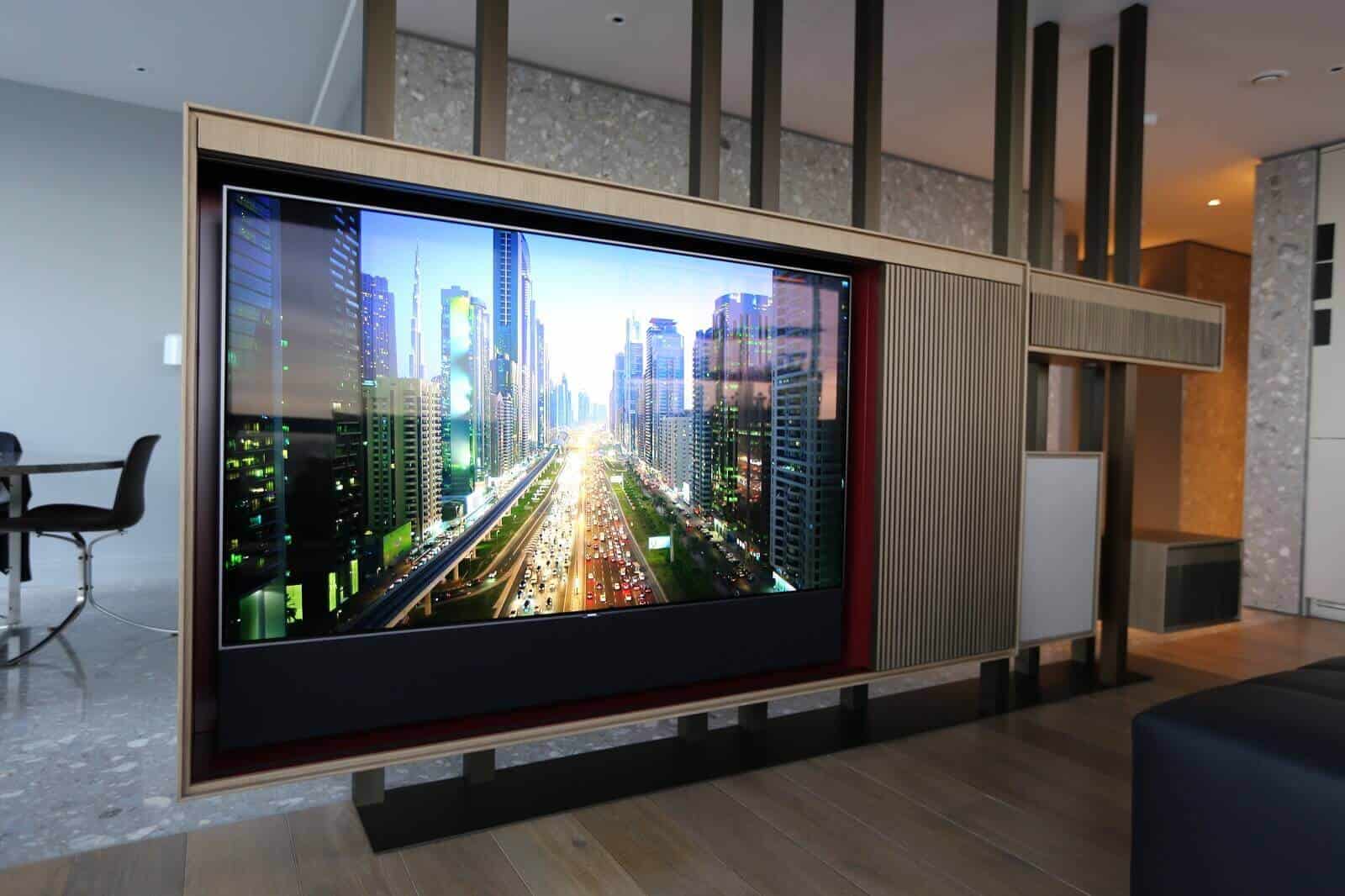
When the television should disappear completely, there are other routes: a lift that raises it out of a cabinet or lowers it from the ceiling, a screen hidden behind sliding or pocketing joinery panels, or an art-mode television that shows paintings when it is not in use. Each changes the joinery and the services behind the wall, so the choice needs to be made before the cabinetry is drawn.
Sofas, Rows and Bar Stools
With one sofa, the television is sized from the main seats and that is the end of it. Many media rooms have a second row, a chaise behind the sofa or bar stools at a kitchen island, and those seats see the same picture at a smaller angle. A television that gives the sofa 36 degrees may give a seat 1.6 metres further back only 26, so the size becomes a balance: large enough that the back seats still get a good picture, not so large that the front row is overwhelmed.
The main seat matters for the sound as well as the picture. It should sit roughly on the centre line of the television and away from the back wall, where bass builds up, with the surround speakers to the sides and slightly behind. A second row or bar stools behind can be raised slightly so heads in front don’t cut into the bottom of the screen.
When a TV Is No Longer Enough
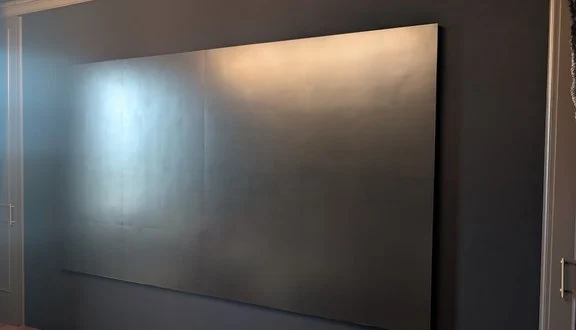
For most media rooms, a large television is the simplest and brightest answer, and screens of 75 to 85 inches cover most sofa distances up to about three metres. Above about 100 inches, televisions become rare and specialist products, and the usual answer is to keep a television for everyday viewing and add a motorised projection screen that drops in front of it for films and big matches, with the projector concealed in the ceiling or the back wall.
Where the room is a dedicated cinema rather than a media room, a projector and an acoustically transparent screen let the speakers sit behind the picture and the image be sized exactly to the room. Our home cinema design page and room size guide cover that route, with the same calculator set for a cinema.

TV Size — Frequently Asked Questions
What size TV is best for a media room?
It depends on how far you sit from it. The screen should fill at least 30 degrees of your view, and up to about 36 degrees for a more cinematic picture. From three metres that means about 73 inches as a minimum and 85 inches or so for a properly cinematic picture.
What size TV is best for a home cinema?
In a small cinema room built around a television, aim for 36 to 40 degrees from the main seats, which from 2.5 metres is roughly 73 to 82 inches and from 3 metres roughly 88 to 99 inches. Beyond that, a projector and screen is usually the better route.
How do I work out the right TV size for my sofa distance?
For a 16:9 television, multiply the distance from the screen to your eyes in metres by about 25 for the minimum size and 29 for the THX-recommended size. The answer is the diagonal in inches. The calculator on this page does the same sum and checks the result against your wall.
Can a TV be too big for the room?
Yes. Beyond about 40 degrees most people have to move their eyes to follow the action, and score graphics and subtitles drift to the edge of comfortable vision. In a room used for sport and everyday television, a slightly smaller screen is more comfortable to live with.
How close can I sit to a 4K TV?
Much closer than to an HD one. A 4K picture stays sharper than the eye can resolve up to a viewing angle of around 64 degrees, so resolution no longer limits the size at the distances people actually sit. Comfort and the room are the real limits.
How high should a TV be mounted?
With one row of seats, the bottom of the screen usually sits around 0.6 metres above the floor, so the centre of the picture is close to seated eye level. Mounting a television high over a fireplace is uncomfortable for films; a lower position or a motorised mount is better.
Media Room Installation → · Media Room Ideas → · Home Cinema Installation → · Cinema Design → · Discuss your project →