Living Room Lighting Ideas — Layered Light and Scene Control
One Room, Lit for Every Part of the Day
Published November 2026 · Custom Controls · Lutron and Crestron lighting control specialists since 1998
The living room has the hardest lighting brief in the house. In the space of one day it is a bright family room, a quiet place to read, a room full of guests and a quiet retreat at the end of the day, and in a period house it often has to do all of that while showing off cornices, joinery and artwork. A ceiling of downlights on one dimmer can’t manage it: the room is either flat and bright or dark and gloomy, and the things that make it beautiful are never properly lit.
The answer is layered light under scene control. This guide works through the layers using a drawing room we planned for this article, in a period London townhouse, and shows how the same fittings produce a lively room for entertaining and a quiet, low-lit room for the evening at the press of a button. It is written for homeowners, architects and interior designers planning a new build or renovation.
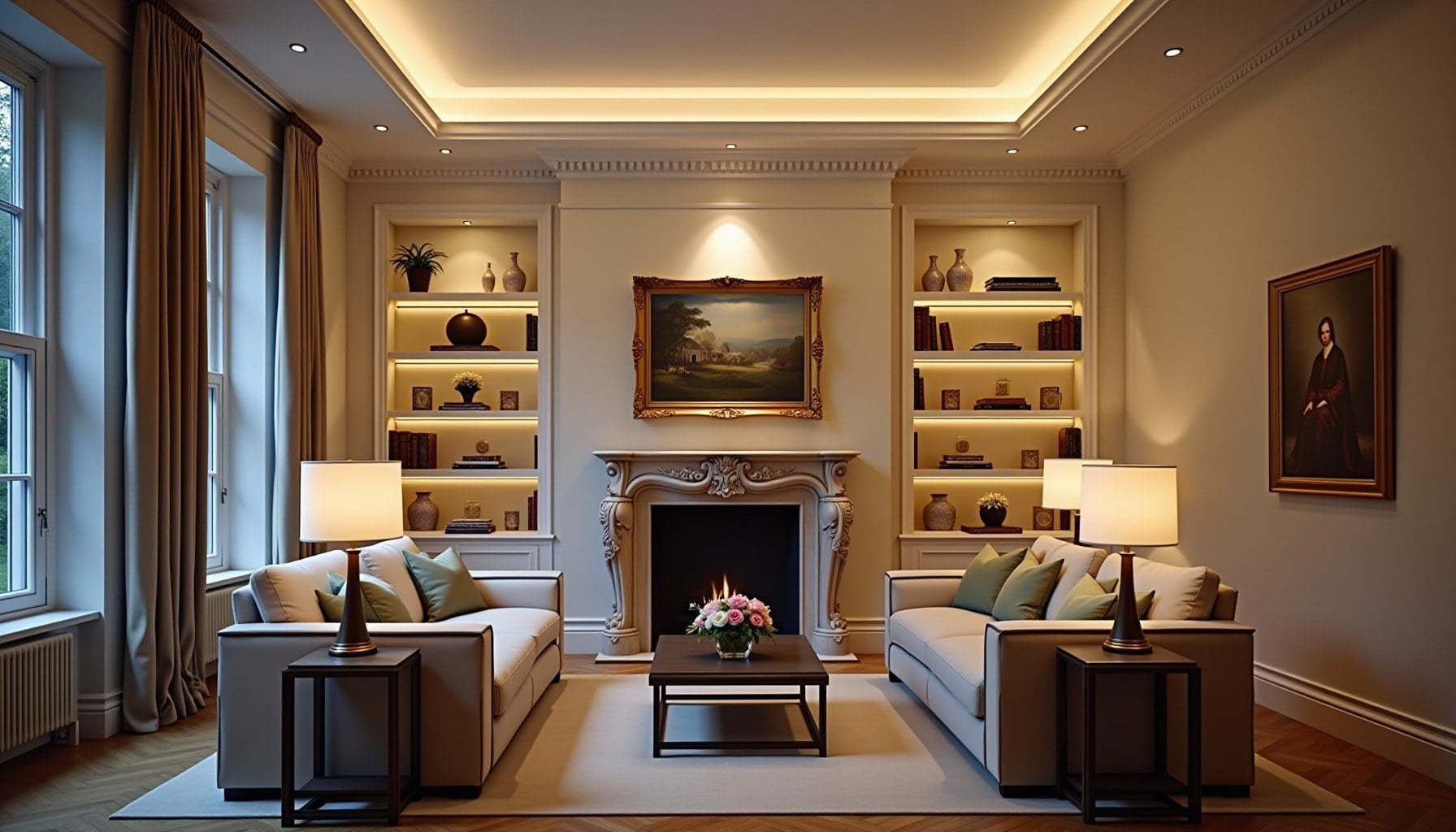
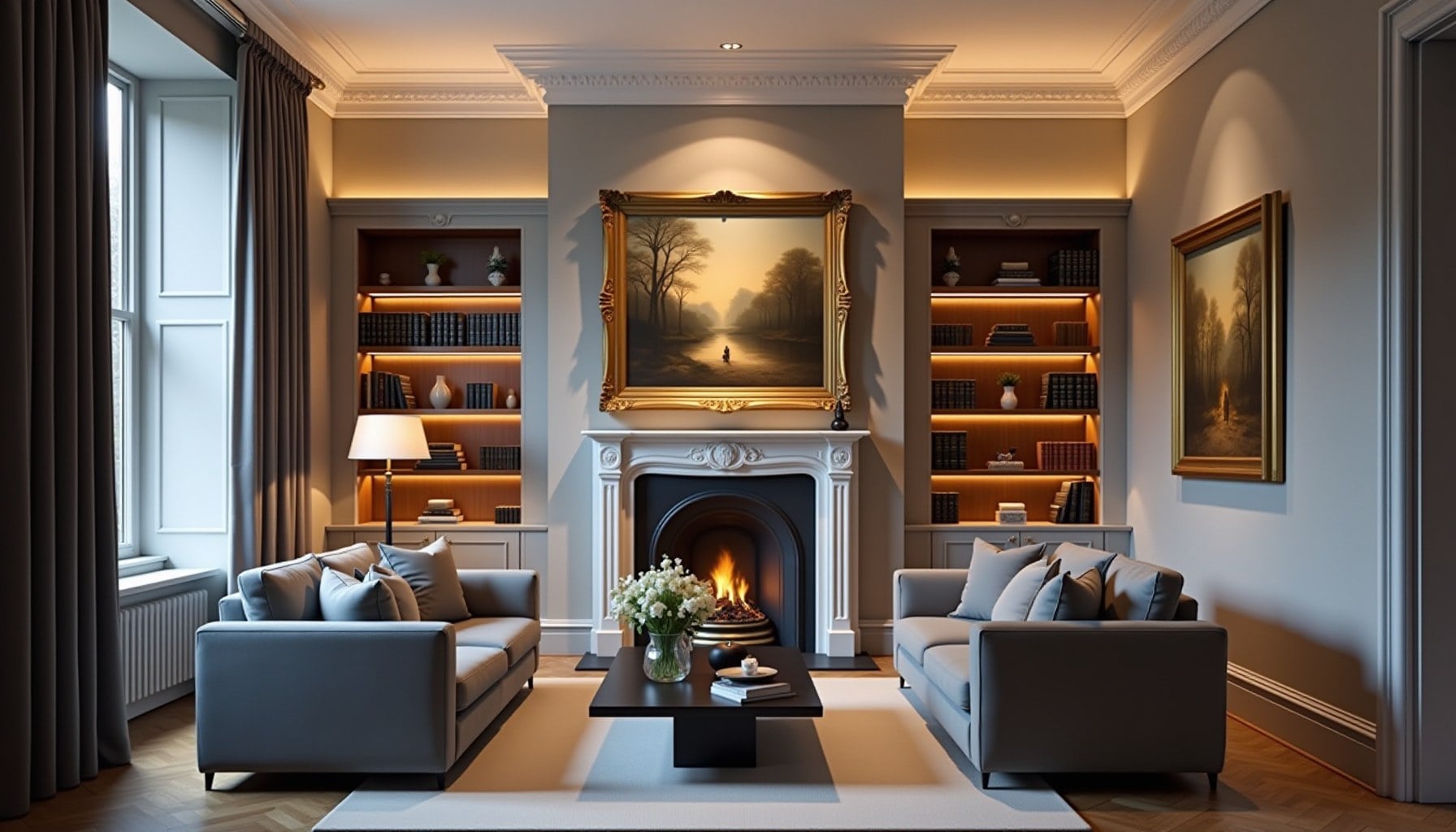
The two renders show that planned room in two of its scenes. If you are new to the subject, our guide to what a lighting control system is explains how keypads, dimmers and scenes work together.

Lighting

Design
Lutron

Crestron

Climate
Plan Around How the Room Is Used
A living room scheme is designed from its uses, not from the ceiling plan. Daytime family use, reading in a chair by the window, drinks with friends, a formal dinner party spilling through from the dining room, a quiet hour with a book or a drink at the end of the day. Each needs a different amount of light, in different places, at a different colour, and the scheme has to deliver all of them from the same set of fittings.
Our planned drawing room is 7 by 5 metres with a 3 metre ceiling: two tall windows on one long wall, a fireplace flanked by bookcases opposite, a second painting on the end wall and two sofas facing across a coffee table. That produces six lighting channels: wall-washing downlights, a cove uplight in the cornice, bookcase lighting, picture lights, the table lamps and a narrow pin spot over the coffee table.
The room dimensions and layout are assumed for this article. On a real project they come from the survey and the architect’s drawings, and the number of channels follows from the furniture plan and the artwork.
Light the Walls, Not the Floor
A room feels bright and generous when its walls are lit, and flat when only the floor is. Rather than a grid of downlights over the seating, our plan uses five wall-washing fittings placed to light the bookcases, the end wall and the window wall. The light lands on vertical surfaces, which is where the eye reads brightness, and the centre of the room is lit indirectly by what bounces off them.
Above them, a cove in the cornice holds Lutron Lumaris tunable white tape, washing the ceiling all round the room. In a period room the cornice is the obvious place for it; in a new build the same effect comes from a shadow-gap detail or a dropped ceiling margin. The cove is the base layer of almost every scene: at 50% it gives the room a soft overall glow, and at 20% it holds the room together in the quiet evening scene.
Both layers are tunable white, so the room can be crisp at 3,000 to 4,000 kelvin in daylight hours and warm at 2,400 to 2,700 kelvin in the evening. The light is designed into the joinery and ceilings before first fix rather than added afterwards.
Bookcases, Joinery and Art
Bookcases either side of a fireplace are one of the most characteristic features of a London drawing room, and lit properly they become a light source in their own right. Concealed LED in each shelf, set in a profile with a diffuser, lights the books and objects from the front edge and gives the end of the room a warm, layered glow. We cover the details in our guide to bookcase and joinery lighting.
Artwork needs light of its own. A picture light on the painting over the mantel and an adjustable recessed fitting with a framing beam on the end wall pick out each work without spilling light across the rest of the wall, with high colour rendering so the colours stay true. On their own channel, the paintings can be lit at 40% in daylight, when they compete with the windows, and at 80% in the evening, when they become the focal points of the room.
The narrow-beam pin spot over the coffee table is a small detail with a big effect: it catches flowers, glass and silver and gives the seating area a point of sparkle that the softer layers can’t.
Lamps Belong in the Scenes
Table lamps give a living room its domestic character, and they are usually the one thing left out of the lighting control system. In our plan they sit on a dimmed 5-amp lamp circuit, so they come on, dim and switch off with every scene, rather than being turned on one at a time at the lamp.
The lamps do something the architectural layers can’t: they put light at seated eye level, close to people. That is why they matter so much in the evening scenes. A room lit only from the ceiling and walls can look beautiful and still feel slightly formal; add two lamps at half brightness and it becomes a room people want to sit in.
The lamp sockets and the furniture plan have to be agreed together, so the sockets land where the side tables will be. It is one more reason to settle the furniture layout before the electrical first fix.
A Quiet Evening Scene
The test of a living room scheme is the end of the day, when the room should feel calm and enclosed rather than lit. In our plan the Relax scene takes the downlights off altogether, holds the cornice cove at 20%, drops the bookcases to 40% so the shelves become a warm glow rather than a display, keeps both paintings lit at 60% as the focal points, and leaves one lamp at 30%, all at a very warm 2,400 kelvin with the curtains closed. That is the scene shown in the second render.
The balance matters more than the levels. With the walls, shelves and art lit and the centre of the room left soft, the eye reads the room as comfortable rather than dark, and the light sits on the things worth looking at rather than on the floor. It is also the scene where the quality of dimming shows: every layer has to fade smoothly to low levels without flicker, which is why the drivers and the dimming method are specified together.
Where a living room includes a television, a TV scene adds a low bias light behind the screen and closes the curtains to remove reflections. In our Primrose Hill townhouse, the formal living room has a retractable projector screen, and the screen, projector, sound and lighting are all operated from one interface, so the room works as both a reception room and a cinema.
Scenes for Every Use of the Room
In our planned drawing room each door has a keypad with Day, Entertain, Relax, Clean and Off, and a table keypad beside the sofa carries Relax, Entertain, the curtains and Off, so nobody has to cross the room. Entertain sets the cove at 50%, the bookcases at 70%, the art at 80%, the lamps at 70%, the pin spot at 60% and the downlights at 30%, all at 2,700 kelvin with the curtains closed. That is the scene in the first render.
Day keeps the lighting almost off and lets the windows do the work, lighting only the bookcases and the art. Clean brings every layer to full at a cool white. Off switches everything off, and a whole-house Goodnight elsewhere covers this room too.
Every scene is set with the household once the room is furnished, because the colour of the walls, the rug and the upholstery all change how much light the room needs. The levels are saved permanently and recalled exactly the same way every time. The keypads are engraved with the scene names, so guests and staff can use them without explanation.
Keypads That Suit the Room
In a drawing room the keypads are seen by everyone, so they are treated as part of the interior. Lutron’s Palladiom, Alisse and Avienna keypads come in dozens of finishes and sit neatly beside sockets and switches, and we keep the button layout consistent across the house so the same scene sits in the same place in every room.
The same scenes are available from the Lutron or Crestron app, wall touchpanels and voice control with Amazon Alexa and Apple Siri, and remote access means the house can be checked or the lights brought up before you arrive. The engraved keypad is still the quickest way to change the room.
Where the living room opens onto a kitchen or dining room, scenes can be linked across the spaces, so an Entertain scene sets the whole ground floor at once while each room keeps its own controls. Our guide to kitchen lighting covers that side of an open-plan space.
Curtains, Daylight and the Rest of the House
Motorised curtains and sheers on the same system mean the room’s daylight is part of the scheme too. They can close at sunset, open in the morning, track the sun to protect furniture and artwork from fading, and close with the Relax scene in the evening. Our page on motorised blinds and curtains covers the tracks and options.
The same system can include the heating and air conditioning, the music in the room and the security system, so arriving home, leaving the house or settling in for the evening is one action rather than several. This is what home lighting control systems are designed to do, and it is why we plan them alongside the rest of the technology in the house.
For an existing house, wireless keypads and wire-free shading can bring scene control to a living room without rewiring, with the cove and joinery lighting added when decoration or joinery is being done anyway. More lighting ideas: our guides to kitchen lighting, hallway and staircase lighting, bookcase and joinery lighting and garden lighting.
Living Room Lighting Ideas — Frequently Asked Questions
How should a living room be lit?
In layers: light on the walls rather than the floor, a soft indirect base layer such as a cornice cove, lighting in bookcases and on artwork, and table lamps at seated height, all on separate channels and recalled together as scenes.
Should living rooms have downlights?
A few, used as wall-washers to light bookcases, artwork and walls. A grid of downlights over the seating gives flat, glaring light and leaves the walls dark.
How do you light a living room for relaxing in the evening?
Turn off the downlights and let the walls, shelves and artwork carry the light, with a low cove or wall wash, softly lit bookcases, picture lights and one or two lamps, all at a warm colour temperature and recalled as a single Relax scene.
What colour temperature is best for a living room?
Warm white, around 2,700 kelvin, in the evening and slightly cooler during the day. Tunable white fittings let the same lights move between the two automatically.
Can table lamps be controlled with the main lighting?
Yes. Wiring lamp sockets to a dimmed 5-amp lamp circuit puts the lamps on the lighting control system, so they dim and switch with every scene.
Can I add scene lighting to an existing living room?
Yes. Wireless keypads and dimmers can replace existing switches and wire-free blinds need no new cabling, while cove and joinery lighting are best added when decoration or joinery is being renewed.
Home Lighting Control → · Lighting Design → · Joinery Lighting Ideas → · Motorised Blinds → · Discuss your project →