Kitchen Lighting Ideas
How to Layer, Scene and Control Light in a Modern Kitchen
Published September 2026 · Custom Controls · Lutron and Crestron lighting control specialists since 1998
The kitchen asks more of its lighting than any other room in the house. In a single day it is a workshop that needs bright, shadow-free light on every worktop, a breakfast room that should feel calm and gentle, a place where guests gather with a drink in the evening, and, late at night, a route to the fridge that should not wake the whole house. A kitchen lit by a grid of identical downlights on a single switch can only ever do one of those jobs well. The kitchens that feel right at every hour are designed in layers, and those layers are brought together with lighting control so that the right balance is always one touch away.
Start With Three Layers of Light
Every well-lit kitchen we design is built from three distinct layers, each doing a different job. Task lighting puts bright, even light exactly where food is prepared — under wall cabinets, over the hob and sink, and across the island worktop. Ambient lighting fills the room with a soft general level so that it never feels like a cave around the edges; in a contemporary kitchen this is often achieved indirectly, with light washed across a ceiling coffer or bounced off a wall rather than pointed straight down. Accent lighting gives the room its character: lit glass-fronted cabinets, a glowing plinth line under the base units, a wash across a stone splashback or a feature wall.
The mistake we see most often is a kitchen that relies entirely on recessed downlights to do all three jobs. Downlights are excellent for task lighting when positioned correctly — over the front edge of the worktop, so the person working is not standing in their own shadow — but used as the only light source they produce a flat, over-lit room during the day and a harsh one in the evening. Separating the layers onto their own circuits is the single most important decision in kitchen lighting design, because it is what makes everything else possible.

Design

Lutron

Crestron

Blinds

Homeworks
Under-Cabinet and Worktop Lighting
Continuous LED profile fitted to the underside of wall cabinets is the workhorse of kitchen task lighting. Set towards the front edge of the cabinet and fitted with a diffuser, it lights the whole worktop evenly without visible hotspots on a polished stone surface — the reflections of individual LED dots on a gloss worktop are one of the tell-tale signs of a lighting scheme that was not thought through. Where there are no wall cabinets, the same job falls to well-positioned downlights or to a shelf with integrated lighting beneath it.
Colour rendering matters more here than anywhere else in the house. Light with a colour rendering index (CRI) of 90 or above shows food, timber and stone as they really are; cheaper LED strip often sits well below that, making ingredients look dull and worktops look grey. We specify high-CRI sources throughout a kitchen as standard, and keep the colour temperature consistent across every fitting in view — mixing a cool-white under-cabinet strip with warm-white downlights is immediately obvious and difficult to correct once the joinery is finished.
Lighting the Kitchen Island
The island is usually the social centre of the kitchen, which means its lighting has to work both as a bright preparation surface and as the soft focal point of the room in the evening. Pendants are the natural choice and set the style of the whole space, but a row of decorative pendants rarely delivers enough useful light on the worktop by itself. The answer is to pair them: discreet downlights or a linear fitting provide the task light, while the pendants are dimmed to a glow for atmosphere. On their own circuit, the two can be balanced independently for every time of day.
Height and spacing need to be set with the people using the island in mind — low enough to create intimacy, high enough not to block sightlines across the room or glare into the eyes of someone seated at the breakfast bar. A plinth light around the base of the island, dimmed low, is one of the most effective night-time details in any kitchen: enough to navigate by, without switching on a single overhead light.
Colour Temperature Through the Day
Most residential kitchens are lit at around 2,700K to 3,000K — warm enough to feel domestic, crisp enough for cooking. For clients who want more, tunable-white lighting allows the colour temperature itself to change through the day: brighter and cooler in the morning, progressively warmer into the evening. Lutron’s Ketra, Rania and Lumaris ranges are designed for exactly this, and we explain the differences between them in our guide to lighting dimming protocols and tunable lighting. In an open-plan kitchen, dining and family space, a gradual shift towards warmer light in the evening does more to change the feel of the room than any other single feature.
Scenes — Where Lighting Control Earns Its Place
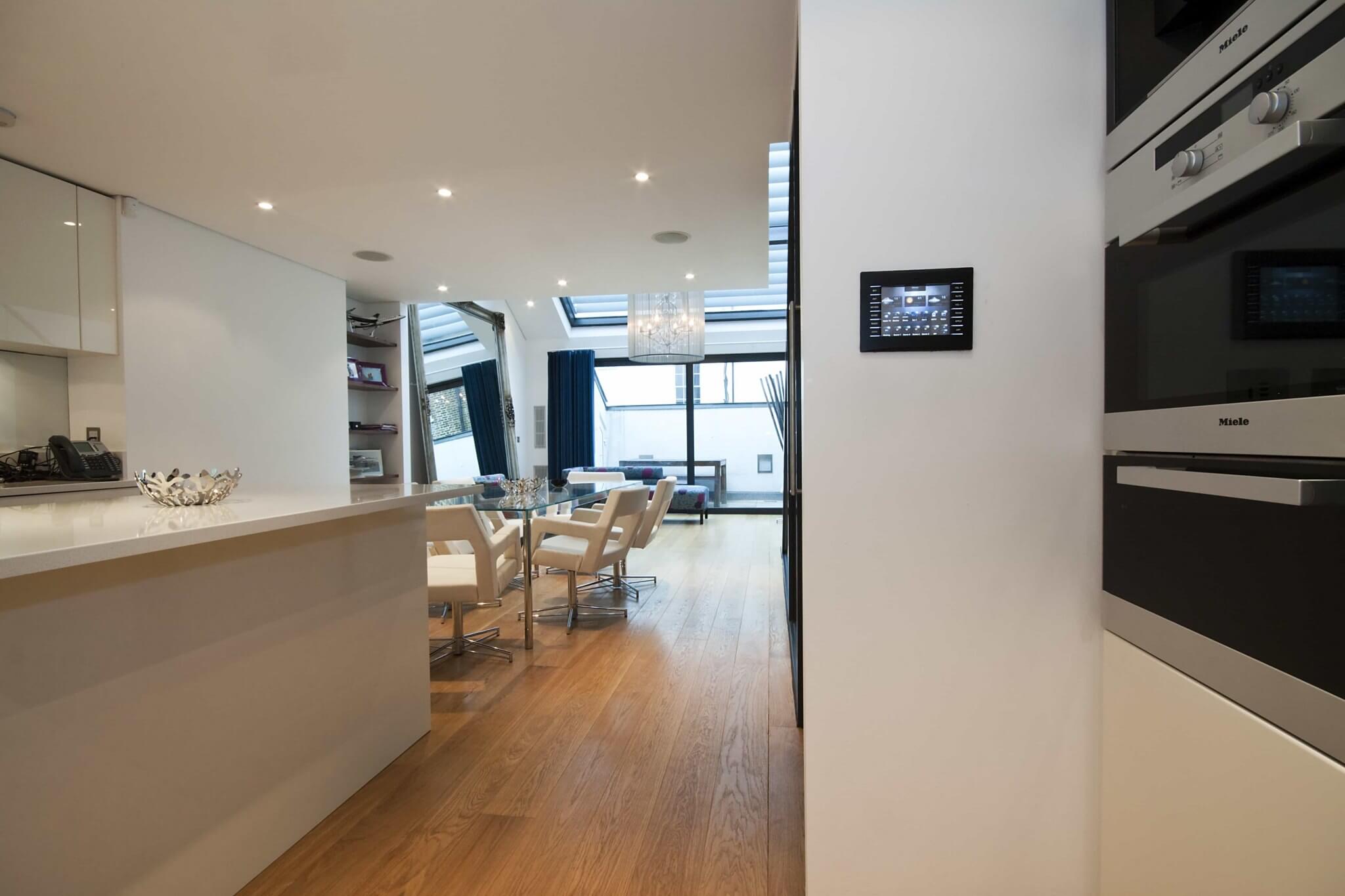
Once a kitchen has four, five or six separate lighting circuits, a row of dimmer switches by the door becomes impractical, and this is where a lighting control system transforms the room. Instead of adjusting each circuit by hand, a single keypad button recalls a complete, pre-balanced scene. In a typical kitchen we programme a bright Cook scene with full task lighting; a softer Dine scene with pendants low, cabinets glowing and the worktop lights off; an Entertain scene for when the kitchen becomes the heart of a party; and a Night scene that leaves only the plinth lights on at a low level.
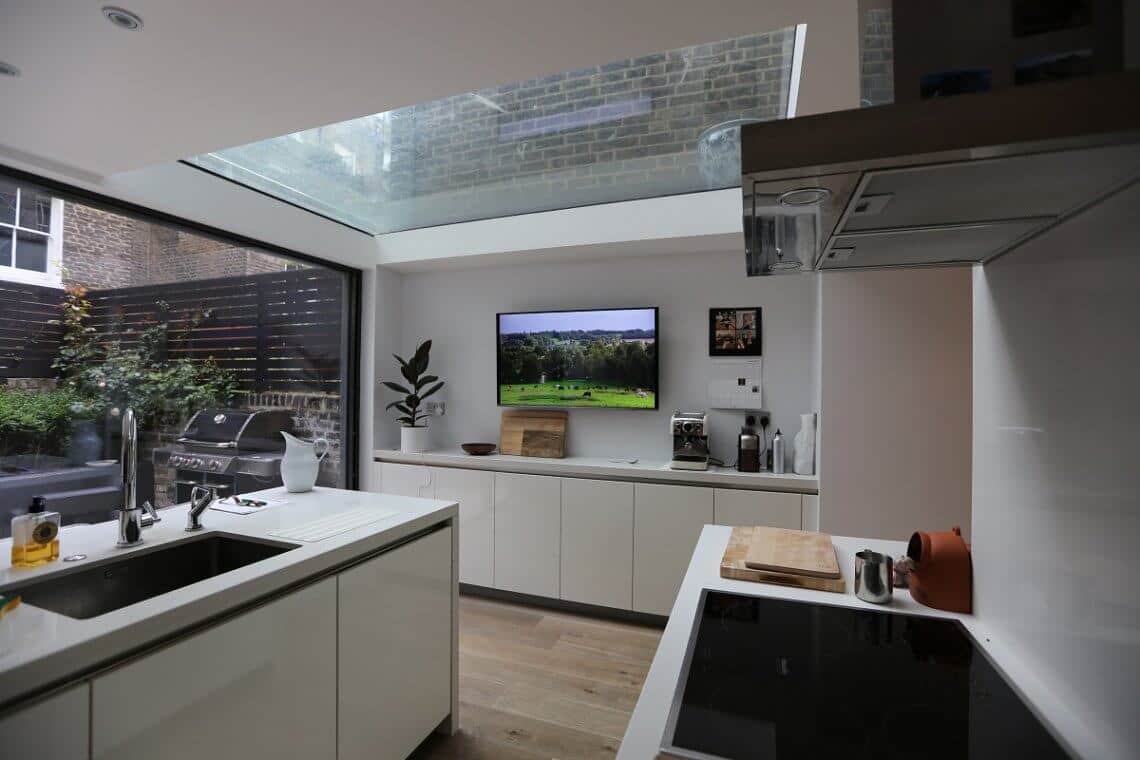
Using Lutron or Crestron lighting control, scenes can also run themselves. A gentle morning scene can come up automatically at sunrise, an occupancy sensor can bring on a low path of light when someone walks in at night, and everything can switch off with a single Goodnight button by the bed. The same keypads can control motorised blinds over a rooflight or glazed wall, so glare on the worktop is managed alongside the light itself.
Planning Kitchen Lighting Alongside the Joinery
The best kitchen lighting is designed at the same time as the kitchen itself, not added once the units are ordered. LED profiles need rebates and cable routes built into the cabinetry; drivers need somewhere accessible and ventilated to live, rather than being buried behind a fixed panel; and every fitting needs a dimming method that matches the control system specified for the rest of the house. We work directly with kitchen designers and joiners at drawing stage so that every light has a place, every driver can be reached for maintenance, and the finished lighting looks as though it was always part of the design — because it was.
Our approach to layered design across the whole house is set out on our residential lighting design page, and you can see lighting control in finished homes in our Baker Street and Wimbledon projects. If you are planning a new kitchen or renovation, talk to us before the joinery drawings are finalised. More lighting ideas: our guides to garden and landscape lighting, hallway and staircase lighting and bookcase and joinery lighting.
Kitchen Lighting — Frequently Asked Questions
How many lighting circuits does a kitchen need?
Enough to separate the layers — at minimum task, ambient and accent, and usually more in a large open-plan space. A typical kitchen we design has the downlights, under-cabinet lighting, island pendants, plinth lights and any feature or cabinet lighting on separate circuits, so each can be balanced independently.
What colour temperature is best for kitchen lighting?
Around 2,700K to 3,000K suits most homes: warm enough to feel domestic and crisp enough to cook by. Whatever you choose, keep it consistent across every fitting in view. Tunable-white lighting lets the colour temperature change through the day if you want the best of both.
Where should downlights go in a kitchen?
Over the front edge of the worktops rather than in the centre of the floor, so the person preparing food is not standing in their own shadow. Downlights work best as part of a layered scheme, not as the only source of light in the room.
Is lighting control worth it in a kitchen?
Once a kitchen has more than three or four circuits, yes. A single keypad button recalls a balanced scene for cooking, dining or late at night, instead of adjusting several dimmers by hand, and the same system can manage blinds and switch the whole house off at bedtime.
Residential Lighting Design → · Lutron Lighting Control → · Crestron Lighting Control → · Smart Lighting Design Guide → · Contact Us →