Garden Lighting Ideas
Landscape Lighting for Houses, Estates and Chalets
Published September 2026 · Custom Controls · Lutron and Crestron lighting control specialists since 1998
A well-lit garden extends the house after dark. Seen from inside, it turns black glass back into a view; used on a summer evening, it makes a terrace, a pool or a lawn somewhere to be rather than somewhere to hurry through. Yet garden lighting is often the least considered part of a project — a row of bulkheads on the back wall, a few spikes pushed into the borders and a security floodlight on a sensor. Good landscape lighting works the other way round: it starts with what you want to see from the house and how you want to use the garden at night, and builds a composition of light from there.
Light the View From Inside First
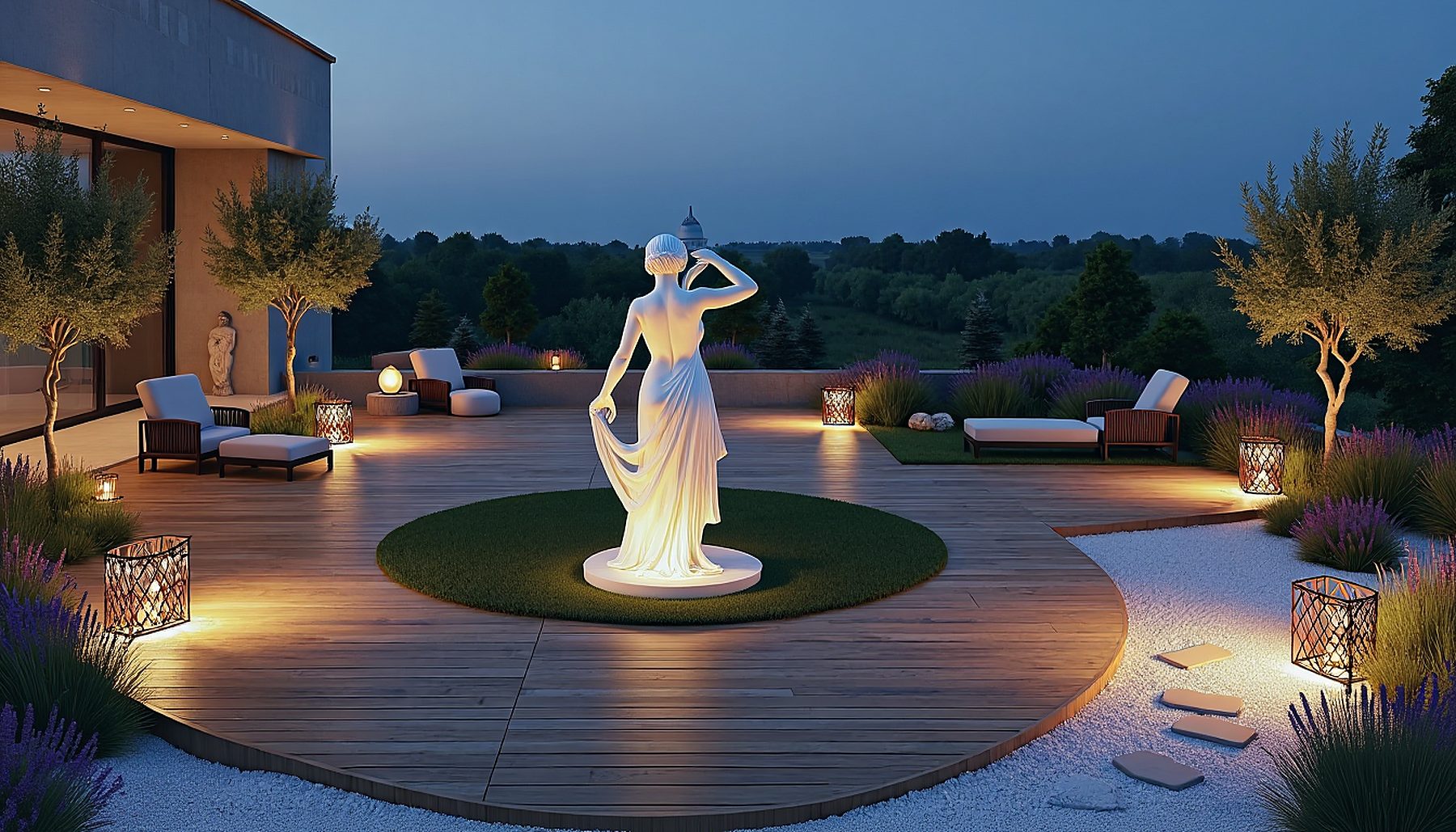
For most of the year, a garden is seen far more often from inside than from within it. The first question we ask is therefore what should be visible from the principal rooms after dark: a specimen tree, the line of a hedge, a sculpture, the far boundary that gives the garden its depth. Lighting a few carefully chosen features at different distances creates layers in the view — foreground, middle ground and background — and stops large windows from turning into dark mirrors in the evening. It also balances the light levels inside and out, so that the room itself feels more comfortable.
Restraint matters. A garden lit evenly from end to end looks like a car park; one lit in pools, with darkness between them, looks natural and considered. The aim is to reveal shape and texture — bark, foliage, stone and water — rather than to make the garden bright.
Colour Temperature and Colour Rendering
The colour of the light matters as much as where it goes. Warm white of around 2,700K is the default for most gardens: it flatters stone, timber and brick, sits naturally alongside candlelight and firelight on a terrace, and matches the warm interior light seen through the windows. A slightly cooler 3,000K can sharpen pale stone or contemporary architecture, and cooler light still is occasionally used to suggest moonlight filtering through a canopy — but sparingly, and never mixed casually with warm light in the same view. Nothing looks less considered than a tree lit at one colour temperature standing in front of a wall lit at another.
Colour rendering is the other half of the picture. Low-quality LED sources render foliage a dull grey-green and turn warm stone flat and lifeless. We specify fittings with a colour rendering index of 90 or above, and look closely at how well they reproduce saturated reds, which govern how natural flowers, brick and skin tones appear. Consistency matters too: fittings from different ranges, or even different production batches, can vary visibly in colour, so everything seen together in one view should come from the same manufacturer and range wherever possible.
Uplighting Trees and Planting
Uplighting a mature tree from its base is one of the most dramatic effects in landscape lighting, and one of the easiest to get wrong. A single spotlight aimed straight up the trunk flattens the tree; two or three fittings placed around the canopy, with beam angles chosen to suit its shape, give it volume and depth. Deciduous trees change through the year, so the scheme should look as good lighting bare winter branches as it does a full summer canopy. Grasses and architectural planting respond beautifully to low-level grazing light, which picks out texture and movement.
Fittings in borders should be as close to invisible as possible during the day — recessed, in dark finishes, or hidden in planting — so that you see the effect, not the equipment. Low-voltage systems make it easier to adjust positions as the planting matures.

Design

Lutron

Crestron

Audio

Homeworks
Beam Angles, Optics and Glare
Choosing the right optic is where landscape lighting becomes a craft. A narrow beam of 10–15° will carry up a tall, slender trunk or a column without spilling onto everything around it; a medium beam of around 24–36° fills the canopy of a medium-sized tree; wide beams of 40–60° wash a hedge, a wall or a sculpture evenly. Asymmetric optics throw light across a wall from a fitting set close to its base, and interchangeable lenses and filters allow the effect to be adjusted on site rather than committed to on paper.
Glare is the enemy of a comfortable garden. A bright source seen directly — from the terrace, from a window or from a neighbour’s garden — draws the eye and destroys the sense of darkness that makes lit features stand out. Glare shields, cowls and honeycomb louvres cut off the view into the lamp; careful aiming keeps beams pointed away from seating and viewing positions. Output is usually far lower than people expect: against a dark background, a few hundred lumens on a tree reads as bright, and every channel should be dimmable so that the balance of the whole garden can be set by eye. Keeping light on its target, rather than spilling into the sky or onto boundary hedges where wildlife roosts and feeds, is good practice as well as good design.
Paths, Steps and Terraces
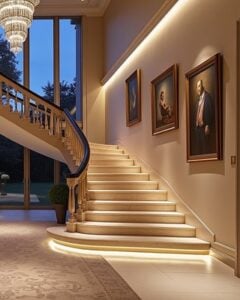
Paths and steps need light for safety, but not glare. Low-level fittings that wash light across the ground, step lights set into walls or risers, and linear LED under the nosing of terrace steps light the way without anyone looking directly into a light source. On a terrace used for dining, a combination of low-level light and soft light from above — from a pergola, an overhanging tree or discreet fittings on the building — makes faces look natural rather than lit from below. Warm colour temperatures of around 2,700K generally sit most comfortably against stone, timber and planting.
Roof Terraces and Courtyard Gardens
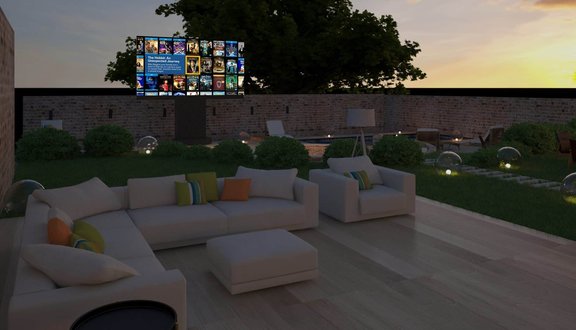
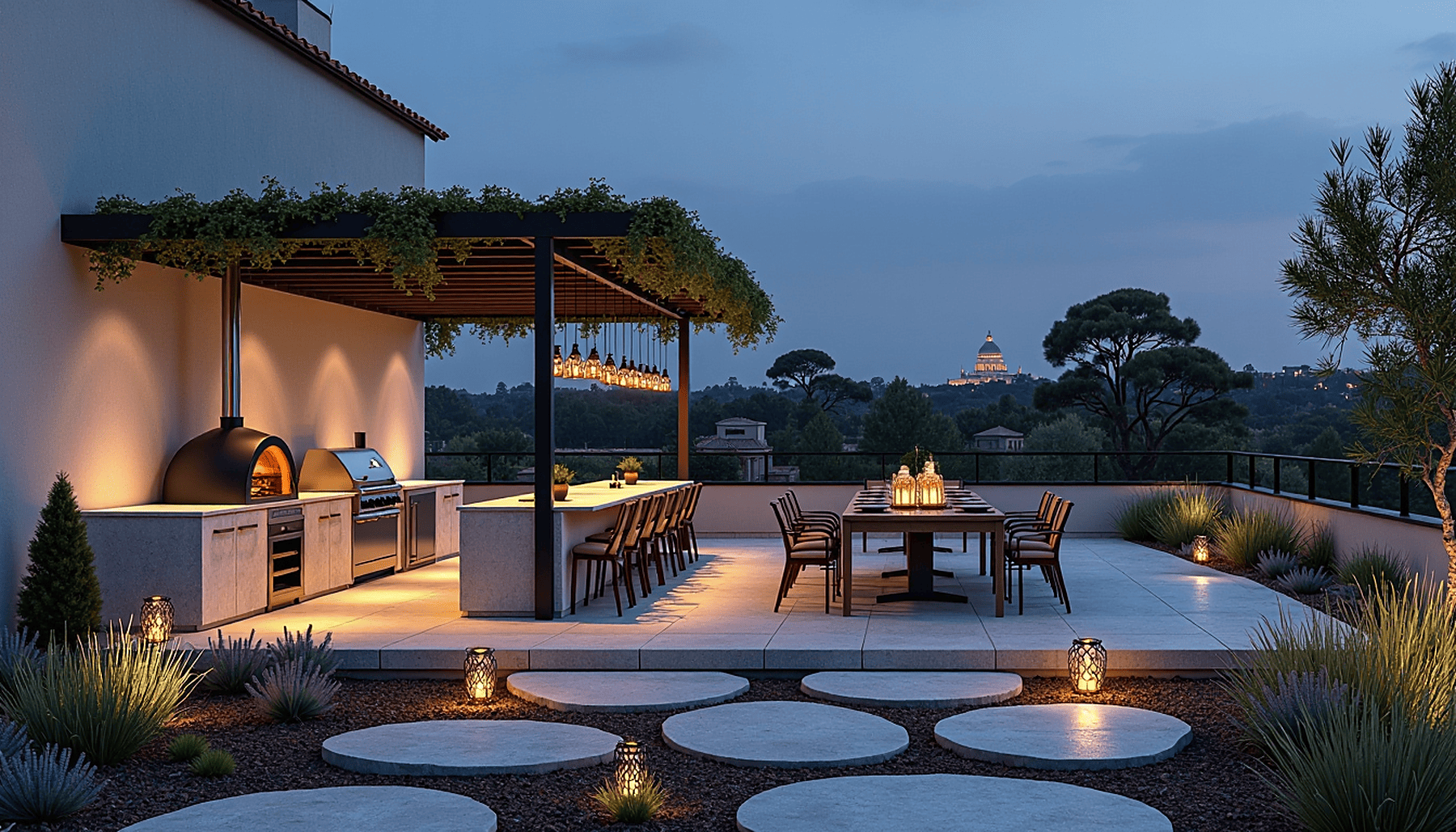
City roof terraces and courtyards turn the usual garden brief around. The planting is contained, the space is often used more intensively than a country garden, and the most important feature is frequently beyond the boundary — a skyline, a park or a dome on the horizon. The lighting should serve that view rather than compete with it. Keep the terrace itself low and warm: lanterns suspended from a pergola over the dining table, discreet downlights giving task light to an outdoor kitchen, low-level lanterns marking stepping stones, and slim spike lights among grasses and planters. Bright fittings at eye level would reflect in the glass of the house and throw the view beyond into darkness; a softly lit terrace lets the city remain the backdrop.
Roofs bring practical constraints of their own. Nothing should be fixed through the waterproofing membrane, so cable routes are planned through planters, beneath raised pedestal paving or within the pergola structure itself. Weight limits favour lightweight fittings, wind exposure means that suspended lanterns and freestanding fittings must be properly secured, and in historic city centres fittings that are unobtrusive by day help a scheme sit comfortably within its surroundings. Light spill matters more when neighbours overlook the terrace, which makes accurate optics and precise dimming even more valuable.
Water, Pools and Architectural Features
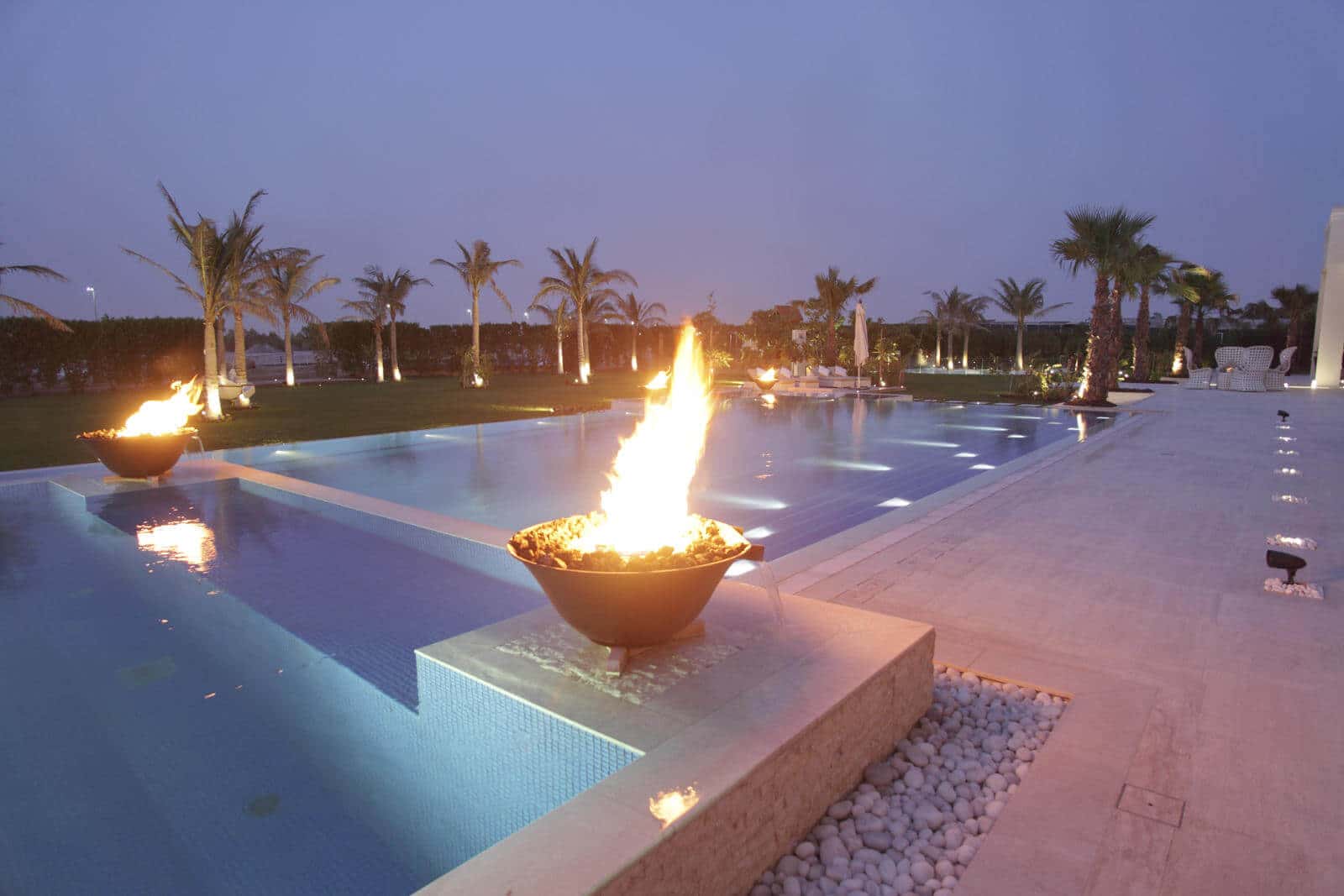
Water is transformed by light. A pool lit from within becomes a glowing focal point; a still pond or rill reflects lit trees and the house behind it; a fountain lit from below catches every drop. Fire features, sculpture and the architecture of the house itself — a façade, a colonnade, a garden wall — can all become part of the composition. Where colour-changing effects are wanted, for a pool or a feature wall, we use dedicated architectural lighting control alongside the main system, as we explain in our guide to lighting dimming protocols.
Control: Scenes That Run Themselves
Exterior lighting is where automation makes the biggest difference, because nobody wants to remember to switch the garden on at dusk and off again at midnight. An astronomic timeclock in a Lutron or Crestron system knows the exact sunset time at the property’s location every day of the year, bringing the view lighting on at dusk, dimming it to a lower level later in the evening and turning it off overnight — automatically, summer and winter. On our Dubai estate, garden, pool and fire features are all brought under the same Crestron control as the house.
Scenes make the garden easy to use: a Dinner on the Terrace button, a Pool scene, an Arrive Home scene that lights the drive and front door as the gates open. The same system can link exterior lighting to security, bringing the whole garden up to full brightness if an alarm is triggered or a camera detects movement, and to outdoor audio for evenings outside.
Seasonal Scenes and Timeclock Programming
A good timeclock programme follows the way a garden is actually used through the year. Astronomic events can be offset — the view lighting fading up a little before sunset so that the transition from daylight is seamless, rather than switching on once the garden is already dark. A fixed-time event later in the evening steps the garden down to a lower level once the terrace is no longer in use, leaving the key views lit from inside, and a final event turns the exterior off overnight except for any lighting needed for security.
Summer and winter call for different programmes. On long summer evenings the emphasis is on terraces, dining areas and pools that are in use until late; in winter the garden is mostly seen through glass, so the view lighting matters most and can run from a much earlier dusk. For chalets in the Alps, snow cover reflects a great deal of light, so levels that suit a green summer garden can look harsh over fresh snow — separate winter scenes at lower levels solve this. Holiday and away modes keep an unoccupied property looking lived in, and every schedule can be adjusted later from the system software as the garden and the way it is used evolve.
Design and Installation Considerations
Exterior lighting has to survive rain, frost, snow and garden machinery, so every fitting needs an appropriate ingress protection rating for its position — higher for anything buried in the ground or near water — and all exterior electrical work must be designed and installed to current regulations. Cable routes, drivers and junction boxes should be planned before landscaping is finished, ideally alongside the garden designer’s drawings, so that ducts can be laid under paving and lawns rather than dug in afterwards. For chalets and properties in the Alps, fittings, cable and control equipment also need to cope with heavy snow cover and freezing temperatures, and scenes can be adjusted for the very different evenings of summer and winter.
As a guide, wall-mounted fittings exposed to rain need at least IP65; in-ground uplights, which can sit in standing water after heavy rain, should be IP67 and installed over a free-draining gravel base so that water drains away from the fitting; and anything permanently submerged in a pool, pond or fountain must be IP68 and designed for continuous immersion. In the UK, outdoor lighting installations and swimming pools and fountains are covered by specific sections of BS 7671, which set out the requirements for protection, safety extra-low voltage near water and the zones around pools.
Survey, Mock-Ups and Aiming at Night
Garden lighting cannot be finished on paper. We survey the garden with the landscape drawings in hand, and on larger schemes test key effects with temporary fittings after dark before positions are fixed — the only reliable way to judge how a particular tree, wall or stretch of water will respond to light. Once the installation is complete, every fitting is aimed and every scene set at night, with the client, from the positions that matter: the principal rooms, the terrace and the approach to the house.
A garden keeps growing after the lighting is commissioned. We recommend a return visit after the first full season to re-aim fittings as planting fills out and to adjust scenes to the way the garden is actually being used, and routine maintenance — cleaning lenses, checking seals and cutting back planting that has grown over fittings — keeps the scheme looking as intended year after year.
Our wider approach to layered light, inside and out, is set out on our residential lighting design page. If you are planning a new garden, or want an existing one to work better after dark, talk to us while the landscaping drawings are still on the table. More lighting ideas: our guides to kitchen lighting, hallway and staircase lighting and bookcase and joinery lighting.
Garden Lighting — Frequently Asked Questions
What is the best way to light a garden?
Start with what you want to see from inside the house after dark, then light a few chosen features at different distances — a tree, a hedge line, a sculpture, water. Pools of light with darkness between them look far more natural than a garden lit evenly from end to end.
What colour temperature is best for garden lighting?
Around 2,700K suits most gardens, sitting comfortably against stone, timber and planting, with 3,000K sometimes used to crisp up architecture or pale stone. Keep the colour temperature consistent across everything seen in one view, and specify a high colour rendering index — CRI 90 or above — so foliage and stone look natural rather than grey.
Should garden lighting be low voltage or mains?
Both have their place. Low-voltage fittings are easy to reposition as planting matures and suit borders and uplighting; mains fittings suit fixed architectural positions and longer runs. What matters most is that every fitting has the right ingress protection for its location and that the installation meets current regulations.
How do you light a roof terrace?
Keep the light low and warm so that the view beyond remains the main feature: soft light from a pergola or lanterns over the table, discreet task light for any outdoor kitchen, and low-level light along paths and in planting. Cables should run through planters, raised paving or the pergola structure rather than through the roof’s waterproofing, and every fitting must be secured against wind.
How do I make garden lighting come on automatically?
An astronomic timeclock in a lighting control system calculates sunset for your exact location every day, so the garden comes on at dusk, dims later in the evening and switches off overnight without any manual input, all year round.
Can garden lighting be linked to security?
Yes. With Lutron or Crestron control, exterior lighting can be brought to full brightness when the alarm is triggered or a camera detects movement, and an arrival scene can light the drive and front door as the gates open.
Residential Lighting Design → · Lutron Lighting Control → · Crestron Lighting Control → · Smart Lighting Design Guide → · Contact Us →