Bathroom Lighting Ideas — Zones, Mirrors and Scenes
Clear Light for Mornings, Calm Light for Evenings
Published November 2026 · Custom Controls · Lutron and Crestron lighting control specialists since 1998
A principal bathroom asks for two completely different kinds of light. In the morning it is a workplace: shaving, make-up and getting ready need clear, even light on the face, with no shadows and true colour. In the evening it can be the calmest room in the house, lit low and warm for a long bath. And in the middle of the night it needs just enough light to find your way without waking yourself up. Most bathrooms get a grid of downlights on one switch and manage none of these well.
This guide works through the layers of a principal bathroom we planned for this article, in a period London townhouse, and covers the regulations that shape where lights can go, the mirror lighting that matters most, and the scenes that let one room serve all three purposes. It is written for homeowners, architects and interior designers planning a new bathroom or renovation.
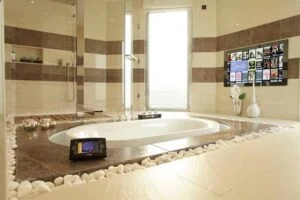
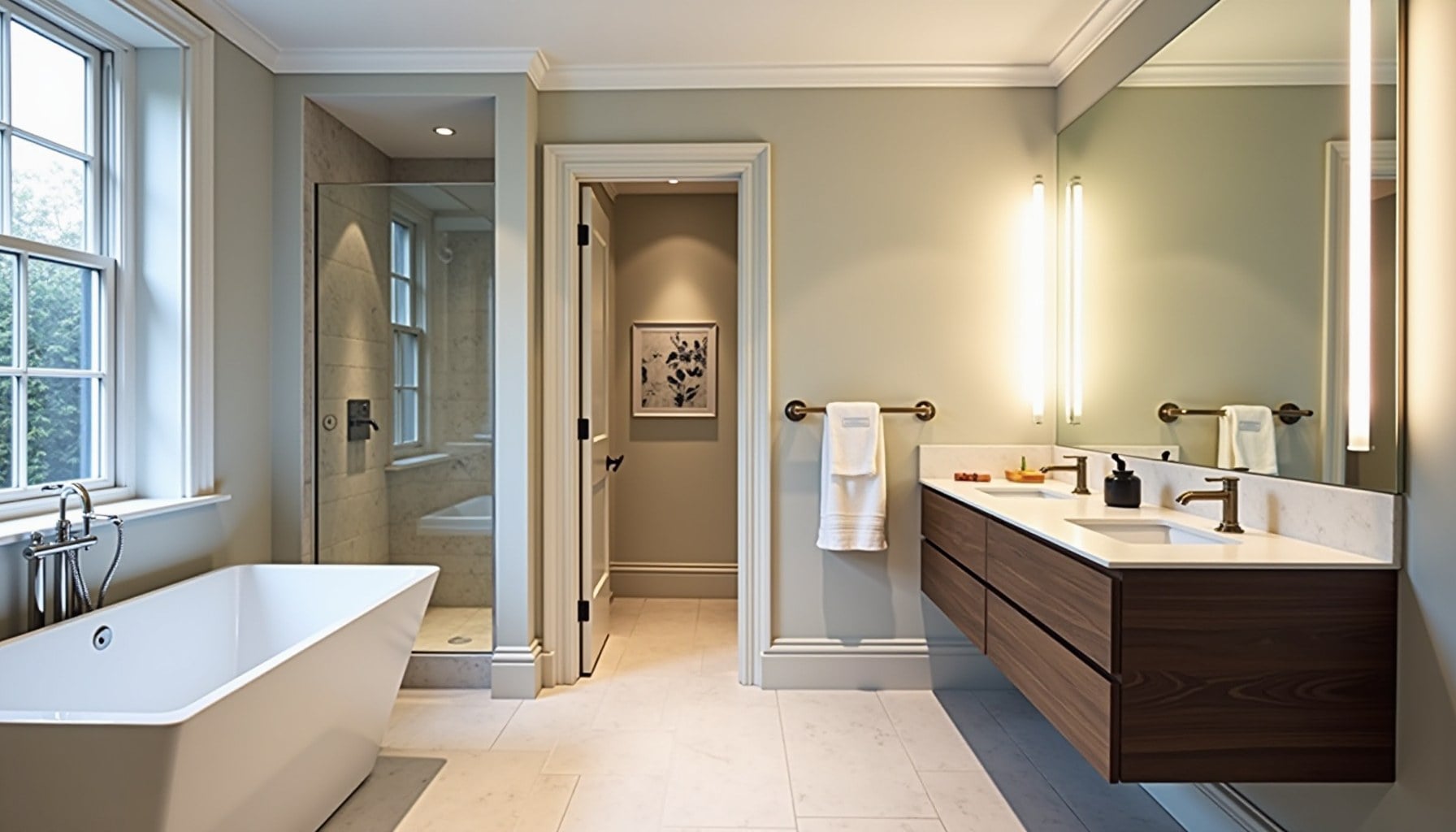
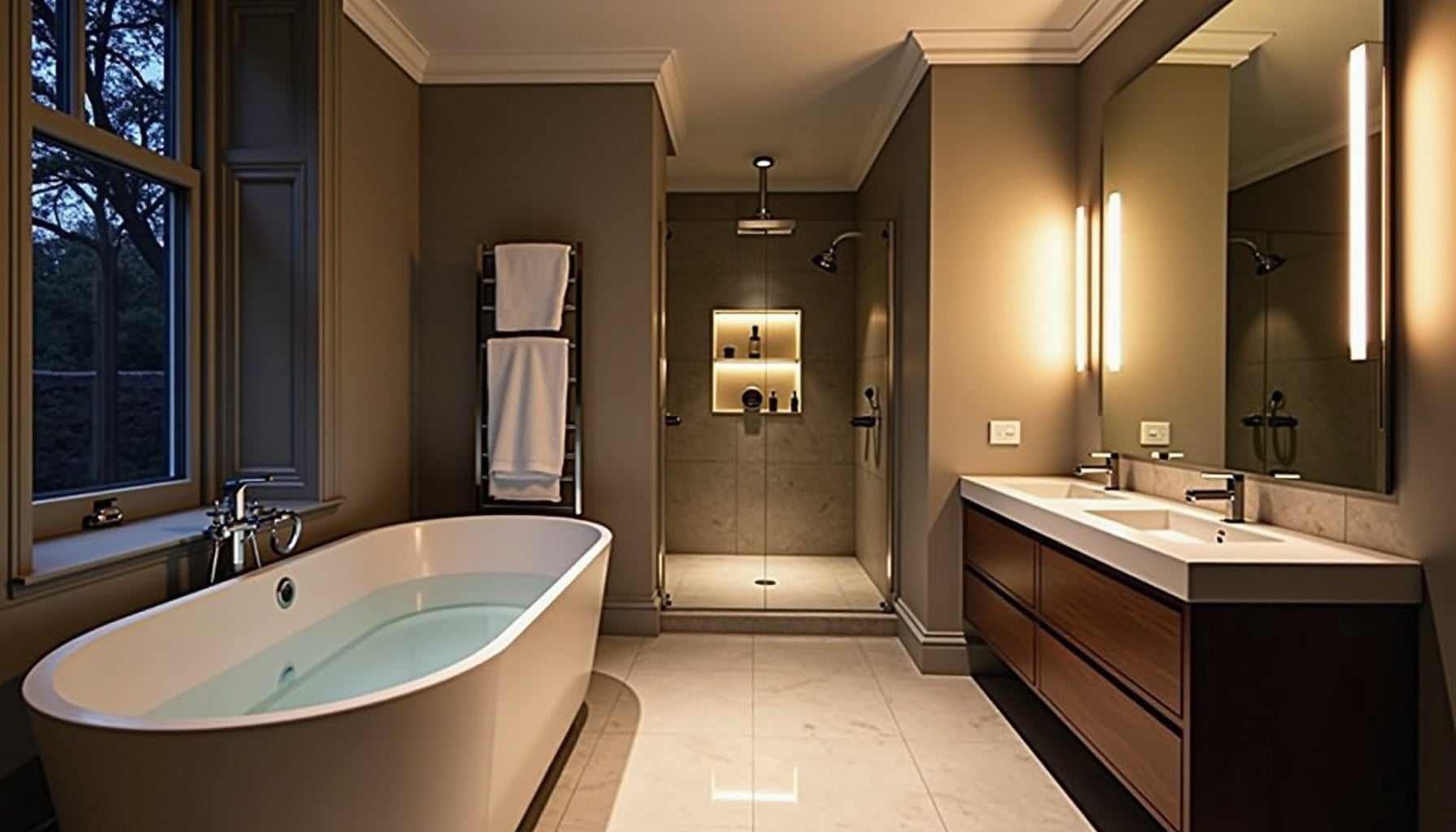
The two renders show that planned bathroom in its Morning and Bath scenes. If you are new to scene control, our guide to what a lighting control system is explains how keypads, dimmers and scenes work.

Lighting

Design
Lutron

Crestron

Climate
Bathroom Zones and IP Ratings
Every bathroom lighting design starts with the zones set out in BS 7671, the UK wiring regulations, which decide what can be installed where. Zone 0 is the inside of the bath or shower tray, and anything there must be rated at least IPX7 and run at safety extra-low voltage of no more than 12 volts. Zone 1 is the space directly above the bath or shower up to 2.25 metres, where fittings need at least IPX4. Zone 2 extends 0.6 metres beyond the bath or shower, and fittings there also need at least IPX4. All circuits in a bathroom need 30mA RCD protection.
Outside those zones no particular IP rating is required unless the room is cleaned with water jets, but in a principal bathroom it is simplest to use IP65 downlights throughout, so one fitting type works everywhere, including over the shower and bath. Light switches and keypads go outside the zones; in our plan the bathroom keypad is outside the door.
The regulations are summarised here from published guidance, not reproduced in full, and every bathroom installation should be designed and certified by a qualified electrician to the current edition. Getting the zones right at design stage is simpler than moving a fitting once the tiles are on.
Plan the Room Before the Fittings
Our planned bathroom is 4 by 3.2 metres with a 2.7 metre ceiling: a freestanding bath under the window, a walk-in shower in one corner, a double vanity with a wide mirror opposite, and a WC. That gives five lighting channels: IP65 ceiling downlights, vertical mirror lights at each basin, a lit shower niche, a warm wall wash behind the bath and a low-level night light under the floating vanity.
The dimensions and layout are assumed for this article; on a real project they come from the architect’s drawings and the bathroom designer’s layout. What matters is designing the light from the activities in the room: getting ready at the mirror, showering, bathing and the night-time visit, and giving each its own layer.
The bathroom is also where lighting most often has to be coordinated with other trades. Mirror cabinets, tile layouts, niche sizes, vanity heights and the position of the heated mirror and towel rail all affect where light can go, so the lighting drawing is agreed with the bathroom designer before first fix.
Mirror Lighting Without Shadows
The most important light in a bathroom is the light on your face at the mirror, and it should come from the front and sides, not from above. A downlight over the basin lights the top of the head and casts shadows under the eyes, nose and chin, which is exactly what you don’t want when shaving or applying make-up. In our plan each basin has vertical lights either side of the mirror at face height, giving even, shadow-free light across the face.
Colour rendering matters here more than anywhere else in the house. Mirror lighting should have high colour rendering, so skin tones and make-up look the same at the mirror as they do outside, and with tunable white the Morning scene can run the mirror lights at a crisp 4,000 kelvin while every other bathroom scene stays warm.
Backlit mirrors and integrated mirror cabinets are an alternative where the bathroom design calls for them. Either way, the mirror lighting goes on its own channel, so it can be at full brightness in the morning and very low, or off, in the evening.
Ceiling Light, Showers and Niches
Ceiling downlights provide the general light in a bathroom, and in our plan four IP65 fittings are placed over the shower, the bath and the centre of the room rather than in a regular grid. In the Morning scene they run at 60% alongside the mirror lights; in the Bath scene they drop to 10%, just enough to define the room without glare in the eyes of someone lying in the bath.
A recessed niche in the shower wall, lit with an IP67 LED strip, turns a practical shelf into a soft accent and gives the shower its own light without a downlight shining down into your eyes as you wash your hair. It is one of the details that has to be agreed with the tiler early, because the profile and its cable route are built into the wall before it is tiled.
Fittings in and around the shower need the correct IP rating for their zone, sealed drivers in an accessible location outside the wet area, and careful detailing so water can’t track along the cable. We specify the fittings, the drivers and their access panels together.
Bath Lighting for the Evening
A bath is the one time in the day when people lie back and look at the ceiling, so the bath scene is built on indirect light. In our plan a warm LED wash on the wall behind the bath, from a concealed detail at the top of the wall or the window reveal, lights the wall rather than the person, and it is the brightest light in the room in the Bath scene at 35%.
The shower niche glows at 40%, the vanity plinth light adds a low line of light at floor level, the mirror lights drop to 15% and the downlights to 10%, all at a warm 2,700 kelvin. That is the scene in the second render: candle-like in feel, but controlled, repeatable and at a single button press.
Lighting is only part of the bathing scene. On our Belgravia project, described below, the en suite bath fills itself at the chosen depth and temperature from the Crestron touchpanel or the client’s iPhone, and the lighting, heating and music can all be part of the same scene.
Night Light Under the Vanity
A floating vanity unit makes the ideal place for a night light: an LED strip in the plinth or under the unit lights the floor in a soft line, at a very warm 2,200 kelvin and around 5% of its output. It is enough to find the basin or the WC in the middle of the night without bringing up any light that would wake you fully.
In our plan the night light is recalled from the keypads, with no sensors: the Night button on the bathroom keypad, and the matching Night button beside the bed, set the same low level on both sides of the door. Nothing switches on unexpectedly, and the light is there only when someone asks for it.
The same plinth light also adds a quiet layer to the Bath scene, and it is a simple detail to include if it is planned before the vanity is built.
Scenes, Keypads and the Rest of the System
The bathroom keypad, outside the door and engraved with Morning, Bath, Night and Off, recalls the whole room at a single press. Morning brings the mirror lights to full and the downlights to 60% at 4,000 kelvin, with the niche at 30%; that is the scene in the first render. Bath and Night are described above, and Off switches the room off, while a whole-house Goodnight from the bedroom keypads covers the bathroom too.
Because the bathroom is on the same home lighting control system as the rest of the house, the scenes can include more than light. Underfloor heating, a heated mirror and the towel rail can come on with the Morning scene, the extract fan can run on after a shower, and music can follow from the bedroom. In one of our City of London apartments, the master bathroom towel rail switches on with the lights so there is a warm towel after every shower.
As with every room, the scenes are set once the bathroom is finished, with the household, and saved permanently. Our page on climate control covers the heating side of the system.
Planning a Bathroom Lighting Scheme
Bathroom lighting has less room for change than any other room in the house. Once the walls are tiled and the vanity is fitted, moving a mirror light, adding a niche strip or relocating a driver means taking finishes apart. That is why the lighting design, the bathroom design and the electrical first fix are best agreed together, with every fitting, zone, driver position and keypad shown on one drawing.
We design the lighting, specify fittings and drivers to suit each zone, coordinate with the bathroom designer, tiler and electrician, and programme and commission the scenes once the room is finished. Our residential lighting design service covers the process from first drawings to handover.
For the rest of the suite, our guide to bedroom lighting ideas covers the reading lights, cornice cove and night path that complete the principal bedroom. More lighting ideas: our guides to kitchen lighting, hallway and staircase lighting, bookcase and joinery lighting and garden lighting.
Bathroom Lighting Ideas — Frequently Asked Questions
What are the bathroom lighting zones?
Under BS 7671, zone 0 is inside the bath or shower (IPX7, 12V SELV), zone 1 is above it up to 2.25 metres (IPX4 minimum) and zone 2 extends 0.6 metres beyond it (IPX4 minimum). All bathroom circuits need 30mA RCD protection, and the installation should be designed and certified by a qualified electrician.
What IP rating do bathroom downlights need?
At least IPX4 in zones 1 and 2, and IPX7 in zone 0. Using IP65 downlights throughout a principal bathroom means one fitting type works everywhere.
What is the best lighting for a bathroom mirror?
Light from either side of the mirror at face height, with high colour rendering, rather than a downlight above the basin. Side lighting lights the face evenly without shadows under the eyes and chin.
What colour temperature is best for a bathroom?
Around 4,000 kelvin at the mirror for getting ready, and warm white around 2,700 kelvin for the rest of the room and evening bathing. Tunable white fittings let one scheme do both.
How do you light a bathroom at night?
With a very low, warm light at floor level, such as an LED strip under a floating vanity at around 5% and 2,200 kelvin, recalled from a Night button so it is enough to see by without waking you fully.
Can bathroom lighting control the heating and towel rail?
Yes. On a lighting control system, a Morning scene can bring on the underfloor heating, heated mirror and towel rail with the lights, and an evening Bath scene can set the lighting, heating and music together.
Home Lighting Control → · Lighting Design → · Bedroom Lighting Ideas → · Climate Control → · Discuss your project →