Dolby Atmos Home Cinema — Everything You Need to Know
What it is, why it matters, how to add it to an existing room and what it actually sounds like
Updated June 2026 · Custom Controls · Dolby Atmos installers since the format launched
Dolby Atmos has been the reference audio format for home cinema since it arrived in the residential market. Every serious cinema room we install today is specified for Atmos. But the format is still widely misunderstood — confused with simply having more speakers, or treated as a marketing term rather than a technical advancement. This guide explains exactly what Dolby Atmos does, why it sounds different from conventional surround sound, and how to add it to an existing cinema room.
Our Home Cinema Services

Design

Calibration

Installation

Seating

Treatments
What Dolby Atmos Actually Is
Conventional surround sound — 5.1, 7.1, even the channel-based extension of these — assigns each element of the film soundtrack to a specific speaker channel. The mixing engineer decides: “this helicopter sound plays from the left surround speaker.” The system has no way to refine that assignment — the sound plays from that channel, and every listener hears it from that speaker, regardless of where they are sitting or how many speakers the room contains.
Dolby Atmos replaces channel assignments with audio objects. The mixing engineer specifies: “this helicopter is at a position 30 degrees to the left of centre, elevated 20 degrees above the listener, and it moves from front to rear over three seconds.” The Atmos processor in the cinema room — whether an Anthem MRX, a Trinnov Altitude or anything in between — takes that object description and renders it through whatever speaker configuration the room contains. A 5.1.2 system and a 13.2.14 system both receive the same object; the larger system renders it with greater spatial precision because it has more speakers to work with. But both benefit from the object-based approach rather than the channel-based limitation.
The practical result is audio that feels genuinely three-dimensional. Overhead effects — rain, aircraft, falling objects, the environmental ambience above the action — arrive from the ceiling. Sounds pan smoothly around the room rather than jumping between channels. The difference between Atmos and a conventional 7.1 system on well-mixed Atmos content is immediately apparent to any listener, even one who knows nothing about the technical format.
Height Channels — the Essential Addition
Dolby Atmos requires ceiling or height speakers. Without them, the processor has no way to render the overhead dimension — the element that most clearly distinguishes Atmos from conventional surround. The minimum Atmos configuration that delivers a meaningful overhead experience is 5.1.2 — five main channels, one subwoofer, two height channels. Most installations we specify are 7.2.4 or larger.
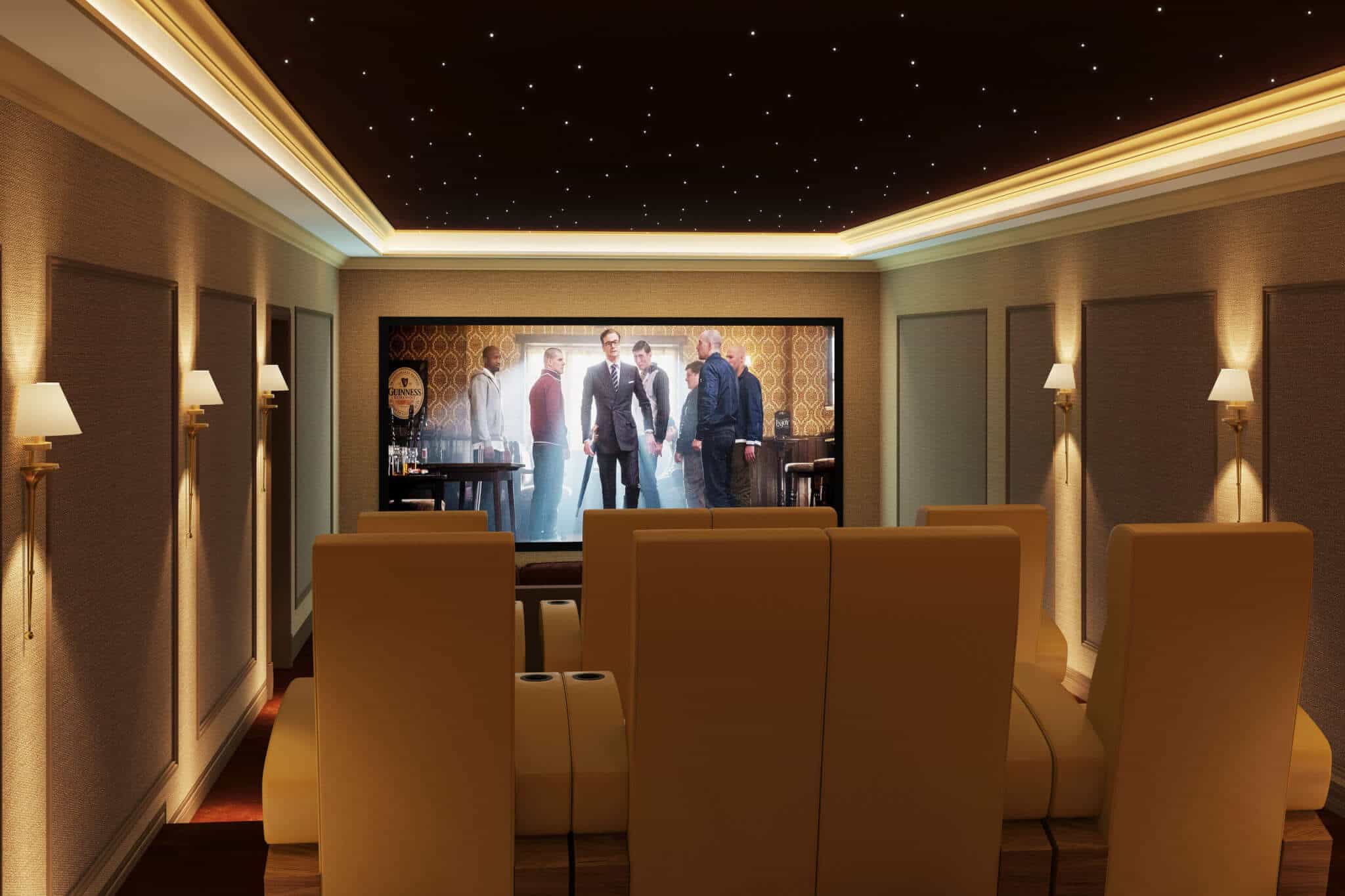
Height speakers can be in-ceiling (mounted flush with the ceiling, firing downward) or high on the walls at a steep angle. In rooms with fabric walls and acoustic ceiling treatment — our standard approach for dedicated cinema rooms — in-ceiling Artcoustic height speakers are concealed behind the ceiling fabric, invisible and acoustically seamless with the main speaker array. In rooms where ceiling access is not available, angled high-wall speakers are the alternative.
The Dolby Atmos specification defines recommended height speaker positions relative to the listening area. For installations with two height channels, the speakers should be positioned above and slightly in front of the main listening position. For four height channels, front-height and rear-height pairs cover the full overhead plane. Our most ambitious installations use up to 15 height channels — in the Ghana 34.7.15 installation, the height channel array creates a continuous overhead soundfield that completely envelops the listening area.
Dolby Atmos Sources — Where to Get It
Kaleidescape — lossless Dolby Atmos. Kaleidescape is the only consumer source that delivers bit-for-bit lossless Dolby Atmos — the same audio that the mixing engineers recorded, delivered intact. The difference between lossless Dolby Atmos from Kaleidescape and the compressed Atmos available from streaming services is audible on any system capable of resolving it.
Streaming — compressed Dolby Atmos. Netflix, Apple TV+, Disney+ and Amazon Prime all offer Dolby Atmos on selected titles. This is lossy Dolby Atmos — encoded at a fraction of the bitrate of the lossless version — and delivers a meaningfully inferior result on a resolving system.
Blu-ray and 4K UHD. Physical disc provides lossless Dolby Atmos on titles encoded with it — equivalent quality to Kaleidescape, without the convenience of a server-based film library.
Upgrading an Existing Cinema Room to Dolby Atmos
The most frequent Atmos upgrade we perform is adding height channels to an existing room that has a good surround system but no overhead capability. The existing processor is replaced with an Atmos-capable unit — an Anthem MRX for mid-range installations, a Trinnov Altitude for the most demanding — and in-ceiling or high-wall height speakers are added to the existing infrastructure.
Cable routing for the new height channels is the main installation variable. In most existing cinema rooms, there is cable conduit already installed in the ceiling void from the original installation. New speaker cable runs can usually be threaded through without opening walls.
The full renovation process for adding Atmos to an existing room is covered in detail in our home cinema renovation guide.
Atmos Speaker Configurations — What We Specify
7.2.4 — the standard high-performance Atmos configuration for rooms from approximately 5m × 6m upward. Four height channels provide front-height and rear-height coverage. This is the configuration in the Cheshire home entertainment complex.
9.2.4 / 9.2.6 — adding front wide channels, filling the spatial gap between front channels and surrounds. The Abuja, Nigeria cinema and the Al Barari Dubai cinema both use 9.2.4 configurations.
13.2.14 and above — IMAX Enhanced configurations for the largest rooms. The Dubai IMAX cinema uses this specification with Trinnov Altitude 32 processing.
DTS:X — The Alternative to Atmos
DTS:X is Dolby Atmos’s direct competitor — an object-based immersive audio format using the same principles. DTS:X is supported by all current Anthem and Trinnov processors. Most content is mixed for either Atmos or DTS:X but not both; having a processor that decodes both ensures no content is left behind.
Case Studies — Dolby Atmos in Practice
The Ghana 34.7.15 installation is our most technically ambitious Atmos implementation — 15 height channels across a 5.5m × 12m room, creating a continuous overhead soundfield.
The Cheshire garden cinema demonstrates Atmos in a challenging glass-walled garden studio with an Artcoustic 7.4.2 system.
The Knutsford, Cheshire cinema and the Berkshire basement cinema both demonstrate Atmos delivering full three-dimensional immersion in smaller rooms.
Frequently Asked Questions — Dolby Atmos Home Cinema
What is the minimum speaker configuration for Dolby Atmos?
5.1.2 — five main channels, one subwoofer and two height channels — is the minimum that delivers a meaningful overhead effect. Most installations we specify are 7.2.4 or larger for a genuinely immersive result.
Can Dolby Atmos be added to an existing cinema room?
Yes, in most cases. The existing processor is replaced with an Atmos-capable unit and height speakers are added — often using existing ceiling conduit from the original installation, with no need to open walls.
Is Dolby Atmos from streaming services as good as from Kaleidescape or Blu-ray?
No. Streaming services deliver lossy, compressed Dolby Atmos at a fraction of the bitrate of Kaleidescape or physical disc, which both provide bit-for-bit lossless Atmos — the difference is audible on any genuinely resolving system.
What is the difference between Dolby Atmos and DTS:X?
Both are object-based immersive audio formats using similar principles. Most film content is mixed for one format or the other, not both, which is why we specify processors capable of decoding both Atmos and DTS:X.
Trinnov Home Cinema → · Anthem AV → · Artcoustic Speakers → · Kaleidescape → · Cinema Renovation Guide → · Contact Us →