Smart Home vs Home Automation vs Connected Home
Smart Home vs Home Automation: The Real Difference
Smart home, home automation and connected home are used almost interchangeably in everyday conversation, but they describe genuinely different levels of capability. Understanding the distinction matters when planning a project, because it shapes both the budget and the result. Solutions range from straightforward consumer systems suited to a technically confident homeowner, through to fully bespoke, professionally installed and maintained systems — which is where Custom Controls specialises. Here’s what each term actually means.
The terms blur because manufacturers and retailers use them loosely: a single app-controlled bulb is marketed as “smart home”, a timer on a heating boiler is described as “automation”, and almost anything with a WiFi chip is “connected”. In a large private property the distinction is far from academic. Each level depends on the one beneath it, and a system specified at the wrong level — or built on weak foundations — is the most common reason a technically expensive house still feels unreliable to live in.
Connected Home
This is the simplest of the three. A connected home refers to the underlying infrastructure — a solid network supporting smart TVs, streaming devices and a reliable WiFi signal throughout the property. It can extend further to include media servers and home cinema computers, but at its core a connected home is about good connectivity rather than control. Most homes today have some element of this already in place, even if nothing is formally automated.
In a large home, “good connectivity” is harder to achieve than it sounds. Thick stone walls, multi-storey layouts, basement cinema rooms, pool houses and outbuildings all defeat consumer WiFi products designed for a two-bedroom flat, and the average large private home now has well over fifty connected devices competing for the same airspace. Consumer mesh systems add a further weakness: the nodes talk to each other over the same wireless spectrum they use to serve your devices, so every hop between nodes reduces the bandwidth available.
A properly engineered home network solves this with wired Ethernet backhaul to every access point, enterprise-grade equipment from manufacturers such as Cisco Meraki, Ruckus, Pakedge and Ubiquiti UniFi, and proper segmentation — personal devices, guests, smart home controllers and IP cameras each on their own network segment, so a compromised guest device cannot reach your private data or security infrastructure. For properties with unreliable primary broadband, multi-WAN designs combine broadband, leased line, 4G/5G and satellite connections with automatic failover. None of this is visible to the household, but everything above it depends on it.
Smart Home
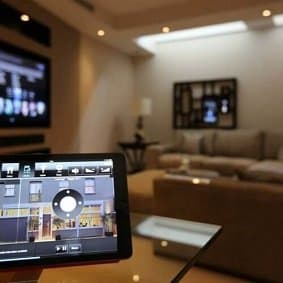
A smart home builds on that connected infrastructure with genuine distribution and control. Multi-room audio and video lets any room access the household’s full music collection or any centralised video source. Lighting control adds scene-setting and mood lighting, either in key rooms or throughout the property. Simple automated actions — exterior lighting coming on at dusk, AV switching off automatically when the alarm is set — start to add real convenience on top of straightforward distribution. This is the level at which a property genuinely starts to feel intelligent rather than simply well-connected.
Lighting is usually where the difference is felt first. A conventional home has a switch for every light, each doing one thing. A lighting control system replaces them with a single custom-engraved keypad per room, where one button recalls a precise, pre-set level for every circuit at once: “Reading”, “Entertaining” or “Cleaning”, set once by a designer and recallable forever after. In existing homes, period properties and listed buildings, Lutron RadioRA 3 installs over the existing wiring using Lutron’s Clear Connect RF, which runs independently of your WiFi; in new builds and major renovations, Lutron HomeWorks QSX offers unlimited zones and the full designer keypad range. RadioRA 3 introduces the Vierti keypad, Lutron’s newest wall control, and supports Lumaris tunable white lighting, while HomeWorks QSX adds native support for Ketra full-spectrum tunable lighting.

Smart Home

Lighting Control

Multi-Room Audio

Climate Control

WiFi & Networks
Multi-room audio and video follow the same principle of centralisation. Rather than a streaming box, satellite receiver and disc player behind every television, sources are housed in an equipment rack and distributed to each room, with any room able to play something different or join others for a party. The result is fewer boxes, fewer remotes and a single, consistent interface in every space — but at this level each system is still largely doing its own job, with only light-touch links between them.
Home Automation
Home automation is the most comprehensive of the three. It builds on everything a smart home delivers — whole-home AV and lighting — and extends control to heating, air conditioning and genuinely any electrical system in the property, all working together to add convenience and save energy simultaneously. Heating and cooling can run only when rooms are actually occupied, rather than on a blanket schedule, saving meaningful energy across a large property. Homes with renewable energy systems can go further still, managing whole-house power consumption intelligently — heating water when electricity is cheapest or production is highest, or redirecting warm air from a sun-facing room to a cooler north-facing one rather than running a separate heat source. Run this way, a property delivers genuine day-to-day comfort while using the minimum energy necessary to provide it.
The defining feature is that systems respond to each other rather than to separate schedules. Arming the alarm switches off all non-essential lighting and AV and sets every heating zone back to an energy-saving temperature. Arriving home — triggered by a keypad at the front door or a phone’s location — disarms the alarm, brings up a welcome lighting scene and returns every zone to its comfort setting. A visitor at the gate can appear on the kitchen touchpanel while the hall lights come on and the client’s phone is notified, all without anyone lifting a finger.
Climate control is where this integration makes the biggest practical difference. A single thermostat reading the air beside itself is a poor proxy for a whole room, so we specify remote temperature sensors as standard — Crestron’s CHV-RTS and CHV-RTHS sensors, for example, let one thermostat read from up to four points in a room or zone. Where a client’s chosen air conditioning brand does not speak to a smart home platform natively, Cool Automation gateways bring each indoor unit into Crestron or Lutron as if it were native hardware. Motorised blinds join the same logic: closing against direct summer sun reduces the cooling load, and opening fully on winter days maximises passive solar gain.
How Home Automation Scales to Large Properties
On a large or multi-building property, a home automation system needs a different architecture from a single-room upgrade. Rather than routing every device back to one central cabinet, we design distributed rack systems — typically a dedicated rack per building, a further rack per floor on larger structures, and one or two more serving the garden and grounds. Every rack runs its own processing and is networked back to the same control system, so the property is controlled as one seamless whole, and any fault is isolated to a single building or zone rather than taking down the estate.
This is also the point at which the choice of platform matters most. We build primarily around Crestron, the most capable residential automation platform available, with Lutron handling lighting and shading on the majority of significant projects; Control4 and Savant often suit simpler systems where the priority is ease of use over raw capability. Crestron’s processing power and flexibility scale to whole-estate projects in a way few competitors match.
Why Professional Installation Changes the Answer
Each of the three levels can, in principle, be assembled from consumer products: a mesh WiFi kit, smart bulbs from one brand, a smart thermostat from another and a video doorbell from a third. The difficulty is that none of these were designed to work together, so the “automation” rarely extends beyond each product’s own app, and a failure in one silently breaks the routines that depend on it.
A poorly designed network is the single most common cause of smart home unreliability. When Custom Controls is responsible for both the smart home system and the network, they are designed together from the outset: we know what bandwidth the cinema distribution requires, what latency the Crestron controllers need and how many concurrent streams the multi-room audio will generate. Every installation includes training, full documentation and ongoing support, and remote monitoring is standard, so most issues are identified and resolved before a client has noticed anything was wrong.
Which Level Is Right for You?
Most clients don’t need to choose a single tier and stop there. A connected home is the foundation everything else builds on; smart home elements — AV distribution, lighting control — are added as budget and priority allow; full home automation, integrating heating, security and energy management, represents the complete picture for clients who want every system in the property working together rather than independently. Custom Controls design systems modularly, so elements of smart home and home automation technology can be added incrementally to an existing connected home rather than requiring everything to be specified and installed at once.
The one decision that is hard to reverse is infrastructure. For new builds and major renovations, smart home design begins during architectural planning, not once the walls are up: we work with architects and interior designers to integrate control points, wiring routes, equipment locations and user interfaces into the building design, so that later stages can be added without disruption. In an existing home, wireless lighting control and a hybrid network — wired Ethernet to the locations that can be cabled, mesh extending coverage where they cannot — allow a property to move up a level without chasing walls. Read our complete guide to modern home automation →

Frequently Asked Questions
What is the difference between a smart home and home automation?
A smart home typically refers to AV distribution and lighting control — the systems that make a property feel intelligent day to day. Home automation extends this further, integrating heating, cooling, security and energy management so every electrical system in the property works together rather than independently.
What is a connected home?
A connected home is the underlying infrastructure: a reliable wired and wireless network supporting smart TVs, streaming devices and every other connected device in the property. It is about good connectivity rather than control, and it is the foundation both smart home and home automation systems depend on.
Do I need a connected home before adding smart home features?
Effectively, yes — a reliable network and good connectivity are the foundation that AV distribution and other smart home features depend on. Most properties already have some of this infrastructure in place, even informally, before any formal smart home or automation system is specified.
Can these systems be added incrementally rather than all at once?
Yes. We design systems modularly specifically so that elements can be added over time as budget allows — starting with reliable connectivity, then adding AV and lighting control, then extending into full home automation if and when it’s needed.
Can home automation be added to an existing home without rewiring?
Largely, yes. Wireless lighting control such as Lutron RadioRA 3 installs over the existing wiring, and a hybrid network combines wired access points where cabling is practical with mesh coverage where it is not. For new builds and major renovations, a wired design remains the approach we recommend.
Custom Controls have been designing and installing smart home and home automation systems since 1998. Contact us to discuss the right level of system for your property.
Home Automation → · Home WiFi & Networks → · Lighting Control → · Benefits of a Smart Home System → · Energy Management & Smart Home Automation →