Upgrading from Mode, iLight, Vantage or Rako to Lutron or Crestron
Replacing an Old, Unreliable Lighting System
Lutron and Crestron’s lighting platforms are flexible enough that we can confidently upgrade almost any older lighting control system — Mode, iLight, Vantage, Rako and similar — to a modern, efficient and genuinely reliable equivalent. We have completed a number of these projects, replacing an unreliable legacy system with something the household can actually depend on day to day.
Our Wimbledon case study is a particularly good example of just how bad things can get. The clients had lived with an old, unreliable lighting system for ten years, and had gradually given up on it entirely — reverting to table lamps and side lamps because the system itself couldn’t be trusted. When we first visited, pressing a single light switch produced genuinely unpredictable results: it might switch on a couple of lights, switch every light in the house off, or even switch off lights in an entirely different room. This is an extreme example, but a great many households are still living with a ten-year-old (or older) lighting control system that has neither the reliability nor the flexibility of a current Lutron or Crestron installation.
What a Modern Replacement Delivers

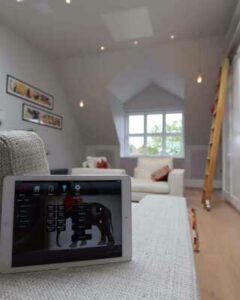
Our replacement systems use the traditional lighting keypad for everyday scene recall, alongside full app and touchpanel integration — a client can stand in the room, adjust each circuit to exactly the level they want, and save the result permanently to any keypad button for instant recall afterward. A holiday or “away” mode replays the household’s recent lighting activity automatically while everyone is out, making the property look genuinely occupied rather than running off a single predictable timer. Scheduling can bring exterior lights on at a fixed time or in response to actual sunset and sunrise, switching off again automatically. The digital dimmers themselves are considerably more efficient than older lighting systems — dimming a light genuinely saves meaningful energy, on top of making the home look its best at every level.
The keypads themselves are a significant part of the upgrade. Lutron’s Palladiom, Alisse and Vierti ranges and Crestron’s own keypad families are designed as architectural products, available in multiple finishes and button configurations, and engraved with scene names the household actually uses rather than the cryptic labels many older systems carried. The same system can bring motorised blinds, climate control and AV into the same scenes, so a single “evening” button sets the lighting, lowers the blinds and adjusts the temperature together.
Why Legacy Lighting Systems Fail
Most older lighting control systems do not fail all at once. They become progressively harder to live with: a keypad that occasionally ignores a press, a scene that no longer recalls the right levels, a module that has to be reset, and eventually behaviour nobody can predict. Underneath this there are usually three causes. The first is obsolescence — the processor and modules are no longer manufactured, spare parts are scarce, and the software needed to reprogramme them may no longer be available. On legacy Lutron Homeworks Interactive and Illumination systems, for example, a failed processor generally means the original programming is lost unless it was captured beforehand.
The second is data wiring that can no longer be trusted. In our Wimbledon project, the original developer-installed KNX system was slowly failing, and the most reliable fix was to stop relying on the existing cable infrastructure for data at all. The third is LED. Many older systems use leading-edge dimming modules designed for the resistive loads of halogen and incandescent lamps, while most LED lamps and drivers need trailing-edge dimming. Fit LED to an unmodified legacy system and the typical results are flicker, audible buzzing, a limited or unreliable dimming range and shortened lamp life.

Lutron

Crestron

Lighting Design

Smart Home

Climate Control
Assess Before You Replace
The right response to a failing system is not automatically to replace everything. Every upgrade we carry out starts with a survey that records every lighting circuit, identifies which dimming modules are fitted and whether they are leading-edge or trailing-edge, notes the function of every keypad the household actually uses, and assesses the condition of the existing cabling. Where the existing processor is still online and responsive, we try to extract its programming before anything else happens, so that scenes and schedules the household relies on are not lost.
From the survey we produce a proposal with genuine options: full replacement and, where it is sensible, a partial or phased upgrade, with the dimming modules and keypad choices relevant to each path. Once a direction is agreed we produce a full lighting control schematic, order the equipment, and prepare and test as much as possible before any work starts on site, which keeps disruption to the household to a minimum.
Reusing the Existing Wiring
For clients whose existing system has reached this point, the right upgrade path depends on what’s actually salvageable — sometimes the existing wiring infrastructure can be reused with new Lutron or Crestron dimming modules behind the wall, keeping disruption to a minimum. For the full detail on how we approach this kind of upgrade with Lutron specifically, see our guide: Upgrading a Legacy Lutron System →. For systems where the original installer is no longer trading or simply never configured things properly, see: Inherited a Bad Crestron or Lutron Installation? Here’s How We Fix It →
The Wimbledon retrofit shows how far this approach can go. The existing KNX keypads were replaced with mains-powered Crestron wireless keypads, using the existing cabling only for mains power rather than data, which immediately removed the dependence on an unknown cable infrastructure. The wireless keypads form a mesh network and act as repeaters, so coverage becomes stronger as more are installed, and they communicate with centralised Crestron DIN-rail dimmers through a wireless-enabled processor housed in a new, regulations-compliant DIN-rail enclosure. Thirty lighting channels and nineteen keypads were upgraded without opening a single wall.
Lutron Homeworks QSX, RadioRA 3 or Crestron?
Where a legacy Lutron system is being replaced, Lutron Homeworks QSX and the latest Athena Edge processor generation are the direct successors, designed with this kind of upgrade in mind. They drive LED properly through trailing-edge, phase-adaptive modules such as the 4A5 Pro LED+ range, or through DALI and 0-10V load types from the same processor, and Homeworks QSX’s LEAP API gives a clean, reliable integration path to Crestron. A phased upgrade is genuinely viable on these platforms: the processor and dimming modules behind the wall can be replaced first, solving the obsolescence and LED problems immediately, with ageing keypads replaced room by room as redecoration reaches each space.
Where rewiring is impractical — a period or listed property, or a home that has just been redecorated — Lutron RadioRA 3 offers a fully wireless alternative. It uses Lutron’s Clear Connect RF technology, which operates independently of the home’s Wi-Fi, installs over the existing wiring, and can start with a single room and expand to the whole house over time. For clients who want lighting, AV, climate and security on one platform, a Crestron system — either with Crestron’s own dimming or with Lutron handling the lighting layer beneath a Crestron interface — remains the most capable option. Our lighting control team will recommend the platform that suits the property rather than a single house style.
Getting LED Dimming Right
An upgrade is the moment to fix LED performance properly rather than work around it. Modern dimming modules are matched to the load they drive — trailing-edge for most mains LED lamps, DALI or 0-10V for architectural fittings and LED drivers that support those protocols — and the lamps themselves matter as much as the dimmer. On the Wimbledon project our electrical team progressively replaced the client’s inefficient lamps with Crestron LED lamps that dim smoothly from 0 to 100% with a consistent colour temperature throughout the range, and on RadioRA 3, Lutron’s Lumaris LED tape and tunable white sources dim from 0.1% to 100% across 1,800K to 4,000K.
We test every circuit at commissioning across its full dimming range, looking for flicker, buzzing and drop-out at low levels, and adjust the low-end and high-end trim for each load so that scenes look right at every level. Where a lighting design service is part of the project, the fittings, drivers and control protocol are specified together from the outset, so compatibility is designed in rather than discovered on site.
Handover and Ongoing Support
A replacement system is only a success if the household trusts it again, so handover is as important as the installation. We set up scenes with the household room by room, show them how to adjust a room’s levels and save the result to a keypad button themselves, and configure the schedules and holiday mode around how the house is actually used. Exterior lighting is set to follow sunset and sunrise, and remote access through the app means lights can be checked and changed from anywhere.
After handover, the same remote connection lets us support the system without always needing a site visit. On a Crestron Home system we can monitor and adjust the configuration remotely, so most changes — a new scene, a revised schedule, a keypad button reassigned — can be made with a phone call. For households that had given up on their old system entirely, that ongoing support is what keeps the new one in daily use rather than slowly drifting back towards table lamps.
We can retrofit a Lutron or Crestron lighting control system into any type of property. Get in touch for a free survey and to discuss the options.

Frequently Asked Questions — Upgrading an Old Lighting System
Can you upgrade an old Mode, iLight, Vantage or Rako system to Lutron or Crestron?
Yes. We have completed a number of these upgrades, replacing unreliable legacy lighting systems with modern Lutron or Crestron installations, often reusing existing wiring infrastructure where it’s still suitable.
How do I know if my lighting system needs replacing rather than just fixing?
Genuinely unpredictable behaviour — switches that affect the wrong lights, scenes that no longer work reliably, a system the household has stopped trusting — usually points to a system that’s reached the end of its useful life rather than one with a single fixable fault. A survey will confirm which applies to your specific installation.
Will my existing dimmers work with LED lamps?
Often not reliably. Many older systems use leading-edge dimming modules designed for halogen and incandescent loads, while most LED lamps and drivers need trailing-edge dimming. Running LED on unmodified legacy modules typically causes flicker, buzzing, a limited dimming range and shorter lamp life, so the dimming modules are usually the first thing we replace.
Does upgrading a lighting system always mean rewiring the whole house?
Not necessarily. In many cases the existing wiring infrastructure can be reused with new dimming modules, keeping disruption to a minimum. Where rewiring genuinely isn’t practical, Lutron RadioRA 3 offers a fully wireless alternative.
Can I keep my existing keypads?
Sometimes. On a legacy Lutron system, a well-planned upgrade can frequently keep the existing keypads while replacing the processor and dimming modules behind the wall, and ageing keypads can then be replaced room by room as redecoration reaches each space. Where the keypads themselves are the problem, as in our Wimbledon project, they are replaced with modern Crestron or Lutron equivalents.
Lighting Control → · Lutron → · Crestron → · Upgrading a Legacy Lutron System → · Contact Us →