
Amazon Alexa for Multi-Room Audio
Alexa Voice Control for Whole-Home Music
Voice control is now a mainstream part of how people interact with music at home, and Amazon Alexa remains one of the leading platforms. Beyond starting and stopping music, Alexa handles a genuinely wide range of tasks — adding items to a shopping basket, checking traffic ahead of a commute, or answering a question that’s been nagging at you. Here we focus specifically on what Alexa means for audio distribution around the home.
Voice control is also widely misunderstood. Some clients assume it should replace every other form of control; others dismiss it as a gimmick because it doesn’t suit every room. Both views miss the point. Voice is excellent in specific situations and a poor substitute for a proper interface in others, and the systems that work best are designed with that balance in mind from the start — voice where it genuinely helps, and keypads, touchpanels and apps everywhere else.

Multi-Room Audio

Smart Home

Crestron

Lighting Control

WiFi & Networks
Voice Assistants and Audio Quality
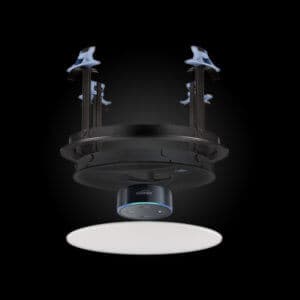
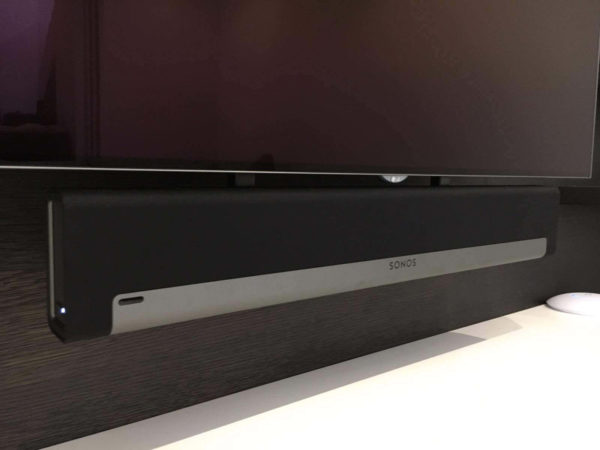
Alexa makes streaming music into any space straightforward — Amazon Music and internet radio are a single voice command away. Standalone Echo devices have improved considerably over the years, but a small smart speaker is still a small smart speaker: fine for catching the radio in the morning, less convincing for genuinely filling a room. Sonos addressed this directly by building Alexa support into much of its current range — the Era 100, Era 300 and Five all support Alexa natively, alongside Sonos’s own Sonos Voice Control. This means a Sonos system can deliver genuinely high-quality, room-filling audio with the same voice convenience as a standalone Echo, without needing a separate speaker for the microphone and another for the sound.
The better answer for most of our clients, though, separates the two jobs entirely. The microphone — the part that listens for “Alexa” — can be small, discreet and placed wherever it hears the room best. The sound comes from properly specified architectural speakers driven by a central amplifier, chosen for the room’s size and use rather than for how much can be squeezed into a device on a shelf. Voice control then becomes a feature of the audio system rather than a compromise on it.
That separation matters most in the rooms where voice control is genuinely useful. Bathrooms, kitchens and home gyms are where it consistently earns its place: hands are wet, full or otherwise occupied, and being able to say “Alexa, next track” without touching anything is a real convenience rather than a novelty. They are also rooms where a smart speaker on a worktop or vanity unit looks out of place, and where in-ceiling speakers deliver far better sound.
Origin Acoustics Valet and Amazon Alexa
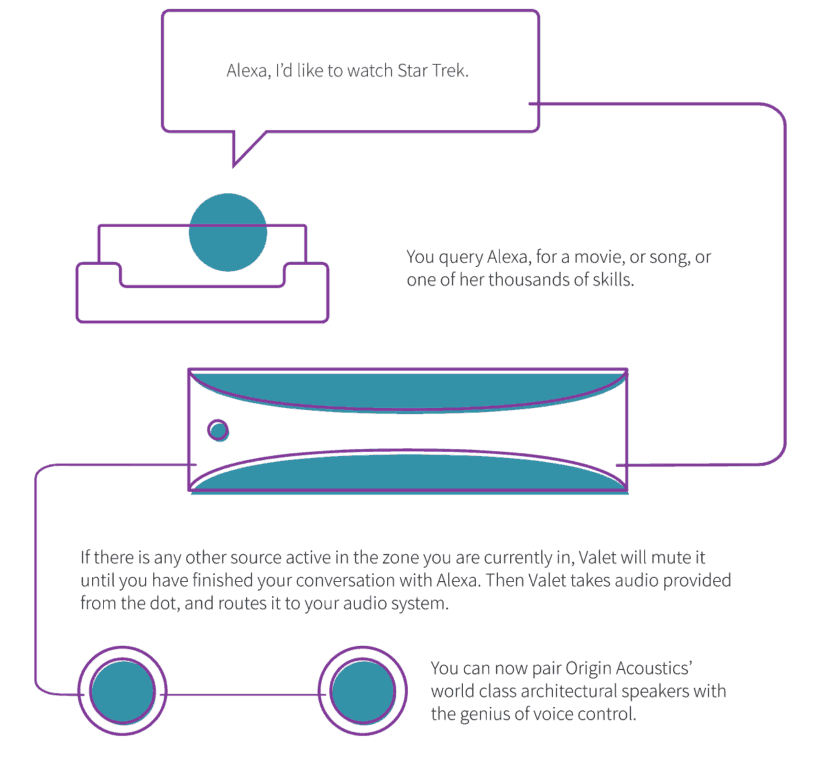
We have installed Origin Acoustics ceiling speakers for years — most of our case studies feature their products, and we rate both the build quality and the breadth of the range highly. The Origin Acoustics Valet system is a genuinely elegant solution to the “smart speaker on a surface” problem: an in-ceiling bracket conceals an Amazon Echo Dot out of sight, wired back to a central amplifier that powers high-end Origin Acoustics in-ceiling speakers. This avoids the need for an Echo sitting on a worktop or shelf — particularly useful in bathrooms and sleek modern kitchens — while delivering the same voice control. During playback, music dips briefly while you speak to Alexa before returning to its previous level, exactly the same interaction as a standalone Echo, but through genuinely high-quality, properly installed audio. We frequently specify 10-inch Origin Acoustics in-ceiling speakers in key rooms for exactly this combination — real bass extension paired with Alexa convenience.
Origin also offers a Dot wall mount for the Valet system, and it opens up a particularly useful retrofit route. Many older multi-room audio systems were installed with speakers already in the ceilings of remote rooms and a Cat5 cable running to a wall keypad. Origin’s own description of the opportunity is that swapping the ageing keypad for an Echo Dot and adding the Valet amplifier requires no additional wiring — turning a dated system into a voice-controlled, multi-room, multi-source one without chasing new cables through finished walls.
The choice of speaker still determines how good the result sounds, which is why we pair the Valet system with properly specified Origin in-ceiling models rather than treating the speakers as an afterthought to the voice assistant. You can read more about our approach on our Origin Acoustics in-ceiling speakers page.
Amazon Alexa and Crestron Home Automation
Audio is only one part of what Alexa makes possible. Integrating Alexa with a Crestron home automation system unlocks considerably more — beyond requesting music playback through a Crestron audio distribution system, imagine being able to say “Alexa, close the blinds,” “Alexa, raise the heating one degree,” or “Alexa, run the bath.” Because a Crestron system is modular and capable of controlling virtually anything electrical in a property — we have controlled everything from irrigation systems to fire pits — Alexa simply becomes one more way to issue commands to a system that’s already there.
Crestron Home integrates natively with Amazon Alexa, Google Assistant and Apple Siri, giving voice control of lighting, climate, AV and more through whichever platform a household already uses. We go beyond the basic skill or routine that a standalone Echo offers on its own: once integrated, voice commands are coordinated through the same Crestron programme that drives every keypad and touchpanel in the property, so “Alexa, turn on the kitchen lights” recalls the same carefully designed scene as the keypad by the door, not a crude on/off command.
For clients who want a more natural voice experience than a standard skill provides, Josh.ai is a voice platform built specifically around deep Crestron integration. Where a standard voice assistant requires fairly rigid phrasing, Josh.ai understands room context and handles more conversational requests — “play the news in the kitchen” or “it’s a bit warm in here” — without the household needing to learn a fixed command structure. We cover the options in more detail in our guide to Crestron voice control with Alexa, Siri, Google Home and Josh.ai.
Where Voice Control Works — and Where It Doesn’t
For a touchpanel-driven living room or cinema, a proper interface usually remains the better choice for day-to-day control. Selecting a film, adjusting a lighting scene precisely or browsing a music library is faster and more reliable with a touchpanel or app than with a voice command. We treat voice control as a genuinely valuable addition to a Crestron or multi-room audio system, not a wholesale replacement for it, and we design it alongside physical and on-screen control rather than instead of it.
There are practical design points too. Alexa relies on a reliable connection, so the network and WiFi infrastructure has to be designed to the same standard as the audio system itself. Room and zone names need to be consistent across Alexa, the audio platform and the control system, so that “the kitchen” means the same thing everywhere. And households with guests, staff or children often want some rooms voice-enabled and others not; that is a design decision to make early, not an afterthought.
Voice control is also genuinely valuable for clients with limited mobility or dexterity, where a more conversational and forgiving voice interface meaningfully increases independence. In those installations, it moves from a convenience to one of the most important parts of the system.
Frequently Asked Questions — Alexa for Multi-Room Audio
Can Alexa control a Sonos multi-room system?
Yes. Several current Sonos models — including the Era 100, Era 300 and Five — support Alexa natively, letting you control music throughout a Sonos system by voice without needing a separate Echo device in every room.
How does Origin Acoustics Valet hide an Alexa device?
The Valet system uses an in-ceiling bracket to conceal an Amazon Echo Dot out of sight, wiring it back to a central amplifier driving proper Origin Acoustics in-ceiling speakers — giving full voice control without a visible smart speaker on a worktop or shelf.
Can Alexa control more than just music?
Yes, significantly more, when integrated with a Crestron home automation system. Beyond playback, voice commands can control lighting, blinds, heating and virtually any other electrical system already connected to the Crestron platform.
Which rooms benefit most from voice control?
Bathrooms, kitchens and home gyms consistently benefit the most — situations where hands are wet, full or otherwise occupied. For touchpanel-driven rooms like a living room or cinema, a proper interface usually remains faster and more precise for everyday control.
Can Crestron work with Alexa, Google Home and Siri at the same time?
Yes. Crestron Home integrates natively with all three platforms, and a household can use whichever voice assistant it already prefers without needing to standardise on one.
Custom Controls have been integrating voice control into smart home and audio systems since 1998. Contact us to discuss the right setup for your home.
Multi-Room Audio → · Sonos Dealer & Installer → · Origin Acoustics Speakers → · Crestron Voice Control → · Contact Us →