Trinnov Home Cinema — The Complete Guide
Why Trinnov is the Reference Standard for Home Cinema Audio — and When You Should Specify It
Updated June 2026 · Custom Controls · Authorised Trinnov dealers and installers since 2012
Trinnov is the processor that serious home cinema installers reach for when the brief is uncompromising. It is not the right choice for every installation — it is the right choice when the room, the speaker system and the client’s expectations are all operating at the level where the performance gap between Trinnov and everything else becomes audible, measurable and impossible to ignore. This guide explains what Trinnov does, why it does it better than the alternatives, which products are available, and how to know whether your installation warrants one.
Our Home Cinema Services

Design

Calibration

Installation

Seating

Treatments
What Trinnov Actually Does
Every home cinema processor — from an entry-level AV receiver to a Trinnov Altitude — takes a multi-channel audio signal from a source and distributes it to the speakers in the room. What separates Trinnov from everything below it is the precision and depth of what happens between those two points.
The 3D measurement microphone. The foundation of Trinnov’s advantage is its proprietary measurement system. A conventional AVR calibrates using a single omnidirectional microphone placed at the listening position — measuring frequency response and timing for each speaker from one point in space. The Trinnov microphone is a four-capsule 3D array that maps not just the frequency response and timing of each speaker but its precise physical position and height in the room. The processor knows, to within a few centimetres, where every speaker is relative to every seat. It uses this spatial map to apply time alignment, level correction and EQ to each channel with a precision that single-point calibration cannot approach.
The Optimizer. Trinnov’s calibration algorithm — the Optimizer — takes the 3D spatial map and applies corrections that account for the room’s acoustic behaviour at every frequency. Bass modes, early reflections, boundary interference between multiple subwoofers, phase relationships between adjacent speakers — all are measured and addressed. The result is a system where every seat delivers the same audio experience: not approximately the same, but measurably, consistently the same. In a cinema room with three rows of seating, the back row sounds like the front row. This is not achievable on any conventional processor at any price.
Subwoofer management and bass steering. Most AVRs treat the LFE (Low Frequency Effects) channel as the only source of bass — a single channel fed to one or two subwoofers. Trinnov treats every speaker in the room as a potential bass source. A properly specified Trinnov installation pairs subwoofers with the front, surround and height channels — so bass does not just come from the front of the room but from the correct spatial position relative to the action. An explosion to the rear left of the screen has bass energy arriving from the rear left, not from a subwoofer at the front. This is the specific characteristic that clients who have auditioned a properly installed Trinnov system describe most consistently: bass that feels directional and natural rather than omnidirectional and fatiguing.
WaveForming. Trinnov’s WaveForming technology — available on the Altitude 16 and above — addresses the specific problem of room modes in the bass frequencies. Room modes are standing waves created by the interaction of bass energy with the room boundaries: they cause certain bass frequencies to be dramatically over-represented at some seats and almost absent at others. WaveForming uses multiple subwoofers driven with precise timing and level differences to cancel the room modes rather than simply equalising around them. The result is bass that is even, deep and controlled across every seat in the room — something that EQ alone, however sophisticated, cannot achieve.
The Current Trinnov Range
Trinnov produces a focused range of processors and amplifiers. Understanding the range is the key to correct specification.
Trinnov Altitude 16
The entry point to the Trinnov range. The Altitude 16 handles up to 16 channels of speaker output — sufficient for installations up to approximately 9.2.4 (nine main channels, two subwoofers, four height channels). It includes the full Trinnov 3D measurement microphone, Optimizer calibration, WaveForming bass management and Dolby Atmos and DTS:X decoding. For the majority of high-performance cinema rooms — rooms with good acoustic design, an Artcoustic speaker package up to around 12–14 total channels and a client who wants reference-quality audio — the Altitude 16 is the correct specification. It is where the Trinnov advantage is fully available without the additional cost of higher channel count processors.
Trinnov Altitude 32
The Altitude 32 extends to 32 channels of speaker output — covering the largest Dolby Atmos and DTS:X configurations available in residential cinema. It supports installations up to 13.2.14 (the IMAX Enhanced specification) and beyond, and manages complex multi-subwoofer configurations including the subwoofer-per-channel approach that defines our most ambitious installations. For cinema rooms where the speaker count, room scale or client ambition goes beyond what the 16 can manage, the Altitude 32 is the specification.
Trinnov Amplitude Amplifiers
Trinnov Amplitude amplifiers are designed specifically to partner with the Altitude processors. Available in eight-channel configurations, multiple units combine to drive the full speaker count of the installation. The Amplitude range delivers the clean, high-current amplification that demanding speaker loads — particularly the multiple subwoofer arrays typical in Trinnov installations — require. Keeping amplification within the Trinnov ecosystem simplifies setup, ensures compatibility and allows the Optimizer to calibrate the entire signal chain end-to-end.
Trinnov vs Anthem — Which Should You Specify?
This is the question we answer most frequently when specifying a cinema room. The honest answer is that both are excellent — the decision depends on scale, speaker count and the specific acoustic demands of the room.
Anthem’s MRX and AVM range with ARC Genesis room correction is the right choice for a cinema room with up to 7.2.4 channels where a single well-calibrated processor-amplifier solution is appropriate. ARC Genesis is a genuinely good room correction system — significantly better than the auto-calibration in standard AVRs — and the Anthem range delivers outstanding results at a price point substantially below Trinnov. For a client with an excellent room and an Artcoustic 7.2.2 or 7.2.4 speaker package who does not need the scale of Trinnov processing, Anthem is the honest recommendation.
Trinnov is the right choice when any of the following apply: the channel count exceeds nine main channels; the installation uses multiple subwoofer arrays paired with surround channels; the room has acoustic characteristics that EQ alone cannot adequately address; or the client’s expectations are at the absolute reference level. In practice, for rooms above approximately 6m × 7m with a full fabric wall treatment and a speaker system of fifteen or more channels, Trinnov consistently outperforms Anthem in ways that are immediately audible to any serious listener.
We specify both and calibrate both to the same exacting standard. The choice is always driven by what the room actually needs.
Trinnov vs Lyngdorf
Lyngdorf’s Room Perfect technology takes a philosophically similar approach to Trinnov — multi-position measurement, full-range correction, bass management at a depth beyond conventional EQ — but operates within a different ecosystem, primarily the Steinway Lyngdorf speaker and processor range. For clients who specify Steinway Lyngdorf speakers, Room Perfect is the natural calibration companion. For clients specifying Artcoustic or similar high-performance third-party speakers, Trinnov is typically the more appropriate pairing. Both are reference-quality systems; the choice is usually determined by the speaker specification rather than a meaningful performance difference at the processor level.
Trinnov in Our Installations
Ghana 34.7.15 Cinema — A 5.5m × 12m room with a full Trinnov system comprising an Amplitude 32 pre-amplifier, Magnitude 32 active crossover and eight Amplitude 8 channel amplifiers driving 46 individual Artcoustic speaker outputs. One of the most technically ambitious private cinema rooms in the world.
Dubai IMAX Cinema — An IMAX Enhanced certified cinema room with a Trinnov Altitude 32 and four Amplitude amplifiers driving 48 Artcoustic Performance A6 speakers and five P6 subwoofers in a 13.2.14 configuration.
Ascot 15.3.8 Cinema — A Trinnov Altitude 16 installation managing an Artcoustic 15.3.8 speaker configuration in a purpose-designed acoustic room.
Megève, France — An 11.4.2 Dolby Atmos installation in a luxury ski chalet with Trinnov handling the full channel count.
How a Trinnov Installation Works — The Process
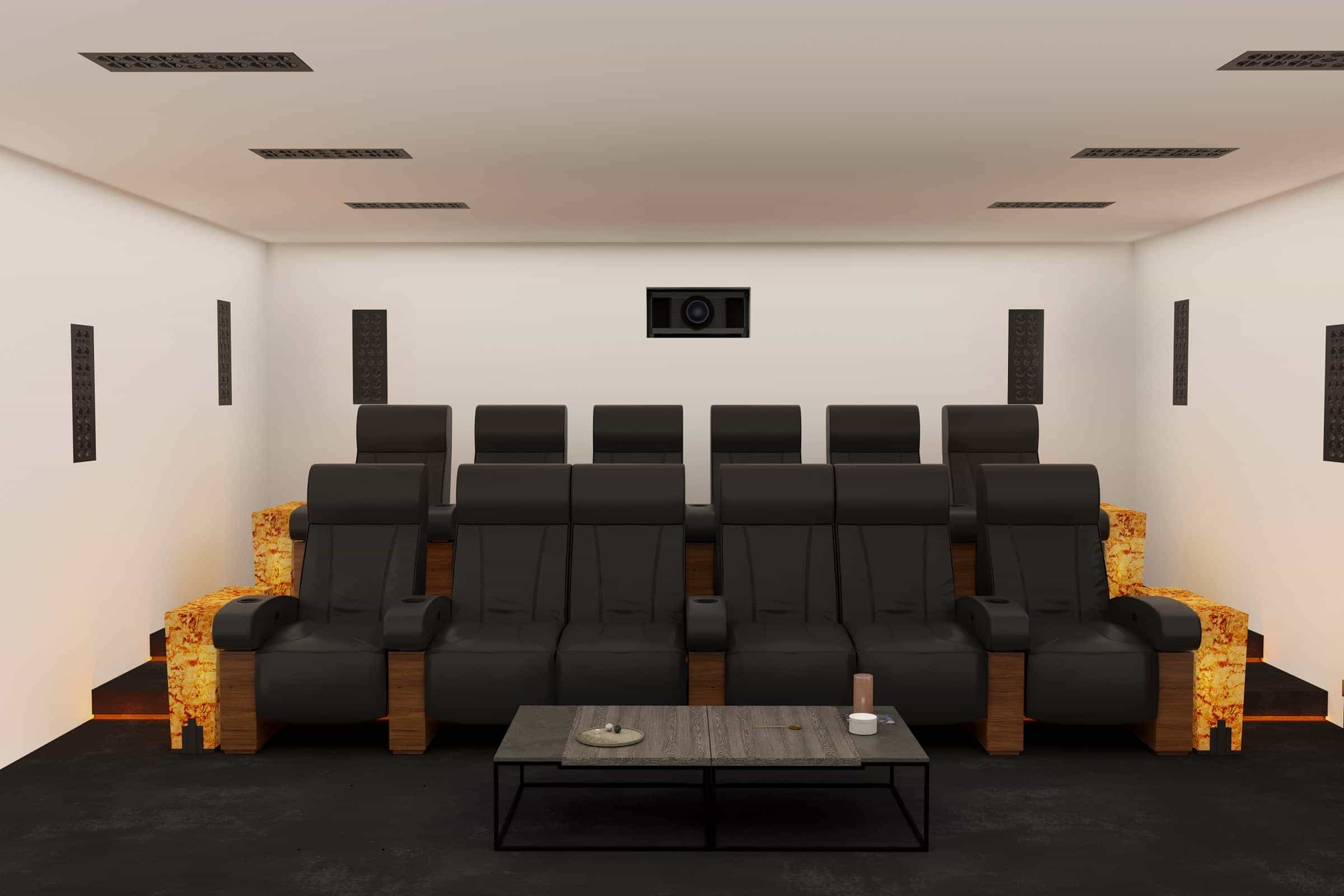
A Trinnov installation is not simply a matter of racking the processor and connecting the cables. We begin with the room — acoustic modelling determines speaker positions, subwoofer locations and treatment placement before any equipment is ordered. Once installed, the Trinnov 3D microphone measures from each seating position in sequence, building the spatial model and applying corrections. The process takes several hours for a complex multi-seat installation. Final calibration requires both technical knowledge to interpret the measurements and the experience to know when the system has reached its optimum.
Is Trinnov Right for Your Cinema Room?
Specifying Trinnov in a room with a full Artcoustic speaker array, a properly designed acoustic environment and a quality projector delivers a result that clients consistently describe as the best audio they have ever heard in a domestic setting. If you are planning a cinema room and want an honest assessment of whether Trinnov is the right specification, contact Custom Controls.
Frequently Asked Questions — Trinnov Home Cinema
What is the difference between Trinnov Altitude 16 and Altitude 32?
The Altitude 16 handles up to 16 channels, suitable for most high-performance cinema rooms up to roughly 9.2.4. The Altitude 32 extends to 32 channels, covering the largest Dolby Atmos and IMAX Enhanced configurations.
Should I choose Trinnov or Anthem for my cinema room?
Anthem with ARC Genesis suits rooms up to roughly 7.2.4 channels at a lower price point. Trinnov is the right choice above nine main channels, with multiple subwoofer arrays, or where the room’s acoustic challenges exceed what conventional EQ can address.
What makes Trinnov’s room correction different from a standard AVR?
Trinnov’s 3D measurement microphone maps the precise physical position of every speaker relative to every seat, rather than calibrating from a single point, delivering consistent performance across every seating position rather than just one sweet spot.
Trinnov Home Cinema Service Page → · Artcoustic Speakers → · Anthem AV → · Home Cinema Installation → · Acoustic Design → · Contact Us →