Why Your Home Wi-Fi Fails: The Hidden Barriers to High-Speed Living
We have the answers and Explain Below
In the modern home, Wi-Fi is no longer a luxury; it is a fundamental utility. We rely on it for work, education, and staying connected. Yet, many households still struggle with “dead zones” and frustrating buffering. If you are relying on a standard setup to cover a modern home, you aren’t just fighting a bad signal — you’re fighting the very materials your house is built with. Here is why standard Wi-Fi fails and why Enterprise-Grade Wireless Access Points (WAPs) are the gold standard for reliable connectivity.
The Anatomy of Failure: The “Free” Router & Mesh Limitations
Most Wi-Fi issues start at the source: the ISP-supplied router. While these boxes are “free,” they are often built with budget components and weak processors that struggle to manage the 50+ devices found in a typical modern household.
- The Faraday Cage Effect: Modern building standards use foil-backed insulation, radiant floor heating, and steel-frame reinforcements. These materials act as a shield, reflecting and blocking wireless signals.
- The “Hop” Penalty: Mesh nodes talk to each other wirelessly. If a node has to punch through a foil-backed wall to talk to the main router, the signal degrades instantly. Every “hop” can drop your speed by as much as 50%.
The Power of PoE: Elegant and Efficient Deployment
One of the most significant advantages of a professional network is the use of PoE (Power over Ethernet). This technology is the backbone of high-end wireless installations.
PoE works by allowing a single Ethernet cable to provide both a high-speed data connection and electrical power to a device. The power is injected into the cable from a central PoE switch located in your main equipment hub. There are many benefits:
- No Need for Extra Sockets: You aren’t forced to place WAPs near floor-level plug sockets. We can install them high on walls or across ceilings for optimal coverage.
- Cleaner Aesthetics: There are no messy power bricks or trailing wires.
- Centralized Reliability: By using a single Uninterruptible Power Supply (UPS) in your hub, your Wi-Fi remains operational even during a brief power cut.
More Than Just Browsing: The Unified Network Ecosystem
A professional network becomes a platform for critical services:
- Smart Security & Surveillance: High-definition cameras use PoE for Zero Latency and Continuous 24/7 Recording.
- Network Attached Storage (NAS): Your Private Cloud: A NAS offers Full Data Control, allowing you to store family photos and work documents locally rather than relying on third-party cloud providers.
- Energy Management & Access Control: Dedicated network segments keep “smart” devices (thermostats, lighting) separate from your “work” devices for improved security.

Smart Home

Mood
Lighting

HVAC
Controls

Security & CCTV

Wifi & Networks
Unleashing the Potential of French Fibre
In the Haute-Savoie region, the “Plan France Très Haut Débit” has seen incredible progress. In Morzine, over 55% of premises are now connected to high-speed fibre (FTTH), with full coverage expected by 2027.
While these connections offer massive speeds (up to 8Gbps), an underpowered ISP router acts as a “choke point.” Our systems ensure you distribute that full capacity across the home, matching the hardware to the speed of the street.
Specialist Expertise: Retrofitting & Hub Optimization
We specialize in resolving these issues in the French Alps, where luxury chalets present a “perfect storm” for Wi-Fi failure.
- Infrastructure Enhancement: We transform chaotic cabling into a neat, well-terminated central hub.
- Reliability & Easy Identification: By labeling every cable, we ensure the network is robust and easy to maintain.
- Wired-to-Wireless Excellence: We convert high-speed cable points into professional-grade WAPs via PoE, bypassing structural barriers.
Proactive Management: The “Silent” Guardian
A professionally installed system is actively managed via a Remote Dashboard which provides the below benefits.
- Remote Monitoring: If a device goes offline, we are alerted immediately and can often fix the issue remotely.
- Auto-Optimization: The system constantly scans for interference and shifts your Wi-Fi to the cleanest available frequency automatically.
- Scheduled Updates: We push security patches overnight, ensuring your home is protected without interrupting your day.
Frequently Asked Questions (FAQ)
How many access points do I need?
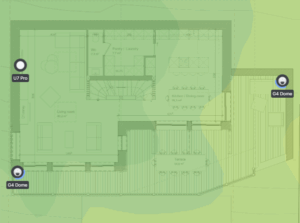
This varies for each property. Factors such as size, construction materials, and specific client requirements all affect the design. We perform a full wireless survey for each client to determine the exact number of units needed for wall-to-wall coverage.
What speeds can I get?
Wireless clients often enjoy speeds up to 1.2Gbps for both download and upload, ensuring a reactive and snappy experience. Wired devices (such as computers, media servers, and TVs) can be provided with a 10Gbps network connection—fantastic for fast backups and streaming 4K/8K content from local storage.
Do you install the fibre into the property?
The actual fibre rollout, and internet provision, is handled by specialist contractors on behalf of French internet providers (Orange, SFR, Free, etc.). You will still need a service contract with one of these providers. We take over from the arrival point to provide the high-speed service within the house. Our costs cover professional equipment and labour; there are no ongoing subscriptions or contracts with us.
Where can we install the access points?
Most chalets are pre-wired with network cables, which often dictates the location. However, we regularly hide access points behind TVs, in wardrobes, or on top of kitchen units to keep them out of sight. As a last resort, if cabling isn’t available in a critical area, we can install access points using a professional mesh system that extends the wired infrastructure in a fast, reliable way that is invisible to your devices.
Summary: Which is right for you?
| Feature | ISP / Mismatched System | Enterprise WAPs (Professional) |
|---|---|---|
| Wireless Speed | Often <100Mbps (Inconsistent) | Up to 1.2Gbps+ (Stable) |
| Power Supply | Requires Mains Socket per room | Centralised PoE (One Cable) |
| Data Privacy | Cloud-Dependent | Local NAS Control |
| Installation | Disorganized “Spaghetti” | Neat, Terminated Patch Panel |
The Bottom Line
If your home is your office and your sanctuary, you shouldn’t be fighting your router. By moving to Enterprise-Grade hardware and a professionally managed service, you move from a connection that “usually works” to one you never have to think about again.