Listening Room Design
How to Design a Room for a High-End Home Hi-Fi
Published September 2026 · Custom Controls · Independent high-end hi-fi designers and installers since 1998
A dedicated listening room — a hi-fi room designed around the music rather than the furniture — is the one space in a house where the room itself is treated as part of the hi-fi system. Put a pair of reference loudspeakers into an ordinary drawing room and what reaches your ears is as much the room as the recording: bass that booms at one seat and vanishes at the next, a stereo image smeared by reflections from a glass wall, and a noise floor set by the boiler, the street and the fridge in the next room. Design the room properly and the same home hi-fi can sound like a different, far more expensive system.
This guide sets out how we approach listening room design for clients commissioning a serious home hi-fi system: room size and proportions, speaker and seat placement, bass behaviour, isolation, power, acoustic treatment and measurement. It is written for homeowners, architects and interior designers planning a new room or reworking an existing one, and it draws on the dedicated two-channel rooms we have designed, installed and calibrated since 1998.
Why the Room Matters as Much as the Hi-Fi System
Below a few hundred hertz, a domestic room does not simply contain the sound from a pair of loudspeakers; it reshapes it. Every surface reflects low frequencies back into the space, and the reflections combine with the direct sound to produce peaks and deep cancellations that vary from seat to seat. It is common to measure swings of 15 to 20dB in the bass at a single listening position in an untreated room — far larger than any difference between two competent amplifiers.
Higher up the frequency range the problem changes character. Early reflections from side walls, the floor, the ceiling and furniture arrive a few milliseconds after the direct sound and blur the stereo image, making voices and instruments sound wider, vaguer and further back than the recording intended. Too much reverberation muddles detail; too little makes the room feel dead and oppressive. A well-designed listening room controls all of this so that the hi-fi system, rather than the architecture, decides what you hear.
That is why we treat the room as the first component of any high-end home hi-fi rather than the last. The same approach sits behind our cinema room design: acoustic modelling comes before construction, and the equipment is chosen to suit a room that has been designed to let it perform.

Hi-Fi

Acoustics

Calibration

Crestron

Lighting Control
Room Size and Proportions
If you are building from scratch, the dimensions of the room are the single most important acoustic decision you will make, and the cheapest to get right. Every room has resonances — room modes — at frequencies set by its length, width and height. The first axial mode along any dimension falls at the speed of sound divided by twice that dimension: roughly 343 ÷ (2 × length). A room 6m long therefore has modes at around 29Hz, 57Hz and 86Hz along its length, and a matching set across its width and height.
The trouble starts when dimensions are equal or simple multiples of one another. A room 3m high and 6m long stacks its height and length modes on the same frequencies, producing a few very strong resonances and large gaps between them. Cubes are the worst case. Published ratios, such as Louden’s 1 : 1.4 : 1.9, spread the modes more evenly, and modelling software lets us test a proposed room against these criteria before the walls go up. Where the dimensions are fixed by an existing building, the same analysis tells us where the problems will be and how much work the treatment and bass management will need to do.
Size matters too. A very small room pushes the first modes up into the musically important bass region and puts the listener close to the walls; a larger room lowers the modal frequencies, makes the bass smoother and gives more freedom to place loudspeakers away from boundaries. Volume also affects how much energy large floorstanding speakers and subwoofers need to fill the space.
Short Wall or Long Wall?
Most listening rooms set the loudspeakers along the short wall, firing down the length of the room. This gives the most distance between the speakers and the front wall, puts the listener well away from the rear wall and usually produces the deepest, most natural sense of soundstage depth. It suits most rectangular rooms and most loudspeakers, and it is the starting point for our layouts.
Firing across the room from the long wall has its own advantages. The side walls are further away, which reduces the strength of the first side-wall reflections and can give an unusually wide, open image. The penalty is that the listener often ends up close to the rear wall, where bass pressure builds up, so rear-wall treatment becomes essential. We model both layouts where the room allows, and the choice often comes down to the architecture: windows, doors, fireplaces and the way the client wants to use the room day to day.
Symmetry matters more than either choice. The two loudspeakers should see the same boundaries at the same distances, so that the left and right channels are coloured by the room in the same way. An open side on one channel and a solid wall on the other will pull the image off centre however carefully everything else is set up. The design work that follows — placement, bass management, isolation, power, treatment and calibration — is where our core services come together in a hi-fi room.
Speaker Placement and the Listening Position
A good starting point for stereo is an equilateral triangle: the distance between the loudspeakers roughly equal to the distance from each speaker to the listener’s head, with the speakers toed in towards the listening position. From there, placement is refined by measurement and listening, often in steps of a centimetre or two, until the balance between image focus, width and tonal neutrality is right for the speakers and the room.
Distance from the front wall matters as much as spacing. Sound radiating backwards from a loudspeaker reflects off the wall behind it and returns out of phase at the frequency where the path difference equals half a wavelength — the speaker boundary interference response, or SBIR. A woofer 1m from the front wall produces a cancellation near 86Hz (343 ÷ 4); moving it to 0.5m pushes the dip up towards 170Hz. The answer is either to place the speakers far enough out that the dip falls low and is treated, close enough to the wall that it moves above the woofer’s range, or to absorb the reflection with deep treatment behind the speakers.
The seat is just as important. Sitting against the rear wall exaggerates the bass; sitting exactly halfway down the room puts the listener in the null of the first length mode. A position around 38% of the room length from the front or rear wall is a widely used starting point because it avoids the strongest peaks and nulls of the first few axial modes. In practice we model the room, measure at candidate positions and fix the listening chair where the bass is smoothest — then place the loudspeakers around it.
Room Modes, SBIR and Subwoofers
Bass is where listening rooms succeed or fail. Above the transition frequency — typically somewhere between 100 and 200Hz in a domestic room — sound behaves like light, reflecting off surfaces in ways that can be absorbed or diffused. Below it, the room behaves as a set of resonances, and conventional acoustic panels make little difference. Controlling this region needs a combination of room proportions, placement, deep bass trapping and, increasingly, multiple subwoofers and digital correction.
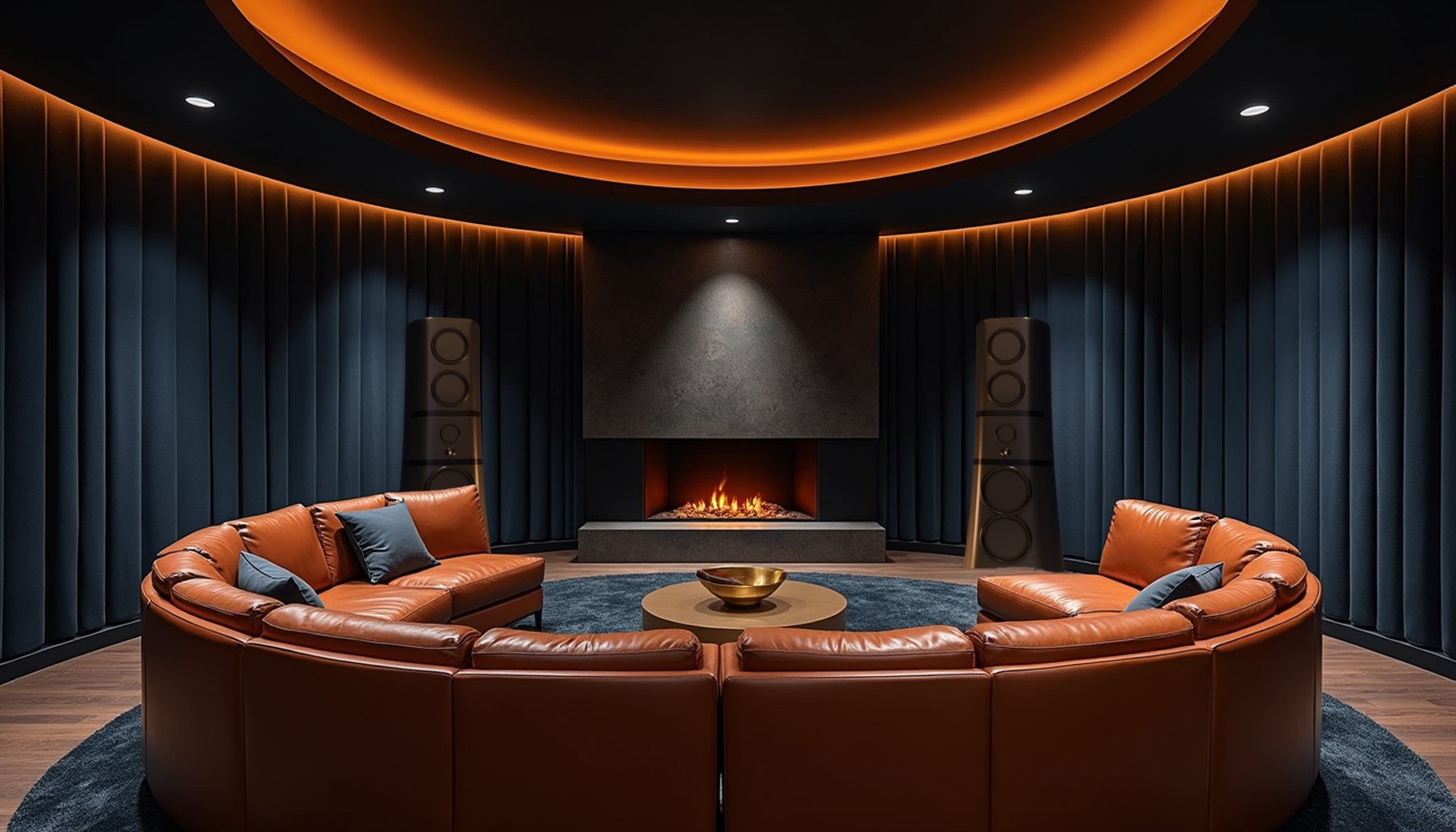
Well-integrated subwoofers are one of the most effective tools available. Two or more subwoofers placed to excite the room’s modes in opposition can smooth the response across several seats far more effectively than a single large woofer, and they relieve the main loudspeakers of the lowest octave. In our Dubai listening room, a Magico Ssub M extends the bass so that the S5 Mk II’s own woofers never have to work beyond the register they were voiced for.
Digital room correction completes the job. Steinway Lyngdorf RoomPerfect, for which we are certified installers, measures the room from many positions and corrects the loudspeakers’ interaction with it rather than simply equalising a single seat. Trinnov processors measure where each speaker actually sits in three dimensions as well as how it sounds. Correction is powerful, but it works best on a room that is already well designed: it can tame a peak, but it cannot fill a deep cancellation without asking an amplifier and woofer for enormous amounts of energy.
Bringing the Hi-Fi System Into the Whole Home
A dedicated listening room does not need to be cut off from the rest of the house. In most of our projects the room is a high-end endpoint on the property’s wider audio system: a streaming transport such as Lumin draws from the same music library as every other room, and source selection is handled from the same Crestron touchpanel or keypad used throughout the home. The reproduction itself — preamplifier, power amplifiers and loudspeakers — remains a dedicated, purist signal chain with nothing from the wider system in its path.
The same principle works at every scale. In a Pimlico townhouse, the reception room doubles as a serious listening space, with Bowers & Wilkins floorstanding speakers driven by a dedicated amplifier, while the iPad that runs the kitchen TV selects music for the listening room. Equally, some clients want a listening room with no automation at all, and we design and install fully standalone two-channel systems too.
Integration also covers the room’s environment. Lighting scenes, blinds and climate can be set with a single Listening scene, dimming the room, closing the blinds and dropping the air conditioning to its quietest setting, so that nothing competes with the music once playback starts. The details of how the hi-fi system and the rest of the house connect are covered on our multi-room audio page.
Isolation and the Noise Floor
The quietest passages of a recording sit a long way below the loudest, and every decibel of background noise masks detail at the bottom of that range. Traffic, aircraft, plant rooms, air conditioning and household activity all raise the noise floor, and a room that is not isolated also lets the music out — which becomes the limiting factor on how loudly anyone can listen late at night. A noise rating of around NR 20 or below is a sensible target for a dedicated listening room.
Isolation is achieved with mass, decoupling and airtightness. A room-within-a-room — independent stud walls and a ceiling hung on resilient mounts, separated from the structure by an air gap filled with mineral wool — is the most effective construction, with multiple layers of dense acoustic plasterboard and flexible sealant at every junction. Doors are the weak point in most rooms: a solid-core acoustic door with perimeter seals and a drop seal, or a lobby of two doors, keeps the gains made in the walls. Basements and lower-ground floors are naturally well suited, because the surrounding ground provides mass and isolation that an upper floor cannot.
Ventilation and cooling must be designed with the same care. Air conditioning should use low-velocity ductwork with attenuators and lined bends, with fan coil units positioned outside the room wherever possible, so that the system can run during listening without becoming the loudest thing in it. Equipment racks, with their fans and power supplies, are best housed in a ventilated cupboard or adjacent plant space rather than in the listening room itself.
Power and Electrical Design
High-end amplifiers draw large, fast peaks of current, and the quality of the mains supply they draw it from is audible in dynamics and noise. We plan dedicated radial circuits for the audio equipment, kept separate from lighting, motors and appliances, and design earthing so that the whole system shares a single, clean reference point, avoiding the ground loops that cause hum. All of this is designed and installed to BS 7671, with the specification agreed alongside the electrical contractor at first-fix stage.
Lighting deserves particular attention. Poor-quality LED drivers and some dimming methods generate electrical noise that can find its way into sensitive audio equipment, and a buzzing driver in a quiet room is audible in its own right. Specifying good drivers and lighting control from the outset, and keeping lighting circuits away from the audio supply, prevents this. Power conditioning adds a further layer of protection: in our Dubai listening room a LAB12 Gordian power conditioner separates high-current and low-current filtered outlets, keeping noise out of the signal path before it reaches the electronics.
Cable routes, containment and back boxes for every loudspeaker, subwoofer, control device and network point should be on the drawings before plastering. Changing a listening room layout after the walls are finished is possible, but it is disruptive; a small amount of spare containment at first fix keeps future upgrades to the hi-fi system simple.
Acoustic Treatment
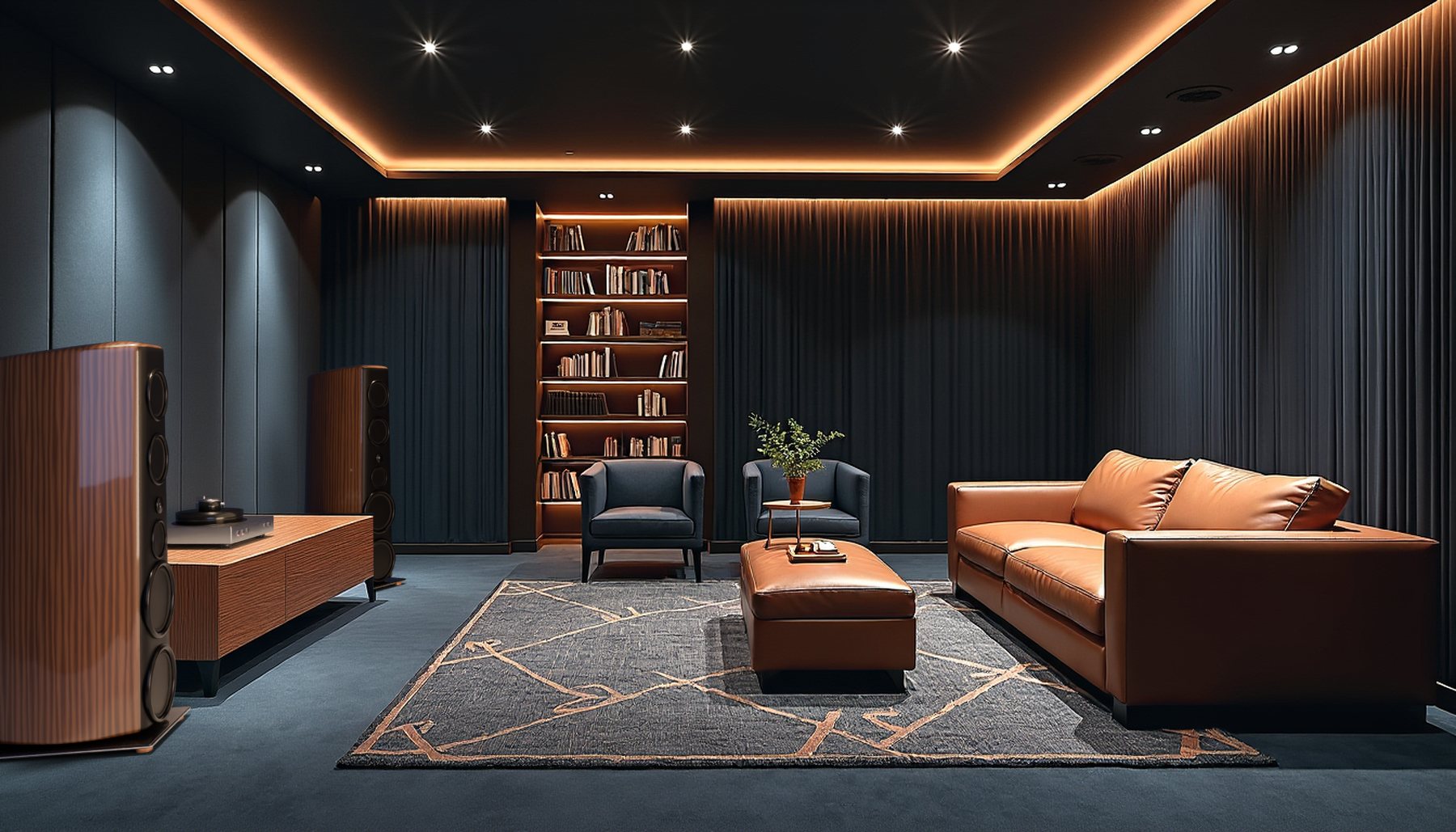
Treatment is where the room is tuned. The aim is not to deaden the space but to control it: absorb the low-frequency energy that causes modal problems, manage the early reflections that blur imaging, and leave enough diffuse, even reverberation for the room to feel natural and for music to sound alive. For a domestic listening room, a reverberation time of roughly a quarter to a third of a second across the midrange, evenly balanced across the frequency range, is a common target.
Bass trapping comes first, because it is the hardest to add later. Deep porous absorbers and membrane traps in the corners — where every room mode has a pressure maximum — do more than any number of thin wall panels. First-reflection points on the side walls and ceiling are found by the familiar mirror test: sitting in the listening position while someone slides a mirror along the wall, every point where a loudspeaker appears in the mirror is a reflection point. Absorption or diffusion at those points sharpens the stereo image. The rear wall is often treated with diffusion, which scatters sound rather than removing it and keeps a larger room from sounding overdamped.
Treatment does not have to look like treatment. Our fabric walling conceals the acoustic core, bass traps and cabling behind a tensioned fabric finish, with open-weave acoustic cloth wherever sound needs to pass through and heavier upholstery fabrics elsewhere. In living spaces that double as listening rooms, bookcases, soft furnishings, rugs and curtains can be specified to do real acoustic work alongside discreet panels, so the room reads as an interior rather than a studio.
One Room for Music and Film
Many clients want a single room that serves as both a two-channel listening room and a home cinema. It can be done well, but the priorities have to be set at the design stage. A cinema is designed for a wide, even response across several rows of seats and for multichannel sound from every direction; a listening room is optimised for one or two seats and a precise stereo image. The acoustic brief for one is not automatically right for the other.
The most successful combined rooms use processing that can handle both. Trinnov processors can run a stereo configuration with its own optimisation alongside a full immersive layout, and Steinway Lyngdorf systems combine hand-built loudspeakers with RoomPerfect correction for music and film alike. Our Steinway Lyngdorf media room in Rome was designed to meet the same reference standard as the listening rooms around it while still delivering the scale of a film. Where the budget and space allow, though, a dedicated listening room alongside a separate cinema remains the uncompromised solution — as on our Dubai estate, where a Magico listening room sits in the same villa as an award-winning eight-seat cinema.
Measurement and Calibration
Every listening room we complete is measured, not just listened to. Calibrated measurement microphones capture the frequency response, decay times and reflection pattern at the listening position and around it, and the results are used to fine-tune loudspeaker positions, subwoofer placement and crossover settings before any digital correction is applied. Listening then confirms what the measurements show, with familiar recordings chosen by the client.
Correction is applied only after the physical room is right, and with restraint. Where RoomPerfect is used, the room is measured from numerous positions to build a model of its behaviour — in our Rome project, from fifteen to twenty positions around the finished space. For purist two-channel systems with no DSP in the signal path, the same measurements guide placement and treatment instead. Our calibration process is the same discipline we apply to reference cinemas.
A room also changes after it is finished: furniture arrives, curtains go up, the client’s listening habits settle. We recommend a follow-up measurement once the room is fully furnished and in use, so the final adjustments reflect the room as it is actually lived in rather than as it was on handover day.
Choosing the Hi-Fi System for the Room
The loudspeakers should be chosen for the room as much as for their sound. Large floorstanders need space around them and a room big enough for their bass output; sealed-enclosure designs such as Magico tend to interact more predictably with room boundaries than ported designs, while the warmth and character of Sonus Faber suits clients who want a more musical, engaging presentation. Amplification has to match the load: a speaker with difficult impedance swings needs an amplifier that keeps delivering current as the load gets harder.
As independent designers and installers of high-end hi-fi systems, we have no manufacturer targets to meet. We are authorised dealers for Magico, Soulution and Lumin, among other reference-grade brands, and specify from Sonus Faber, Steinway Lyngdorf, McIntosh, Bowers & Wilkins and others where they suit the room and the listener better. The right home hi-fi is the one that suits the room, the music and the way it will be used — not the one with the most impressive specification sheet.
The best results come when the room and the hi-fi system are designed together, ideally while the architectural drawings are still being developed. If you are planning a new listening room or want an existing room to work better, talk to us early, and we will model the room, advise on layout and construction, and specify a system that suits both.
Listening Room Design — Frequently Asked Questions
What is a listening room?
A listening room is a space designed specifically for listening to music on a high-end hi-fi system. Its proportions, construction, acoustic treatment and electrical supply are all planned so that the room supports the loudspeakers rather than colouring their sound.
What are the best dimensions for a listening room?
Avoid a cube and avoid dimensions that are equal or simple multiples of one another, because they stack room modes on the same frequencies. Published ratios such as Louden’s 1 : 1.4 : 1.9 spread the modes more evenly, and modelling the room before construction shows how a specific set of dimensions will behave.
Where should I sit in a listening room?
Avoid sitting against the rear wall or exactly halfway down the room. A position around 38% of the room length from the front or rear wall is a widely used starting point, refined by measurement to find where the bass is smoothest, with the loudspeakers then placed around that seat.
Do I need acoustic treatment for a home hi-fi system?
In almost every room, yes. Bass trapping in the corners controls room modes, treatment at the first-reflection points sharpens the stereo image, and diffusion keeps the room from sounding dead. It can be concealed behind fabric walling or built into joinery and furnishings.
Can a listening room also be a home cinema?
Yes, if the priorities are set at the design stage. Processors such as Trinnov and Steinway Lyngdorf can optimise a stereo layout alongside a full immersive system, but a dedicated listening room alongside a separate cinema remains the uncompromised solution.
Can a hi-fi system in a listening room be controlled from a smart home system?
Yes. The listening room can be a high-end endpoint on a whole-home Crestron system, streaming from the same music library and controlled from the same touchpanels, while the preamplifier, amplifiers and loudspeakers remain a dedicated purist signal chain. Fully standalone systems are equally possible.
High-End Hi-Fi Systems → · Magico Hi-Fi System, Dubai → · Fabric Walling → · Steinway Lyngdorf → · Contact Us →