Crestron for Accessibility, Voice Control and EV Charging
Two of the Most Underrated Things a Properly Specified Crestron System Can Do
Published June 2026 · Custom Controls · Certified Crestron dealers since 1998
Most conversations about Crestron focus on lighting, AV and the touchpanel interface. Two genuinely significant capabilities get discussed far less often, despite being among the most meaningful things a properly specified system can deliver: making a home easier to live in for someone with a disability or mobility limitation, and bringing EV charging and home energy management under the same intelligent control as everything else in the property. Both deserve a proper explanation.
Crestron for Clients with Disabilities and Mobility Limitations
A Crestron system’s defining characteristic — that virtually any electrical function in a home can be brought under one consistent interface — has a particular value for clients with a disability, reduced mobility, or age-related limitations that make a conventional home difficult to live in independently. This is not a separate product line; it is the same flexible automation platform we specify on every project, applied with a specific brief in mind.
Voice control as a genuine accessibility tool, not a convenience feature. For clients with limited mobility or dexterity, voice control stops being a novelty and becomes the primary way of interacting with a home. Crestron Home integrates natively with Amazon Alexa and Google Assistant, and via Josh.ai — a natural-language voice platform built specifically around deep Crestron integration — with a considerably more conversational and context-aware level of control. Josh.ai understands which room a request is coming from, what sources are available in that specific space, and can act on a request like “play the news in the kitchen” without the client needing to specify a device, an app or a precise command structure. For a client who cannot easily reach a keypad or hold a remote, this is the difference between genuine independence and reliance on someone else to operate every light, every blind and every piece of AV equipment in the home.
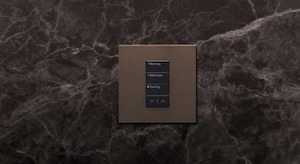
Single-button and macro-based control for limited dexterity. Beyond voice, Crestron’s keypad and touchpanel programming can be built around large, clearly labelled single-button macros rather than the layered menu structures that are typical of consumer smart home apps. A single press can execute an entire sequence — opening a specific door, adjusting lighting and climate to a preset comfortable level, and bringing up a particular AV source — removing the need for sequential, fine-motor interactions that a conventional remote or app demands. Where a touchpanel is the right interface, position and mounting height are specified around the client’s actual physical reach and seating position, not a standard installation height.
Automated door, gate and access control. For clients who use a wheelchair or have limited reach, automating door entry, internal doors and gate access removes one of the most basic daily frictions in a home that wasn’t originally designed around accessibility. Combined with the intercom and camera integration we specify on every security-conscious project, a client can see who’s at the door, speak to them, and grant access without needing to physically reach the door at all.
Emergency and monitoring integration. A Crestron system can be configured to recognise abnormal patterns — a room that hasn’t registered any activity in an unusual length of time, for instance — and alert a family member or carer accordingly, without resorting to anything as intrusive as constant camera monitoring. For clients living independently with family at a distance, this kind of unobtrusive oversight provides real reassurance to everyone involved.
We approach an accessibility-focused brief exactly as we would any other Crestron project: a proper survey of how the client actually lives and moves through the home, followed by a system designed around that reality rather than a generic specification. If you are planning a home, or adapting an existing one, around a disability or mobility need, this is a conversation we are glad to have from the earliest stage of design.

Smart Home

Mood Lighting

Security & CCTV

Energy
Crestron and EV Charging — Genuinely Intelligent Home Energy Management
EV charging has moved well beyond a single wall-mounted box that draws power whenever a car is plugged in. The genuine opportunity in 2026 is treating EV charging as one more load within a property’s wider energy picture — solar generation, battery storage and the building’s incoming electrical supply — rather than as an isolated appliance with its own disconnected app.
Why this matters practically. A property with solar panels and a home battery, but an EV charger that simply draws full power from the grid on a fixed schedule, is leaving real value unused. Bringing the charger under the same Crestron interface as the rest of the home’s energy management means surplus solar production can be directed to the car automatically, ahead of being exported to the grid at a fraction of its value. It means the charger can be instructed to draw only from off-peak grid tariffs, or only once the home battery has reached a client-defined reserve level, protecting backup capacity for the property itself. And it means a sudden demand spike elsewhere in the house — an oven, an immersion heater, a sauna — can automatically and briefly reduce the EV charging rate rather than risk tripping the property’s incoming supply, with charging resuming at full rate once the spike has passed.
One interface, one picture of the whole property’s energy use. The practical benefit of doing this through Crestron rather than the EV charger manufacturer’s own app is visibility and coordination. A client sees solar production, battery state of charge, EV charging status and whole-home consumption from the same touchpanel used for lighting and AV — rather than switching between three or four separate apps that have no awareness of each other. Scheduling a car to charge overnight during the cheapest tariff window, or prioritising solar self-consumption over grid export, becomes a single coherent decision rather than several disconnected ones.
Integration is increasingly standard, not exotic. The current generation of EV chargers with genuine smart energy integration — communicating over open protocols with home energy management systems — has matured considerably, and the principle of coordinating solar, battery and EV load is now a mainstream specification on any property serious about its energy strategy, not a bespoke one-off project. We bring this into the same Crestron framework we use for every other system in the home, for exactly the reason described above: one client interface, one coherent strategy, rather than a collection of disconnected smart devices that each manage their own small piece of the picture in isolation.
For the fuller picture of how Crestron handles renewable energy more broadly — solar, battery storage and heat recovery — see our dedicated page: Crestron Renewable Energy Integration →
Frequently Asked Questions — Crestron Accessibility and EV Charging
Can a Crestron system genuinely help someone with limited mobility live more independently?
Yes. Voice control via Josh.ai, Alexa or Google Assistant, single-button macro programming, and automated door and gate access can together remove much of the daily physical friction that a conventional, unautomated home presents to someone with reduced mobility or dexterity.
What is Josh.ai and how is it different from Alexa or Google Assistant on Crestron?
Josh.ai is a natural-language voice platform built specifically around deep Crestron integration. It understands room context and can act on more conversational requests than the standard Alexa or Google Assistant skill, without requiring a precise command structure — a meaningful advantage for accessibility-focused installations.
Can EV charging be coordinated with solar panels and a home battery?
Yes. Bringing an EV charger under the same Crestron interface as solar production and battery storage allows surplus solar to be directed to vehicle charging automatically, charging to be scheduled around the cheapest grid tariff, and the charging rate to be reduced briefly during a demand spike elsewhere in the property.
Why manage EV charging through Crestron rather than the charger’s own app?
A dedicated charger app only sees the charger. Managing it through Crestron alongside solar, battery and whole-home consumption gives a single, coherent view and a single point of control for the property’s entire energy picture, rather than several disconnected apps with no awareness of each other.
Custom Controls have been designing and installing Crestron systems since 1998, including projects specifically built around accessibility needs and modern home energy management. Contact us to discuss your project.
Crestron Home Automation → · Crestron Renewable Energy Integration → · Crestron Home: The Complete Guide → · Contact Us →