Outdoor Home Cinema: Display, Audio, and Installation Guide
Outdoor Home Cinema: Displays, Audio and Control
Updated July 2026 · Custom Controls · Outdoor cinema specialists
Outdoor home cinema sits at the intersection of ambition and pragmatism. The appeal is visceral: a terrace or garden transformed into a cinema screen that rivals the indoor room. The challenges are equally clear: weather resistance, light control, acoustic isolation, and the technical complexity of deploying professional-grade audio systems in an environment they were never designed for.
The difference between a well-designed outdoor cinema and an expensive Wi-Fi speaker against a garden wall is not the price of the equipment — it is the design philosophy. A reference-quality outdoor cinema is designed as a complete system: display technology matched to the space and viewing distances, audio processing and speaker placement calculated for an open acoustic environment, lighting precisely controlled to eliminate ambient spill, and every source — from cinema to sports to streaming — accessible from a single intuitive interface.
This guide explores the technical decisions that separate good outdoor cinema from exceptional outdoor cinema.
Display Technology for Outdoor Cinema — Projector vs Direct-View Displays
The display choice is foundational. Modern outdoor cinema has five viable options: laser projectors housed indoors projecting through exterior glass, C SEED rising and unfolding MicroLED TVs, VISIONAIR-E HELIOS modular MicroLED screens, Samsung Terrace weatherproof displays, and traditional OLED televisions. Each serves different use cases.
Laser Projectors — Scalability, Flexibility, Year-Round Use
A 4K laser projector offers image size scaling — the same projector delivers equivalent performance at 80 inches or 150 inches, determined only by throw distance and lens selection. For outdoor cinema, the projector is housed indoors (in a dedicated projector room, equipment enclosure, or sealed rooftop cabinet) and projects through an exterior glass window or transparent screen material onto a fixed outdoor screen structure or house fascia. This approach offers several advantages: the projector is protected from weather; image size scales to fill your viewing distance; installation is non-intrusive on the terrace structure; and the system can be retrofitted to existing homes without external equipment boxes.
Modern laser projectors achieve IP54 or IP55 ratings when properly housed with ventilation and drainage. A reference-quality 4K laser projector paired with a high-contrast outdoor screen provides picture quality comparable to a fixed direct-view display, with the flexibility of scalability. Viewing distance determines optimal screen size: at 4 metres viewing distance, a 100-inch screen offers a 60-degree horizontal viewing angle (cinema standard); at 8 metres, a 150-inch to 180-inch screen is required to achieve the same angle. Projectors make large screens feasible; large outdoor displays do not.
Drawback: projectors require darkness or substantial ambient light rejection to perform acceptably. An OLED display or outdoor direct-view system is immediately visible even in partial daylight; a projector requires dusk or twilight to show its best. For year-round use starting in daylight, a direct-view display is preferable.
C SEED 201 — The Rising, Unfolding MicroLED TV
The C SEED 201 is a 201-inch (5.1-metre) outdoor MicroLED television that disappears completely when not in use. In the C SEED Vertical version — the one installed in our Cotswolds case study below — the TV lives in an engineered chamber below ground, rises as a 4.65-metre column in around 15 seconds, then unfolds seven MicroLED panels into a single seamless screen that can rotate up to 135 degrees to face a terrace, pool or lounge area. When the film ends it folds and descends again, leaving the garden with zero footprint. C SEED also builds the HLR version, which rises from a compact compartment and unfolds its panels in the same way. Picture quality is built for open skies: C SEED quotes 4,000 nits of brightness, a 7,000:1 contrast ratio, a 3,840 Hz refresh rate, 16-bit processing per colour and 160-degree viewing angles from almost three million self-illuminating MicroLEDs, so the image holds up in daylight as well as at dusk. The screen is 4.48 metres wide, so it fills a 60-degree horizontal field of view from roughly 4 metres and still reads as a large cinema image from 6 metres or more.
Advantages: dramatic aesthetic impact, zero footprint when lowered, daylight-capable MicroLED brightness with no need for ambient light rejection, and motorised integration with home automation — C SEED’s media controller integrates with Crestron, so raising the screen can be part of a single cinema scene. Disadvantages: premium pricing tier; the underground chamber or compartment has to be planned with the landscape architect and groundworks at the design stage; the lift and folding mechanism needs routine servicing; and the sheer scale of a 201-inch screen suits generous gardens and terraces rather than compact spaces.
VISIONAIR-E HELIOS — Modular Outdoor MicroLED Screen
VISIONAIR-E HELIOS is a modular outdoor MicroLED screen built from LED cabinets in a 16:9 ratio, which VISIONAIR-E describes as ideal for forming outdoor cinema screens. The cabinets tile together to whatever size the wall or fascia allows, and four pixel pitches (1.2mm, 1.5mm, 1.875mm and 2.5mm) let the resolution be matched to the seating distance. The LEDs are protected by a GOB resin coating, the screen is rated IP65 at the front and IP54 at the back for permanent outdoor installation, and VISIONAIR-E quotes 3,500 nits of brightness and a 6,000:1 contrast ratio — enough to hold a watchable image in sunlight. Modules are front-accessible for servicing, and the screen can be wall-mounted, wrapped around corners or stacked.
Advantages: screen size and shape scale with the number of cabinets, daylight-capable MicroLED brightness, permanent outdoor installation with no retraction or seasonal removal, and front service access. Disadvantages: the screen remains a visible structure when not in use; closer seating needs a finer pixel pitch; large configurations require substantial wall or fascia space; mid-to-premium pricing; and an LED video wall needs its own video processing and cabinet calibration, so integration is more involved than with a single television.

Home Cinema

Cinema Design

Calibration

Multi-Room Audio

Lutron
Samsung Terrace — Outdoor TV Built for Daylight and Weather
Samsung Terrace is a weatherproof QLED television engineered for outdoor installation (IP55-rated). Available in sizes up to 85 inches, it delivers consistent brightness and colour in daylight, twilight, and evening conditions — the same display working across the full range of outdoor lighting without technology trade-offs. Unlike projectors, which dim in ambient light, Terrace maintains reference picture quality and brightness outdoors.
Advantages: daylight performance (visible even in bright sunlight); all-weather IP55 installation; no retraction or seasonal removal required; familiar TV interface and source switching; mid-tier pricing compared to C SEED or VISIONAIR-E. Disadvantages: limited to 85-inch diagonal (insufficient screen size for large terraces or distant seating); viewing angle characteristics differ from OLED (colour shift at extreme angles); brightness specifications assume outdoor conditions, not cinema-grade performance standards.
Comparison Matrix — Display Technology Choice
Laser Projector (Indoor Projection): Scalable to 150+ inches · Evening/twilight use · Requires exterior glass window · Protected from weather · Retrofittable to existing homes · Reference picture quality at proper ambient light · Lower cost entry than direct-view displays · Setup: house interior to exterior screen
C SEED 201: 201 inches (5.1m) · MicroLED, 4,000 nits · Rises from the ground and unfolds · Zero footprint when lowered · Premium aesthetic impact · Highest cost tier · Underground chamber planned at design stage · Setup: garden, terrace or poolside
VISIONAIR-E HELIOS: Modular MicroLED cabinets (16:9) · 3,500 nits · IP65 front / IP54 rear · Permanent outdoor installation · Scalable size · Mid-to-premium cost · Requires careful layout · Setup: dedicated wall or fascia
Samsung Terrace: Up to 85 inches · Daylight performance · All-weather IP55 · No retraction needed · Mid-range cost · Limited screen size · Broadcast/streaming optimised · Setup: terrace wall or fascia mount
For Reference-Quality Outdoor Cinema: Laser projector or C SEED 201 are the two recommendations. Projector suits year-round use with evening emphasis and large screen desire; C SEED suits seamless aesthetic integration and daylight flexibility. VISIONAIR-E HELIOS bridges both: full outdoor capability with modular expansion and MicroLED brightness, but at complexity cost. Samsung Terrace is excellent for mixed-use outdoor spaces (casual television + cinema), but picture quality and screen size are compromises for dedicated cinema use.
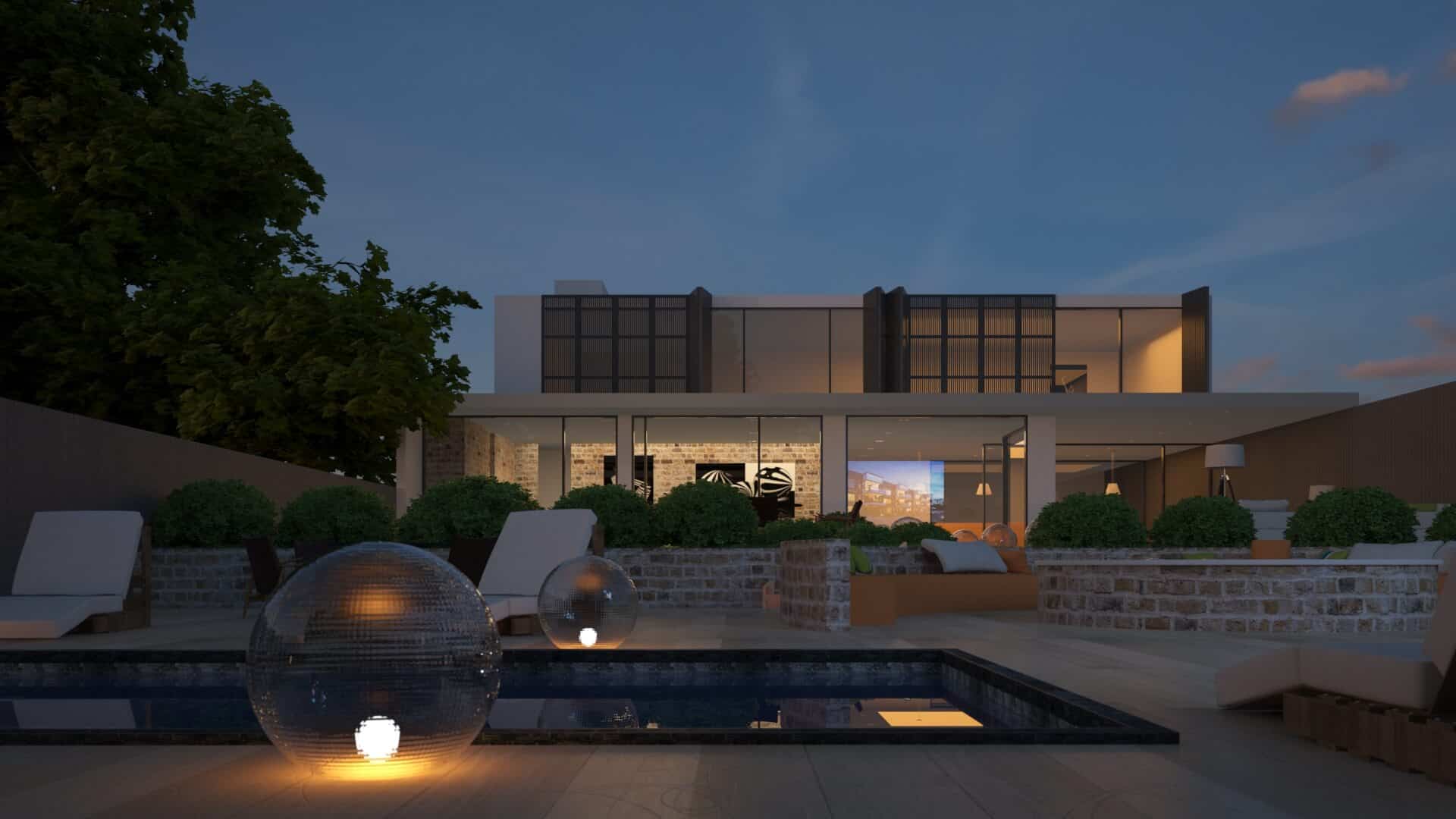
Audio for Outdoor Cinema — Why Conventional Speakers Cannot Deliver
Outdoor audio is fundamentally different from indoor audio. There is no room to work with — no boundaries to reflect sound, no acoustic treatment to absorb it, no enclosed volume to define bass response. Sound dissipates into open air, directionality becomes critical, and the distances involved make conventional indoor speaker placement impossible.
For this reason, outdoor cinema audio requires a custom design philosophy. The system must accomplish three things: deliver full surround-sound directionality despite the absence of room acoustics, provide consistent level and tonal balance across dispersed seating, and resist weather while maintaining reference-quality sound reproduction.
Front Channel Configuration — Stereo and Cinema Flexibility
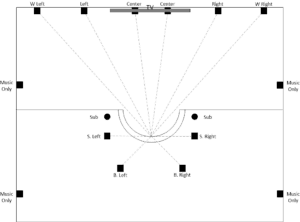
The front left, centre, and right channels define both cinema surround precision and stereo music performance. Professional outdoor cinema systems specify either Steinway Marine speakers or premium Origin Acoustics front channels, mounted at or near the screen structure. This choice affects both cinema localisation and evening music entertaining.
Steinway Marine — IP65-rated, sealed aluminium construction, white lacquer finish with optional 18-carat gold trim — delivers reference stereo imaging for music playback alongside cinema dialogue precision. The centre channel, flanking left and right, provides pinpoint dialogue localisation during film and coherent stereo image during music. Steinway Marine subwoofers (matching cabinet footprint) integrate seamlessly with the front array.
Origin Acoustics reference front speakers provide equivalent cinema performance with a slightly different aesthetic (lower profile, landscape-integrated appearance). The choice between Steinway Marine and Origin Acoustics is aesthetic and architectural; both deliver reference-quality performance across cinema and music playback.
Surround Configuration — Origin Acoustics Bollards Throughout
All surround channels — side, rear, and height (if Dolby Atmos) — use Origin Acoustics bollard speakers. This creates sonic consistency: the same driver and crossover design from front to surround means tonal balance is maintained throughout the terrace, and surround effects achieve spatial precision without colouration from mismatched speaker brands. Bollards positioned at the sides (90 degrees to seating) and rear (behind seating) at 15+ metres from the screen allow surround effects to play with genuine spatial accuracy.
Buried Subwoofers — Bass Throughout the Listening Area
Bass is non-directional, but placement is critical for even low-frequency response across dispersed seating. Buried subwoofers mounted beneath the terrace decking — typically at the rear or rear-side positions — provide consistent bass foundation across the entire listening area. Two buried subwoofers positioned strategically eliminate modal nulls (dead zones where bass disappears) and modal peaks (areas where bass booms). The subwoofers integrate at the same level as the visible speakers: controlled by the Trinnov or Lyngdorf processor, with level and EQ applied as part of system calibration.
This design — Steinway Marine or premium Origin front channels, Origin Acoustics bollards for all surrounds, buried subwoofers at the rear — works equally well for cinema and stereo music playback. During music entertaining, the front left-centre-right delivers the stereo image and full-range response, the side and rear bollards provide ambient width and spatial context, and the buried subwoofers anchor the low end. The result is a system that serves dual purposes without compromise: reference-quality cinema and reference-quality music from identical hardware.
System Gain and Level Matching Across Distance
In a confined indoor cinema room, the front speakers and rear speakers are 5 to 7 metres apart. In a terrace cinema, they may be 15 metres apart or more. A surround effect that requires precise timing and level matching becomes challenging when sound travel time introduces delays. The solution is a processor that understands speaker placement, distance, and timing — applying level corrections and time delays to maintain surround image precision despite the acoustic environment.
Processing Outdoor Cinema Audio — Trinnov and Lyngdorf in Open-Air Environments
Professional audio processors — Trinnov Altitude 16 or Steinway Lyngdorf P300 — understand spatial audio in ways consumer receivers do not. Trinnov’s 3D measurement microphone and Optimizer software model the terrace’s acoustic behaviour (boundary reflections from walls, ground plane effects, standing waves created by adjacent structures), then calculate corrections for each speaker: level, delay, and equalisation tuned to suppress acoustic problems that would otherwise muddy surround effects or render dialogue unintelligible.
For outdoor use, the processor itself is housed in a weatherproof equipment enclosure — typically a stainless steel cabinet mounted on the house wall with the screen and amplifiers — while the front-panel controls remain accessible via the tablet interface. The processor handles all routing (cinema, streaming music, sports), all source selection, and all audio processing, so the control experience from the terrace seating is identical to indoors: select the source, adjust volume, and the system manages everything else transparently.
A Trinnov Altitude 16 or Steinway Lyngdorf P300 in an outdoor context delivers something single-purpose outdoor speakers cannot: stereo precision for music playback (critical for evening entertaining), perfectly balanced surround effects for cinema, and adaptive response to time-of-day and season (Steinway Lyngdorf’s RoomPerfect voicings, or Trinnov target-curve presets, let a summer-evening entertaining setting differ from autumn dusk viewing).
Why Not Wireless Speakers?
Commercial outdoor speaker systems based on wireless multi-room audio — Sonos, Bose, etc. — trade simplicity for performance. They lack surround-sound coordination, sub-bass integration, and tonal calibration. A wireless system is ideal for background music on a summer afternoon; it is not equipped for cinema-grade surround sound. The performance gap is not subtle: the difference between a Sonos speaker and an Origin Acoustics bollard speaker paired with a Trinnov processor is the difference between outdoor entertainment and outdoor cinema.
Lutron Lighting Control — Essential for Outdoor Cinema Ambience
Ambient light is the enemy of outdoor cinema. Even a well-chosen projector or display performs poorly under daylight conditions. The solution is not darkness — harsh, unapproachable darkness destroys the terrace’s appeal — but carefully considered lighting that eliminates stray spillover while maintaining path lighting and architectural emphasis.
A Lutron RadioRA 3 or Homeworks QSX system controlling the terrace lighting works in concert with the cinema processor. A “Cinema” scene simultaneously selects the correct audio processing voicing, routes the correct video source, and dims or extinguishes all terrace lighting except a subtle path lighting circuit. The same system allows adjustable “entertaining” scenes where lighting remains at a level that permits conversation while cinema content is visible on the screen.
The magic of outdoor cinema lies in this integration: a single scene trigger transforms the terrace from a lit outdoor space into a cinema environment, with every system — lighting, audio processing, video switching — responding in concert.
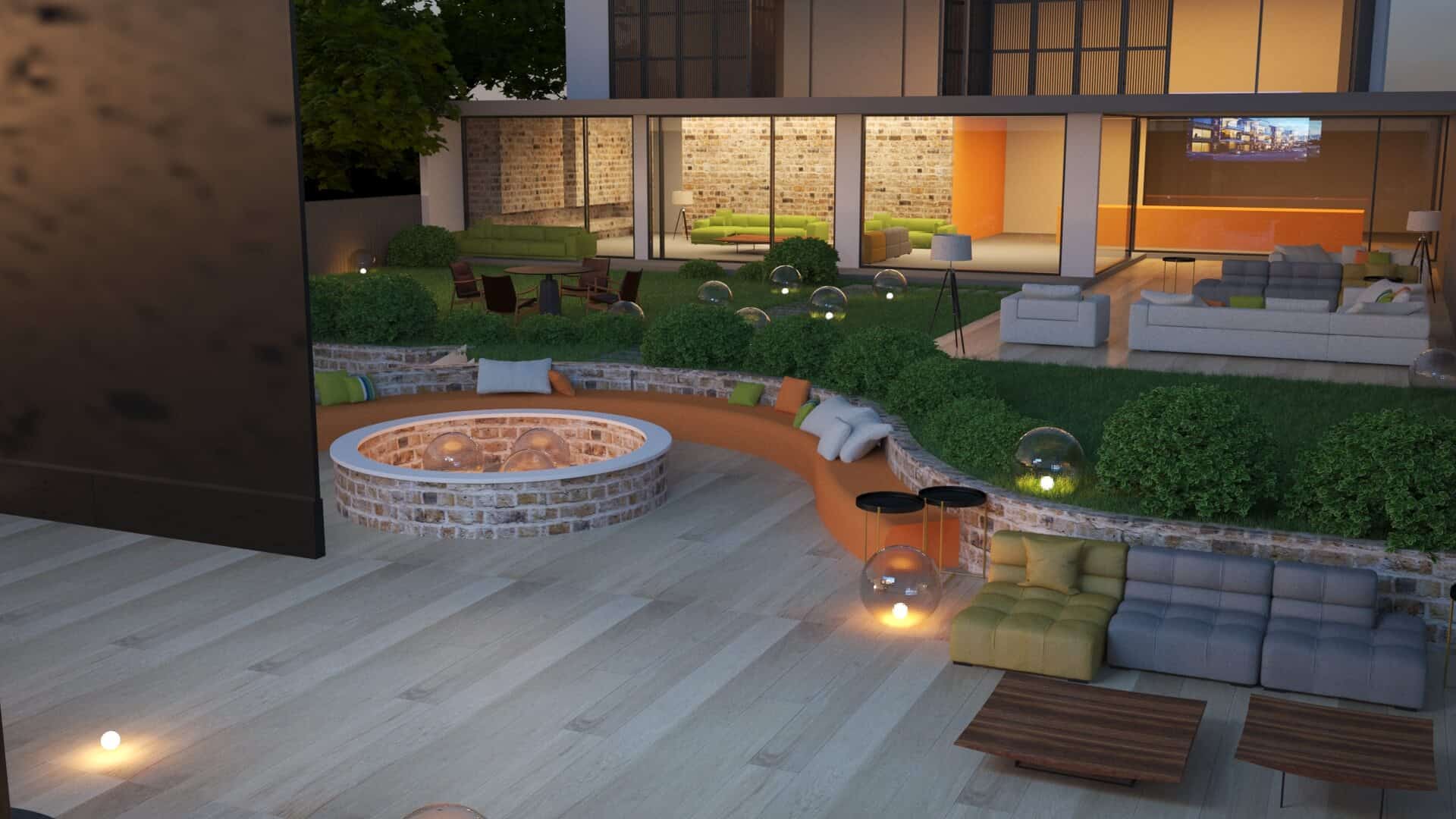
Video Sources — Apple TV, Kaleidescape, Sky Sports
An outdoor cinema system demands the same source flexibility as an indoor one: streaming services via Apple TV, local 4K content via Kaleidescape, and broadcast television including live sports. Crestron system integration ties these sources into a single interface — the terrace resident selects “Apple TV” or “Sky Sports” or “Kaleidescape” from the touchscreen, the cinema processor routes the correct video and audio format, lighting adjusts automatically, and the system is ready for entertainment.
For a terrace that doubles as an outdoor living space, the flexibility to play casual background television (sports, news, music videos) as easily as dedicated cinema content is essential. Seamless source switching makes the system approachable; fussy source routing makes it feel like infrastructure rather than entertainment.
Example System — Integrated Outdoor Cinema Configuration
A reference outdoor cinema installation combines a 150-inch fixed outdoor screen (mounted on a pergola structure) with a 4K laser projector housed in a weatherproof enclosure, projecting through an exterior glass panel onto the terrace screen. Audio comprises Steinway Marine left-centre-right front channels mounted at the screen structure for dialogue precision and stereo music imaging, Origin Acoustics bollard speakers positioned at the sides and rear of the seating area as surround channels, and two buried Origin Acoustics subwoofers beneath the terrace decking for consistent bass throughout the listening area.
A Trinnov Altitude 16 processor manages all audio routing and surround-sound coordination. Lutron RadioRA 3 controls the terrace lighting — path lighting remains discreetly on during cinema use, while the main terrace lighting dims to zero. Crestron system integration ties the cinema processor, lighting, video sources and screen control into a single “Cinema” scene; pressing a single button simultaneously begins the film, adjusts lighting, and primes the audio system for surround-sound playback.
The system delivers verifiable surround-sound coordination despite the open-air environment — rear effects remain convincingly in the rear channels, the buried subwoofers integrate seamlessly with the front and surround speakers, and the overall sound field maintains theatrical precision. Evening entertaining with streaming music shows the same level of audio quality: the Steinway Marine front channels deliver the stereo image and full-range response, the Origin bollards at sides and rear provide ambient width and spatial context, and the buried subwoofers anchor the low end throughout the seating area.
Practical Considerations for Outdoor Cinema Installation
Cable runs require conduit runs beneath terrace decking or along structural elements — this planning should start during the terrace design phase, not as an afterthought. Weatherproofing is non-negotiable: every connector must be stainless steel or solid nickel plating, outdoor-rated cable runs through IP67 conduit, and amplifier enclosures must have drainage and ventilation to prevent condensation and corrosion. Testing should include seasonal water accumulation: a summer terrace functions perfectly; a winter terrace with standing water on the decking is a different environment entirely.
For projector-based systems: the projector enclosure requires clear line-of-sight to the exterior glass window and adequate ventilation for thermal management. For display-based systems (C SEED, VISIONAIR-E, Samsung): structural mounting must account for wind loads and vibration isolation.
Equipment enclosures should be as invisible as possible: a stainless steel cabinet mounted against the house wall, painted to blend with the architecture, with external controls eliminated in favour of control via iPad or the Crestron touchscreen. The terrace should feel like an entertainment space first and a technical installation second.
Planning Your Outdoor Cinema
An outdoor cinema begins with light and viewing distance. Measure the terrace depth to determine comfortable screen size; assess ambient light conditions at different times (twilight, dusk, full darkness); and plan the display and lighting control strategy accordingly. From there, the audio design follows — bollard speaker placement determined by seating layout and surround image requirements — and finally the processor and source integration.
For a project of this scope, early collaboration between the architect or landscape designer, the AV integrator, and the control system installer is essential. The best outdoor cinemas are designed as integrated systems, not equipment assembled on an existing terrace.
Contact Custom Controls to discuss your outdoor cinema project. Get in touch →
Frequently Asked Questions — Outdoor Home Cinema
What’s the minimum viewing distance for outdoor cinema?
About 4 metres for a 100-inch screen (laser projector or direct-view display). Larger terraces allow 150+ inches with 8+ metre viewing distance, which approaches cinema standard sight angles.
Can I retrofit outdoor cinema to an existing terrace?
Yes, but cabling is harder and acoustic placement may be limited. Easier during terrace design or renovation when structures are being planned.
Do I need a dedicated processor or can an AV receiver work?
Consumer AVRs handle basic surround and Dolby Atmos but lack the room correction precision and outdoor calibration capability of professional processors. For cinema-grade outdoor systems, a dedicated processor (Trinnov, Lyngdorf) is recommended.
Which display technology is best for year-round outdoor use?
Direct-view displays (C SEED, VISIONAIR-E, Samsung Terrace) work in any light. Laser projectors excel at year-round large-screen scenarios but require evening emphasis. C SEED offers the best all-around flexibility if budget permits.
How much space do outdoor speakers require?
Origin Acoustics bollards are 300mm tall and 180mm diameter — discreet enough to integrate into any landscape. Positioning is more critical than size: rear surrounds 15+ metres from screen, sides positioned at 90-degrees to seating.
Do I need subwoofers outdoors?
Yes. Buried or ground-coupled subwoofers provide bass tactility that bollard speakers alone cannot deliver. A single buried sub is better than no sub; two buried subs (positioned strategically) eliminate bass modal problems across the seating area.
Home Cinema Installation → · Origin Acoustics Outdoor Speakers → · Trinnov Audio Processors → · Lutron Lighting Control → · Crestron Home Automation → · Cotswolds Outdoor Cinema Case Study →