
AI and Smart Homes: The Complete Guide to Intelligent Automation
How Artificial Intelligence Is Reshaping Crestron and Lutron Smart Homes
Smart homes have always promised intelligence, but until recently that intelligence was mostly an illusion — fixed schedules, simple triggers, and rules that had to be manually rewritten every time your routine changed. Artificial intelligence is changing that. In 2026, AI is moving from a marketing buzzword to a functional layer that sits across voice control, scheduling, energy management, and — increasingly — natural conversation. This guide covers where AI genuinely adds value to a professionally installed Crestron or Lutron system today, and where the technology is heading next.
Voice Assistants Meet Professional Automation
Google Home, Amazon Alexa and Apple Siri are now firmly embedded in daily life, and the good news for homeowners with professional systems is that they don’t have to choose between consumer convenience and professional-grade automation. Crestron and Lutron are both built to sit alongside these assistants rather than compete with them.
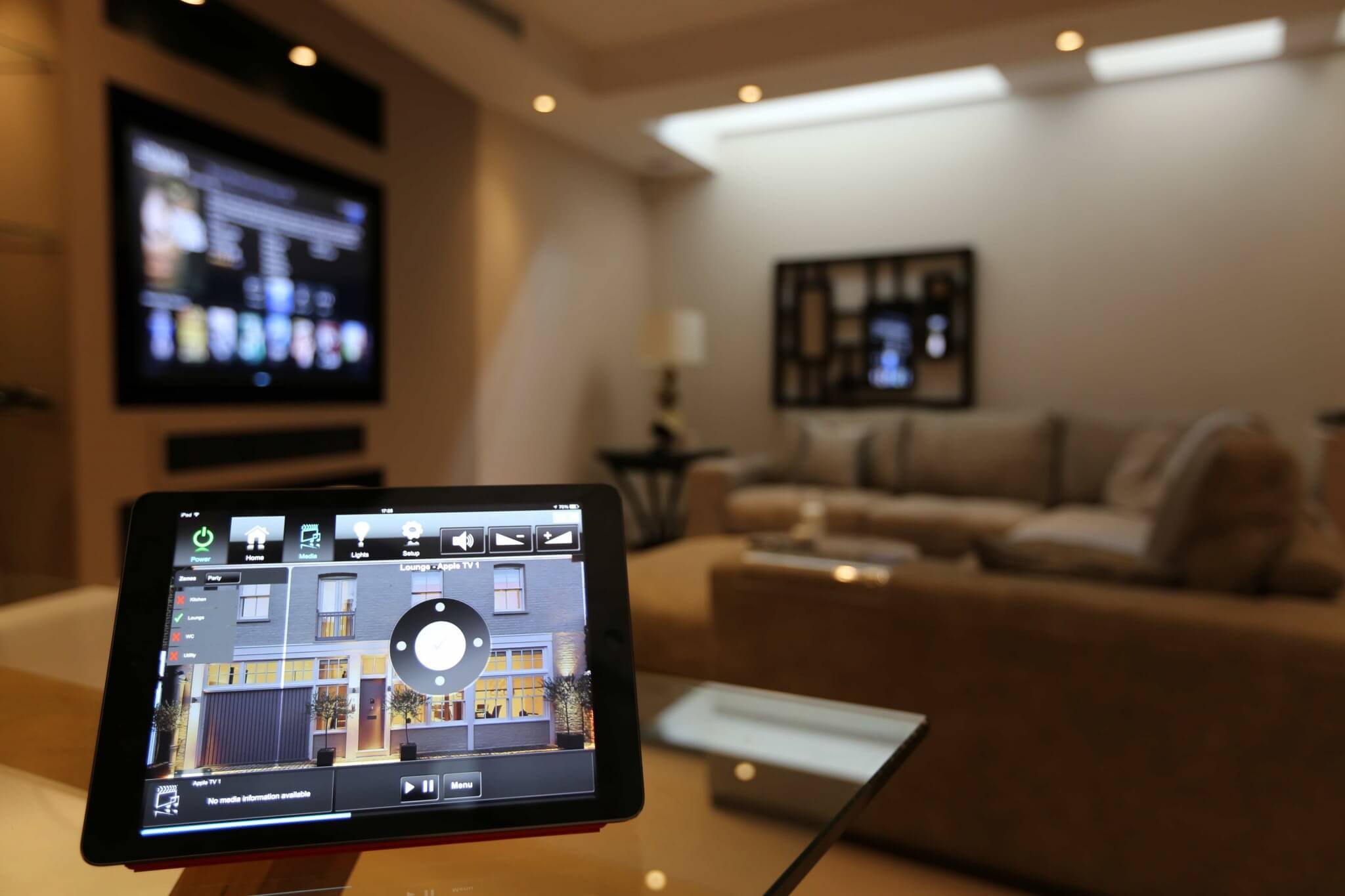
Crestron and voice control — Crestron Home systems can be paired with dedicated voice platforms such as Josh.ai, which auto-discovers every Crestron-programmed device once authorised and lets you control lighting, climate and AV with natural speech rather than rigid commands. For simpler needs, Crestron Home also supports direct integration with Amazon Alexa and Google Assistant, so “Hey Google, dim the dining room” triggers exactly the same scene as pressing the keypad.
Lutron and voice control — Lutron’s professional lines, including Homeworks QSX and RadioRA 3, connect natively with Alexa, Google Assistant and Apple Home/Siri. Once linked, every keypad-programmed scene becomes a voice command, and Lutron’s Smart Away feature can even randomise lighting patterns while you’re travelling, so the house looks occupied without you doing anything at all.
The key distinction for a professionally installed home is that voice assistants become an additional way to trigger scenes that have already been carefully programmed — not a replacement for that programming. You still get the reliability of a wired, professional-grade backbone, with the convenience of asking for what you want out loud.

Smart Home

Music Systems

Mood Lighting

Security & CCTV

Wifi & Networks
AI-Driven Scheduling: Beyond Lights and Blinds
The next layer of intelligence moves scheduling away from fixed clock times and towards behaviour. Traditional automation says “turn the lights off at 11pm.” AI-driven scheduling asks a more useful question: what does this household actually do, and when?
Modern platforms — from Crestron’s evolving AI roadmap to open ecosystems like Home Assistant — increasingly learn occupancy patterns and adjust proactively rather than waiting for a fixed trigger. That extends well beyond lighting:
Switched sockets and mains devices — Any device on a Crestron- or Lutron-controlled switched socket can be brought into the same intelligent scheduling as your lighting. Coffee machines, towel rails, pond pumps, and other mains appliances no longer need a separate plug-in timer; they become part of the same scene and schedule logic as everything else in the home, and can be adjusted from the same touchpanel, app or voice command.
Learning routines, not just times — Because AI-capable systems can reason over multiple signals (time, presence, recent activity) rather than a single trigger, a scene can combine several actions intelligently: lights rising gradually, blinds opening partway, and the kitchen coffee machine switching on, all coordinated around when the system expects you to actually get up — not a clock time that becomes wrong the moment your routine changes.

Smart Management of Renewable Energy
For homes with solar panels, battery storage or EV chargers, AI is arguably delivering its most measurable value anywhere in the smart home. Fixed schedules simply cannot keep up with variable weather, changing export rules and time-of-use electricity tariffs that shift throughout the day — but AI-driven energy management can react to all three in real time.
Solar-aware load management — Rather than running heavy appliances on a preset timer, an AI energy layer watches live solar generation and shifts demand to match it — pausing a load when cloud cover drops production, and resuming when generation recovers. Research from real-world installations has found that conventional, non-intelligent systems typically achieve only around 35% self-consumption of the solar power they generate, with the rest exported to the grid at a lower rate — a gap that AI-based coordination is specifically designed to close.
Battery optimisation — AI-managed battery storage charges when electricity is cheapest — during solar peaks or overnight off-peak tariffs — and discharges during expensive peak-rate periods, a strategy sometimes described as “low charge, high discharge.” The system continuously analyses tariff structures, weather forecasts and household demand to decide, hour by hour, whether stored energy should be used, held in reserve, or topped up.
Scheduling power-hungry devices to off-peak — EV charging, immersion heaters, dishwashers and washing machines are the classic candidates for off-peak scheduling, and AI extends this further by cross-referencing live grid pricing and forecast solar surplus rather than a single fixed overnight window. Some systems can even anticipate a period of surplus renewable generation on the wider grid and schedule flexible loads to take advantage of it automatically.
For a professionally installed Crestron or Lutron system, this intelligence doesn’t have to live in a separate app. Solar inverters, battery systems and EV chargers can be brought into the same interface as lighting and AV, so the whole home — not just the energy system — benefits from a single, coordinated view.
Conversational AI: Controlling Your Home By Message
The most significant shift already underway is the move from voice commands to genuine conversation. Traditional voice assistants match a spoken phrase to a predefined command; conversational AI agents, built on large language models, understand intent, hold context across a conversation, and can reason about what you actually want — even if you don’t phrase it the way a rigid system would expect.
Available today — Custom Controls now offers conversational AI as part of our smart home systems, giving clients the ability to control their home through natural conversation rather than a fixed set of app commands or voice phrases. It’s accessed through everyday messaging platforms like WhatsApp and Telegram, so a message such as “we’re heading home, warm up the house” is understood and actioned without opening a dedicated app at all — from anywhere in the world.
Troubleshooting, not just control — The same conversational layer is also used for support. Rather than describing a fault over the phone or waiting for an engineer visit, clients can describe an issue in plain language and get it diagnosed — and often resolved — through the same conversation used to control the home.
Calendar-aware home and away — Integrated with a client’s calendar, the system can distinguish routine, everyday activity from genuine travel automatically, adjusting into away mode and back again without a manual trigger. “We land at 6pm, everything ready for us” carries very different implications from a message sent while already at home — pre-conditioning rooms, adjusting the away-mode lighting pattern, and confirming security status, all understood in context rather than requiring a sequence of separate app taps.
What’s Next: Towards a True Digital Home Assistant
The natural endpoint of everything above is a single, unified intelligence for the home — the kind of ever-present digital assistant familiar from science fiction, from HAL to Tony Stark’s JARVIS. That’s not available today, from Custom Controls or anyone else in the industry, but it’s a realistic near-term destination rather than a distant one.
The building blocks are already in place: voice control, AI-driven scheduling, energy intelligence, and conversational messaging are each proven and deployable individually. What’s still to come is bringing them together into one continuous, proactive assistant — aware of the whole home rather than one system at a time, and able to anticipate rather than simply respond. It’s on our roadmap, and given how quickly the underlying AI technology is advancing, it isn’t far off.
Bringing It Together
The common thread across every layer of AI in the smart home is that it works best as an addition to a properly designed professional system, not a replacement for one. Voice assistants, learning schedules, energy intelligence and conversational agents all depend on a reliable, well-integrated foundation — the wiring, the processors, and the programming logic that only a professional Crestron or Lutron installation provides. AI makes that foundation smarter; it doesn’t remove the need for it.
As certified Crestron and Lutron dealers, Custom Controls designs systems with this in mind — built to support today’s voice assistants, scheduling intelligence and conversational AI control, and architected so that tomorrow’s unified digital assistant can be added without starting again. If you’re planning a new smart home installation or looking to bring AI into an existing Crestron or Lutron system, get in touch to discuss what’s genuinely worth adding today.
Frequently Asked Questions
Can I use Alexa or Google Home with a Crestron or Lutron system?
Yes. Both Crestron and Lutron support direct integration with Amazon Alexa, Google Assistant and Apple Siri, so voice commands trigger the same scenes programmed into your professional system.
Can AI control switched sockets and appliances, not just lighting?
Yes. Any device connected through a Crestron- or Lutron-controlled switched socket — from coffee machines to pumps — can be included in the same intelligent scheduling as lighting and blinds.
Does AI energy management require replacing my existing solar or battery system?
No. AI energy management typically sits on top of your existing solar inverter, battery and EV charger, coordinating them intelligently rather than replacing the hardware itself.
Can I control my smart home through WhatsApp or Telegram?
Yes. Custom Controls now offers conversational AI control through everyday messaging platforms like WhatsApp and Telegram, including calendar-aware home and away functionality and conversational troubleshooting support.