Ascendo Speakers and Infrasonic Subwoofers for Home Cinema
German Reference Audio for Dedicated Cinemas
Updated September 2026 · Custom Controls · Home cinema specialists since 1998
The speakers define a home cinema more than any other component. The projector sets what you see, but the loudspeakers and subwoofers decide whether a film feels like a performance in the room or a soundtrack played at you. Ascendo Immersive Audio builds loudspeakers and subwoofers designed specifically for residential cinemas, rather than adapting products from studios, commercial cinemas or hi-fi — and its infrasonic subwoofers, reaching far below the range of human hearing, are among the most ambitious bass products made for the home.
This guide explains who Ascendo are, how the coaxial speakers and subwoofer ranges work, when infrasonic bass is worth specifying, and what it takes in room design and calibration to get the best from them. It is written for clients planning a dedicated home cinema, and for the architects and interior designers working alongside them.
Who Ascendo Are
Ascendo was founded in Stuttgart in 1999 by Norbert Heinz, Stefan Köpf and Jürgen Scheuring, and grew into a technology company focused on DSP, audio networking and acoustic measurement. That engineering base led to Ascendo Immersive Audio GmbH, set up with Geoffrey Heinzel to build high-end home cinema systems, and now based in Heilsbronn, Germany.
The company’s approach is measurement-led. Ascendo designs its speakers specifically for residential theatre environments and publishes complete measurement data for its products, so a system can be designed around known performance rather than marketing claims. For an integrator that matters: it means the output of a proposed system can be calculated against the size of the room and the seating distance before anything is ordered.
CCRM Coaxial Screen, Surround and Height Speakers
The core of an Ascendo system is the CCRM range of coaxial speakers, built in 5, 6, 10, 12 and 15-inch sizes. Each pairs a woofer with a compression driver mounted at its centre, and the same family covers the screen channels, surrounds and height channels — so tonality stays consistent as sound pans around the room and overhead, rather than changing character from one speaker to the next.
The speakers are available as active or passive models. Active versions such as the CCRM12-MKII carry their own amplification — two 500W amplifiers in the 12-inch model — and built-in DSP, programmed over an Ethernet connection with multiple preset slots. Passive versions are driven by external amplification in the equipment rack, which suits rooms where the speakers must sit behind an acoustically transparent screen or fabric wall with no power at the speaker position.
Beyond the CCRM range, Ascendo makes specialist models such as the THE8 PRO LED wedge. On every project the speaker choice follows the room: the size of the screen wall, the listening distance, the ceiling height for the Atmos layer and the output the room needs to reach reference level at every seat.
A speaker system is only as good as the room and the design around it. These are the services that shape every cinema we design and install.

Home Cinema

Cinema Design

Calibration

Acoustics

Crestron
Why Coaxial Design Suits a Cinema
In a conventional speaker the tweeter and woofer sit apart on the front baffle, so their sound reaches a listener from slightly different positions and at slightly different times, and the balance changes as you move off-axis. A coaxial speaker places the compression driver at the centre of the woofer, so both radiate from a single point — time-aligned, with symmetrical dispersion, behaving as a true point source.
In a cinema with two or three rows, that consistency is the point. Listeners in the outer seats hear the same tonal balance as the centre seat, dialogue stays anchored to the screen, and effects pan cleanly between speakers because every channel shares the same dispersion. Compression drivers also bring high sensitivity and low distortion at high output, which lets a room reach reference level without the speakers straining.
Subwoofers: Sealed, Shallow and Scalable
Ascendo’s subwoofer range runs from 12-inch models through 16, 18, 19, 21 and 28-inch designs, most of them sealed and many built as shallow enclosures that fit behind a screen, in a riser or within a stud wall. Most are available as passive “Pro” models for rack amplification, with active versions in the smaller sizes. Sealed designs roll off gently and control the driver tightly, giving bass that starts and stops with the soundtrack rather than lingering.
In practice we rarely specify a single subwoofer. Several subwoofers, placed according to the room’s modes and managed together, smooth out the peaks and nulls that make bass boom in one seat and vanish in the next. The shallow enclosures make that practical: subwoofers can be built into the front wall void behind an acoustically transparent screen, into the rear wall or into the seating riser, where they disappear from view entirely.
Infrasonic Subwoofers: From 24 to 100 Inches
Infrasonic bass sits below the roughly 20Hz lower limit of human hearing. It is not heard as a note but felt as pressure and movement — the weight of an explosion, the rumble of an engine, the shudder of thunder. Reproducing it cleanly takes enormous cone area and long, controlled excursion, because the lower the frequency, the more air has to move. For the same sound pressure, every halving of frequency requires four times the air displacement — so a subwoofer that is comfortable at 40Hz needs sixteen times the displacement to deliver the same level at 10Hz. That can only come from a larger cone, longer excursion, or several drivers working together. Co-managing partner Geoffrey Heinzel pioneered infrasonic bass in home audio, and Ascendo quotes reproduction as low as 3Hz.
The infrasonic range starts at 24 inches and runs through the THE32, THE50 and THE80 to the THE64 SUB PRO and THE100 SUB PRO — at 100 inches, described as the world’s largest home theatre subwoofer. The latest models use multi-layer carbon fibre cones, single-piece surrounds and quad-spider suspensions designed for extreme linear and non-linear excursion, in sealed, passive enclosures around 40 inches deep with improved internal bracing and multi-density damping. A field-replaceable re-cone kit allows the driver to be serviced on site rather than removing a very large enclosure from the room.
Why Size Matters Below 20Hz
The physics explains why Ascendo’s infrasonic models are so large. Cone area and excursion together set how much air a driver can move, and at infrasonic frequencies the required volume rises steeply. A very large cone moving a modest distance can produce deep bass with far lower distortion than a small cone pushed to the limit of its travel, because the suspension and motor stay within their linear range.
Sealed enclosures help too. A sealed subwoofer rolls off at 12dB per octave below its tuning, compared with 24dB for a ported design, and its response can be extended downwards with DSP and the natural gain of a closed room. That combination — very large sealed drivers, generous amplification and room gain — is what allows a properly designed system to reproduce the lowest content on a soundtrack at realistic levels.
When Infrasonic Bass Makes Sense
Infrasonic subwoofers are not essential for every cinema, and we would not specify them by default. They suit large, dedicated rooms where the client specifically wants the physical sensation of the deepest bass, where the structure can take it, and where the room can be isolated from the rest of the house. A basement with solid walls or a purpose-built room is a very different proposition from a first-floor media room above a bedroom.
The decision is made at design stage, because infrasonic subwoofers affect the structure, the isolation and the layout. The enclosures need space in the front wall, rear wall or floor; the room’s construction has to contain energy that travels through a building far more readily than midrange sound; and the rest of the system has to be specified to match. For most rooms, a well-placed array of sealed subwoofers, carefully calibrated, delivers reference-level bass on its own — and tactile transducers in the seats are another way to add physical impact without the scale of an infrasonic installation.
Room Design and Acoustics
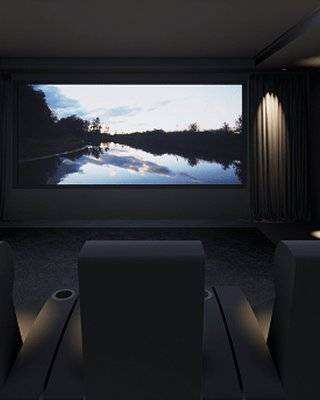
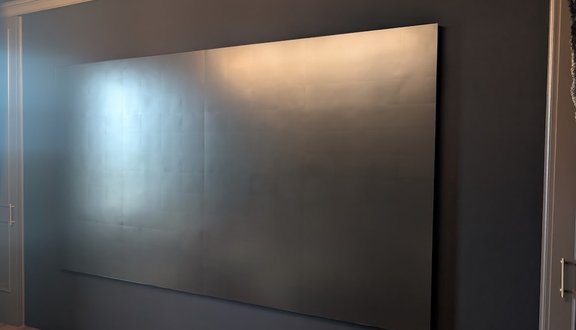
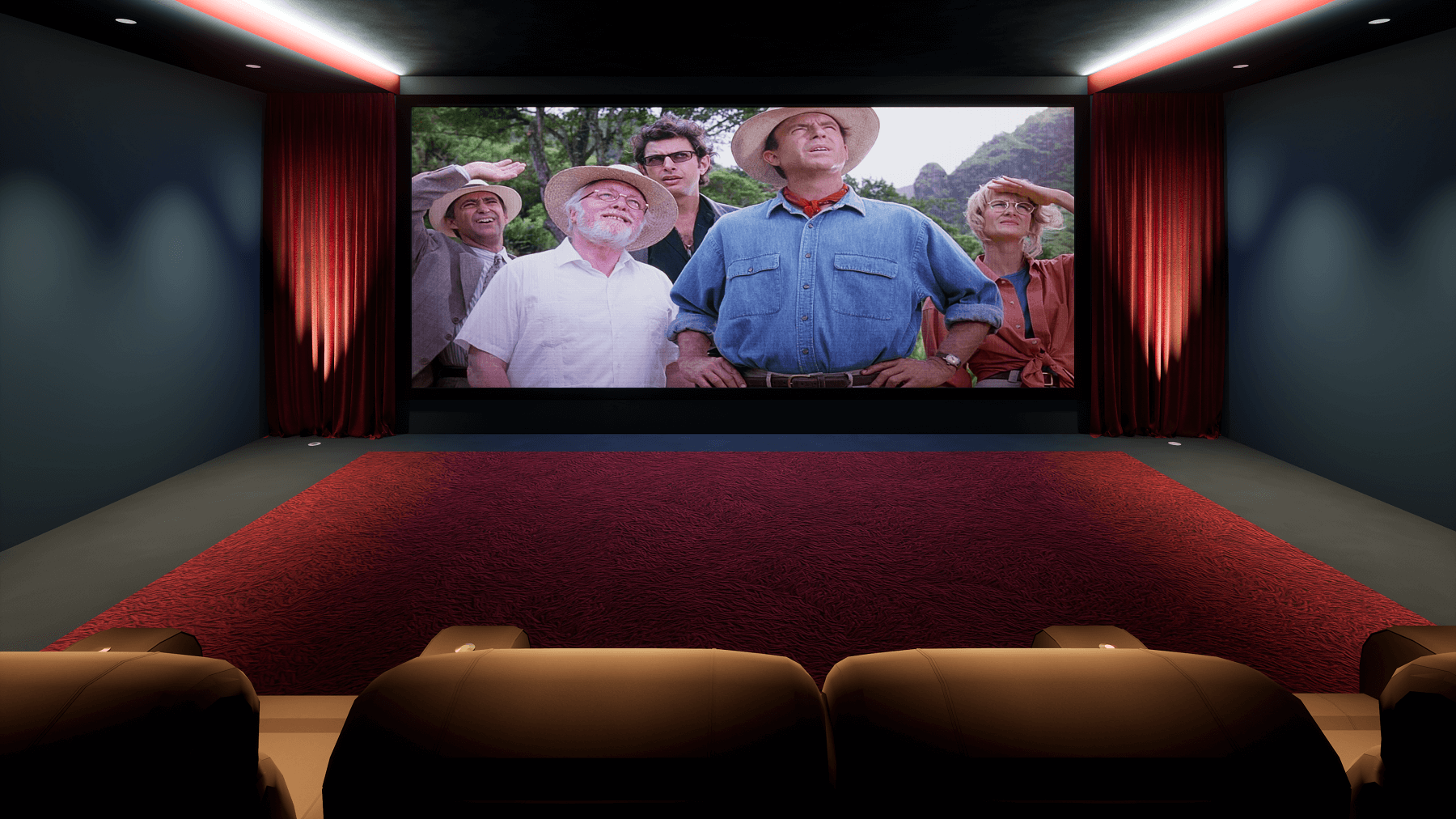
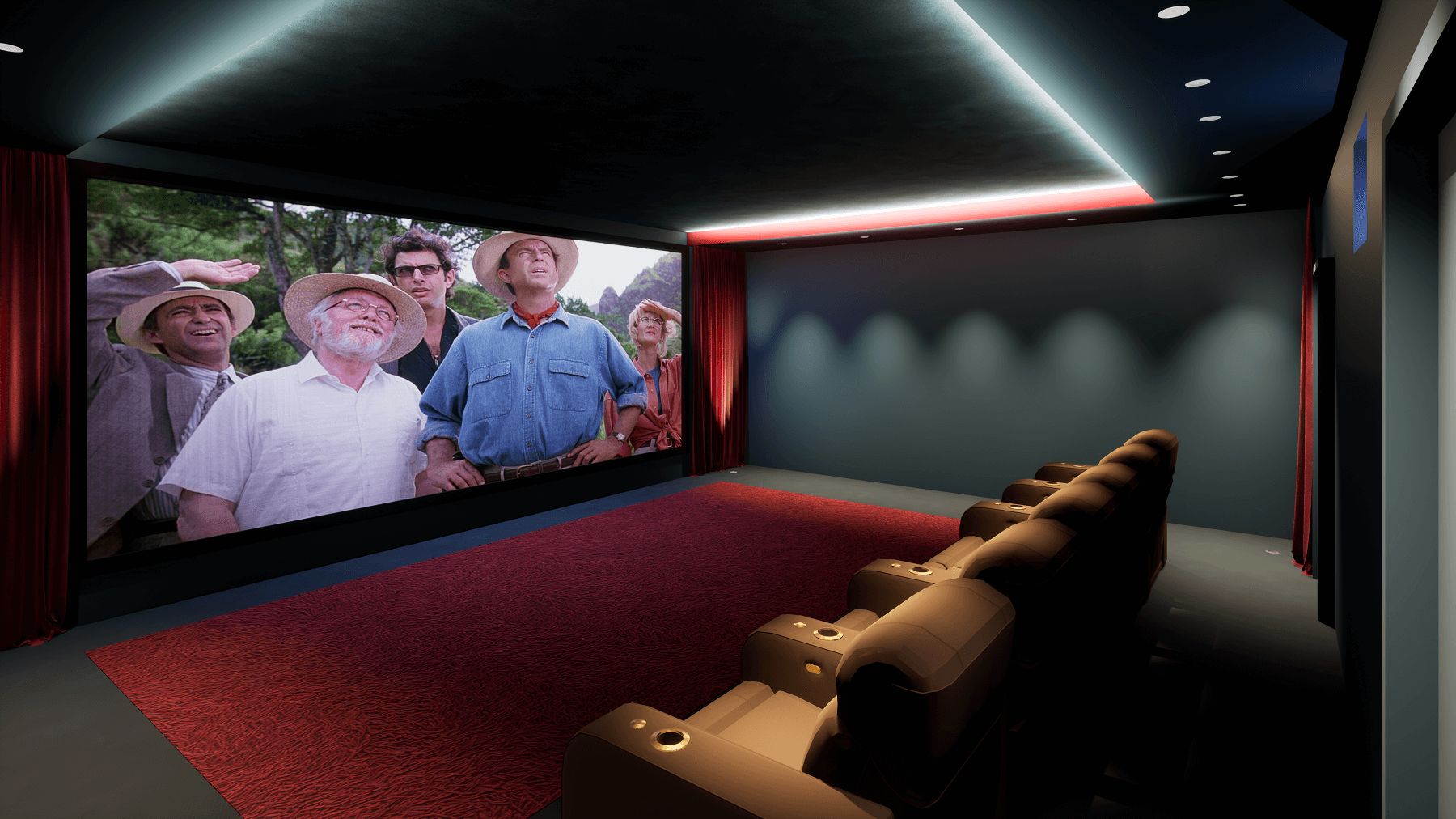
Ascendo speakers are designed for dedicated cinemas, and they perform best in a room designed around them. In our cinemas the front speakers and subwoofers sit behind an acoustically transparent screen, so the sound comes from the image itself, and the surrounds sit behind stretched fabric walls with acoustic treatment in the void behind. Nothing is visible except the screen, the seating and the lighting.
The acoustic design sets the treatment, the speaker positions and the listening positions together. First reflections are controlled so the coaxial speakers’ imaging stays precise, bass treatment is sized for the room’s modes, and speaker heights are set so every row has a clear path to the surrounds. For multi-row rooms, the riser is built as a sealed, damped platform so that it does not resonate with the bass the subwoofers produce.
Calibration and Processing
A system of this capability has to be calibrated in the finished room. Active Ascendo speakers carry their own network-programmable DSP, and Ascendo’s speaker management software sets up each speaker; the system as a whole is then calibrated with the cinema processor. On our reference rooms that is usually Trinnov Altitude, which measures at every seat and optimises for the whole seating area rather than a single sweet spot.
Calibration covers crossover points between speakers and subwoofers, delays, levels and phase alignment across multiple subwoofers, then room correction to smooth the response at every seat. With infrasonic subwoofers it matters even more: uncontrolled deep bass can pressurise a room unevenly and swamp the rest of the system, while a properly integrated infrasonic layer should be felt rather than consciously heard. We treat calibration as a mandatory part of handover on every system we install.
Amplification and the Equipment Rack
The amplification strategy follows the speaker choice. Active CCRM speakers carry their own amplifiers and DSP, so the rack sends each one a signal and a network connection, and each speaker needs mains power at its position. Passive CCRM speakers and passive Pro subwoofers are driven from amplifiers in the rack, which keeps power and heat out of the screen wall and makes the speakers easier to reach for service.
Large passive subwoofers, and infrasonic models in particular, need substantial amplifier power with headroom, and the rack has to be designed for it: dedicated mains circuits, ventilation for the heat generated, and cable runs sized for the distances involved. We design the rack, power and cabling as part of the cinema, so the equipment runs quietly, stays cool and is never visible in the room.
Ascendo Alongside the Other Speakers We Specify
We specify loudspeakers to suit the room and the brief rather than a single brand. Artcoustic is the cinema speaker we specify on many of our rooms — its on-wall and in-wall designs suit rooms where the speakers must work with the interior, and our Artcoustic cinemas have won Install of the Month. Steinway Lyngdorf suits media rooms and listening rooms where RoomPerfect correction and a combined hi-fi and cinema system are the priority.
Ascendo is our choice where the brief is uncompromising output and bass in a dedicated cinema: reference-level coaxial speakers behind the screen, arrays of sealed subwoofers, and, where the room and the client suit it, an infrasonic layer beneath them. As with every system we specify, the brand follows the room, the acoustic design and the way the space will be used.
How We Design an Ascendo Cinema
An Ascendo system starts with the room. We survey the space and model its acoustics, then set the screen size, seating layout and listening positions before choosing speaker sizes and subwoofer quantities — including whether an infrasonic layer is appropriate. The speaker, subwoofer and amplifier specification is then matched to the output the room needs at every seat.
The design drawings set the speaker and subwoofer positions within the front wall, side walls, ceiling and riser, the cable routes and the rack. On site, stud walls, treatment and fabric are built around the speakers, the equipment is installed and commissioned, and the system is calibrated with the processor. The finished room is controlled from a single Crestron interface, with lighting, projector, screen and audio responding together.
Everyday Control
However sophisticated the system, using it should be simple. A single Crestron scene starts the projector, selects the source, sets the processor to the right preset and dims the lights, and Kaleidescape or streaming sources are browsed from the touch panel or handset. Volume and bass levels can be limited for late-night viewing, and the system returns everything to standby at the end of the film.
The lighting is part of the same design: cove, step and seat lighting are programmed into scenes for arrival, the film, an interval and leaving the room, so the whole cinema responds together from one button. Guests can use the room without instruction, and the same scenes are available from keypads at the door and the touch panel at the seats.
Frequently Asked Questions — Ascendo Speakers
What are Ascendo speakers?
Ascendo Immersive Audio is a German manufacturer of loudspeakers and subwoofers designed specifically for residential cinemas. The range centres on CCRM coaxial speakers, available in active versions with built-in DSP and amplification or as passive models, alongside sealed subwoofers and a range of infrasonic subwoofers from 24 to 100 inches.
What is an infrasonic subwoofer?
An infrasonic subwoofer reproduces bass below the roughly 20Hz lower limit of human hearing. Those frequencies are felt as pressure and movement rather than heard as a note, adding the physical weight of explosions, engines and thunder that conventional subwoofers cannot reach. Ascendo quotes bass reproduction as low as 3Hz.
Does every home cinema need infrasonic subwoofers?
No. They suit large, dedicated cinema rooms with solid construction, where the client specifically wants the physical sensation of the deepest bass. Most rooms achieve reference-level performance with well-placed sealed subwoofers and careful calibration.
Why does Ascendo use coaxial speakers?
In a coaxial speaker the tweeter sits at the centre of the woofer, so both drivers radiate from a single point. The sound is time-aligned and disperses evenly, which keeps tonality consistent across the seating area and keeps dialogue anchored to the screen.
How are Ascendo systems calibrated?
Active Ascendo speakers carry network-programmable DSP, and the system is then calibrated as a whole with a processor such as Trinnov Altitude, measuring at every seat. Crossover points, delays, levels and room correction are set in the finished room, so the speakers and subwoofers integrate as one system.
Home Cinema Installation → · Trinnov Home Cinema → · Artcoustic Speakers → · Dolby Atmos, THX and IMAX Enhanced → · Best Home Cinema Seats → · Discuss your project →