Home Cinema Installation London — Process, Timeline & What to Expect
From initial design through final calibration: a complete walkthrough of how we install a dedicated cinema room
Installing a home cinema room in a London property — whether a basement, garage conversion, or dedicated space — is genuinely complex. The room itself has to be acoustically treated, the equipment has to be precisely calibrated, the integration with your home’s controls has to work flawlessly, and the entire project has to work alongside your day-to-day life without taking over your home for months.
This guide walks through exactly how we approach a home cinema installation from start to finish: what happens in the design phase, the timeline you should expect, the disruption to your home, and what separates a properly installed cinema from one that merely looks good on day one but frustrates in day-to-day use.
Phase 1: Initial Consultation & Design (2–4 Weeks)
Every project starts with understanding what you actually want. Not what we think you should have, but what will genuinely work for your home, your family and your budget.
We visit your London property, measure the space precisely, and photograph it extensively. We ask about how you’ll actually use the room — is it film-focused, or will it be games, sport and casual TV? Do you have young children? Do you entertain groups, or is it primarily for two? What’s your audio preference — cinema-accurate Dolby Atmos, or something warmer and more musical?
We then produce a detailed technical design covering: room acoustics (identifying where sound treatment is needed), screen and projector specification (ensuring the image size and brightness is correct for the room), seating layout (optimizing viewing angles and comfort), equipment selection (from processors to speakers to Kaleidescape servers), and integration with your home’s Crestron or Lutron system (so the cinema integrates seamlessly with your wider smart home).
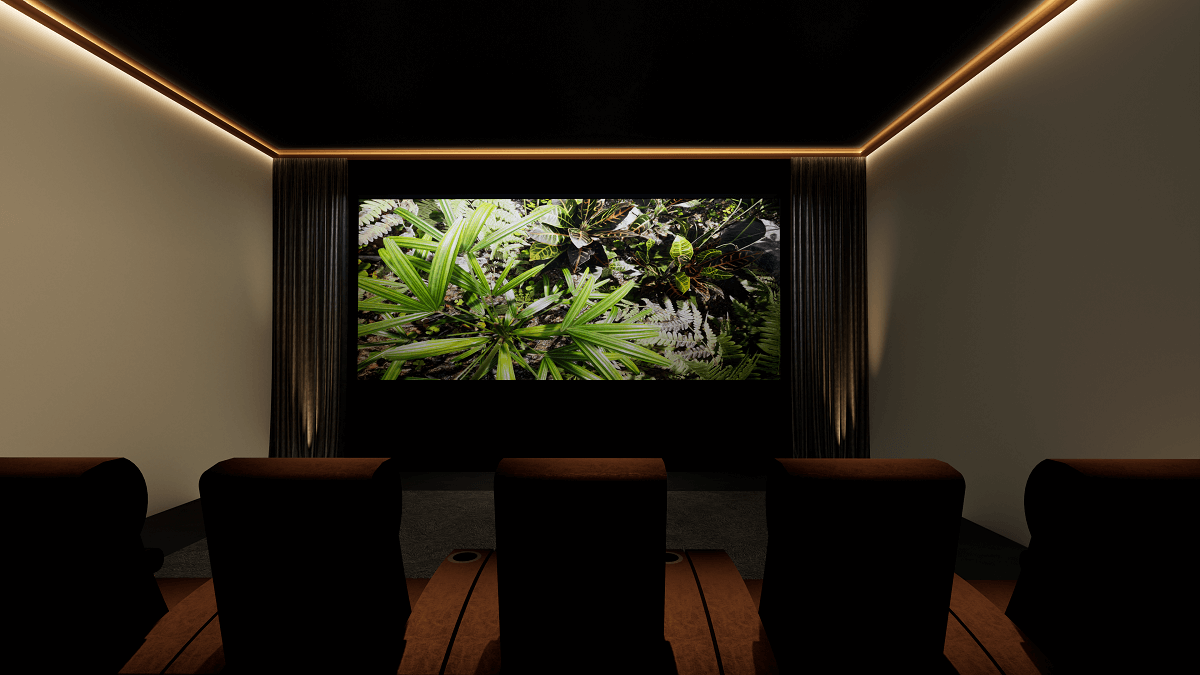
The design phase culminates in a full 3D render showing exactly how the finished room will look — not an artist’s impression, but a pixel-accurate visualization built from the actual equipment you’ll be installing.
Phase 2: Planning Permission & Building Regulations
Depending on the type of conversion — a basement room, garage conversion, or new garden room — you may need planning permission and building regulation approval. We handle the technical documentation and liaise with your architect or surveyor. This phase typically takes 4–8 weeks and is essential before any building work begins.

Control System

Lighting

Projection

Seating

Design
Phase 3: Building & Construction (6–12 Weeks)
Once approvals are in place, the actual construction begins. This is where much of the “invisible” work happens — and it’s often the most critical part of a cinema installation.
Acoustic treatment is installed into the structure: Acoustiblok barrier material on walls and ceilings to contain low-frequency noise, QuietFiber absorption panels positioned to control reflections without over-damping the room, bass traps in corners where low frequencies accumulate. This phase alone takes 2–3 weeks and directly determines how your finished cinema actually sounds.
Electrical infrastructure is installed to specification: dedicated circuits for the AV equipment (isolating it from lighting and general household power), low-voltage cabling for audio, video, control and networking, conduits and trunking routed invisibly through walls, all terminating at a central equipment rack.
HVAC integration ensures the room stays at comfortable temperature and humidity even when filled with people and running projection and amplification equipment that generates significant heat. This is often overlooked in amateur installations and results in either a stuffy room or systems that are constantly running.
Lighting is installed to your design specification — typically a combination of dimmed task lighting for navigation when not watching, bias lighting behind the screen to reduce eye strain during viewing, and accent lighting integrated into seating and architectural features.
This phase is where a proper cinema differs from a room with a TV. Every detail matters — the positioning of acoustic panels, the routing of cabling, the specification of electrical circuits — because they’re built into the structure and become impossible (or very expensive) to change once the room is finished.
Phase 4: Equipment Installation (3–4 Weeks)
Once the building work is complete, the equipment goes in. This phase includes:
- Projector installation — mounted, focused and keystoned precisely onto the screen
- Speaker installation — screen channels (left, center, right), surrounds and rear surrounds positioned and angled to match your acoustics, Atmos ceiling speakers if specified
- Seating installation — Cineak or alternative seating assembled, positioned and tested for comfort and viewing angle
- AV rack — processors, amplifiers, servers and control systems installed, cabled and powered up
- Screen installation — fixed or motorized, positioned and masked to the exact frame size
- Integration & control — Crestron or alternative control system programmed to manage lighting, projection, audio, motorized blinds, and motorized seating
We test everything during this phase but don’t yet optimize it. The goal is to get to a point where the room actually works as a functional cinema.
Phase 5: Calibration & Final Tuning (1–2 Weeks)
This is where a properly installed cinema becomes genuinely exceptional. Calibration is the process of measuring and optimizing every parameter of the system — speaker levels, delay times, equalization, room modes, projector color accuracy, black levels, brightness.
We use professional calibration equipment (Trinnov room analysis, Lumagen probe, calibrated microphones) to measure the room’s actual acoustic and visual performance, then adjust the system to compensate. A room that sounds mediocre during installation can become exceptional during calibration — and this is why DIY installations so often disappoint compared to professional ones.
Projector calibration in particular is critical: we measure color temperature, gamma curve, and absolute brightness, then adjust the projector’s internal settings to match cinema standards (DCI-P3 color space for most home cinemas, SMPTE reference levels for brightness and black).
Once calibration is complete, we run through the room with you: showing you how to use the Crestron touchpanel or remote, how to connect your own devices, how to achieve different presets (a “Movie Mode” with cinema-optimized audio and lighting, a “Gaming Mode” with brighter picture settings, etc.), and how to maintain the room going forward.
Total Timeline: 4–6 Months
A realistic home cinema installation in London takes 4–6 months from initial consultation to sitting down for your first film in a fully calibrated room. The building phase is the longest single component — acoustic treatment, structural work, electrical infrastructure and HVAC all take time to do properly.
Projects that promise completion in 6–8 weeks are either skipping essential steps (acoustic treatment, electrical specification, calibration) or understating the timeline. A cinema room is not furniture you can assemble in a weekend — it’s a permanent architectural modification to your home, and it deserves the time it actually requires.
Disruption to Your Home
A home cinema installation is genuinely disruptive. There’s dust from construction, noise from drilling and installation, and the room itself is off-limits during much of the building phase. We try to minimize this by:
- Working in clearly defined phases so you know when disruption will peak
- Isolating dust using temporary partitions and air scrubbers
- Scheduling work to avoid school holidays and family occasions
- Keeping the rest of your home accessible — we don’t need exclusive access to the whole property
It’s worth being realistic about this upfront. A cinema room doesn’t materialize overnight, and taking shortcuts to speed things up almost always results in a worse finished product.
Why London Projects Take Longer Than Country Conversions
London homes present specific challenges that country properties often don’t: listed building restrictions, party wall notices (required if you’re working on a shared wall), tighter construction tolerances in terraced and townhouse properties, and the logistical difficulty of managing noise and dust in dense residential areas.
We factor all of this into our timelines. Projects in listed buildings or subject to party wall notices will take longer — that’s not a delay, it’s compliance with planning and building regulations.
What Affects the Cost
The cost of a home cinema in London depends on the scope of the room, the number of seating rows, the tier of equipment specified and the complexity of the building and integration work. The biggest cost components are typically:
- Building and acoustic treatment (30–40% of total cost)
- Seating (15–25%)
- AV equipment and processors (20–30%)
- Integration and installation labor (15–20%)
Acoustic treatment is the area where compromises are most often regretted — you’ll notice the moment you try to watch a film with meaningful bass content — so it is worth protecting when the specification is set. Every project is different, so we provide a free, detailed quotation based on your room and brief rather than a generic price guide.
Next Steps: Starting Your Cinema Project
If you’re considering a home cinema installation in London, the first step is a no-obligation consultation at your property. We’ll measure the space, understand your brief, and provide honest feedback on what’s realistic for the budget and timeline you have in mind.
From there, we produce a detailed technical design and cost estimate. If you decide to proceed, we handle everything — planning permission, building regulation liaison, construction supervision, equipment installation and professional calibration.
Home Cinema Installer London → · Home Cinema Room Dimensions Guide → · The Complete Home Cinema Design Guide → · Contact our London office →