The Smart Home Automation Guide (2026 Edition)
What to Install, What It Costs, and Which System Is Right for You
This guide has been updated for 2026. Smart home automation has changed significantly in recent years — the technology is more capable, more reliable and more accessible than it was when we first published this guide. We have rewritten the content throughout to reflect the current state of the market, the systems we actually recommend today, and an honest view of what drives cost.
If you are researching smart home systems for a new build, a renovation or an existing property, this guide covers everything you need to know — from the core principles through to the specific systems we recommend, what shapes their cost, and what working with an installer actually looks like. Custom Controls have been designing and installing smart home systems since 1998. What follows is our honest assessment of the current landscape, not a manufacturer’s marketing summary.
Our Smart Home Services

Smart Homes

Home Automation

Lighting Control

HVAC Controls

Home Wifi
What a Smart Home System Actually Does
Smart home automation brings lighting, heating, AV, security and shading under one system — controlled from a touchpanel, an app, or automatically in response to the time of day, occupancy or weather. The value is not the gadgetry; it is the way these separate systems start working together. A heating system that knows the family has left because the alarm has been set. A bathroom that pre-warms before guests arrive because the calendar says they’re due. Underfloor heating that knows it needs longer to respond than a radiator, and adjusts accordingly.
Five Reasons to Install a Smart Home System
1. Energy saving and convenience. A single action — setting the house alarm on exit — can simultaneously drop the heating, switch off every AV device and turn off the lights. Outdoor lighting can revert to a dusk-to-dawn schedule, and interior lighting can replay the household’s recent activity pattern to suggest occupancy while the family is away. Heating and air conditioning can be controlled room by room, so guest rooms hold a set temperature range rather than being left running at full heat indefinitely. Heat recovery integration can take warm air from a sun-facing room and distribute it to a colder one — effectively free heating.
2. Control over anything electrical. A properly designed system extends beyond lighting and heating to genuinely unusual requests — saunas, steam rooms, pool covers, fountains. If it has a control input, it can usually be brought into the same system and the same interface as everything else in the home.
3. Energy monitoring and control. A smart home system shows exactly where energy is being used — lights left on, heating set higher than necessary — and can take automatic action: lowering blinds in a sun-facing room instead of relying on air conditioning to compensate, or shutting off cooling once a setpoint is reached rather than continuing to run. Integration with renewable energy systems allows surplus solar production to be routed automatically to immersion heaters, underfloor heating, or pool heating.
4. Home security. A monitored security system integrated with the smart home means gate access automatically brings up camera views at a central monitoring station, motion in the grounds triggers an audible warning to any intruder before they reach the house, and the police can be alerted directly if needed — addressing a threat before it reaches the building rather than after.
5. Peace of mind. For clients with multiple properties or extensive travel, remote viewing and control of every system — lighting, heating, security — removes the uncertainty of an unoccupied home, with monitored security providing the same reassurance as if the property were occupied.
Which Smart Home System Should You Choose in 2026?
The smart home market has consolidated significantly. The consumer systems that attracted attention a decade ago — standalone thermostats, individual smart plugs, voice-activated speakers — have been largely superseded by proper integrated platforms for anyone serious about the result. For luxury residential clients, the choice comes down to a small number of professional-grade systems:
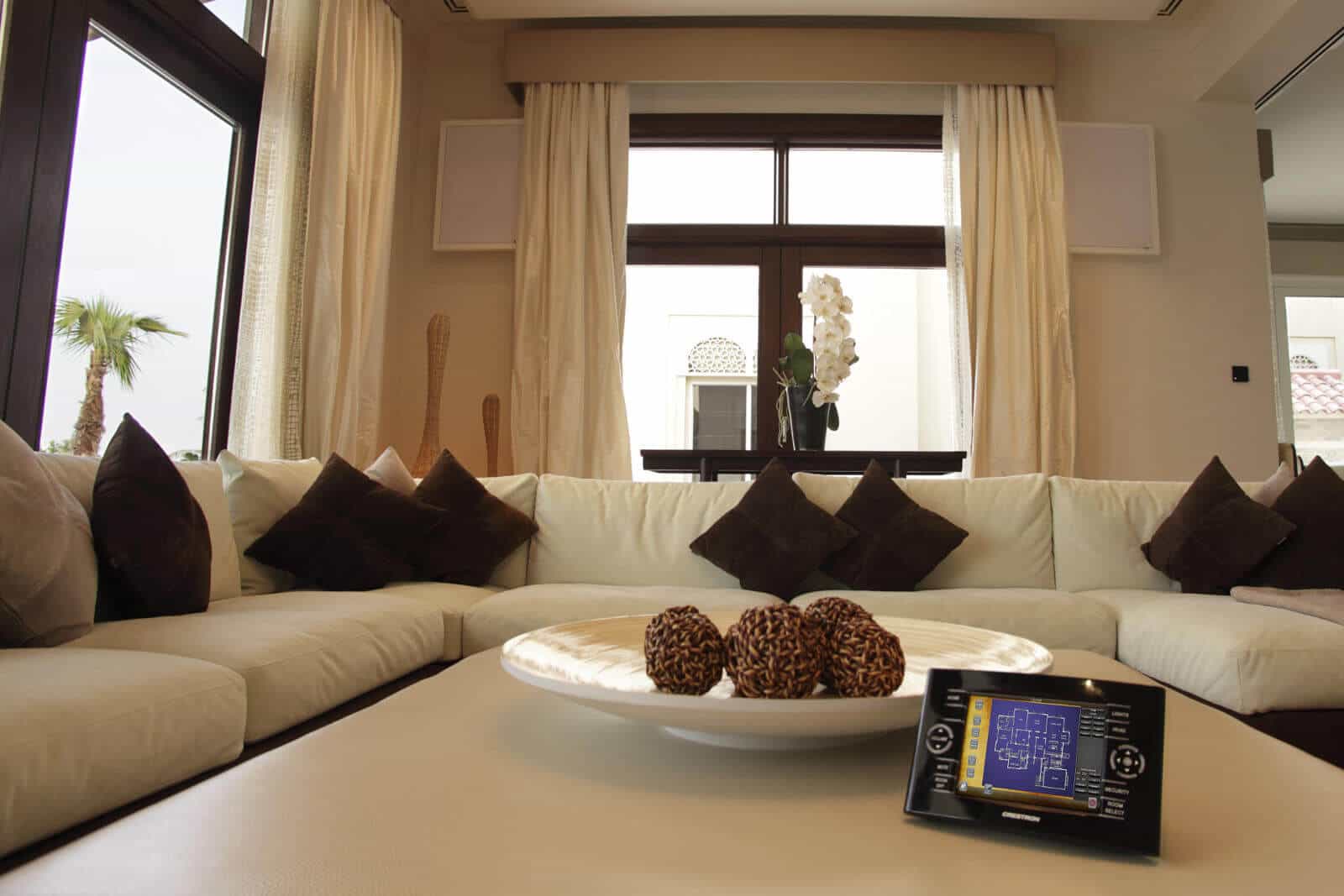
Crestron remains the most powerful and flexible home automation platform available. It is programmed bespoke for each installation — no templates, no limitations — and can integrate virtually any device or system in the home. Crestron Home provides a streamlined version of the same platform for projects that do not require full custom programming. We have been Crestron dealers since 1998 and it remains our recommendation for the most demanding projects.
Lutron is not a whole-home automation platform — it is a dedicated lighting and shading control system. But it is the best dedicated lighting control system available, and we specify it alongside Crestron on the majority of our significant projects. Lutron Homeworks QSX for new builds and major renovations; Lutron RadioRA 3 for retrofits where wireless installation is required.
Control4 is the most widely installed professional smart home platform in the UK — more accessible in cost than Crestron, with thousands of third-party device integrations and a capable whole-home interface. Our recommendation for projects where Crestron’s depth is not required.
Savant sits alongside Crestron and Control4 as a third professional-grade option, distinguished by an exceptionally polished interface and deep Apple integration — the Savant Pro Remote and app feel like a natural extension of an Apple-centric household. We specify Savant for clients who prioritise interface elegance and are committed Apple users, typically on projects that don’t require Crestron’s full bespoke programming depth.
Consumer systems — Apple HomeKit, Google Home, Amazon Alexa — remain useful as voice control layers on top of professional systems, but are not appropriate as the primary control platform for a properly designed smart home. Their reliability, programming depth and integration capability fall significantly short of professional platforms.
For a detailed comparison of the main professional systems, read our Crestron vs Lutron vs Control4 expert comparison → or our Crestron vs Savant comparison →
How Much Does a Smart Home System Cost in the UK in 2026?
Cost is the question we are asked most frequently, and we will give an honest answer: smart home system costs vary enormously, and no single figure is meaningful without a proper brief. The cost of a system is driven by the size of the property, the number of rooms and zones controlled, the tier of hardware specified, how much bespoke programming and integration the project needs, and whether it is a new build (hardwired) or a retrofit (wireless). The table below shows what typically shapes the cost for each platform and project scale.
| System | Typical Project | What Drives the Cost |
|---|---|---|
| Lutron RadioRA 3 | 4-bedroom home, lighting only | Number of lighting circuits, keypads and shading |
| Control4 | Whole-home AV, lighting, climate | Number of AV zones, integrations and touchpanels |
| Crestron Home | Mid-size luxury property, full system | Scope across lighting, AV, climate and security |
| Lutron Homeworks QSX | Larger property, dedicated lighting | Circuit count, DALI and dimming requirements, shading |
| Crestron + Lutron Homeworks QSX | Substantial new build or renovation | Property size, integration depth and bespoke programming |
| Full Crestron estate system | Whole-estate, multiple buildings, cinema | Number of buildings, processors, zones and dedicated cinema rooms |
Our most ambitious projects — whole-estate installations in Dubai with eight automation processors, 72 audio zones and dedicated home cinema rooms — are scoped and quoted individually around the scale of the estate and the systems it needs.
All Custom Controls projects include a free, detailed, no-obligation consultation and quotation. Contact us to discuss your project →
Lighting Control — The Foundation of a Good Smart Home
Lighting does more to define how a room feels than almost any other element of a smart home system. Whole-home lighting control allows a single keypad by the front door to switch off every light on exit, but the real value is felt room by room — a single button press recalling exactly the right combination of lighting for a specific activity, calibrated once and saved permanently. A proper lighting design highlights the best architectural and interior features of a space while giving it the right atmosphere for how it’s actually used.
We work with the two manufacturers that matter at this level: Crestron and Lutron. Both offer hardwired solutions for new build properties but also offer wireless retrofit solutions which work standard UK wiring. Consumer systems like Philips Hue or Rako can be a reasonable starting point for a single room on a limited budget, but they don’t offer the same dimming quality, reliability or scene flexibility — and costs add up quickly once a household tries to scale them across a whole property.
Automated Curtains and Blinds
Every major lighting control manufacturer offers motorised window treatments as a natural extension of the same system. A single keypad press closes and opens blinds without ever handling delicate fabric directly, and scheduling can close blinds automatically at sunset for privacy. Many of our installations use layered window treatments at a single window — sheer voiles for daytime privacy, blackout blinds for night, curtains over the top — all controlled from the same keypads and touchscreens as the lighting.
Crestron and Lutron’s lighting systems also handle LED dimming more reliably than cheaper alternatives, which often require lamps to be specifically matched to the dimmer to avoid flickering or buzzing. This Wimbledon project shows what a full wireless Crestron retrofit looks like, including Crestron LED lamps throughout the property.
Heating, Cooling and Climate Control
Climate control is one of the most overlooked elements of a smart home system, yet it is where some of the largest energy savings and the most noticeable improvements in day-to-day comfort actually happen. Bringing heating and air conditioning under the same control system as lighting and AV means the two never work against each other — underfloor heating never tries to warm a room that air conditioning is simultaneously cooling, because both are managed by the same logic rather than two independent thermostats unaware of each other.
Room-by-room control is the foundation: bedrooms that are rarely used during the day don’t need to be held at the same temperature as a kitchen in constant use, and guest rooms can sit at a lower holding temperature until a booking calendar or manual override tells the system a guest is arriving. Because underfloor heating responds far more slowly than a radiator or air conditioning unit — often taking hours rather than minutes to reach temperature — a properly programmed system accounts for that lag automatically, pre-warming a room well ahead of when it’s actually needed rather than reacting to a temperature drop after the fact.
Integrating blinds and curtains into the same climate logic adds a further layer of efficiency: a south-facing room with large windows can have its blinds close automatically as solar gain pushes the temperature up, reducing or eliminating the need for air conditioning to compensate. We have used the same approach to heat rooms with no natural light at all, redirecting warm air recovered from elsewhere in the building via a heat recovery system.
Renewable Energy and EV Charging Integration
Renewable energy integration has become one of the fastest-growing areas of our work, and 2026 has added a new dimension to it: EV charging that talks to the rest of the home’s energy system rather than operating as an isolated appliance. Solar PV, battery storage and EV charging can all be brought under the same Crestron interface as lighting, heating and security — turning what would otherwise be three separate systems with three separate apps into a single, coherent energy strategy for the property.
In practice, this means surplus solar production can be directed automatically to wherever it delivers the most value at that moment — an immersion heater, underfloor heating, or the EV charger itself, rather than being exported back to the grid at a fraction of its value. Battery storage can be scheduled to charge from the grid when electricity is cheapest and discharge during peak-rate periods, or held in reserve to keep essential circuits running through a power cut. EV charging can be set to draw only from solar surplus or off-peak grid power, with the system automatically reducing the charging rate if a sudden demand elsewhere in the house — an oven, an immersion heater — would otherwise trip the property’s incoming supply.
The genuine benefit of doing this through a Crestron system rather than each component’s own app is that every device shares the same picture of what’s happening across the property. A client can see exactly where energy is being produced, stored and consumed from a single touchpanel, schedule high-draw appliances to run when production is highest, and adjust everything from one place rather than juggling separate solar, battery and EV charging apps that don’t talk to each other. Read more about our renewable energy integration service →
Multi-Room Audio and Video
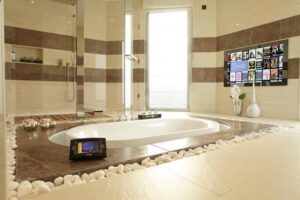
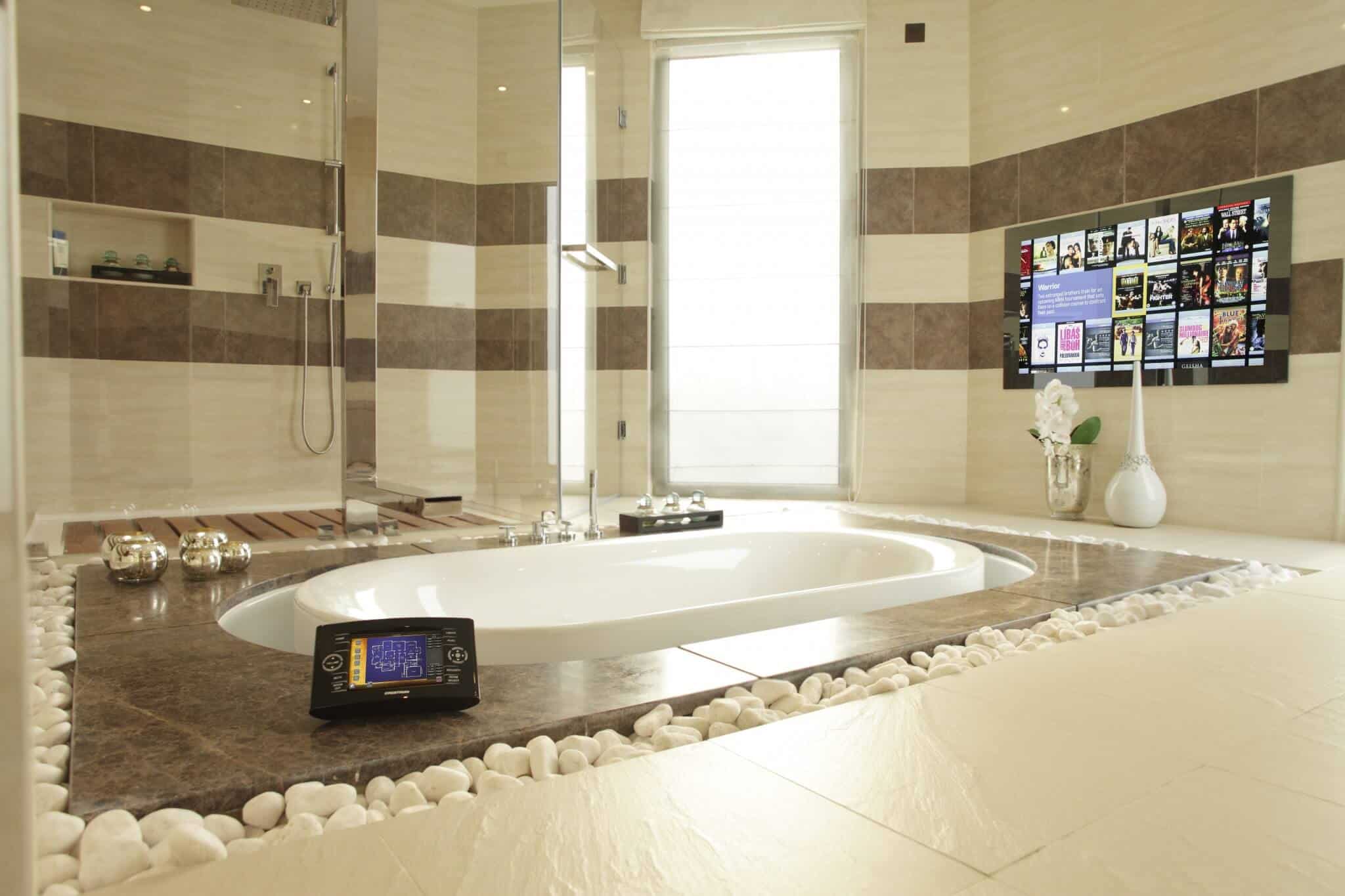
The right approach to multi-room audio and video is to centralise every source and make it available anywhere in the home — the same Sky box or Apple TV accessible in the bedroom as in the living room, with individual user profiles so favourites and recordings follow each family member around the house. Audio works the same way: a favourite radio station or playlist is a single button press away, in any room. Mirror TVs in bathrooms let clients catch up on the news while getting ready, or continue last night’s film from the bath.
The serious professional platforms in this space are Crestron, Savant and Control4 — all offer fully customisable, professionally installed multi-room distribution where any source can reach any room: internet radio, Spotify, SoundCloud, Apple TV, satellite TV, all instantly available. For clients building a simpler, single-room system, Sonos remains an excellent option, with Amazon Alexa and Google Home useful as voice-controlled add-ons in bathrooms and kitchens.
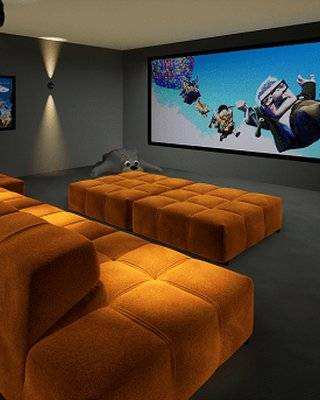
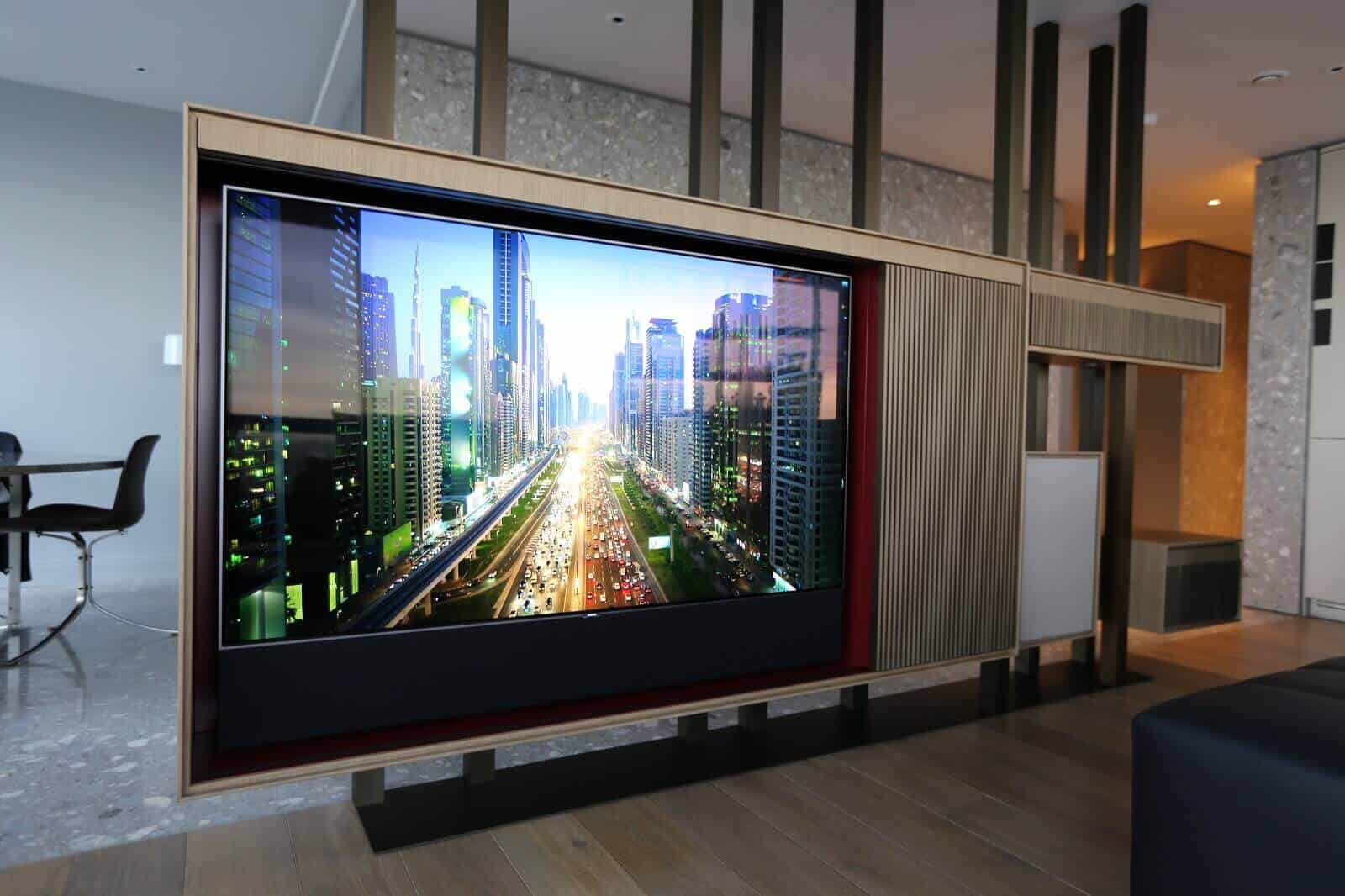
For film and music collectors, Kaleidescape sits above streaming entirely — storing films at full disc quality (or better, via its own download store) and serving them instantly to any room in the home, with none of the compression that affects even premium streaming services. The difference is immediately apparent in a dedicated cinema room or on a large living room display. A full Crestron system of this scale is shown in our Dubai estate case study.
Bringing It All Together
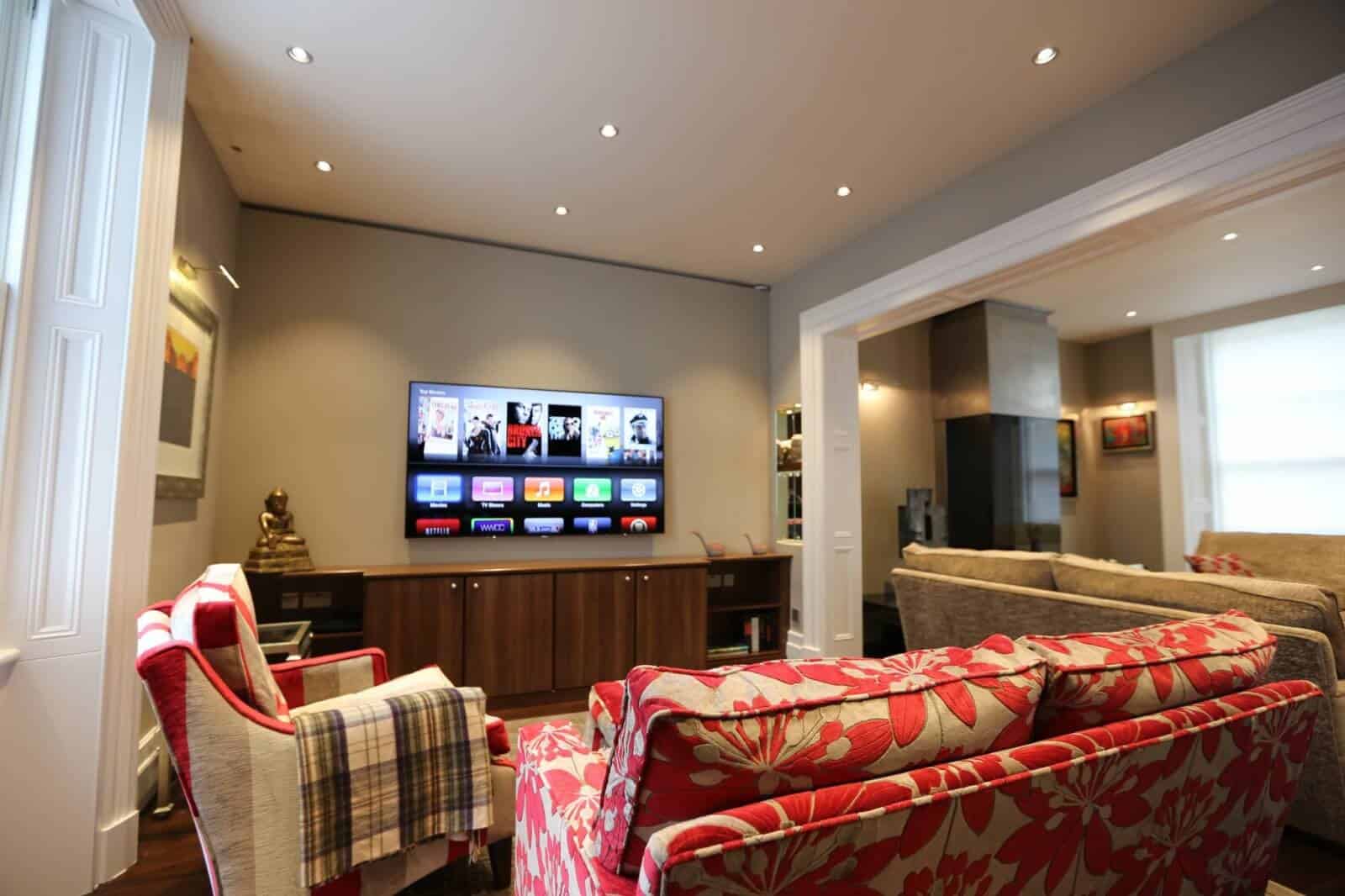
Because Crestron is so flexible, there are many valid ways to approach a system design. As well as full centralised systems, we frequently retrofit existing properties — installing Apple TV and satellite receivers behind each television with a small dedicated Crestron processor, giving simple unified control of video sources and any attached surround sound receiver from a single remote or iPad button.
Our most frequently specified audio-video elements:
- Digital music servers — centralising Spotify, internet radio and a household’s own music library for delivery to any zone in the home.
- Apple TV — straightforward high-quality video integration for households already invested in the Apple ecosystem.
- Surround sound — specified room by room, from slim soundbars to fully concealed in-ceiling speaker arrays, always well ahead of a standard TV speaker or lifestyle soundbar.
- Crestron Digital Media — still the benchmark for residential video distribution: flexible, powerful, and giving every room the feeling that the source is physically present in it.
- TVs and projectors — Samsung, LG and Sony Professional displays depending on aesthetics, size and warranty support; Sony for projection, offering excellent value at the price point.
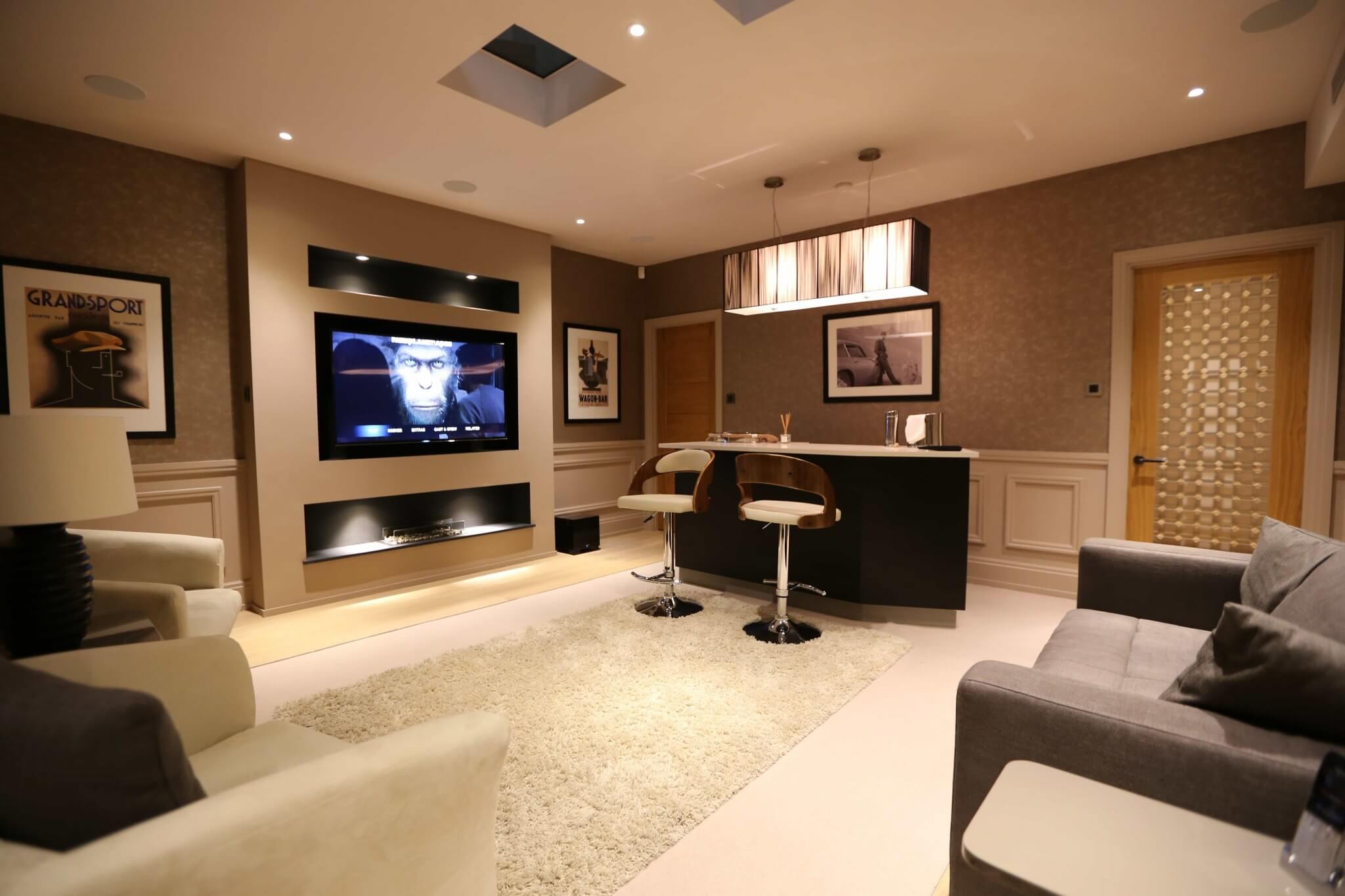
A good example of a multi-room audio video project at this scale is our Kensington case study.
Door Entry, Intercom and Security
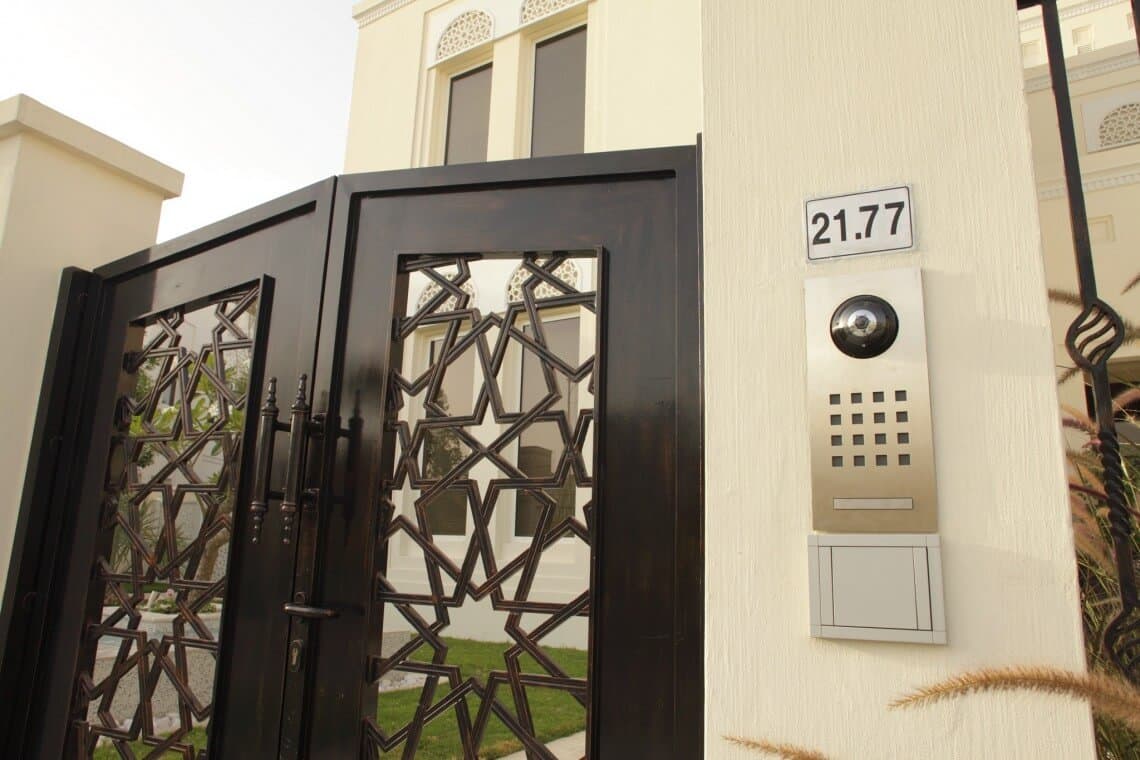
Larger properties with electric gates benefit from a full intercom system — a visitor at the gate rings every touchpanel in the house with a live video feed and two-way audio. When the property is unoccupied, the call can divert to mobile phones, allowing communication from anywhere. The same intercom can be used room to room inside larger homes, paging staff or announcing arrivals without anyone needing to shout up a staircase. Integrated with the security system, the gate can be unlocked remotely from anywhere in the world, or set to recognise a known caller ID and grant access automatically.
A fully integrated security system extends well beyond door entry. High-definition CCTV throughout the property can be viewed on any touchpanel or TV, with footage retained on a rolling basis for review. Perimeter detection — passive beams, vibration sensors on fencing, volumetric sensors that distinguish a person from an animal — adds a layer of protection before an intruder ever reaches the building, triggering exterior lighting and an audible warning automatically. Access control for staff and regular visitors can be managed by phone number or scheduled time window, removing the need to issue physical keys at all. Disarming the alarm can bring lighting up to a preset scene during darkness; arming it can switch everything off. Exterior lighting can run on a dusk-to-dawn schedule or a fixed timetable, improving both security and the way the property presents itself after dark.
Home Wi-Fi and Internet Connectivity
A modern home needs fast, reliable internet for every connected device, and the specific challenges differ between rural and urban properties — rural homes often need to solve for raw bandwidth, while dense urban properties more often struggle with interference from neighbouring networks. We specify load-balancing solutions that combine multiple internet feeds — typically fibre with 4G or satellite backup — presented to the household as a single fast, resilient connection.
Home WiFi at this level uses centrally managed access points that continuously monitor the network and adjust channels and output power automatically to maintain a strong signal throughout the property, both indoors and out, with seamless roaming as a client device moves between access points. A common request is a separate, restricted network for children — with limited content access and a schedule that switches off automatically at bedtime.
How to Choose a Smart Home Installer
The single biggest variable in how a smart home system actually performs is not the brand of equipment specified — it’s the quality of the installer behind it. The same Crestron or Lutron hardware can deliver a system that feels effortless in one home and one that frustrates daily use in another, purely based on the design and programming behind it. A few things worth genuinely checking before choosing who to work with:
- How long have they been operating, and do they have a track record you can verify? Smart home installation is a field where a company can disappear between installation and the point a system needs serious support — ask how long the business has been trading and look for a substantial portfolio of completed, documented projects.
- Do they employ their own programmers, or subcontract the work out? A company with in-house Crestron or Lutron programmers can iterate faster, take genuine ownership of a project’s outcome, and provide direct ongoing support — rather than relaying every change request through a third party.
- Can they show you real installations, not just renders? Case studies with verifiable detail — room dimensions, equipment specified, the actual problem solved — tell you considerably more than a portfolio of generic marketing photography.
- Do they offer genuine, ongoing support after handover? A smart home system is not a one-off purchase. Ask specifically what happens if something goes wrong eighteen months after installation, and whether remote monitoring is included as standard or charged separately.
- Are they honest about which system suits your project, rather than pushing one brand regardless of brief? The right installer will sometimes recommend a less expensive platform than the one they make the most margin on, because it’s the better fit for your specific property.
What the Installation Process Actually Looks Like
For clients who haven’t been through this before, it’s worth knowing roughly what to expect. Our own process, refined over more than two decades, generally follows the same sequence regardless of project size:
- Survey and consultation. We visit the property, or review architectural drawings for a new build, to understand the space, the brief and the budget — establishing scope before any equipment is specified.
- Design. Full system schematics are produced — every device, every cable run, every integration point mapped out and documented, rather than improvised on site.
- Pre-build and pre-programming. Wherever possible, racks are built, wired and programmed at our workshop before they ever reach site — tested and verified in operating condition, so on-site time is spent refining rather than troubleshooting basic faults.
- Installation. Equipment is fitted, cabled and connected according to the design, with electricians and other trades coordinated around the same schedule.
- Commissioning and calibration. Every scene, automation and integration is tested and refined in the finished space, with audio and video systems calibrated to the room’s specific acoustic and visual characteristics rather than left on factory defaults.
- Handover and ongoing support. The client is walked through the finished system, with remote monitoring typically enabled from day one so that the majority of issues are identified and resolved before they’re even noticed.
Maintenance and Long-Term Support
A smart home system is not something to install and forget. We still maintain systems we installed in the late 1990s, and the reason is straightforward: proactive monitoring catches the majority of issues before a client is aware anything is wrong. A properly configured Crestron system reports its own status automatically — processor health, network connectivity, device responsiveness — flagging problems for remote resolution, often without a site visit.
We also regularly take over support for systems originally installed by other companies, whether because the original installer is no longer trading, no longer responsive, or simply didn’t deliver to the standard the technology deserves. Support is typically available either on a time-and-materials basis or as part of an agreed maintenance plan, and a genuinely good installer will be upfront about which one suits your situation rather than defaulting to whichever is more profitable for them.
Future-Proofing a Smart Home Investment
A frequent and entirely reasonable concern is whether a smart home system will still be relevant in ten years. The honest answer is that the platforms which matter at this level — Crestron, Lutron — have a multi-decade track record of backward compatibility and gradual evolution rather than the planned obsolescence that affects consumer smart home gadgets. Lutron’s first dimmers from 1961 are, in some cases, still in service today. Crestron processors are routinely upgraded rather than replaced wholesale, and new device drivers and integrations are added to existing systems on an ongoing basis as new equipment is released.
The single most effective thing a client can do to future-proof an investment is specify proper cabling infrastructure at the outset — even where wireless options exist, a wired backbone for AV, networking and control gives a system room to grow that a fully wireless installation cannot match. The systems that age badly are almost always the ones built on consumer hardware with short product lifecycles, not the professional platforms specified for genuinely demanding projects.
Some Examples of Our Smart Home Installations
Crestron Installation in Primrose Hill
Crestron Install in the Canaletto Tower, London
Crestron Installation in Kensington
Crestron Installation in Belgravia
Frequently Asked Questions — Smart Home Automation
What is the difference between Crestron, Lutron, Control4 and Savant?
Crestron is a fully bespoke, programmed-from-scratch automation platform suited to the most complex projects. Lutron is a dedicated lighting and shading specialist, frequently paired with Crestron rather than competing with it. Control4 is a more accessible whole-home platform using pre-built device drivers. Savant offers a similarly accessible whole-home platform with particularly strong Apple integration and interface design.
How much does a smart home system cost in 2026?
Cost depends on the size of the property, the number of rooms and zones controlled, the tier of hardware specified and how much bespoke programming and integration is involved. A Crestron Home installation for a mid-size luxury property, a Control4 whole-home system and a Lutron RadioRA 3 lighting retrofit are all scoped very differently, and larger projects combining Crestron with Lutron Homeworks QSX are quoted individually. We provide a free, detailed quotation once we understand your brief.
Is voice control (Alexa, Google Home) good enough on its own?
Consumer voice assistants are useful as an additional control layer — particularly in bathrooms and kitchens — but lack the reliability, programming depth and integration capability of a professional platform, and are not appropriate as the primary control system for a serious smart home installation.
Can an existing home be retrofitted without rewiring?
Yes. Both Crestron and Lutron offer wireless solutions designed to work over standard UK wiring, and we regularly retrofit AV, lighting and security into existing properties without major structural work.
Can solar, battery storage and EV charging be integrated into the same system as lighting and AV?
Yes. A Crestron system can bring solar production, battery storage and EV charging under the same interface as the rest of the home, allowing surplus energy to be directed automatically to wherever it delivers the most value and giving the household a single view of the property’s entire energy picture.
How do I choose between installers offering the same system?
Look for a verifiable track record, in-house programmers rather than subcontracted work, real documented case studies, genuine ongoing support after handover, and honesty about which platform actually suits your project rather than a default recommendation toward whichever earns the installer the most margin.
What is home automation?
Home automation is the control of a home’s systems — lighting, blinds, heating and cooling, audio and video, security and energy — from a single platform, so they can be operated from one interface and made to respond to each other automatically. A departure scene that turns off the lights, closes the blinds, sets back the heating and arms the alarm is a simple example; the same system can react to time of day, occupancy or the weather without anyone touching a keypad.
Custom Controls have been designing and installing smart home systems since 1998. We are certified dealers for Crestron, Lutron, Control4 and Savant — and are happy to advise honestly on which system is right for your project during a free, no-obligation consultation.