Small Home Cinema Ideas: The Complete Guide
Real Rooms, Real Constraints — What Actually Works at Small Scale
A small home cinema doesn’t need to be a compromised one. Some of the most satisfying theatre rooms we’ve built have started life as a box room, a small basement, or a spare room nobody quite knew what to do with — and the constraints of a modest footprint often produce a more disciplined, better-considered result than an oversized room with space to waste. If you’re weighing up whether your spare room, garage or basement is genuinely big enough for a theatre room, this guide covers what actually matters at small scale, and where the real limits are.

Installation

Design

Treatments

Seating
Media Rooms
How Small Is Too Small for a Theatre Room?
There’s no fixed minimum, but there is a genuine physical floor. A single row of proper cinema seating with correct spacing needs roughly 2.5-3m of depth in front of the screen wall, and a screen worth watching needs enough width to feel immersive without forcing the front row too close. In practice, a room as small as 3m × 3.5m can work as a genuine small home cinema — tight, but capable of a real theatre experience with the right screen size and seating choice for the space. Below that, the brief usually shifts from “cinema room” to “media room”: a space that does an excellent job of film and TV alongside its everyday function, rather than a dedicated single-purpose room. Both are legitimate answers — the right one depends entirely on what you’re prepared to give the space over to.
Box Rooms and Small Bedrooms
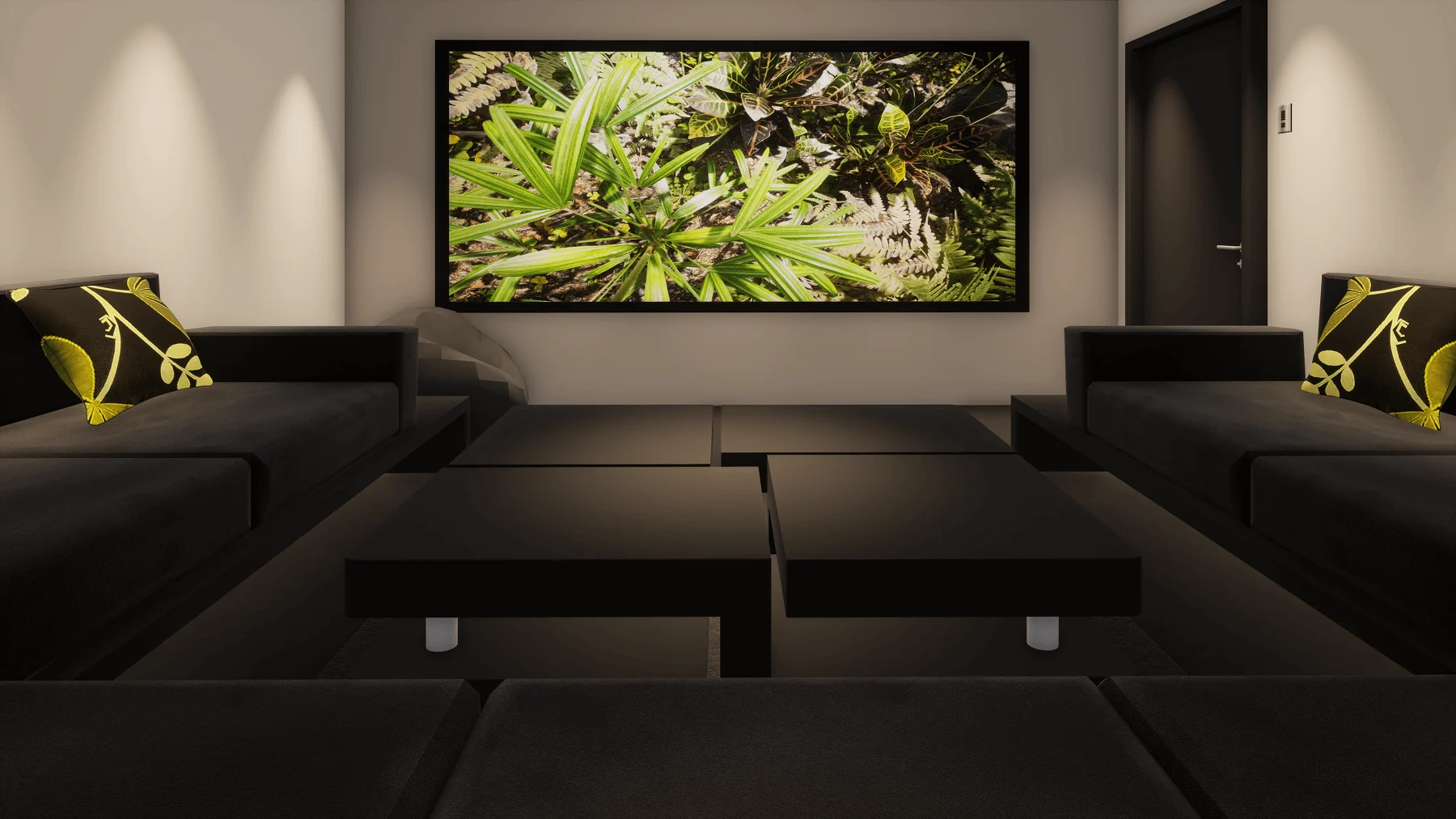
The most common small home cinema conversion we see is a spare bedroom or box room — typically 2.5-3.5m across, with a single window and a standard ceiling height. These rooms work well as cinemas precisely because they’re already small, self-contained and away from the main living space, meaning light control and acoustic isolation are both more achievable than in an open-plan room. The main design decision is screen size versus seating distance: in a genuinely small room, a projector and acoustically transparent screen at 2.2-2.5m wide, viewed from 2.5-3m back, delivers a properly cinematic field of view without the front row craning upward. A single row of 3-4 seats is realistic; a second row rarely fits without compromising the front row’s comfort.
Basements and Cellars
Basements bring their own small-room logic. Ceiling height is usually the binding constraint rather than floor area — many UK basement conversions sit at 2.2-2.4m, which rules out tiered seating platforms but doesn’t rule out a genuinely excellent single-row cinema. The upside is acoustic isolation: below-grade rooms are naturally quieter and easier to treat than an equivalent room upstairs, since structure-borne sound has less far to travel to disturb the rest of the house.
Garages
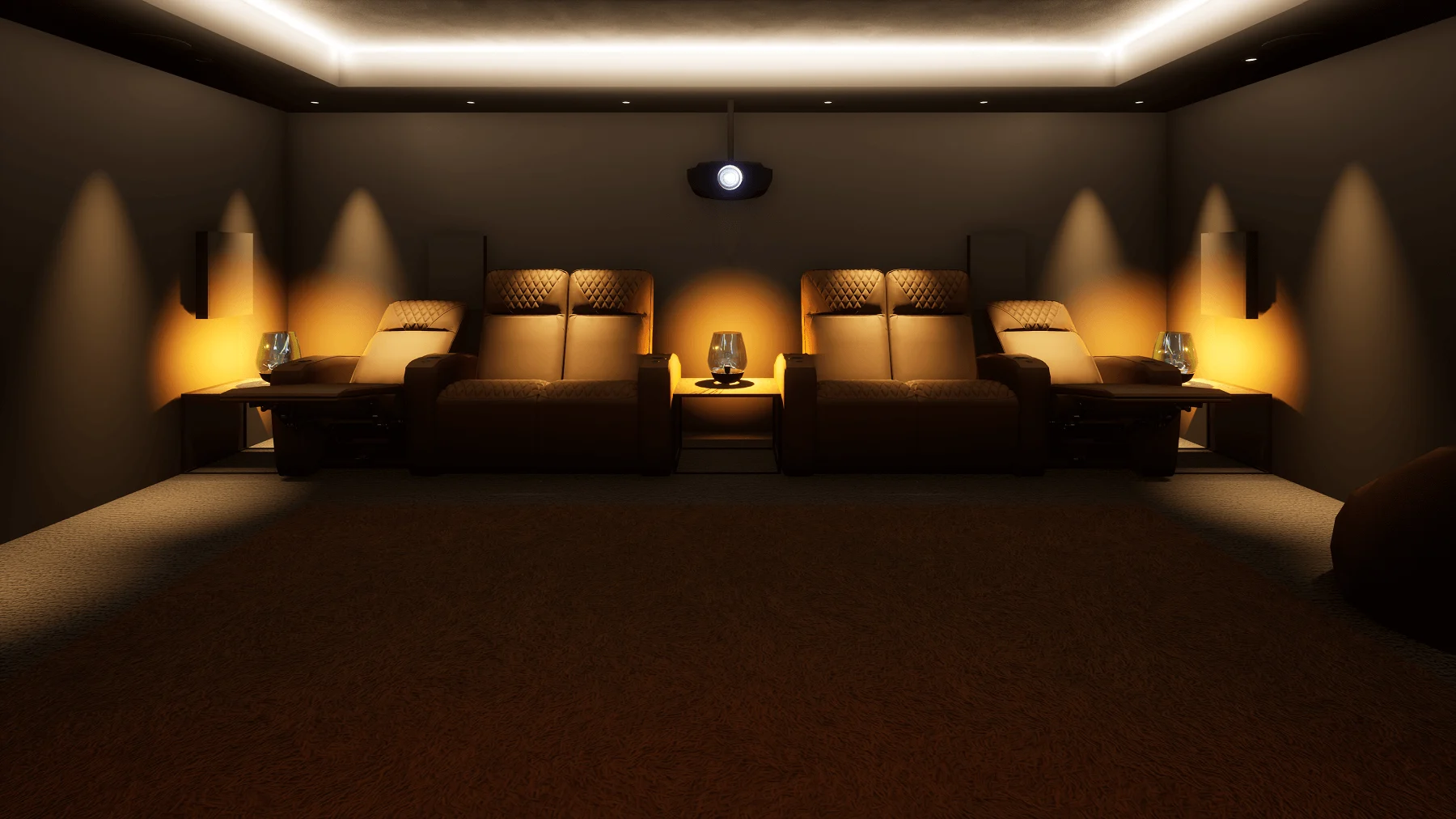
A single garage — typically around 2.5-3m wide and 5-6m deep — is one of the most naturally cinema-shaped spaces available, since the proportions already suit a screen wall and a row or two of seating without much structural adjustment. The main work is thermal and acoustic: garages are rarely insulated to living-space standard, and the up-and-over or sectional door needs replacing or building over to get proper light control and sound isolation. Once that’s addressed, a single garage converts into a small home cinema with genuinely minimal structural change compared to a basement dig-out or loft conversion. Read more about garage cinema conversions →
Living Room Cinema — When the Room Has to Do Both Jobs
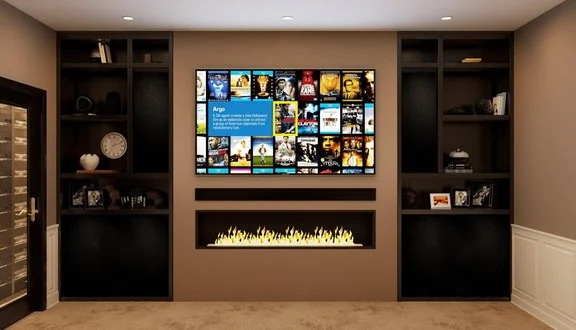
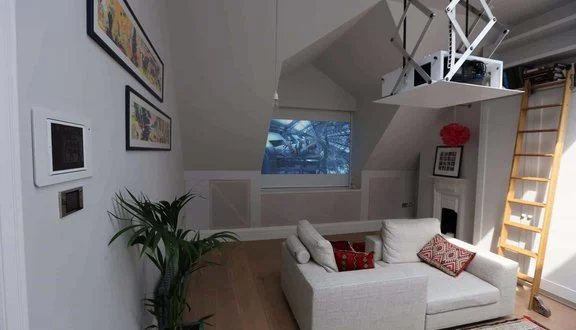
Not every small space can be given over entirely to a theatre room, and for many clients that’s the right call rather than a compromise. A living room cinema keeps the room fully functional as a living space while delivering genuine cinema-quality picture and sound when it’s wanted — the discipline here is concealment rather than dedication. Colour-matched, flush architectural speakers rather than freestanding towers. A large-format display rather than a drop-down screen, or a screen that retracts completely into the ceiling when not needed. Seating that reads as proper furniture first and cinema seating second. See a living room cinema installation using exactly this approach →, and read our full guide to media room design → for the complete brief.
Making a Small Screen Feel Big
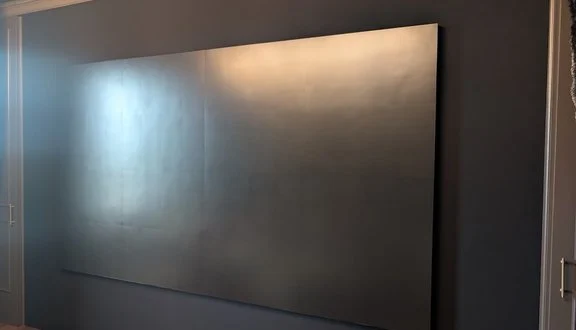
Field of view matters more than screen size in a small room. A 2.2m screen viewed from 2.5m back fills more of your vision than a 3m screen viewed from 4.5m back — the ratio of distance to width is what determines how immersive the image feels, not the raw screen size in isolation. In a genuinely small cinema, we specify the screen and seating position together, calculating the correct viewing angle for the room rather than defaulting to the largest screen that will physically fit on the wall. An acoustically transparent screen — perforated to let sound pass directly through from speakers positioned behind it — is worth the investment even in a small room, since it means the front speaker channels don’t need to be squeezed to one side of an opaque screen. Read our guide to screen sizes and aspect ratios → for how to calculate the right screen for your specific room.
Acoustic Treatment at Small Scale
Small rooms are more, not less, demanding acoustically. Reflections from close walls arrive at the listening position faster and with more relative energy than in a larger room, and low frequencies build up more aggressively in a small enclosed volume — the classic “boomy bass in a small room” problem. Acoustic treatment matters just as much here as in a large dedicated theatre, and in some respects more: bass traps in the corners, absorption panels at first-reflection points on the side walls, and a treated ceiling directly above the seating position all do genuine work in a small room’s acoustic behaviour. Read our complete guide to acoustic treatment → for the specifics of what to specify and where.
Frequently Asked Questions — Small Home Cinema Ideas
What’s the smallest room that can work as a home cinema?
There’s no fixed minimum, but roughly 3m × 3.5m is a practical floor for a genuine single-row theatre room with proper seating and screen distance. Smaller than that, a media room approach — where the space also serves an everyday function — usually delivers a better result than forcing a dedicated cinema brief onto a space that can’t comfortably support it.
Can a low-ceilinged basement or garage still work as a cinema?
Yes, for a single row of seating. Low ceilings rule out tiered platforms for a second row, but they don’t prevent a genuinely excellent single-row theatre room — and basements in particular benefit acoustically from being below grade.
Is a small home cinema less immersive than a large one?
Not necessarily. Immersion depends on the ratio between screen size and viewing distance, not absolute screen size — a correctly proportioned small room can feel just as enveloping as a larger one, provided the screen and seating position are calculated together rather than the screen simply being made as large as the wall allows.
Should I build a dedicated cinema or a multi-use media room in a small space?
It depends on whether you can give the room over entirely to film and TV. If yes, a dedicated small cinema delivers the most complete experience. If the room needs to keep functioning as a living space, bedroom or playroom, a media room approach — concealed speakers, a large-format display, furniture that doubles as seating — is usually the better brief.
Start Your Small Cinema Project
Whether it’s a box room, a basement, a garage or a living room that needs to do double duty, we design and build the whole project — acoustic treatment, screen and display, seating and control — around the room you actually have, not a generic template. Read more about dedicated home cinema installation → or read more about media room design and installation →, or get in touch to discuss your room.