The Ultimate Home Cinema Design Guide
Room Design, Acoustics, Equipment and Installation — 25 Years of Experience in One Guide
Decoding the complex world of home cinema, from room size considerations to where to place the snack bar. Click on any of the titles below to jump to the relevant section, or read the whole article for the best experience.
- Introduction
- Styles of Home Cinema
- Cinema Room Sizes & Shapes
- Colour Choices (and Textures)
- Home Cinema Lighting
- Home Cinema Seating
- Calculating Screen to Seating Distances
- Cinema Speaker Layouts
- Home Cinema Receivers
- Tactile Transducers
- Cinema Receiver Calibration
- Acoustic Treatments for Cinema Rooms
- Home Cinema Fabric Walls
- What Affects the Cost of a Home Cinema?
- What Equipment Is Needed for a Home Cinema?
- Our Step by Step Design Process
- Professional Calibration for Home Cinema
- Summary
–
Introduction
We have been designing and installing home cinema rooms for over 25 years. Our beginnings were modest — one of our earliest case studies was a 50-inch plasma TV with boxed speakers in a basement near Baker Street. Today we routinely design 4-metre wide screens with completely concealed speaker arrays, IMAX Enhanced certified rooms, and systems running 30 or more individual channels. Along the way we’ve worked for ultra-high-net-worth clients, public figures and five-star hotels, which gives us a fairly unusual vantage point on what separates a good cinema room from a genuinely great one. This guide covers every stage of the home cinema design and installation process. If you have a question this guide doesn’t answer, get in touch.
Our Home Cinema & Home Theater Services

Design

Calibration

Treatments

Seating

Theatres

Cinema Ideas
Why Have a Home Cinema?
A complete dedicated cinema room isn’t for everyone, though almost any living room can benefit from audio that genuinely outperforms a TV’s built-in speakers. For those who do commit to a dedicated room, the result is a space free from distraction — total immersion in the audio-visual experience — and a professionally designed cinema also adds genuine value to a home while making productive use of space that would otherwise sit empty: basements, attics, garages. Browse our case studies covering all of these scenarios and more.
What Are the Options for a Home Cinema?
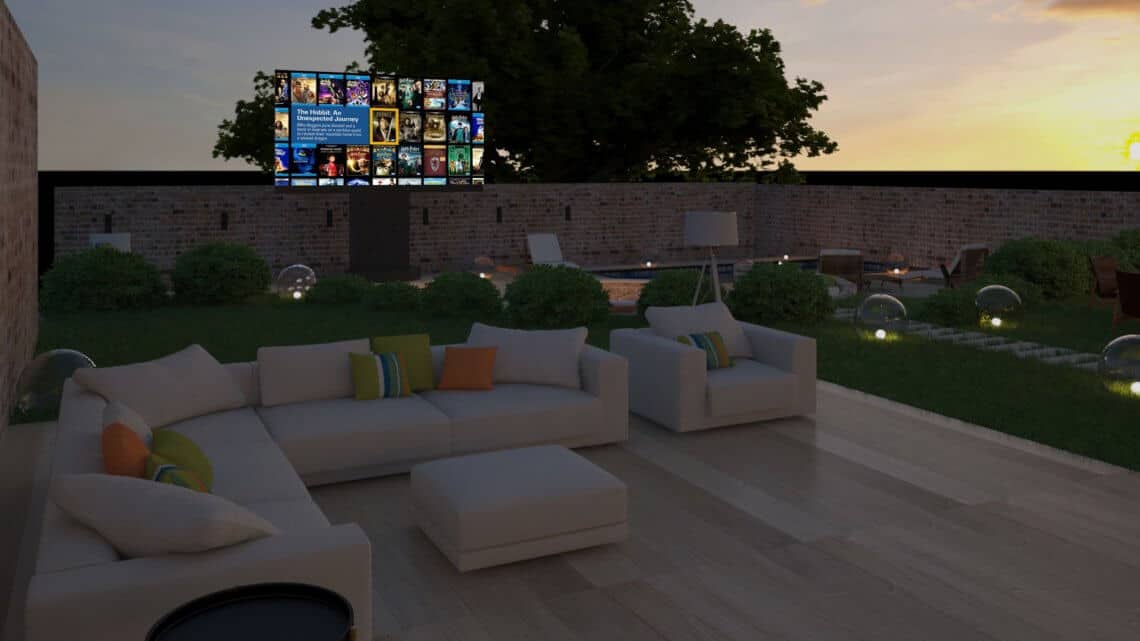
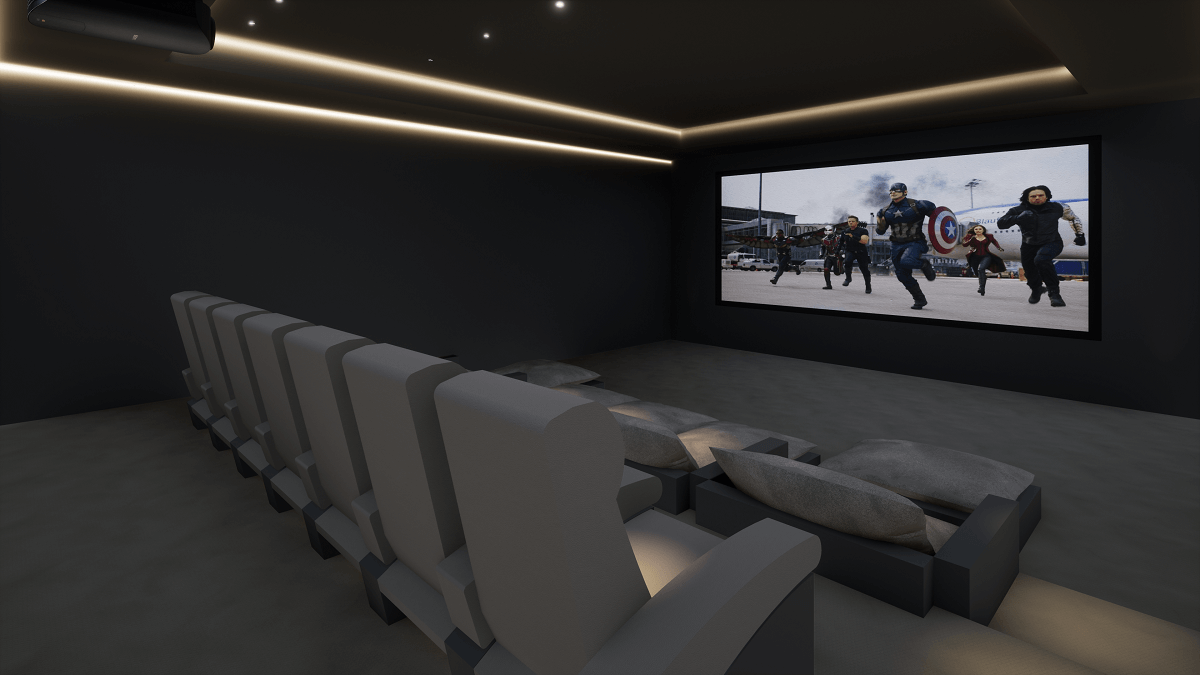
The options are nearly endless. Our 40 Home Cinema Ideas gallery shows the full range, but here are a few examples to get the imagination moving (click any image for the case study):
–
Styles of Cinema
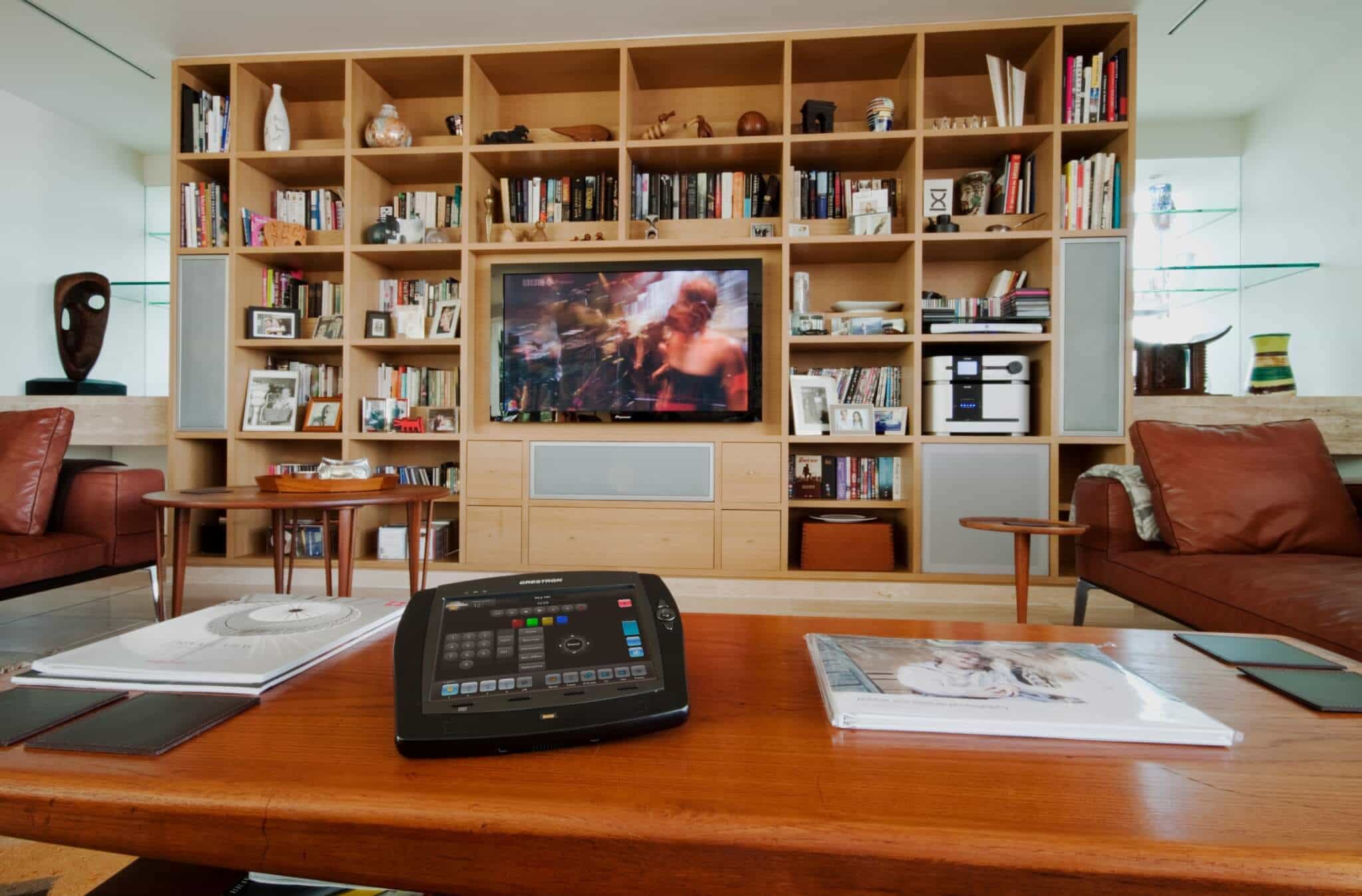
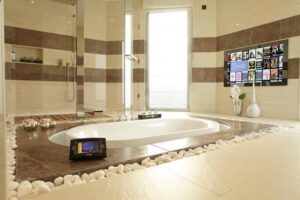
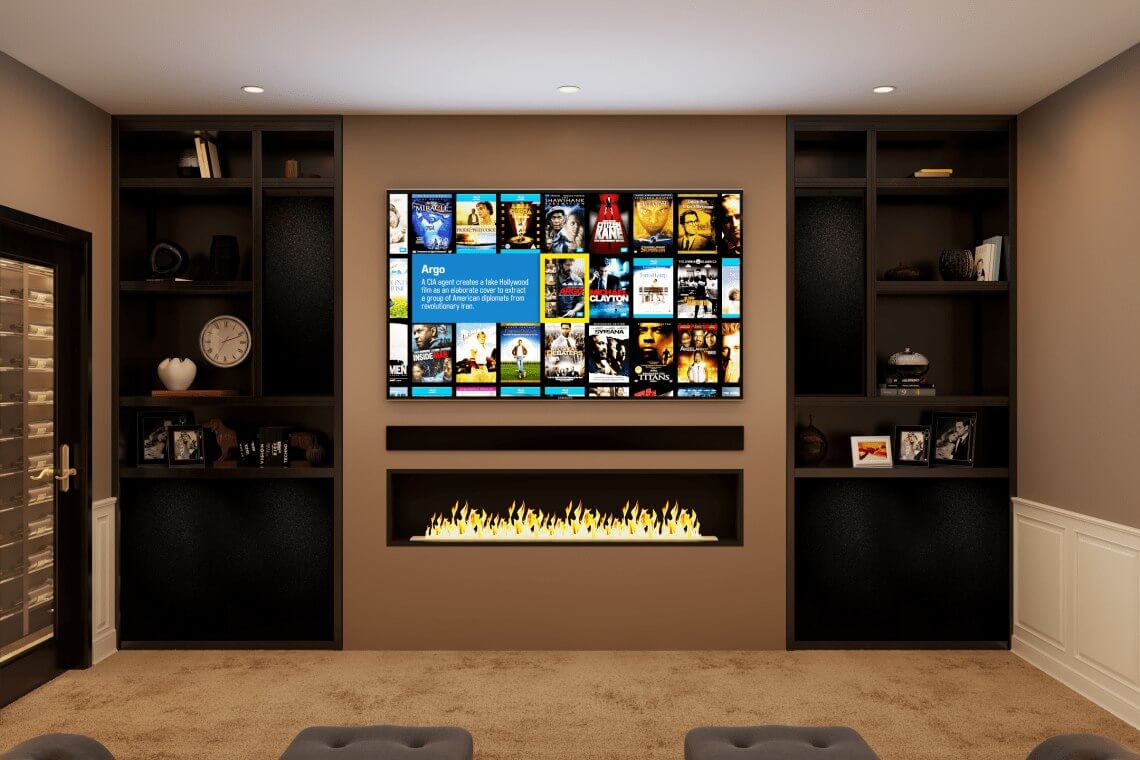
- Living room cinemas. These range from straightforward TV-based systems through to dedicated cinema rooms with individual seating for sixteen or more. Living room systems are typically TV-based but need not compromise on audio — a custom-width soundbar enhances the TV’s own output, paired with on-wall or in-ceiling speakers for fully immersive sound. The speaker system is smaller than in a dedicated room, but still delivers a genuinely cinematic result. Some clients with a TV-based living room cinema add a drop-down screen and projector to get the best of both worlds.
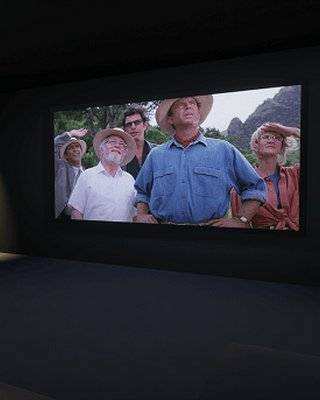
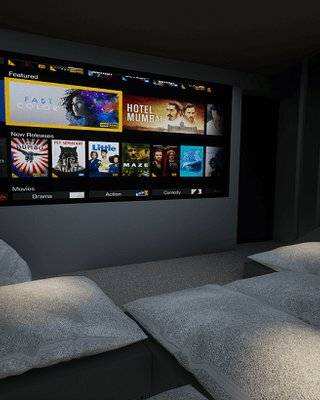
- Dedicated cinema rooms. Our most common project type — usually a basement, spare bedroom, converted loft or converted garage, or sometimes a new-build garden room. While typically a larger investment, building a space from scratch lets us optimise acoustics and sightlines fully, and incorporate bespoke elements like snack bars, drink stations and tiered seating.
–
Space Considerations for a Home Cinema
Every great home cinema begins with a great design. A complete pre-construction design identifies the elements that elevate a cinema from good to exceptional. We start by understanding everything you want included, then produce 3D renders and an acoustic model so the room delivers the best possible sight and sound from day one.
- Is the room big enough? Most clients don’t get to choose their cinema space freely — it’s whatever room is available. Before settling on a layout, check the room comfortably fits your family and likely guests. A sofa takes up less space than individual chairs, and smaller children or occasional guests can use floor seating if needed. Lower seating works better where headroom is limited. Tiered rows should step up 25–30cm per row so the row behind can see over the heads in front.
- Does the screen fit? A projector screen can easily run 3–4 metres wide, and fitting one into an attic space can be genuinely difficult. As a rule of thumb, anything under 100 inches usually makes more sense as a TV than a projector. There are established ratios for screen size relative to seating distance — covered below.
- Do you need to worry about sound leakage? Cinema rooms get loud. An attic cinema can expose every bedroom below to noise — manageable with older children, more of a concern with early bedtimes. We cover the available solutions later in this guide.
- What is the shape of the room? Room shape affects the audio experience more than the choice of speakers or amplifier. Avoid square rooms wherever possible — they cause bass to pile up at certain positions and disappear at others, producing uneven sound that no equaliser can fully correct. Rectangular rooms are better, but the real goal is a room where length, width and height each produce different resonant frequencies that spread evenly rather than reinforcing one another.
We design to one of three room shapes depending on the space available. The Ultimate Trapagon — our acoustic ideal — has gently tapering walls and a slightly sloped ceiling, so no two surfaces are exactly parallel. The Normal Trapagon is easier to build within an existing structure and still removes the worst standing-wave problems. The Golden Cuboid works within a fixed rectangular room, using a false front wall to adjust the effective room length toward established acoustic ratios (Bolt, Louden or EBU). We cover all three shapes in depth, along with viewing distance guidance and real dimension examples from our portfolio, in our dedicated guide: Home Cinema Room Size, Shape and Dimensions — The Complete Guide →
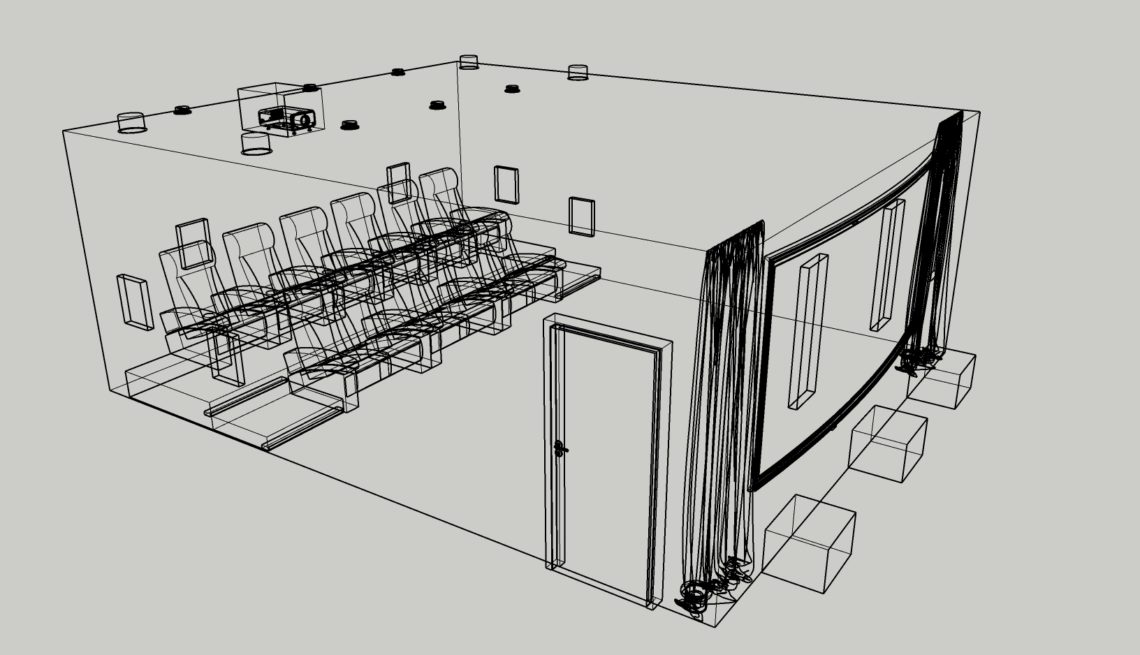
- How do you know if a room will work for your needs? We use professional design software to lay out cinemas precisely — seating, screens, speakers and architectural features all modelled together. You can get a rough idea yourself with graph paper or a free tool like SketchUp. Drawing the room serves two purposes: it confirms everything physically fits, and it lets you test seating layout against the screen and speaker positions. Architectural features — doors, pillars, windows — often dictate speaker placement to some degree, and working through the layout properly lets you account for those constraints early.
–
Colours, Textures and Finishes
A cinema’s purpose is full immersion, which means looking beyond screen width and speaker placement into the finer details — wall colours, textures, finishes. We’ve seen plenty of professionally installed cinema rooms undermined by distracting visual choices. A room should look good without compromising its function.
Colours should generally sit at the darker end of the spectrum, reducing ambient light levels and effectively increasing the perceived brightness of the display. Paint finishes should be as matte as possible to eliminate reflections that distract during viewing. Our preferred ranges are Farrow & Ball Estate Emulsion and Little Greene Absolute Matt Emulsion — both offer extensive colour ranges with suggested matching carpets, seating and soft furnishings. We typically keep room colours fairly muted, then choose a single accent colour for cushions and floor seating.
–
How Do You Manage Cinema Light Levels?
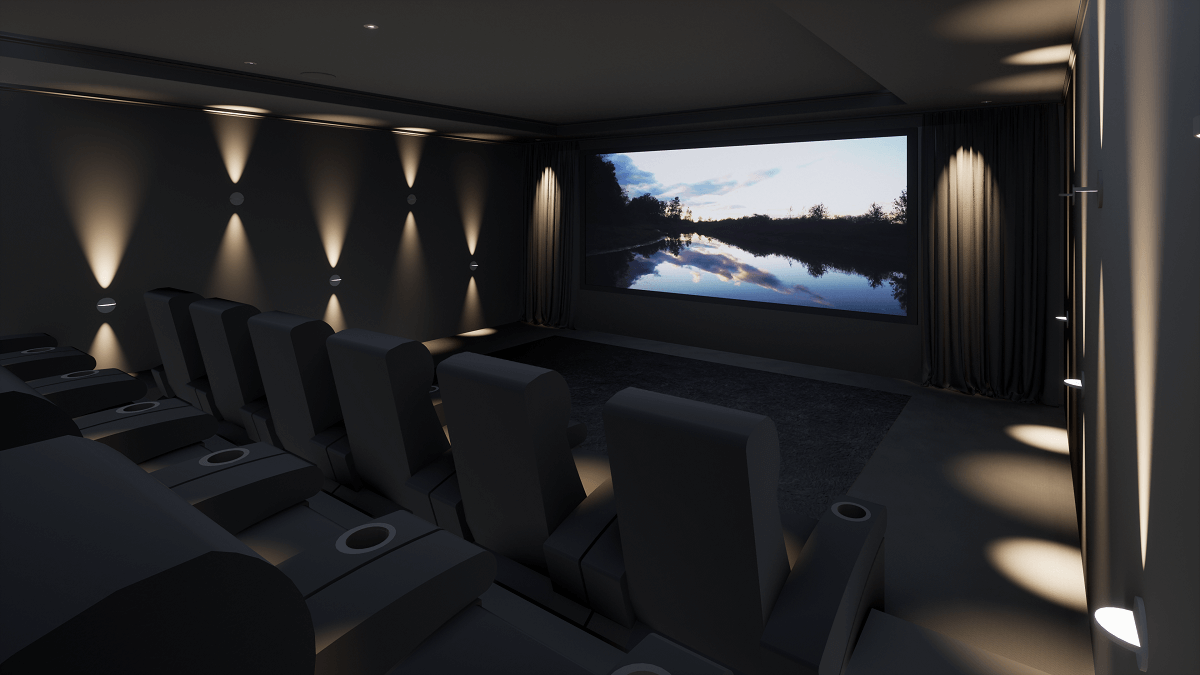
Properly managing light levels is one of the most critical aspects of a cinema room. Most of our rooms have no windows or natural light at all, and we manage levels with a mood lighting system — recessed and hidden fittings, narrow-beam spotlights above each seat, LED strip lighting, and a dimming system precise enough to set the perfect viewing level for any moment. This removes distraction during viewing and lets the screen perform at its absolute best. It also creates genuine drama on entry — the room should generate real anticipation before the film even starts. Read our dedicated cinema lighting design guide for more detail.
–
What Are the Best Cinema Seating Styles and Options?
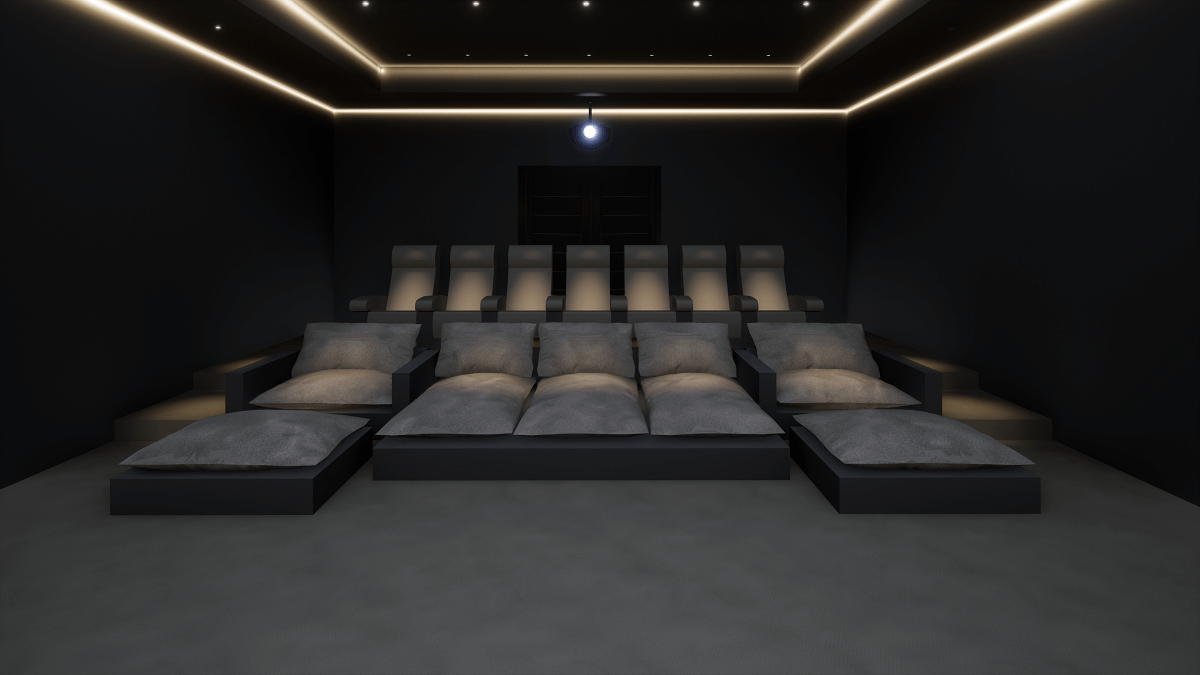
Seating needs to stay comfortable over long viewing sessions. Clients with younger families often prefer more relaxed seating — day beds and chaise longues — while clients planning to entertain more often choose formal seating, including double sofas for couples.
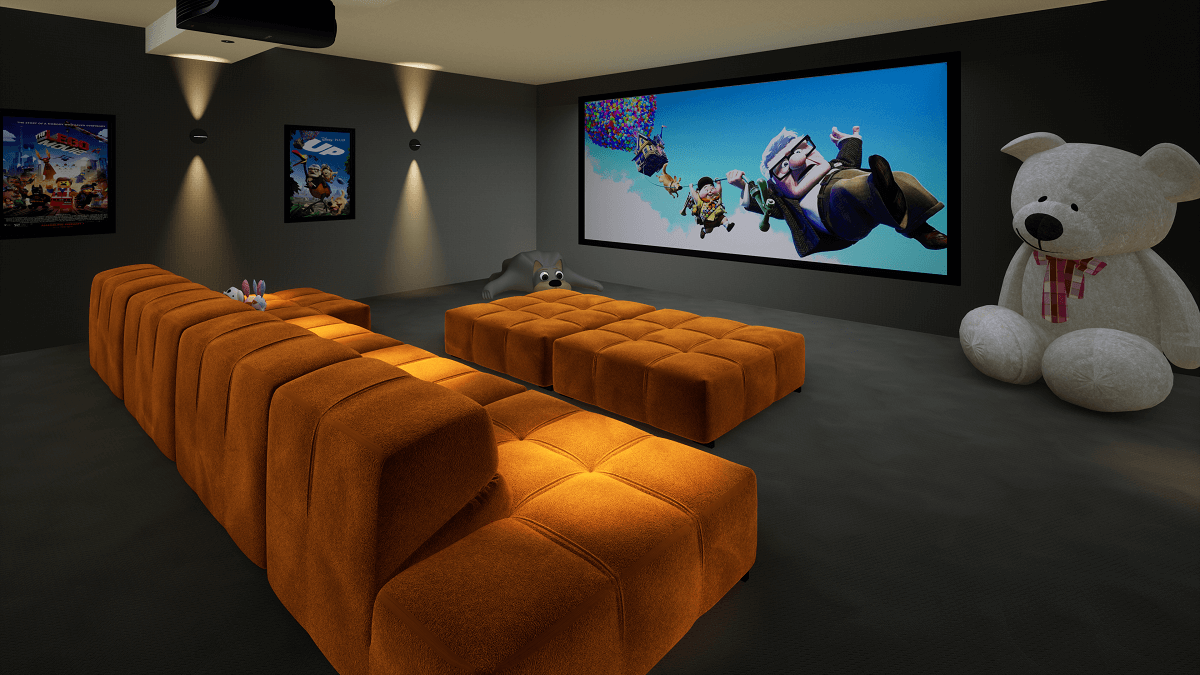
Alongside the usual high-street sofa suppliers, we work with several specialist cinema seating manufacturers. We’re particularly fond of the BB Italia Tufty Time — a high-end modular sofa with a relaxed style, used in this family cinema room. Rows are typically installed at 30cm height intervals so the back row can see over the row in front, with roughly 80cm between rows and the same allowance for circulation space down the sides. See our dedicated page on Home Cinema Seating, and our manufacturer guide to Cineak.
Popcorn, Snacks and Drinks Stations
A professional-grade popcorn machine is a memorable and surprisingly affordable addition to a private cinema. Popcorn machines, fridges and drinks stations are best located outside the cinema itself, so noise and smell don’t interfere with viewing — they often make good use of an alcove created by the room’s shape, while adding to the atmosphere of the space.
–
Optimal Seating Distance From the Screen
Getting the right distance from the screen is critical to the viewing experience, though there’s no single correct answer. A reasonable rule of thumb: viewing distance roughly equal to screen width — so a 4-metre screen suggests sitting around 4 metres away. This guidance has shifted as projector resolution has improved from 1080p to 4K; at the lower resolution, viewers would have needed to sit closer to 6 metres from the same 4-metre screen to avoid seeing individual pixels. We cover this in depth, including ratios from 1:1 through to 1:7 depending on resolution and preference, in our dedicated seating distance guide →
—
Speaker Layouts and Surround Sound Options
How a speaker system is incorporated into a cinema room depends on the room’s design, the budget and the client’s specific requirements. We mentioned earlier that some TV-based cinema rooms can match the audio quality of a larger projector-based room. In a projector-based system, we install the front channel speakers behind the acoustically transparent screen — tying audio and image together at the same point in space. In a TV-based system, a soundbar custom-built to the width of the TV incorporates front left, centre and front right into one physical unit. The larger the TV, the further apart the drivers sit and the better the result — bigger TVs also allow taller soundbars with larger drivers. We typically specify Leon or Artcoustic soundbars, chosen to suit the rest of the room.
Surround channels — everything other than the front three — have a wide range of options, including ceiling speakers and on-wall or in-wall units. We tend to pair Leon soundbars with ceiling speakers, and Artcoustic speakers with on-wall surrounds. Artcoustic’s range is highly modular, letting us specify smaller units for less critical positions and larger units for the front stage.
Modern audio formats support height channels for 3D audio formats like Dolby Atmos. With a Leon soundbar and ceiling-speaker approach, adding height channels is difficult since the ceiling already carries the surrounds — so we tend to use this combination for living rooms where strong audio matters but a full cinema experience isn’t the goal. With Artcoustic, front and surround channels are wall-mounted, leaving the ceiling free for height channels — a fully immersive soundstage from a single manufacturer across every position in the room, which keeps the sound moving smoothly and naturally as it travels around the space.
–
Home Cinema Receivers
Every speaker in a home cinema needs an amplifier to drive it. A surround sound processor takes the signal from a source — an Apple TV, a Kaleidescape movie server, a Sky TV receiver — decodes the audio and sends the correct signal to each speaker. This functionality can live in a single box, taking HDMI in and sending speaker cable out. This piece of equipment is called a home cinema receiver (Anthem is a good example). The same receiver can often take multiple HDMI inputs and route one through to the display, acting as a simple video switch for managing several sources.
Receivers vary considerably in scale, and the better ones can drive a large number of speakers for fully immersive sound. Higher-end designs split the preamplifier (decoder/processor) from the power amplifiers, opening up more choice on both sides — particularly relevant for driving large subwoofers, which can use drivers up to 18 inches and deliver bass you genuinely feel as well as hear.
One of the very best solutions at the top end is a Trinnov system, capable of driving up to 64 individual speakers. It performs sophisticated processing to deliver a seamless, fully immersive result — and while 64 speakers may sound excessive, each one performs a specific role, sometimes covering just a narrow frequency range within a single channel.
–
Tactile Transducers
Tactile transducers bring all of the above together physically. A transducer creates vibration, and fitted under cinema seating and fed from the audio system, it lets the seat itself become another speaker. Multiple transducers on a single row can run in stereo, so the sensation of an explosion moving across the screen is felt as well as heard. The goal throughout a Custom Controls cinema room is full immersion — transducers take that a step further.
–
Room Correction and Automatic Calibration
Most home cinema receivers include some form of built-in room correction. Calibration typically involves placing a microphone at the listening position and running a series of tonal tests to map the room — including the distance from each speaker to that position and the room’s tonal response. We cover acoustics in more depth below, but calibration quality generally improves with the price of the system. Trinnov’s microphone, for instance, maps the room in three dimensions, calculating both distance and height for every speaker — essential when dozens of speakers are involved. Without this level of correction, sound quality suffers and detail can be lost or muddled.
–
What Acoustic Treatments Are Used in a Home Cinema?
Acoustics may be the single most important consideration in a home cinema project, and we take it seriously on every installation. There are two distinct elements: in-room acoustics, and sound leakage to the rest of the building.
In-room acoustics. Acoustic performance has more impact on enjoyment than almost anything else — even the most expensive system can be let down by a poorly treated room. We model every room fully to ensure even frequency response across the speaker system’s full range, so the audio performs without the room working against it. Hard surfaces are the enemy of clarity, reflecting sound and forcing the ear to filter multiple copies of the same signal — tiring, and not pleasant to sit in for long. Soft furnishings — cushions, carpets, curtains — absorb sound effectively, and we go further still with full fabric-wrapped walls, which conceal speakers while adding acoustic insulation exactly where the room design needs it.
Sound leakage. How much this matters depends heavily on the room’s location. We typically combine several techniques for maximum effect:
- Mass-loaded vinyl. We frequently use a mass-loaded vinyl barrier from Acoustiblok as the first layer of construction, before anything else begins — a significant reduction in sound leakage. A 4mm Acoustiblok layer offers sound deadening comparable to roughly a foot of concrete.
- Acoustic plasterboard and Green Glue. Doubled plasterboard, correctly installed to minimise gaps between boards, is highly effective at deadening sound. Green Glue is a specialist compound that reduces sound transfer between layers while bonding them together.
- Acoustic underlay. Fitted beneath carpet, acoustic underlay significantly dampens sound transmission through the floor — particularly important in loft and attic conversions, protecting bedrooms or living spaces below.
–
Home Cinema Fabric Walls
You may have noticed our case study photos rarely show visible speakers or acoustic foam — so where does it all go? After the sound-deadening layers above, we turn to in-room acoustics and the finished look of the room itself. We build a stud wall around the entire room — 100mm deep on the side and rear walls, 300mm deep on the front wall. The side and rear stud depth lets us position speakers and acoustic treatment anywhere in the room without constraint. The 300mm front wall depth creates a void behind the projector screen, large enough to house the front three speakers (left, centre, right) with a subwoofer between each. An acoustically transparent screen lets sound pass straight through, tying audio and image together at the same point on the wall. The 100mm ceiling stud allows for height speakers (for Dolby Atmos and similar formats) and architectural lighting features such as cove lighting or a star-effect ceiling — see our dedicated cinema lighting guide.
Once the stud work, acoustic treatment, speakers and lighting are in, we install a track system that lets fabric be stretched over the walls — finishing the room in the client’s choice of colour and texture, from velvet through to leather. The build order is:
- Mass Loaded Vinyl
- Acoustic Plasterboard & Green Glue
- Stud Walls
- Speakers
- Lighting & Ceiling Features
- Acoustic Treatments — foams and bass traps
- Acoustic Underlay
- Fabric Walls
- Soft furnishings — seating, carpet, curtains
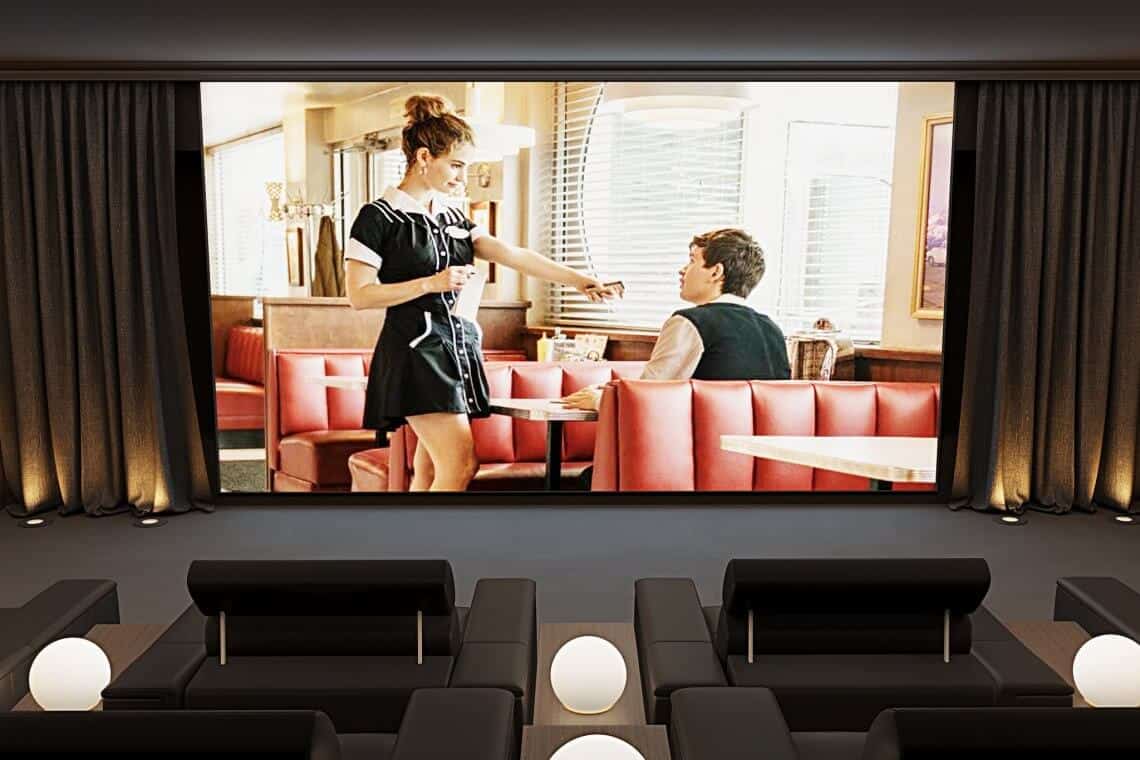
A considerable amount of work goes into creating the right cinema room. Curtains flanking the screen add drama and double as effective bass traps, controlling unwanted reflections — as do floor cushions, which also make useful occasional seating for visiting children. Thick carpets minimise reflections and help reduce sound leakage to rooms below. Read our dedicated guide on home cinema acoustics and fabric walls.
–
What Affects the Cost of a Home Cinema?
Generic pricing for home cinema rooms is genuinely difficult to provide — every project we undertake is unique, from room shape through to client requirements. While all our cinemas share the same DNA — careful design, custom features and a high standard of finish — the individual specification varies enormously. Even superficially similar rooms can involve very different scopes of work, from a complete fit-out to supplying wiring diagrams and installing only the technology. The main drivers of cost are:
- Room type and scope — from a double garage conversion or movie room fit-out through to a modern dedicated cinema, an IMAX Enhanced home cinema or a luxury reference room, where the technology alone changes dramatically. See a double garage conversion, a family movie room, a modern home cinema room, an IMAX Enhanced home cinema and a luxury home cinema room for real examples across that range.
- Projection and screen — resolution, brightness and screen size and type.
- Audio system — channel count, speaker range and processor choice.
- Seating — the range chosen, the number of seats and the accessories specified.
- Acoustic construction and fabric walling — the level of sound isolation and in-room treatment required.
- Lighting and control — the depth of lighting design and Crestron or Lutron integration.
By combining these elements, and using existing client-supplied contractors where appropriate, we put together a project budget and approach suited to most clients, and provide a free, detailed quotation for every project. For a full breakdown of exactly what drives these costs up or down — acoustic construction, channel count, processor choice, projection and seating — read our dedicated guide: How Much Does a Home Cinema Room Cost in the UK? →
–
Home Cinema Equipment
Our installs vary hugely by client requirement and budget, but a few equipment categories are common to nearly every project:
- Projectors. Most of our cinema rooms use projectors, simply because a projector is more economical than a TV once the screen size exceeds 100 inches. Most current projectors display 4K, providing significant detail and letting clients sit closer to the screen than older resolutions allowed. We typically specify the Sony Professional projector range, which combines 4K resolution with a laser light source for genuinely high brightness — generally, the more you spend, the brighter the image. Read our dedicated guide to home cinema projectors.
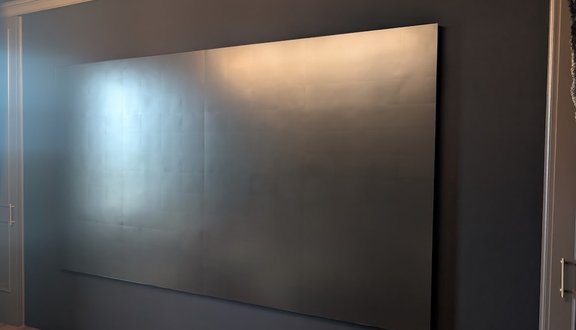
- Projector screens. Screens come in fixed and retractable formats. Retractable screens let us install a cinema system into a non-dedicated space such as a living room — hidden when off, dropping into position with a single tap when needed. In a dedicated room, where the screen is permanently visible, we specify fixed screens — fewer moving parts, fewer alignment issues, and the option to build a recess behind the screen for the front speaker channels, tying audio and image together. Aspect ratio is also a decision point: standard HD (matching most TVs) or true cinema widescreen, which suits dedicated rooms with the budget to support it. Some premium screens include automatic masking that switches the visible screen shape between widescreen film and standard HD TV sources. Read more in our dedicated guides to movie aspect ratios and projector screens.
- Speaker options. Even a basic speaker package outperforms standard TV speakers. Most clients start with “5.1” audio — five surround speakers and one subwoofer, typically positioned at ear level, with different audio fed to each to create movement around the room. Modern formats add height channels — speakers in the ceiling delivering sound from above — giving “5.2.1” or similar configurations. Our highest-specification systems run to 15.8.4 and beyond, sometimes splitting a single surround channel into dedicated high, mid and low-frequency drivers with their own subwoofer. Our preferred manufacturers — Artcoustic and Krix — offer genuinely modular ranges, letting us specify the right speaker for every position rather than a single fixed package.
- Living room speaker systems. We also specify a range of speakers built specifically for living-room cinema, offering excellent sound quality at a more modest physical scale. In-ceiling speakers, angled toward the normal seating position, are an easy route to surround sound in a living space. A better option is a soundbar beneath the TV, putting front-channel audio at the same height as the picture, with ceiling speakers covering the less critical surround channels. We custom-build soundbars to the exact width of the TV — a small detail that makes a meaningful aesthetic difference.
- Receivers and amplifiers. Every speaker needs power, most simply provided by a home cinema receiver — sources connect in, the receiver decodes the audio and sends the correct signal to each speaker. Different receivers support different channel counts and can be an effective one-box solution for many cinema rooms. Anthem, Audio Control and Denon are reliable choices at this level. For rooms with a large number of speakers, Trinnov is the strongest option available — capable of driving up to 64 individual speakers, with each channel decoded discretely from the same source material (Blu-ray, streaming or otherwise), made possible by sophisticated processing and a 3D microphone that precisely maps every speaker’s position and height in the room.
–
How We Create the Perfect Home Cinema Room — Step by Step
Most clients are working within a fixed space — an unused basement, loft or garage. Increasingly, clients are building dedicated garden structures, often achievable under permitted development. The space allocated may be dedicated purely to cinema, or — more commonly — multi-use, doubling as a living room, games room or exercise space.
- Step 1 — Space analysis. We assess the room to determine the most logical layout, accounting for doorways, windows and access. This typically establishes the maximum achievable screen size and seat count. We usually work from existing plans to get a feel for the room before discussing options.
- Step 2 — Budget. Home cinemas are fully bespoke, and the specification can vary enormously even within an identical room layout — two projectors lighting the same size screen can differ in price by a factor of five, primarily driven by brightness and resolution.
- Step 3 — Full quotation. We prepare a quote structured to maximise value within the available budget and space, balancing amplifier, speaker, projector and screen costs against installation. Modular, line-item quotes let clients see exactly what’s specified and why, so every design decision is transparent.
- Step 4 — Acoustic modelling. Running alongside Step 3, we fully model the room to confirm correct sound pressure levels and frequency response — checking the speaker and amplifier combination will genuinely perform in the space, and designing speaker and subwoofer layout along with acoustic treatment to suit the room’s specific requirements.
- Step 5 — Visualisation. Using the model from Step 4, we produce a fully accurate virtual version of the room, letting clients review colour choices, lighting levels and viewing angles before construction begins — as static renders or, for clients who want to walk through the space, a VR headset experience. This level of detail gives complete confidence in the finished room before any work starts.
- Step 6 — Installation. Our team handles every aspect of the project through to handover, and we’re equally happy to work alongside client-appointed sub-contractors where required.
–
Post-Installation Professional Home Cinema Calibration
Professional calibration goes a meaningful step beyond the automated calibration built into most receivers. Whatever the level of equipment — from an entry-level Denon AVR through to a 64-channel Trinnov system — everything needs calibrating to perform at its best. Audio calibration balances output levels across every speaker and corrects frequency response for the influence of the room, furnishings and surroundings. Video calibration ensures the projector delivers the best possible image onto its specific screen. We use a combination of measurement tools and accumulated experience to get this right on every installation.
–
Home Cinema — The Big-Screen Experience Without Leaving Home
A well-designed home cinema delivers everything good about the big screen, in the comfort of your own home — and the right room can match, or exceed, a commercial cinema. A home cinema lets you:
- Get the same movie experience, without the hassle
- Take video games to another level
- Get front-row seats for any sporting event
- Experience acoustics genuinely tailored to your taste
- Host memorable viewing parties
- Give your children a space to entertain their friends
- Add genuine value to your home
Ready to see what a home cinema could look like for you? Contact Custom Controls for a free consultation, browse our 40 Home Cinema Ideas gallery for inspiration, or read our dedicated home cinema cost guide for a full budget breakdown.
Frequently Asked Questions — Home Cinema Design
What size room do I need for a home cinema?
The minimum practical size for a dedicated room with projection is around 4m × 5m, with 5m × 7m to 6m × 9m the comfortable range for most installations — large enough for proper tiered seating and a meaningful screen size while remaining manageable acoustically.
Why does room shape matter more than equipment?
A square room causes bass to build up unevenly at certain positions and disappear at others — a problem no equaliser can fully correct. We design every dedicated room to one of three acoustically favourable shapes (the Ultimate Trapagon, Normal Trapagon or Golden Cuboid) before specifying any equipment.
How much does a home cinema cost?
The cost depends on the scope of the room — from a garage conversion to the most ambitious dedicated rooms — and on the projection, audio, acoustic construction, seating, lighting and control systems specified. We provide a free, detailed quotation for every project. For a full breakdown of what drives these costs, see our dedicated cost guide.
Should I choose a TV or a projector?
As a general rule, a projector becomes more cost-effective than a TV once the required screen size exceeds 100 inches. Below that, a high-quality TV with a properly specified soundbar and surround system can deliver outstanding results.
How do you make a home cinema?
Start with the room, not the equipment. Fix the room’s dimensions and shape, then the screen size and seating distances, then the speaker layout and acoustic treatment that suit that geometry — and only then choose the projector, processor and speakers to fill it. Isolation, ventilation, lighting and control are designed in at the same stage, because they’re far harder to add once walls are finished. Our complete guide to home cinema installation covers each step in more detail.
Custom Controls have been designing and installing smart home systems since 1998. We are certified dealers for Crestron, Lutron, Trinnov and Artcoustic — and are happy to advise honestly on the right specification for your project during a free, no-obligation consultation.
Some Examples of Our Home Cinema Installations
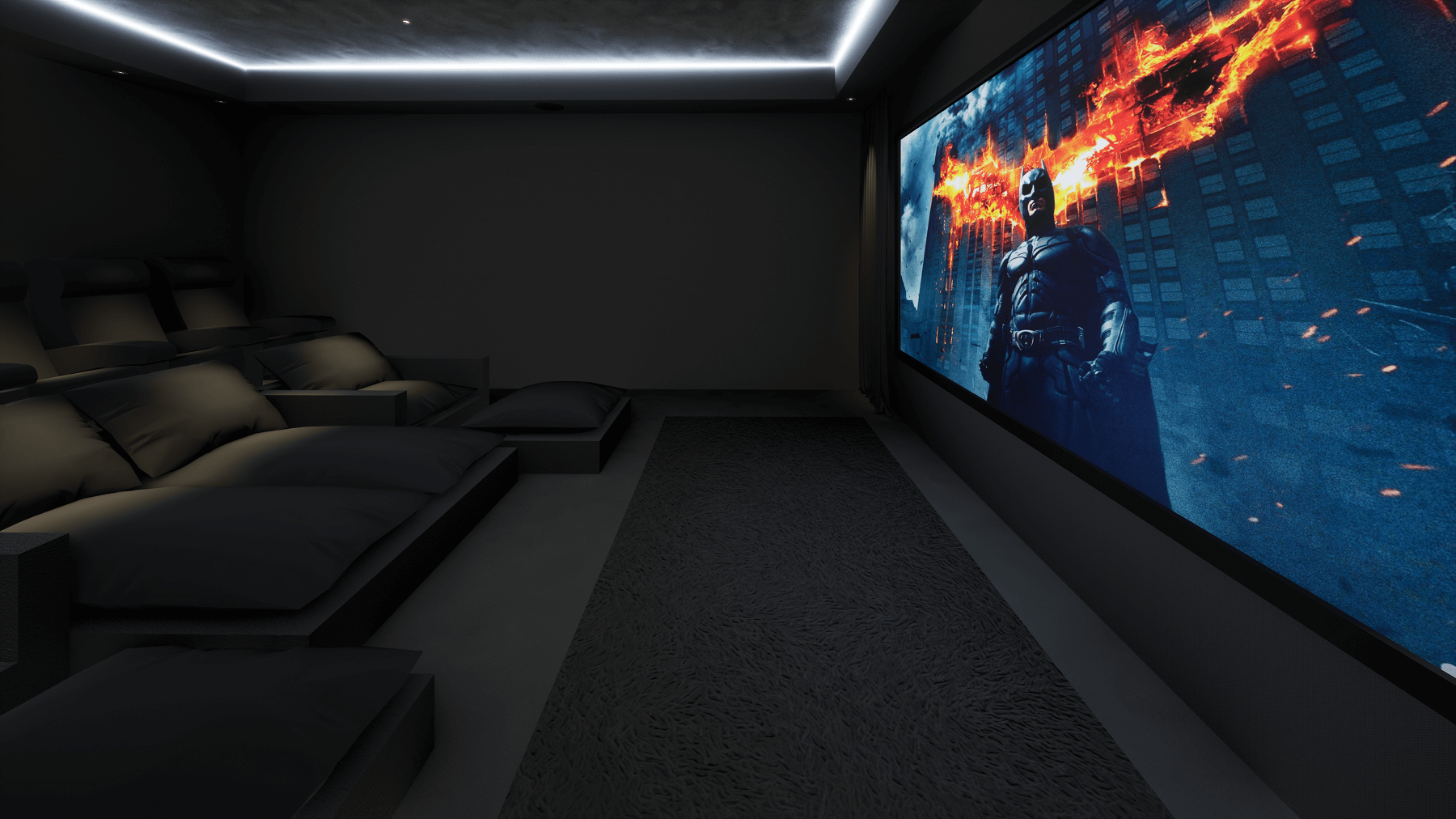
Living Room Home Cinema — North London
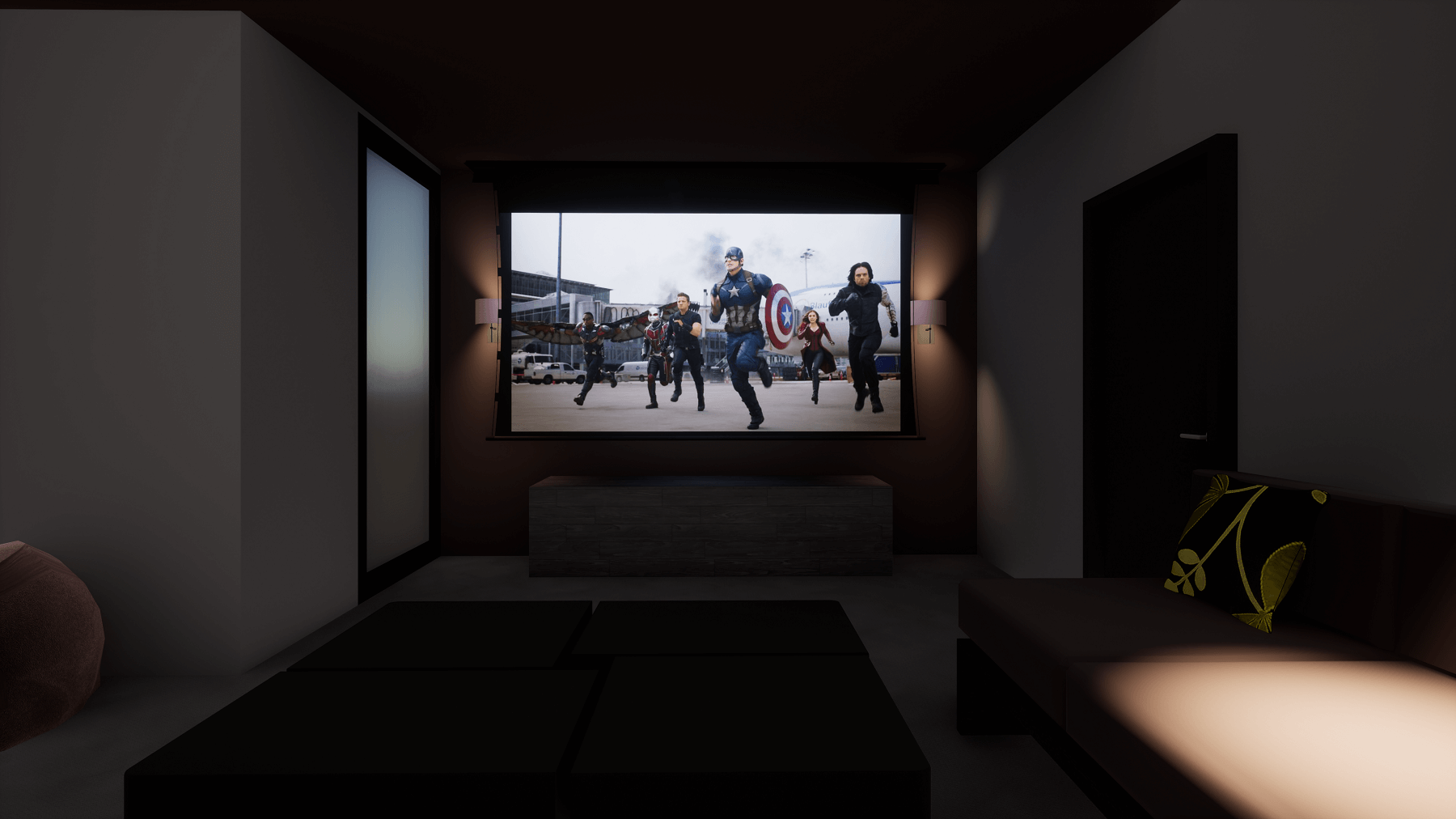
Basement Home Cinema — Berkshire
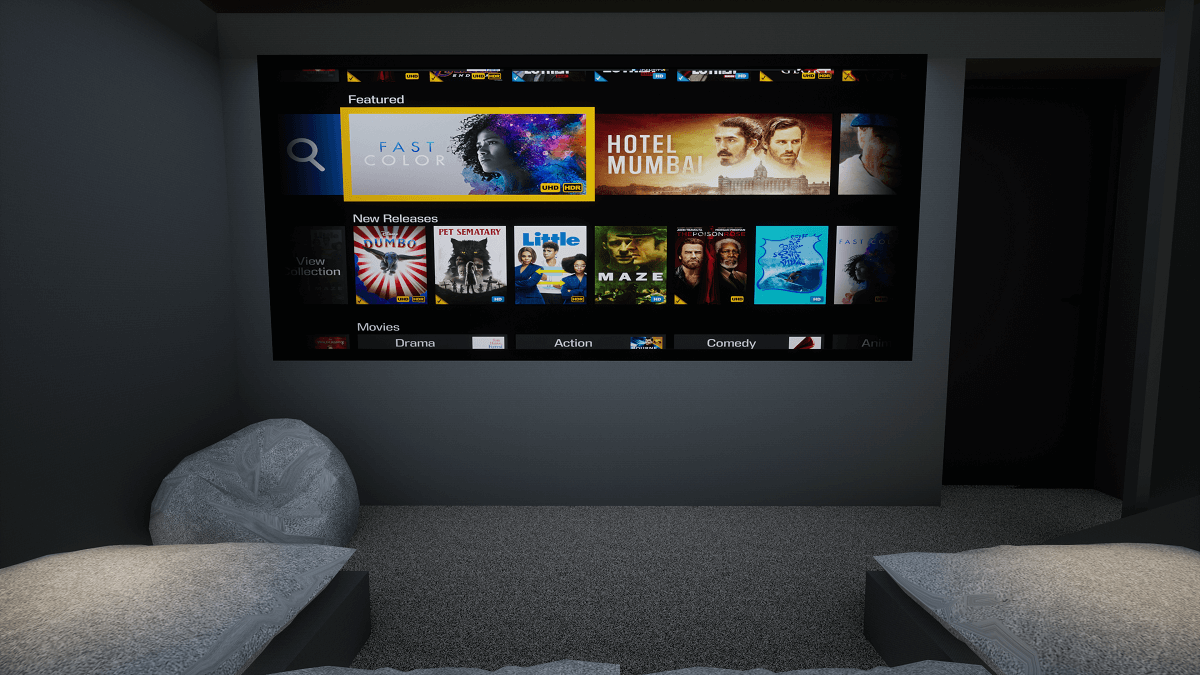
Outdoor Home Cinema in the Cotswolds