
Home Cinema Installers

Luxury Home Cinema Installation & Design Specialists
Luxury Home Cinema Rooms Designed and Installed Since 1998
Custom Controls are a high-end home cinema design and installation company specialising in dedicated luxury cinema rooms. As experienced home cinema installers, we have been designing and installing home cinemas since 1998 across London, Cheshire, Surrey, Dubai and the French Alps — from an intimate four-seat room in a London apartment to the most ambitious private screening rooms we have ever delivered, including an 18-seat IMAX Enhanced theatre in Dubai. Every installation is built to the same standard, whether it’s a compact luxury cinema room or a full-scale private theatre — the same rigour that makes a cinema at home genuinely rival a commercial screening room.

Cinema Design

Calibration

Acoustics

Seating

Home Theatres
Certified Home Cinema Specialists
Five-time Crestron Integration Award winners — the most consecutive wins of any dealer in EMEA and a unique recognition of cinema design and installation excellence. Crestron Dealer of Distinction status. Steinway Lyngdorf RoomPerfect Certified — advanced training in acoustic design and room correction technology. Trinnov Certified Dealers — specialist training in high-end audio processor setup and calibration. These certifications represent training, standards and technical competency that translate directly into the quality of the home cinema we design and deliver, across more than 25 years of continuous installation work in London, Cheshire, Surrey, Dubai and the French Alps.
The training matters most at the final stage, where speaker calibration, processor set-up and video calibration are measured rather than estimated. The engineers who design a room are the same people who commission it, so the intent on the drawings is checked against what is actually heard and seen in the finished space. You can see the results across our selected home cinema installations in London, Cheshire, Dubai, the Alps and beyond, or browse 40 home cinema room ideas drawn from real rooms.
Fully Bespoke: What a Home Cinema Installation Can Include
There is no standard Custom Controls cinema, and there is no package to choose from. Every room we design starts with a blank sheet and the people who will use it: how many seats are needed, whether the room is for reference-level film, music, live sport, gaming or all of them, who will operate it, and how it has to look when the screen is off. The architecture, the household and the brief decide the specification, never the other way round, which is why no two of our cinemas share the same equipment list, layout or finish.
Depending on the room and the brief, a home cinema installation can include any combination of the following, each one specified for that room rather than taken from a catalogue:
- Room and acoustic design — room geometry, sightlines, seating layout, isolation and in-room acoustic treatment, modelled before construction.
- Construction design — false walls, risers, bulkheads, speaker voids, ventilation and acoustic fabric walling that hides every speaker and treatment.
- Picture — 4K and laser projection onto acoustically transparent, fixed or curved screens, or direct-view displays such as Samsung The Wall, with video processing where the room justifies it.
- Sound — Dolby Atmos systems from 7.2.2 to large-scale arrays, from in-wall and behind-screen loudspeakers to reference systems from Artcoustic and Steinway Lyngdorf, with processing from Anthem to Trinnov.
- Sources — Kaleidescape movie servers, streaming, satellite TV for live sport, games consoles and high-resolution music.
- Seating — electric recliners, luxury cinema seating, modular sofas or a mix, arranged around the sightlines and the speaker layout.
- Lighting, shading and control — star ceilings, step and cove lighting, blinds and one-touch scenes through Crestron, Lutron or RTI, unified with the rest of the house.
- Calibration and aftercare — measured audio and video calibration at handover, and ongoing support for the life of the system.
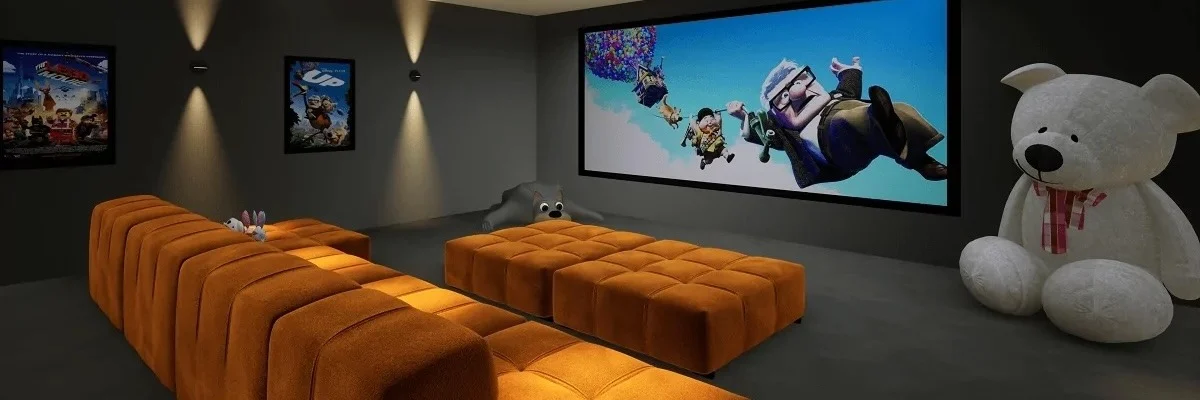
Two recent rooms show how far apart the results can be. Our family cinema in a Dubai villa basement was designed for three young children and their friends: an orange BB Italia Tufty Time modular sofa, bean bags, soft toys and film posters chosen for the children, with two Apple TVs, one for the adults and one for the kids. Behind the playful interior sits a 3.8m screen, a Sony laser projector, an Artcoustic 7.2.2 Dolby Atmos system behind a wool fabric wall and Trinnov processing, so the room delivers reference sound today and can grow up with the family as the décor changes.
The media room in a converted villa in Rome started from the opposite brief: a reference point for film and music in a 6.5m × 9m room with a 3.8m ceiling, where period plaster, parquet and architectural details could not be removed. We built a false wall lined with Acoustiblok and QuietFiber and finished in acoustic fabric to house the whole Steinway Lyngdorf system, a P300 processor with RoomPerfect, four A2 amplifiers and an in-wall array, in front of a 3m × 2m Samsung The Wall. Lutron HomeWorks QS handles the lighting and blinds, so the room matches the ten dedicated stereo listening rooms elsewhere in the villa. Same company, same process, two rooms with almost nothing in common, because each was designed around the people using it.
Home Cinema Design
Every home cinema we build is designed in full before any construction starts: room geometry, seating layout, acoustic treatment, screen size and position, loudspeaker placement and lighting are all fixed on paper first, because each one constrains the others. We work with architects and interior designers from the earliest planning stage, producing design drawings and construction specifications that are handed to contractors and builders. For clients without an existing design team, we manage the cinema design as a standalone commission. Read our complete home cinema design guide →
A design package covers room geometry, seating layout and sightlines, acoustic treatment, screen size and position, loudspeaker placement, lighting and the cabling and rack requirements, presented as drawings and a specification a contractor can price and build from. Photorealistic renders let the finished room be agreed before construction starts, when changes cost the least.
Our Process, From First Brief to Aftercare
Every cinema follows the same seven stages, whatever its size. The sequence matters: the look and layout are agreed with you before the detailed engineering begins, and the engineering is complete before anything is built, so decisions are made when changing them costs the least.
- Consultation and client brief. We start with the room, the household and how the cinema will be used, not a product list. Plans, photographs or measurements are enough for a first meeting, and the brief we agree covers seating, the balance of film, music, sport and gaming, the look of the room and how it should be operated.
- Initial design and renders. We produce the concept design: room layout, seating and sightlines, screen size, the main equipment and the finishes, presented as drawings and photorealistic renders so you can see the finished room before construction starts. The design is refined with you, and nothing moves forward until you have signed it off.
- Technical design. Once the concept is approved, the room is engineered in depth: a full technical room analysis covering dimensions, room modes, isolation and acoustic treatment, then construction drawings for false walls, risers, speaker voids, ventilation and cabling that your builder can price and build from. Our underground cinema near Derby was designed this way from the ground up around the acoustic performance of its Artcoustic SL system, with a custom false wall built by our carpentry team behind a 3.8m Screen Excellence acoustically transparent screen, and it was selected by Artcoustic as Install of the Month.
- Installation. Our own engineers carry out the installation, working alongside your builder, architect and interior designer and scheduled around the construction programme, so the technology is built into the room rather than added to it.
- Audio and video calibration. Every system is calibrated in the finished room, including by THX certified calibrators. Speaker levels, distances, crossovers and equalisation are measured and set using Trinnov, Dirac Live, Anthem ARC or Steinway Lyngdorf RoomPerfect, and the picture is calibrated to industry standards, so every seat gets the performance the design promised. Read more about calibration →
- Handover. We walk you through the finished room until it is second nature, from the one-touch scenes that dim the lights, close the blinds and start the film to the sources and settings behind them.
- Aftercare. The cinema is enrolled in remote monitoring from the day of handover, and our aftercare service covers system health checks, calibration reviews, projector laser health monitoring, Kaleidescape server management and programming updates. The engineers who built the room are the people who look after it.
Cinema Room Acoustic Treatment
The room itself decides how a cinema sounds, more than any loudspeaker or processor placed in it. A room built to the wrong dimensions, with reflective surfaces and untreated room modes, will never sound right regardless of the quality of the speakers and processors installed. We design room geometry, specify acoustic materials and treatments, and supervise construction to ensure the acoustic performance matches the brief. For dedicated cinema rooms, full acoustic treatment is non-negotiable. For living room cinema systems, we design treatments that integrate with the room’s aesthetic. Read our acoustic treatment guide →
Acoustics is two separate questions. Isolation keeps sound inside the room and is a construction matter best settled at build stage, while in-room acoustics control reflections, reverberation and bass and apply to every cinema. Both are specified before any equipment, because the room sets the ceiling on what the equipment can deliver.
Scope and Scale
Every cinema we install is held to the same standard, whatever its size, while the specification is designed for that room alone: acoustic design, construction specification, 4K, laser or direct-view picture, Dolby Atmos audio, seating, Crestron, Lutron or RTI integration, and professional calibration. We have installed dedicated cinema rooms across London, Cheshire, Surrey, Dubai and the French Alps — visit our London, Cheshire, Surrey, Dubai or Alps cinema pages for local case studies and contact details. We provide free, detailed consultations and quotations for every project, tailored to your room and your brief.
A consultation begins with the room, the household and the brief rather than a product list. Plans, photographs or measurements are enough for us to advise on the type of room, the level of specification the space can support and the sequence of design, construction and installation.
Choosing a Home Cinema Installer
A cinema room is a construction project as much as an equipment purchase, and the installer you choose will shape the room long after the equipment is out of date. These are the questions we would ask of any home cinema company, including ourselves, before committing to a design.
- Is the design bespoke, or a package with a different badge? Every Custom Controls cinema is designed from a blank sheet around the room and the household, and the design is signed off with you, with renders, before any detailed engineering begins.
- Who engineers the room itself? Room geometry, isolation and acoustic treatment decide how a cinema sounds more than any loudspeaker. We carry out a full technical room analysis and produce the construction design, rather than leaving the room to chance and correcting it afterwards.
- Who calibrates it, and with what? Our calibration is carried out by trained specialists, including THX certified calibrators, and we are Trinnov Certified Dealers and Steinway Lyngdorf RoomPerfect Certified.
- What is their track record? We have designed and installed cinemas since 1998, and we are five-time Crestron Integration Award winners, unique in EMEA, and a Crestron Dealer of Distinction.
- Who supports it afterwards? The same engineers who design and commission our systems look after them, with remote monitoring from handover and maintenance contracts for the life of the system. We still maintain systems we installed in the late 1990s.
If an installer cannot answer all five clearly, the room is likely to be specified around the equipment they prefer to sell rather than around you. We are happy to talk through any of them at a first consultation, with no obligation.
What Is the Difference Between a Home Cinema and a Media Room?
A dedicated home cinema is a single-purpose, fully treated room built around film and TV alone; a media room is a multi-purpose space — often a living room or open-plan area — designed to deliver a strong cinema experience while continuing to serve everyday life. The cinema gives the purest picture and sound, because every surface can be treated and the light fully controlled; the media room trades a little of that for a space the family uses every day.
Both start the same way: we design the room first, since room geometry, acoustic treatment, speaker layout and screen position all have to be right before any equipment is specified. And both finish the same way — every system is calibrated before handover, with audio calibration using Trinnov Altitude, Dirac Live or Anthem ARC depending on the processor, and ISF-standard video calibration using professional measurement tools. Read more about our calibration process →
Questions We’re Asked at the First Meeting
Most cinema projects begin with the same handful of questions. These are the ones clients raise most often when we first walk the space with them, from whether a room is big enough to what happens once the cinema has been handed over.
Is every cinema bespoke, or do you offer packages?
Every cinema we install is bespoke. There are no packages: the room, the household and the brief decide the layout, the equipment, the seating and the finishes, and the concept design is signed off with you, with renders, before the technical design begins. You can see how different the results are in our selected home cinema installations.
Do we need a dedicated room, or can our living room become a cinema?
Either can work well — it depends on how the room will be used. If the space needs to stay a comfortable living room, we design it as a media room, with speakers built into walls and ceilings, a screen or projector that disappears when not in use, and acoustic treatment hidden behind finishes the interior designer has chosen. If you want the best possible picture and sound, and a room that exists only for films, a dedicated cinema will always outperform it.
Can a basement, garage or loft be converted?
Yes, and some of our best rooms started that way. Basements are often ideal, with no windows and naturally good sound isolation; garages and lofts need more attention to insulation, ceiling height and, in a loft, sloping surfaces. We adapt the acoustic design and cabling to what is already there, so a converted space performs as well as a purpose-built one. You can see examples in our loft and attic conversions and our Pimlico basement cinema.
How small can a dedicated cinema room be?
Smaller than most people expect. THX’s smallest room tier, Compact, covers rooms of up to about 28m³ with a viewing distance of around 2.4m, and we have built four-seat cinemas in London apartments. What matters more than size is proportion, ceiling height and how the seats relate to the screen, which our room size and dimensions guide covers in detail.
Will the cinema work for sport, gaming and music as well as films?
Yes, if the brief asks for it. Satellite TV for live sport, streaming, games consoles and high-resolution music sources are all designed in from the start, and the processing and calibration serve each one. Our cinema in a converted villa in Rome, for example, was built as a reference for music as well as film, with Kaleidescape, Apple TV, a PlayStation 5 and a Bluesound Node with Roon.
Will the cinema work with the rest of the house?
It should, and in our projects it always does. With Crestron or Lutron control, a single button dims the lights, closes the blinds, lowers the screen and starts the film, and the same system runs lighting, audio and climate throughout the home. The cinema becomes one room of a whole-house system, not a separate set of remotes.
Will you work with our architect and interior designer?
Yes — most of our cinemas are delivered alongside an existing design team. We provide the drawings, acoustic specifications and cabling schedules the builder needs, agree finishes with the interior designer so the technology disappears into the room, and stay involved through construction to handover. For clients without a design team, we manage the cinema design ourselves as a standalone commission.
Do you offer a consultation before we commit?
Yes. We provide free, detailed consultations and quotations for every project, tailored to your room and your brief. Plans, photographs or measurements are enough for us to advise on the type of room and the level of specification the space can support.
Is the cinema calibrated before handover?
Yes. Every system is calibrated in the finished room before handover, including by THX certified calibrators. Audio is calibrated using Trinnov Altitude, Dirac Live, Anthem ARC or Steinway Lyngdorf RoomPerfect depending on the processor, and video is calibrated to ISF standards using professional measurement tools.
What happens after handover?
Every cinema is enrolled in remote monitoring from the day of handover, so most issues are found and resolved before you notice them. Our aftercare service adds annual system health checks and calibration reviews, projector laser health monitoring, Kaleidescape server management, programming updates and fault diagnosis, remotely where possible and on site when required.
Do you look after cinemas installed by other companies?
Yes. We take over and maintain cinema rooms and smart home systems installed by other companies, including where the original installer has closed or moved on, and we can recalibrate and upgrade an existing room as part of that.
Where do you install home cinemas?
We have installed dedicated cinema rooms across London, Cheshire, Surrey, Dubai and the French Alps, as well as Rome and the Midlands, from an intimate four-seat room in a London apartment to an 18-seat IMAX Enhanced theatre in Dubai.
Home Cinema Design → · Home Cinema Installations → · 40 Home Cinema Room Ideas → · Home Cinema Design Details → · Media Room Design → · Home Cinema Seating → · Home Cinema Calibration → · Contact Us →